

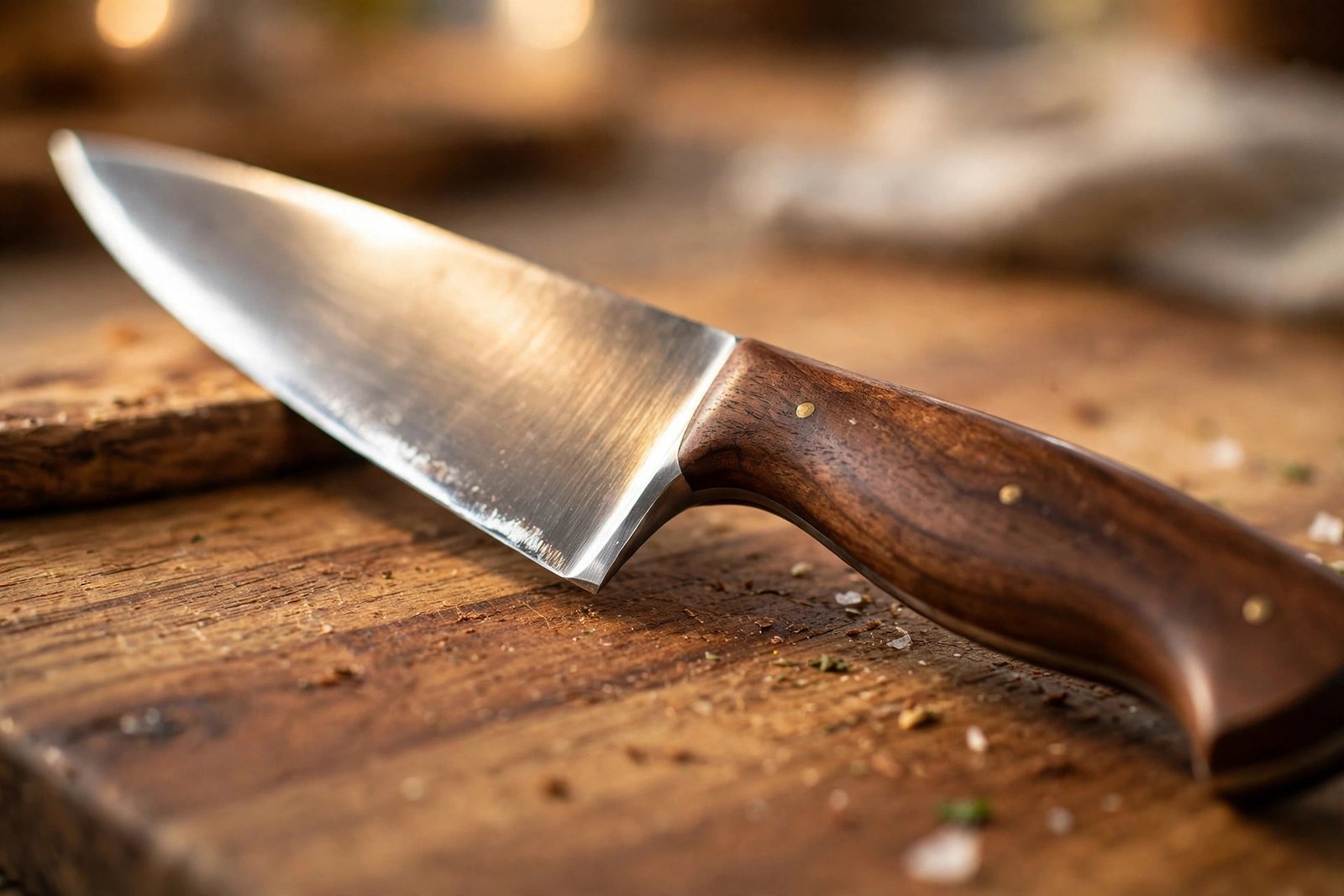

It usually starts with the blade. You compare steels and edge angles and barely glance at the handle — yet the handle decides whether a knife feels like a tool or a liability, which is why choosing the best knife handle materials matters more than most buyers realise. Months later, you notice the handle: swollen wood, a polished grip treacherous with damp hands.
There is no single best material. Micarta is the best all-rounder: it grips better when wet, feels warm, and needs almost no looking after.
Natural wood is the most beautiful, but it swells, shrinks and cracks if it stays wet. G-10 is the toughest and most waterproof for hard use; carbon fibre is the lightest premium choice.
Key takeaways
- Micarta is the best all-rounder: it grips better when wet and needs almost no care.
- Wood is the most beautiful choice, but it swells and cracks if it stays wet.
- G-10 is the toughest and most waterproof; carbon fibre is the lightest premium choice.
1. Is natural wood a good knife handle material?
Wood is the oldest handle material and still the most popular on handmade knives. Walnut has deep tones and intricate grain, rosewood a balanced feel and rich colour, ebony is heavy and jet-black. Each piece is unique, warm and grippy when dry.
The weakness is water: wood is a bundle of hollow cellulose fibres that take up water and swell, then give it up and shrink — and movement across the grain is much larger than along it. Repeat that cycle and pins loosen, gaps open, handles crack; makers report up to 3–4% dimensional change in untreated hardwoods after prolonged moisture exposure. Bare wood must be dried after washing and oiled now and then; left wet, it stains.
Best for: dry use, display.
2. What is Micarta, and why is it the best all-rounder?
Micarta is a composite of canvas, linen or paper layers soaked in phenolic resin, stacked and pressed under heat into a solid block. The brand dates to Westinghouse, at least as early as 1910; Norplex-Micarta owns the trademark today. Canvas Micarta is coarsest and grippiest, linen finer and smoother, paper Micarta smoothest of all.

Warm to the touch, it develops a slight patina and — unusually — gets grippier when wet, as the texture opens up slightly with moisture. It absorbs about 1–2% of its weight in water in a 24-hour lab test; density is 1.35 g/cm³. Maintenance is minimal.
Best for: all-round use.
3. Is G-10 the toughest knife handle material?
G-10 is woven fibreglass cloth soaked in epoxy resin and pressed under heat — the same family of material used for circuit boards. It is the toughest, most waterproof handle material in common use: it absorbs only about 0.1% of its weight in water in 24 hours, so it does not swell, crack in the cold or get slick when wet, and it takes in no water, oil or blood.
It is light, stiff enough to carry a lock, and takes machined texture well. It comes in almost any colour, including layered patterns. Its only real weaknesses: it is a little heavier than carbon fibre (density around 1.85 g/cm³), and a very aggressive texture can wear the inside of a pocket.
Best for: hard, wet use.
4. Is carbon fibre worth it on a knife handle?
Carbon fibre is fine carbon filaments woven into cloth, laid up in layers and set in resin. It is lighter than G-10 and stiffer for its weight, and the woven pattern under a clear finish is unmistakable. It does not absorb water and is temperature-stable.
The trade-offs are cost and fragility at the edges: a hard knock on a corner can chip or crack it where G-10 would shrug it off, and a polished finish can be slick in a wet hand unless textured. It is labour-intensive to produce, so it appears mostly on higher-end knives.
Best for: light premium carry.
5. What is Pakkawood, and is stabilised wood better than natural wood?
Pakkawood is genuine hardwood impregnated with resin — thin sheets layered, soaked in resin and compressed — also sold as Staminawood and Dymondwood. It looks like wood but resists moisture far better than untreated hardwood, in many colours and grain patterns.
Shun, which makes Pakkawood-handled knives, is candid: “Although the wood has been stabilized, it is natural wood and, like all wood, will tend to shrink in very arid environments and swell in very humid environments.” Stabilised wood is made by vacuum-impregnating wood with resin under pressure, filling every pore; supplier data says it resists moisture absorption by up to 90% compared with raw wood. It still needs hand washing and occasional oiling.
Best for: kitchen, gifts.
6. Is titanium a good knife handle material?
Titanium handles (typically Grade 5, Ti-6Al-4V) are the standard for premium everyday carry knives. Titanium is strong, light for a metal, almost immune to corrosion, and anodises in many colours. It feels warm, unlike aluminium, which feels cold in winter.
The downsides are grip and price: smooth titanium is slick, so it needs texturing or grooves, and it is expensive to machine — makers burn through costly carbide tooling, and that cost is baked into every titanium knife. A titanium handle typically adds 0.5–1.5 oz over the same design in G-10.
Best for: premium folders.
7. Are bone and horn handles practical?
Bone — usually cattle shin bone, dyed and often jigged (textured) — has been used for centuries. It is lightweight, easy to shape and full of character.
The problem is porosity: it can absorb moisture if not properly sealed, so it needs to be kept dry, and raw bone can become tacky then slippery when wet, with a risk of micro-cracking in the cold. Horn (buffalo, ram or cow) is similar — fair grip, fair water resistance, and it swells if soaked.
Best for: collectors, light use.
8. Is stag a good handle material?
Stag is deer or elk antler, one of the most characterful handle materials there is. The natural “bark” texture of the antler gives it good grip, better than smooth bone, and its water resistance is fair to good. Each piece is unique, with no two handles alike.
Like other natural materials, it needs to be kept dry, can crack if neglected, and is premium-priced, usually found on hunting knives.
Best for: hunting, collectors.
9. Are rubber handles any good for knives?
Rubber and moulded plastics such as polypropylene, POM and TPE are the most practical materials for wet work. They take up very little water, need almost no maintenance, and give excellent grip even with wet or gloved hands.
Some makers, such as Victorinox, rate certain moulded plastic handles as dishwasher safe — the most forgiving material if a knife goes through the dishwasher by mistake. FRN (fibreglass-reinforced nylon) is the light, inexpensive option on many popular everyday carry knives. The trade-off is looks: functional rather than beautiful.
Best for: wet work, budget.
10. Is resin a good knife handle material?
Cast resin is a coloured polymer poured into a mould, behind the bold, glossy handles on many modern kitchen knives. It is fully waterproof, comes in almost any colour or pattern, and needs no care. The catch is grip: a polished resin handle can be slick when wet, so it suits the kitchen — where hands are usually dry — better than the outdoors.
Best for: kitchen, gifts.
Best knife handle materials compared

| Material | Durability | Water resistance | Grip when wet | Maintenance | Best for |
|---|---|---|---|---|---|
| Natural wood | Moderate | Poor | Poor | High | Display, dry use |
| Micarta | Excellent | Very good (1–2%) | Excellent, grippier | Minimal | All-rounder, hunting |
| G-10 | Excellent | Excellent (0.1%) | Excellent | Minimal | Hard use, wet work |
| Carbon fibre | Good, chips at edges | Excellent | Fair if polished | Minimal | Light premium carry |
| Pakkawood / stabilised wood | Good | Good (90% less) | Good | Low | Kitchen, gifts |
| Titanium | Excellent | Excellent | Fair unless textured | Minimal | Premium folders |
| Bone and horn | Fair | Poor to fair | Fair | Moderate | Folders, collectors |
| Stag | Fair to good | Fair to good | Good | Moderate | Hunting, collectors |
| Rubber / FRN / TPE | Good | Excellent | Excellent | Minimal | Fishing, wet work |
| Cast resin | Good | Excellent | Fair, slick when wet | Minimal | Kitchen, gifts |
Wood vs Micarta: which should you choose?
- Looks: Wood wins.
- Wet grip: Micarta wins — the only material here that grips better when wet. Wood grips well dry but turns slippery when soaked.
- Water resistance: Micarta wins clearly — 1–2% uptake in 24 hours, against up to 3–4% change in untreated wood.
- Maintenance: Micarta wins — it needs almost nothing; wood must be dried and oiled.
- Feel: A tie — both feel warm and natural, unlike cold metals or slick plastics.
- Cost: Wood is usually cheaper; Micarta sits in the mid-range.
- Verdict: Choose wood for dry conditions, beauty and tradition. Choose Micarta if the knife will get wet, be used outdoors, or you want no maintenance.
How do you choose the best knife handle material for you?
Answer four honest questions, and ten materials narrow to one or two.
- 1. Will it get wet? If it will see rain, blood, fish or a sink, cross out wood, bone and horn; shortlist Micarta, G-10, rubber or FRN.
- 2. How much care will you give it? If oiling a handle sounds like a chore you will never do, choose Micarta, G-10, resin or rubber. If you enjoy looking after tools, wood and stag reward you.
- 3. Looks or grip? For display or a gift, wood, stag and resin win. For a working knife, grip first: textured Micarta, G-10 or rubber.
- 4. What is the budget? Rubber and FRN are cheapest; Micarta and G-10 sit in the middle. Carbon fibre, titanium and stag are premium — worth it only if the knife justifies the price.
- 5. Check the texture, not just the material: jigged bone, bark-on stag and textured G-10 grip far better than polished versions.
If you only buy one knife, buy Micarta.
FAQs
Is Micarta better than wood for a knife handle?
For practical use, yes. Micarta grips better when wet, absorbs far less water — about 1–2% in 24 hours, against up to 3–4% dimensional change in untreated wood — and needs almost no maintenance.
What is the most durable knife handle material?
G-10. This fibreglass and epoxy laminate absorbs about 0.1% of its weight in water in 24 hours, so it does not swell, crack or get slick when wet. Carbon fibre is lighter, but it can chip at the edges.
Does Micarta get slippery when wet?
No — the opposite. Micarta gets grippier when wet, because the texture opens up slightly with moisture — one reason it is popular on hunting knives.
How do I maintain a wooden knife handle?
Dry it straight after washing, never leave it soaking or put it in the dishwasher, and oil it periodically with a food-safe mineral oil. Stabilised wood and Pakkawood need far less attention, but still need hand washing and drying.
Sources
- KnifeOrbit, “Knife Handle Materials: Wood, Pakkawood, G-10, Micarta” — knifeorbit.com
- Lavish Blade, “Knife Handle Materials: Micarta vs G10, Wood, Stag & Resin” — lavishblade.com
- Backyard Campout, “Handle Materials for High Humidity: From Wood to Bone” — backyardcampout.org
- TEKTO Knives, “Knife Handle Materials: G10 vs Carbon Fiber” — tektoknives.com
- Damned Designs, “G10 vs Micarta vs Titanium vs Carbon Fiber” — damneddesigns.com
- Knife Informer, “The Ultimate Guide to Knife Handle Materials” — knifeinformer.com
Choose the handle for the life you actually live
The blade is what you buy; the handle is what you live with. Buy for the life it will actually have.
If it will see rain, blood or a busy sink, choose Micarta or G-10. If it will live in a drawer and come out for quiet work, choose wood. Answer the questions, check the table, buy the handle that fits. For other gear guides, see our best golf balls picks and the best arrows for beginner archers guide.














