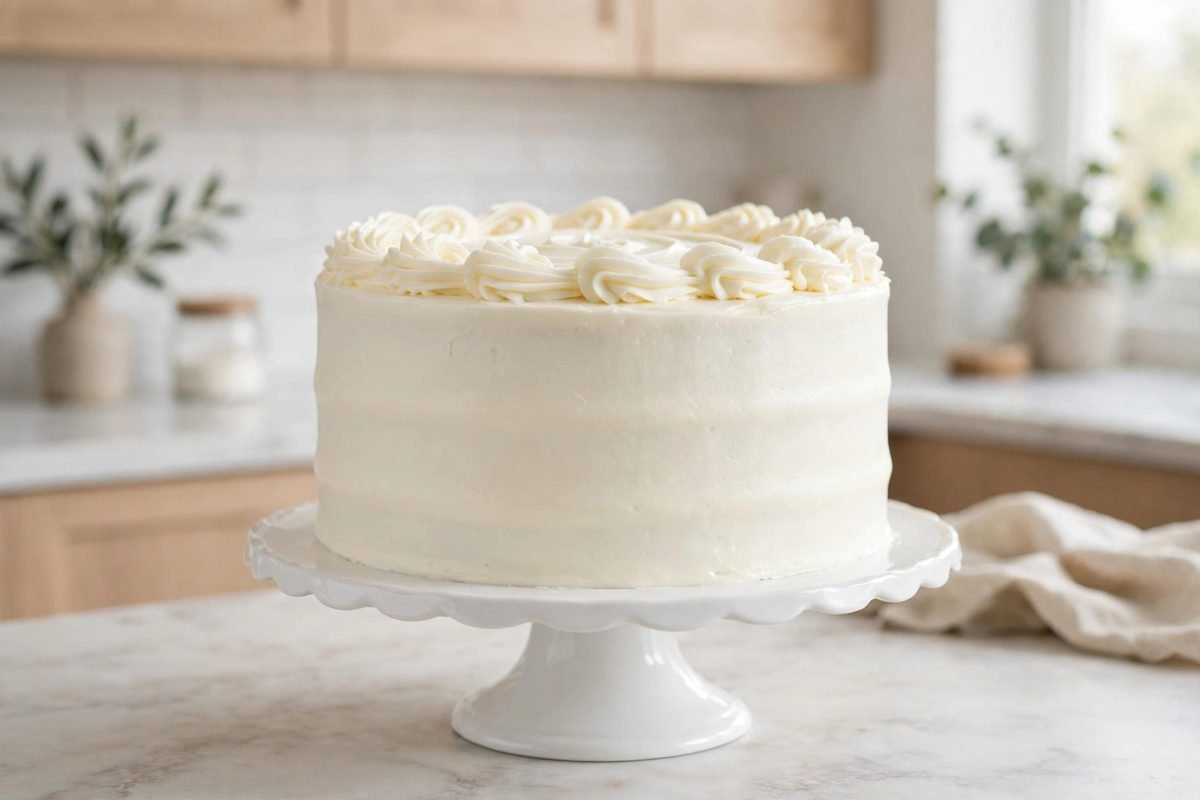
Learning how to frost a cake is the difference between a bake that tastes wonderful and one that looks wonderful too. A cake can be moist, well flavoured and perfectly risen, yet still look untidy if the frosting is patchy, full of crumbs or sliding off the sides.
So how do you frost a cake properly? The short answer is to work with completely cool layers, spread a thin crumb coat first, chill it, then add a final coat with an offset spatula and smooth it slowly. This guide covers the tools, the frosting, the crumb coat, the final finish, decorating ideas, the mistakes to avoid and how to store the finished cake.
Key takeaways:
- Always frost a completely cool cake, because warm layers melt buttercream and make it slide.
- A thin crumb coat traps loose crumbs, and chilling it for 20 to 30 minutes makes the final coat far easier to smooth.
- An offset spatula, a turntable and a bench scraper are the three tools that make the biggest difference to the finish.
- Work in thin layers of frosting rather than one thick coat, and keep the spatula clean as you go.
- A frosted cake keeps at room temperature for a day or two in a cool room, or in the fridge for up to five days.
What does frosting a cake involve?
Frosting a cake means covering the outside of the baked layers with a sweet, spreadable coating, usually buttercream, and smoothing it into an even finish. It does more than make the cake look good: it seals in moisture, holds the layers together and adds flavour and sweetness to every slice.
There are two main stages. The first is the crumb coat, a thin layer of frosting that locks loose crumbs in place. The second is the final coat, a thicker, smoother layer that gives the cake its finished look. Skipping the crumb coat is the most common reason a frosted cake ends up speckled with crumbs.
Before you start: what you need
Start with the cake itself. The layers should be completely cool, ideally baked the day before and wrapped well, or at least cooled for several hours. A cake that is even slightly warm will soften the frosting and make the layers shift as you work.
You will also need frosting at the right consistency. Buttercream should be soft enough to spread easily but firm enough to hold its shape. If it is too stiff, beat in a teaspoon of milk at a time. If it is too soft, beat in a little more icing sugar or chill it briefly.
Set up a clean, flat work surface with the cake on a turntable or a flat plate, and keep a bowl of hot water and a clean cloth nearby for wiping the spatula.
How to prepare the cake layers
Level the layers first. If a layer has a domed top, slice it flat with a long serrated knife, holding the blade level and turning the cake as you cut. A flat top means the layers stack neatly and the finished cake does not lean.
Place the first layer on the cake board or serving plate, cut side down if you levelled it. Put small strips of baking paper under the edges of the cake to keep the plate clean; pull them out once the frosting is finished.
Spread a generous dollop of frosting on top of the first layer and smooth it to the edges. Place the second layer on top, cut side down again, and press gently to settle it. Check from the side that the layers are straight before you move on.
Choosing the right frosting
Buttercream is the most forgiving choice for a beginner, because it spreads smoothly, holds its shape and can be reworked if you make a mistake. A classic buttercream made from softened butter, icing sugar, a little milk and vanilla is a reliable place to start, and it pairs well with almost any sponge.
Cream cheese frosting is softer and tangier, and it suits carrot cake, red velvet and spiced cakes. It is less firm than buttercream, so it needs a gentle hand and a cool room, and the finished cake should be kept in the fridge.
Whichever frosting you choose, taste it before you use it and adjust the sweetness or flavour to your liking. A pinch of salt sharpens buttercream, a little lemon zest brightens it, and cocoa powder or melted chocolate turns it into chocolate frosting. For a dependable recipe and more detail on flavours, see our guide to the best buttercream frosting.
How to frost a cake, step by step
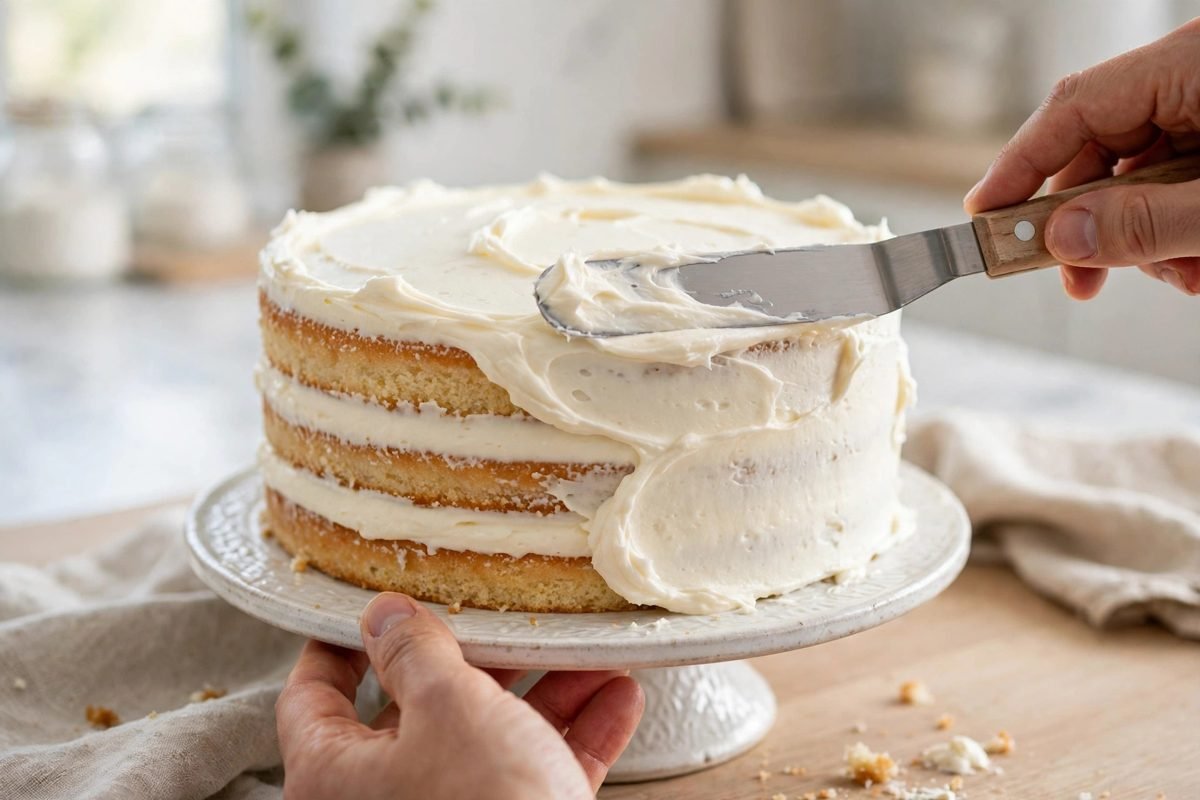
Start with the crumb coat. Spoon a small amount of frosting onto the top of the stacked cake and spread it out to the edges with an offset spatula. Then spread a thin layer down the sides, using just enough frosting to cover the sponge and trap the crumbs.
Do not worry about how this layer looks. Its only job is to seal the cake. Use long, smooth strokes, wipe the spatula clean often, and resist the urge to add more frosting than you need. A thin coat dries faster and chills more evenly.
Chill the crumb-coated cake in the fridge for 20 to 30 minutes, until the frosting feels firm to a light touch. This step is what makes the final coat possible: without it, crumbs lift into the frosting and the layers can shift under the spatula.
Now add the final coat. Place a large dollop of frosting on top of the cake and spread it outward with the offset spatula, letting a little frosting overhang the edge. Then spread frosting around the sides in smooth strokes, working from the bottom up.
Hold a bench scraper against the side of the cake at a slight angle and turn the turntable slowly, letting the scraper remove the excess frosting in one even pass. Wipe the scraper clean and repeat until the sides look smooth. Finally, tidy the top edge by drawing the spatula inward from the rim.
How to get smooth sides and sharp edges
Smooth sides come from patience rather than pressure. Pressing hard with the scraper digs into the frosting, while a light, steady touch lets the excess glide off. If the frosting starts to drag, warm the scraper briefly in hot water, wipe it dry and try again.
For sharp top edges, chill the frosted cake for about 15 minutes, then use a clean offset spatula to pull the frosting from the outer rim toward the centre of the top. Work your way around the cake in short, overlapping strokes until the edge looks crisp.
Decorating your frosted cake
Simple decorations often look the best. A ring of piped rosettes around the top edge, a scattering of fresh berries, a dusting of cocoa or a few chocolate curls can finish a cake without much effort. Fresh flowers also work well, as long as they are food-safe and the stems are kept out of the cake.
Common frosting problems and how to fix them
Most frosting problems have simple causes, and the table below covers the ones bakers meet most often.
| Problem | Likely cause | Fix |
|---|---|---|
| Frosting slides off the cake | Cake still warm, or frosting too soft | Chill the cake and the frosting, then try again |
| Crumbs in the frosting | No crumb coat, or coat too thin | Scrape off the worst of it, crumb coat and chill |
| Frosting is lumpy | Icing sugar not sifted, or butter too cold | Sift the sugar and use fully softened butter |
| Sides look uneven | Uneven layers or rushed scraping | Level the layers next time; smooth with a warm scraper |
How to store a frosted cake
A buttercream-frosted cake keeps well at room temperature for a day or two, as long as the room is cool and the cake is covered. Use a cake dome, a large upturned bowl or a cake box to protect it from dust and drying out.
In the fridge, a frosted cake keeps for up to five days, covered or in a cake box so it does not pick up smells from other food. Bring it back to room temperature for 30 to 60 minutes before serving, because cold buttercream is firm and the sponge tastes better once it has warmed up.
Cream cheese frosting and fresh fruit fillings need the fridge from the start, and the cake should not sit out for more than a couple of hours. Cut slices with a hot, dry knife for clean edges, wiping the blade between cuts.
Your frosting checklist
- Cool the layers completely, and level any domed tops with a serrated knife.
- Make enough frosting before you start, and check it spreads easily.
- Stack the layers straight, with frosting between each one.
- Apply a thin crumb coat and chill the cake for 20 to 30 minutes.
- Add the final coat, smooth the sides with a bench scraper, and tidy the top edge.
- Decorate once the frosting has set, and chill the cake before moving it.
- Store the finished cake covered, and bring it to room temperature before serving.
Frequently asked questions
How long should a cake cool before frosting?
Allow at least two hours, and longer for a large or dense cake. The layers should feel completely cool to the touch, with no warmth at all in the centre. Chilling the layers in the fridge for 30 minutes before frosting makes the job easier still.
Can I frost a cake without a turntable?
Yes. A turntable helps, but a flat plate on a non-slip mat works well too. Turn the plate by hand as you work, and take your time with the sides. A lazy Susan from the kitchen cupboard can also do the job.
How much frosting do I need for a layer cake?
A two-layer cake usually needs around 500 grams of buttercream, and a three-layer cake needs closer to 700 grams. If you are piping rosettes or adding a thick coat, make a little extra. Leftover buttercream keeps in the fridge for a week.
Why is my buttercream too runny?
Runny buttercream usually means the butter was too soft, the room is warm, or too much liquid was added. Beat in a little more icing sugar, chill the bowl for 15 minutes, and beat again briefly. Avoid adding more liquid until the frosting firms up.
Can I frost a cake the day before serving?
Yes, and many bakers prefer it. Frost the cake, chill it until the frosting is firm, then cover it and keep it in the fridge. Bring it to room temperature for 30 to 60 minutes before serving so the sponge and frosting taste their best.
Sources
Baking guidance on cooling, crumb coats and buttercream follows standard references such as the King Arthur Baking Company and BBC Good Food guides. Storage guidance follows UK Food Standards Agency advice on refrigerating perishable foods and not leaving them at room temperature for long periods. For more baking ideas, see our guides to how to make apple pie and gluten-free dessert recipes.
The bottom line
Frosting a cake is a skill that improves quickly with practice, and the first cake does not need to be perfect to be a success. Cool layers, a crumb coat, a chilled pause and a steady hand with the spatula will carry you most of the way there.
Your next step is simple: bake your favourite sponge, make a batch of buttercream, and try the crumb coat method on your next cake. Once you have done it once, the second cake will feel far easier, and the third will look like it came from a bakery.