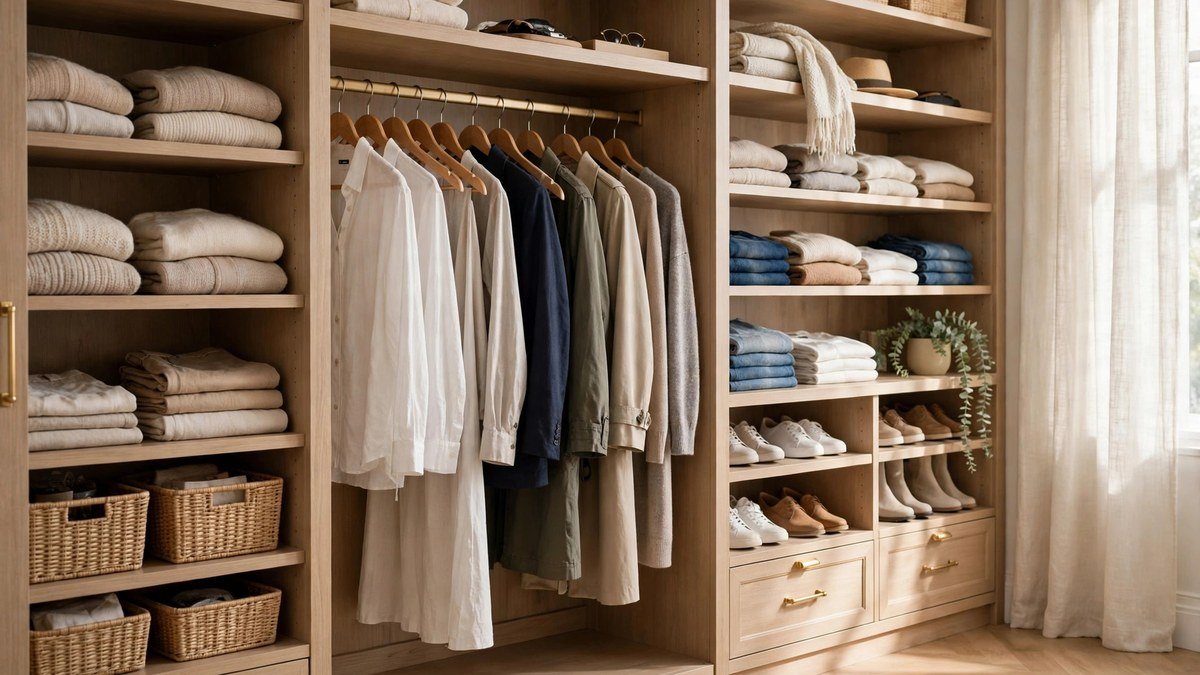

A closet that works is not a bigger closet. It is a closet where every piece has a place, where you can see what you own, and where getting dressed in the morning takes five minutes instead of twenty. Most closets fail on the same three points: too much stuff crammed into too little space, no clear system for what goes where, and a layout that hides the clothes you actually wear behind the ones you never touch.
The good news is that organising a closet is a skill, not a talent, and the systems that work best are simple ones you can build in a weekend. You do not need custom cabinetry or a walk-in wardrobe. You need a clear method for deciding what stays, a zone for each type of clothing, and storage that matches the way you actually live, not the way a showroom looks.
Below are nine closet systems that actually work in 2027, from the capsule method to the colour-coded rail, each described by what it is good at, what to watch for, and who it suits best, so you can pick the one that fits your space, your budget, and your habits.
Key takeaways
- Start by taking everything out and sorting it into keep, donate, repair and store — no system works on top of clutter.
- Zone your closet by use, not by type alone: everyday pieces at eye level, occasion wear higher, out-of-season lower or stored away.
- Matching hangers and a single colour story per rail make a small closet look twice as big and twice as calm.
- Measure before you buy any storage — bins, dividers and rails that do not fit your exact space end up in a cupboard, unused.
- No system stays organised on its own, and a closet organised once and never maintained will be back to chaos within a season.
What a good closet system actually does
A good closet system does three things at once. It makes everything visible, so you stop buying duplicates of things you already own. It makes everything reachable, so the clothes you wear most are the easiest to grab. And it makes putting things away as easy as taking them out, so the system survives a busy week instead of collapsing by Wednesday.
Visibility is the part most people underestimate. When clothes are folded in deep stacks or hung three deep on a rail, the pieces at the back effectively do not exist. You wear the same ten outfits on rotation while the rest of the wardrobe sits untouched, and you keep shopping because it feels like you have nothing to wear.
Reachability matters just as much. The top shelf and the floor of a closet are where clothes go to be forgotten, so they should hold the things you need least: out-of-season pieces, occasion wear, and spares. Everyday clothes belong between waist and eye level, where your hand lands without thinking.
How we chose these systems and what to look for
We looked first at whether a system survives real life. A method that needs daily upkeep, expensive custom fittings, or a perfectly tidy household is not a system, it is a photo shoot. The nine systems below all work in ordinary homes, with ordinary amounts of time, and they can all be started with what you already own plus a small number of affordable additions.

Look next at fit. A system designed for a walk-in wardrobe will not translate to a single rail in a small bedroom, and a method built for a minimalist with thirty pieces will not hold a collector’s wardrobe. The right system matches your space, your wardrobe size, and your habits, and it leaves room to grow. Our guide to the best luxury fashion brands is a useful companion here, because the pieces worth the most space in your closet are usually the ones you invested in most carefully.
Finally, look at cost and time honestly. Some systems cost almost nothing and take an afternoon. Others need matching hangers, shelf dividers, storage boxes and a full weekend. Neither is better in itself. What matters is that the system you choose is one you will actually finish, and then maintain with a ten-minute reset once a week.
The 9 closet systems that actually work in 2027
The Capsule Wardrobe
What we like: A small set of versatile pieces that all work together, so every outfit is an easy combination and nothing sits unworn. It cuts decision fatigue and makes a small closet feel generous. What to consider: It needs discipline at the buying stage, and it suits people who like a consistent style more than those who love variety. Best for: Minimalists and busy professionals. Cost: Low, often free. Time needed: One weekend to set up.
Start with thirty to forty pieces per season, including shoes and outerwear, and choose a palette of two neutrals plus one accent colour. Everything must pair with at least three other pieces.
The Colour-Coded Rail
What we like: Clothes grouped by colour, light to dark, so you can find any piece in seconds and the closet looks calm and intentional. It works with any wardrobe size and costs nothing. What to consider: It only works if you keep it up, and it does not solve overcrowding on its own. Best for: Visual thinkers and anyone with a large wardrobe. Cost: Free. Time needed: Two to three hours.
Hang each category in colour order, from white through pastels to black, and keep the same order after every wash. The visual effect is immediate, and it makes gaps obvious: if you own six black tops and no white ones, the rail tells you before a shop does.
The Zone System
What we like: The closet is divided into zones by use, such as work, weekend, evening and gym, so you dress for the day in one place instead of hunting across the rail. What to consider: It needs enough rail or shelf space to give each zone room, and zones blur if you do not label them clearly. Best for: People with varied lifestyles and mixed wardrobes. Cost: Low. Time needed: Half a day.
Give each zone its own rail section or shelf, and keep the everyday zone at eye level. A yellow dress that only comes out for summer parties belongs in the occasion zone, not mixed in with your work shirts where it hides them.
The KonMari Fold
What we like: Clothes folded into neat rectangles and stored upright in drawers, so every item is visible at a glance and nothing gets buried at the bottom of a stack. What to consider: It takes practice to fold well, and it suits drawers far better than shelves. Best for: People with drawer space and lots of knits, tees and casual wear. Cost: Low, plus drawer dividers. Time needed: One afternoon to learn and fold.
Fold each piece into a rectangle that stands on its own, then file it upright like a book. Drawer dividers keep the rows from collapsing. Once you can see every T-shirt at once, you stop wearing the same three on rotation.
The Seasonal Rotation
What we like: Only the current season lives in the closet, while the rest is stored away in labelled boxes, so a small closet holds twice as much over the year. What to consider: You need somewhere to store the off-season boxes, and the swap takes a few hours twice a year. Best for: Small closets and four-season climates. Cost: Low, plus storage boxes. Time needed: Half a day, twice a year.
At each season change, take everything out, clean the closet, and put back only what fits the coming months. Wash and repair off-season pieces before you box them, and label each box by season and contents so you can find things without opening all of them.
The Uniform Method
What we like: A personal uniform, a simple formula you repeat with small variations, so getting dressed takes no thought at all and your style looks consistently polished. What to consider: It can feel repetitive if you love experimenting, and it needs a clear idea of your best silhouette first. Best for: Anyone who wants effortless mornings. Cost: Low. Time needed: One weekend to define and build.
Pick your formula, such as tailored trousers, a silk blouse and loafers, or a midi dress and a blazer, then buy multiples in your best colours and fabrics. The uniform is not boring, it is a signature, and it frees your attention for everything else in the day.
The Matching Hanger System
What we like: One type of hanger throughout, slim and velvet, so clothes hang evenly, stop slipping, and the rail holds up to a third more pieces. It is the cheapest visual upgrade a closet can get. What to consider: You need to replace all your hangers at once for the full effect, and heavy coats still need sturdy wooden hangers. Best for: Crowded rails and anyone who hates visual clutter. Cost: Low to moderate. Time needed: One to two hours.
Choose slim velvet hangers for most pieces and wide wooden hangers for coats and structured jackets. Throw out wire hangers, which stretch shoulders and tangle. The difference in how a closet looks and feels is out of proportion to the cost.
The Open Shelf and Basket System
What we like: Open shelves with labelled baskets for categories like gym wear, scarves and accessories, so everything is visible and easy to return to its place. What to consider: Open storage shows dust and mess, so it needs a weekly tidy to stay presentable. Best for: Walk-in closets and people who fold rather than hang. Cost: Moderate, plus baskets and shelf dividers. Time needed: Half a day.
Use one basket per category, label it clearly, and keep only one category per basket. Shelf dividers stop stacks of knitwear from toppling sideways. A classic trench coat still belongs on a hanger, but scarves, belts and gym kit are happier in baskets.
The Digital Wardrobe
What we like: An app or simple photo catalogue of everything you own, so you can plan outfits, spot duplicates before shopping, and track what you actually wear. What to consider: Photographing a whole wardrobe takes time, and the system only helps if you keep it updated. Best for: Tech-comfortable shoppers and anyone who over-buys. Cost: Free to low. Time needed: A weekend to catalogue, minutes a week to maintain.
Photograph each piece against a plain background, tag it by category, colour and season, and log each wear.
Which system is right for your space
Small closets do best with the capsule wardrobe, the seasonal rotation, and matching hangers, because all three create space without needing more of it. If your closet is a single rail and a shelf, removing off-season clothes and slimming your hangers will do more than any storage product you can buy.
Large wardrobes and walk-ins suit the zone system and the open shelf and basket system, because they have room to give each category a home. The colour-coded rail works at any size, and it pairs well with almost every other system on this list, which is why so many organisers start there and add a second method on top.
If you hate maintenance, choose the uniform method or the capsule, because both reduce the number of decisions you make every day and the number of pieces you own. If you love variety, choose the colour-coded rail and the digital wardrobe, which keep a big wardrobe usable without asking you to own less.
The caveats that matter
No closet system fixes a wardrobe that is simply too big for its space. If your closet is overstuffed, every system will fail, because clothes need air between them to stay visible and unwrinkled. The honest first step is always the edit: remove what does not fit, what you have not worn in a year, and what is damaged beyond repair.
| Detail | What is known |
|---|---|
| Best first step | Empty the closet completely and sort every piece into keep, donate, repair and store |
| How long a full reset takes | One weekend for most closets, including the edit and the new system |
| Cheapest big win | Matching slim hangers and a colour-coded rail, usually under the cost of one new top |
| Best system for small closets | Seasonal rotation plus a capsule wardrobe, to keep only the current season in view |
| Best system for large wardrobes | Zones plus colour coding, so every category has a home and is easy to find |
| What to avoid | Buying storage before measuring, and keeping clothes that do not fit “just in case” |
| How often to maintain it | A ten-minute reset once a week, and a full edit at each season change |
| What it does not do | It does not create space you do not have, and it does not stop impulse buying on its own |
Be careful with storage products. Bins, dividers and hanging organisers are useful only when they fit your exact measurements, and they are a common impulse buy that ends up unused. Measure your shelves, rails and drawers before you shop, and buy one product at a time rather than a whole matching set you may not need.
Checklist: organising your closet honestly
Use these checks before you start, and again a month after your new system is in place.
- Empty the closet completely first — you cannot organise what you cannot see.
- Try on anything you are unsure about, and donate what does not fit or flatter you now.
- Measure every shelf, rail and drawer before buying any storage product.
- Put everyday pieces at eye level, and occasion and out-of-season pieces higher or lower.
- Use one type of hanger for most clothes, and sturdy hangers for coats and structured jackets.
- Schedule a ten-minute weekly reset and a full edit at each season change.
Frequently asked questions
How long does it take to organise a closet properly?
Most closets take one weekend, including the full edit. A small closet can be done in an afternoon, while a large walk-in may need two days. The edit, deciding what stays, takes longer than the organising itself, so do not rush it.
What is the best closet system for a small closet?
Seasonal rotation plus a capsule wardrobe. Keep only the current season in the closet, store the rest in labelled boxes, and limit yourself to pieces that all work together. Matching slim hangers add useful space for very little cost.
Should I organise by colour or by type?
By type first, then by colour within each type. Group all shirts together, then order them light to dark. That way you can find a shirt quickly and see the colour range at a glance, which is the best of both methods.
How do I stop my closet getting messy again?
Build in a ten-minute weekly reset, and follow a one-in, one-out rule: every new piece means one old piece leaves. The reset is the whole secret. Without it, even the best system drifts back to chaos within a few weeks.
What should I do with clothes I never wear but cannot throw away?
Box them, label the box with a date six months ahead, and store it out of sight. If you have not opened the box by that date, donate it unopened. Sentimental pieces can live in a separate keepsake box, not in your everyday closet.
Do I need to buy expensive storage to organise my closet?
No. The most effective changes, the edit, the colour order, and matching hangers, cost very little. Buy storage only after measuring, and only for a specific problem, such as drawer dividers for knits or baskets for accessories.
The bottom line
The best closet system in 2027 is not the most expensive or the most photographed. It is the one that fits your space, matches your habits, and survives a busy week. For most people, that means an honest edit first, then a simple combination: a capsule or zone layout, colour-coded rails, matching hangers, and a seasonal rotation if space is tight.
Start with the edit, choose one system rather than trying all nine at once, and give it a month before you judge it. A closet that works saves you time every single morning, and that is a return no storage product can match on its own.
Note: This guide is general home organisation advice, not professional interior design. Measure your space before buying storage, and check weight limits on rails and shelves before loading them heavily.