

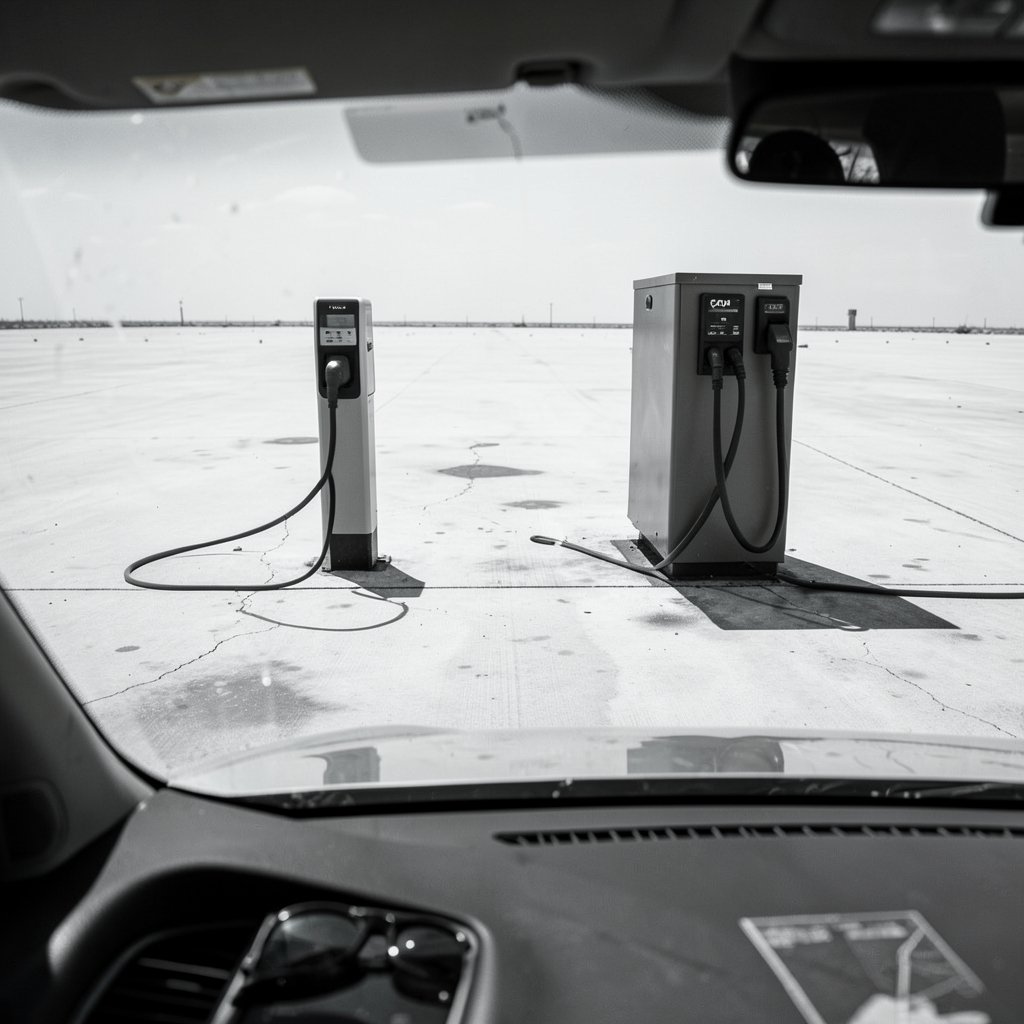
Two connectors at the same charging station can look almost identical: one promises a full battery in forty minutes, the other four hours. The first time you see both options, the setup is confusing. The car is the same. The plug shape is often the same. So what is actually different?
The difference is where the electricity gets converted. Once you understand that, AC vs DC charging becomes a matter of matching the charger to your schedule. The comparison below sets the two side by side, shows where each one wins, and helps you pick the right one for home, work, and the open road.
AC vs DC Charging at a Glance
Before the deep dive, here is the short version. Your EV battery stores direct current (DC). The grid delivers alternating current (AC). The only real difference between the two charging types is where that AC-to-DC conversion happens.
| Feature | AC Charging | DC Charging |
|---|---|---|
| Where conversion happens | Inside the car (onboard charger) | Inside the charger itself |
| Typical power output | Roughly 7 kW to 22 kW | Roughly 25 kW to 420 kW |
| Typical charging time | Several hours | As little as 30 minutes |
| Best suited for | Home, workplace, overnight parking | Motorways, quick top-ups, fleets |
| Equipment cost | Lower and simpler | Higher and more complex |
| Impact on battery | Gentle, slow | Faster, more heat |
That table is the whole story in miniature. Everything else is detail.
Where the Conversion Happens (and Why It Matters)

AC charging works like a translator inside your car. The grid sends alternating current down the cable, and your vehicle’s onboard charger converts it to DC before it reaches the battery. That onboard unit has a ceiling. Many cars sold in India carry a 3.3 kW onboard charger, while others step up to around 7 kW. Whatever the wall box’s rating, the car can accept only what its internal converter allows.
DC charging flips the arrangement. The charger does the conversion work itself and feeds DC straight into the battery, bypassing the onboard charger entirely. That shorter electrical path is exactly why DC is so much faster. As one glossary explanation puts it, direct current enables particularly fast charging because the current goes directly into the battery while the AC-to-DC conversion happens right at the station.
This single architectural difference explains almost every practical distinction that follows: speed, cost, cable weight, and even where you tend to find each type of charger.
AC Charging: The Steady Workhorse
AC chargers are the standard home and workplace solution. They are simpler, smaller, and cheaper to install than their DC cousins, and they run happily on ordinary domestic power supplies.
The trade-off is speed. Because the car’s onboard charger caps the rate, AC charging is measured in hours, not minutes. That sounds like a drawback until you think about how cars are actually used. A vehicle parked overnight for eight hours does not need to charge in half an hour. It needs to be full by morning, and AC handles that comfortably.
Choose AC if:
- You charge at home overnight and the car sits for hours anyway
- Your workplace or apartment complex has long parking durations
- You want the lowest installation cost and the simplest equipment
- You are charging a fleet that returns to base each evening
DC Charging: The Road-Trip Rescue
DC fast chargers are built for urgency. They convert power externally and push it directly to the battery, which is why a DC unit can add serious range in the time it takes to drink a coffee. Many EVs can top up in as little as 30 minutes on a DC charger. (4c hair)
The catch is cost and complexity. DC fast chargers cost more than slower charging options, which is why they tend to cluster along motorways and in cities where drivers need a quick stop rather than a long stay. They are a convenience you pay for, not a default.
Choose DC if:
- You are on a long trip and need a fast top-up
- You run a commercial site where turnover matters more than dwell time
- You operate a fleet on tight schedules
- You cannot guarantee long parking windows
For businesses weighing infrastructure, the practical answer is often a mix: AC where vehicles sit, DC where they hurry. Locations with long parking durations, like offices where employees stay eight hours or malls where shoppers spend an afternoon, suit AC perfectly. Sites that need rapid turnover lean DC.
Charging Speed in Real Terms
Numbers on a spec sheet can mislead. A 22 kW AC charger sounds impressive until you remember your car might only accept 7 kW. The bottleneck is almost always the vehicle, not the post.
DC charging has its own ceiling, set by the battery’s acceptance rate and state of charge. The fastest part of a DC session happens in the low-to-middle range; the last stretch slows deliberately to protect the cells. That is why drivers chasing speed often stop around 80 percent rather than waiting for a full battery.
The practical lesson: match the charger to the car, not to the marketing. If your EV’s onboard charger maxes out at 7 kW, paying extra for a 22 kW home unit buys you nothing.
The Cost Question
AC equipment is cheaper to buy and install, and it draws power more gently over a longer window. DC hardware carries a higher upfront price and higher operational costs, which is why public DC charging usually costs more per unit of energy than charging at home.
There is also a hidden cost in speed: heat. Fast charging generates more of it, and while modern battery management systems handle this well, routine DC sessions are best treated as a tool for when you need them rather than a daily habit. A home AC setup remains the comfortable default for most drivers.
Common Mistakes People Make
A few habits trip up newcomers again and again.
Assuming every cable works the same. AC and DC connectors may look similar, but they are not interchangeable in function. Check the label before you plug in.
Buying more charger than the car can use. A home wall box rated far above your vehicle’s onboard charger limit is wasted money. Confirm your car’s acceptance rate first.
Treating DC as the everyday option. DC is brilliant for road trips. It is overkill, and pricier, for a car that sits in a driveway all night.
Ignoring the parking window. The best charger is the one that matches how long the car is actually stationary. A slow charge over eight hours beats a fast charge you did not need.
Forgetting the last 20 percent. Chasing a 100 percent DC charge can mean waiting far longer than necessary for the final few percent.
A Note on Battery Health and Smarter Systems
DC charging sends current straight to the battery, skipping the onboard converter, and that shorter path is why it is faster. But speed is no longer the only question worth asking. Home energy setups are evolving, and a home DC charger paired with solar panels, a home battery, and intelligent controls becomes part of a two-way energy system where the car can receive power, store it, and send it back to the house or grid.
That shift changes the calculation from how fast to how smart. For most households, though, AC remains the sensible backbone, with DC reserved for the moments that genuinely demand speed.
Charging in India and Other Markets
The AC vs DC split plays out slightly differently depending on where you plug in. In India, AC chargers are the common home and workplace choice, while DC fast chargers serve quicker top-ups during long journeys. Elsewhere, AC charging at 7 to 22 kW is the standard at home and public points, while DC rapid charging runs from around 50 kW up to 350 kW at motorway service stations.
The pattern holds across markets: AC for dwell time, DC for distance. If you are building out a site or planning a purchase, start with how long vehicles actually park, then choose accordingly. The same logic applies to smaller everyday tech decisions, whether you are picking a pad for your phone or a post for your car. Just as the best wireless charging pads actually matters before you buy, matching the charger to the device and the routine is what separates a smart buy from an expensive one. (The row)
Which One Should You Choose?
Here is the verdict, stripped of hedging.
Choose AC if your car parks for hours at a time, you charge at home or work, you want lower upfront costs, or you are setting up overnight charging for a household or fleet. It is the sensible default for the majority of drivers.
Choose DC if you need a fast top-up mid-trip, you manage a commercial site where vehicles turn over quickly, or you simply cannot afford to wait. It is a tool for urgency, not a replacement for routine charging.
For many people, the honest answer is both: AC at home, DC on the road. That combination covers the slow, steady charging that suits daily life and the fast rescue that makes long trips practical.
Conclusion
The AC vs DC charging debate sounds technical, but it boils down to a simple question: how long is your car going to sit there? If the answer is hours, AC is the calm, cost-effective choice, quietly converting power inside the car and capping speed at whatever the onboard charger allows. If the answer is minutes, DC steps in, doing the conversion itself and feeding the battery directly for a much faster result.
Neither is better in absolute terms. AC wins on cost, simplicity, and gentle everyday charging. DC wins on speed and convenience when time is short. Match the charger to your parking window, confirm what your car can actually accept, and skip the marketing noise. Do that, and the two connectors that once looked confusingly similar become two clearly different tools, each doing exactly the job it was built for.
FAQ
What is the main difference between AC and DC charging?
The difference is where the AC-to-DC conversion happens. With AC charging, the car’s onboard charger converts the power, which caps the speed. With DC charging, the charger does the conversion and feeds DC straight to the battery, making it much faster.
Is DC charging bad for my EV battery?
DC charging generates more heat than AC, but modern battery management systems are built to handle it. Routine DC sessions are best treated as a tool for when you need speed, while AC remains the comfortable everyday default.
How long does each type take to charge an EV?
AC charging typically takes several hours, depending on the car’s onboard charger and the power supply. DC charging can top up a battery in as little as 30 minutes, though the final stretch of any session slows to protect the cells.
Can I install a DC fast charger at home?
You can, but it is rarely necessary. DC equipment costs more and is more complex, and most homes are better served by AC charging overnight. Home DC setups make more sense when paired with solar and smart energy controls.
Why is DC charging more expensive?
DC chargers are more complex machines that do the conversion work themselves, so the hardware and installation cost more. That higher cost is reflected in the price per unit of energy at public fast-charging stations.
Which charger should I choose for my business?
It depends on how long vehicles park. Offices, apartments, and malls with long dwell times suit AC. Sites that need rapid turnover, like motorway stops, benefit from DC. Many businesses find a combination of both works best.






