

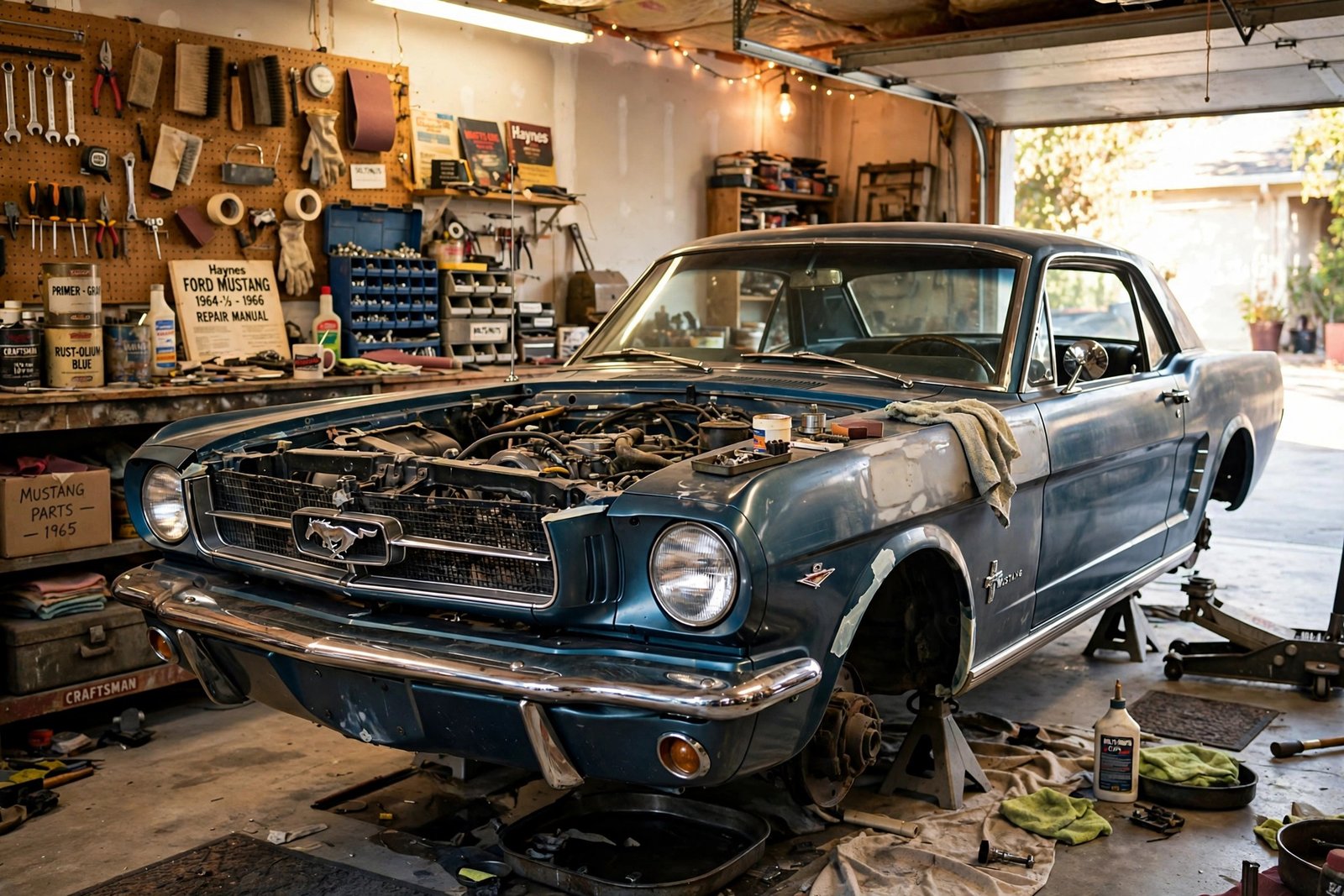
The best classic cars to restore for beginners share three things: parts you can actually buy, a community that has already solved every problem you will meet, and mechanical systems simple enough to learn as you go. Pick wrong, and your dream project becomes an expensive ornament in the garage; pick right, and a few weekends a month turn into the car you always wanted.
For most first-timers, the answer is the Volkswagen Beetle: project cars for under $10,000, a simple air-cooled engine, and parts available almost everywhere. If you want American muscle instead, the Ford Mustang (1964–1973) is the safest bet, with project cars from around $15,000 and reproduction parts for nearly everything.
Key takeaways:
- Best first project overall: the Volkswagen Beetle — cheap to buy, simple to fix.
- Best muscle car: the Ford Mustang (1964–1973), with project cars from around $15,000.
- Best budget buy: the Chevrolet C10 pickup, from around $7,200.
- Buy on parts availability and community support, not on looks alone.
What makes a classic easy to restore?
The best first projects check the same three boxes: plentiful parts, a strong and active community, and a reasonable purchase price. Add mechanical simplicity, and you have a car you can learn on without specialist tools.
Documentation matters just as much. Workshop manuals, online guides and video tutorials are gold when you are stuck at 10 pm with a bolt that will not move.
The 10 best classic cars to restore for beginners
1. Volkswagen Beetle (1950s–1970s) — Best First Project
The Beetle is the easiest classic in the world to restore, and it starts with the price: project cars regularly sell for under $10,000, with a full restoration typically costing $10,000 to $20,000. The air-cooled rear engine is mechanically simple, with fewer components than almost any other car here, and parts are available from suppliers on every continent.
Because millions were built, nothing on a Beetle is rare or mysterious. Whatever breaks, someone has fixed it before you and written about it.
Best for: a first-timer who wants the cheapest, simplest route into restoration.
2. Ford Mustang (1964–1973) — Best Muscle Car
The first-generation Mustang is one of the most iconic cars ever made, and also one of the easiest to restore: it was mass-produced in huge numbers, so project cars turn up everywhere, from around $15,000, and reproduction parts exist for nearly every panel, trim piece and mechanical component.
You will never wait months for a part, and the Mustang community is large enough that every job has a guide. Prices range from around $15,150 for a reasonable car to $41,000 for an outstanding one, so set your budget before you fall in love with a particular car.
Best for: anyone who wants a true American icon with zero parts anxiety.
3. Chevrolet Camaro (1967–1969) — Best Bowtie Alternative
If you prefer a bowtie to a blue oval, the first-generation Camaro is the natural choice. Project cars start at around $10,000, with a full restoration typically costing $20,000 to $50,000 depending on condition and specification.
Like the Mustang, the Camaro benefits from huge production numbers and a vast aftermarket, so body panels, interior trim and engine parts are all easy to find.
Best for: Chevrolet fans who want muscle-car looks with Mustang-level parts support.
4. Chevrolet Nova (1968–1974) — Best Budget Muscle
The Nova is one of the cheapest ways into a classic muscle car. More than a million were built, which keeps prices low, and the car is lighter and smaller than an equivalent Camaro or Chevelle — a real advantage when you are working on it in a home garage.
The engine bay is enormous, so everything from a small-block V8 to a modern LS swap fits without a fight.
Best for: muscle-car performance on the smallest budget.
5. Chevrolet C10 Pickup (1960s–1970s) — Best Budget Buy
The C10 is the cheapest car on this list to buy into, with project cars ranging from around $7,200 to $21,900 depending on condition. It has the looks of a muscle car with a pickup bed on the back, and its simple body-on-frame construction makes it straightforward to work on.
Pickups are forgiving first projects: panels are flat and simple, the engine bay is roomy, and you can use the truck while you restore it.
Best for: the lowest entry price and a truck you can actually use.
6. Oldsmobile Cutlass (1968–1972) — Best Underrated Pick
The Cutlass was one of the best-selling cars of its day, yet it still flies under the radar — which is exactly why it is such a good first project. Project cars run from around $8,000 to $12,000, with a typical restoration costing $15,000 to $30,000.
Its best trick is shared DNA: chassis and mechanical parts are interchangeable with other GM A-body cars, so parts are cheap and easy to find.
Best for: big-car presence and V8 character without the big-car price.
7. Datsun 240Z (1970–1973) — Best Import Classic
The 240Z is the car that proved Japan could build a world-class sports car, and it remains one of the most rewarding classics a beginner can take on. The straight-six engine is simple and tough, the body is light and beautifully shaped, and the owner’s community is large, organised and generous with advice.
Project prices vary widely with condition, so buy on the body, not the badge: rust is the 240Z’s enemy, and a solid shell is worth paying more for.
Best for: a first-timer who wants style and handling as well as simplicity.
8. Chevrolet Chevelle (1964–1972) — Best Big Classic
The Chevelle is a big, handsome coupe with body-on-frame construction that makes restoration straightforward — panels unbolt, the chassis is simple, and the fan base is large enough that parts and advice are never far away. The 1971–1972 hardtop and convertible models are considered the more affordable of the range.
Done well, a Chevelle is one of the most satisfying classics to own — and one of the easiest to sell on.
Best for: a confident beginner with space for a full-size project.
9. Dodge Dart (1967–1976) — Best Starter Classic
Not everyone needs a hulking V8 monster for a first project. The Dart is compact, reliable and famously straightforward to work on, with a reputation for solid reliability that makes it one of the least stressful classics a beginner can choose.
It is budget-friendly both to buy and to keep: parts are cheap, the mechanicals are simple, and there is very little to go wrong.
Best for: a first project that is genuinely manageable, start to finish.
10. Chevrolet Bel Air (1955–1957) — Best for Parts Availability
The 1955–1957 Bel Air is the ultimate proof that parts availability matters more than anything else in a restoration. You can buy every part needed to build one of these cars from scratch — including brand-new bodies for the 1957 model — which takes the fear out of buying a rough example.
The 1955 is generally the most affordable of the three years, so it is the smart entry point.
Best for: a beginner who never wants to hear “that part doesn’t exist any more”.
The 10 best beginner restoration projects compared
| Car | Years | Project car from | Why beginners love it |
|---|---|---|---|
| Volkswagen Beetle | 1950s–1970s | Under $10,000 | Simplest mechanics, cheapest parts |
| Ford Mustang | 1964–1973 | ~$15,000 | Every part available, huge community |
| Chevrolet Camaro | 1967–1969 | ~$10,000 | Vast aftermarket, holds value |
| Chevrolet Nova | 1968–1974 | Low cost | Light, cheap, huge engine bay |
| Chevrolet C10 Pickup | 1960s–1970s | ~$7,200 | Cheapest entry, usable while restoring |
| Oldsmobile Cutlass | 1968–1972 | ~$8,000 | Shares parts with other GM A-bodies |
| Datsun 240Z | 1970–1973 | Varies widely | Simple straight-six, strong community |
| Chevrolet Chevelle | 1964–1972 | 1971–72 most affordable | Body-on-frame, easy to sell on |
| Dodge Dart | 1967–1976 | Budget-friendly | Compact, reliable, little to go wrong |
| Chevrolet Bel Air | 1955–1957 | 1955 most affordable | Every part available, even new bodies |
Before you buy: a first-timer’s checklist
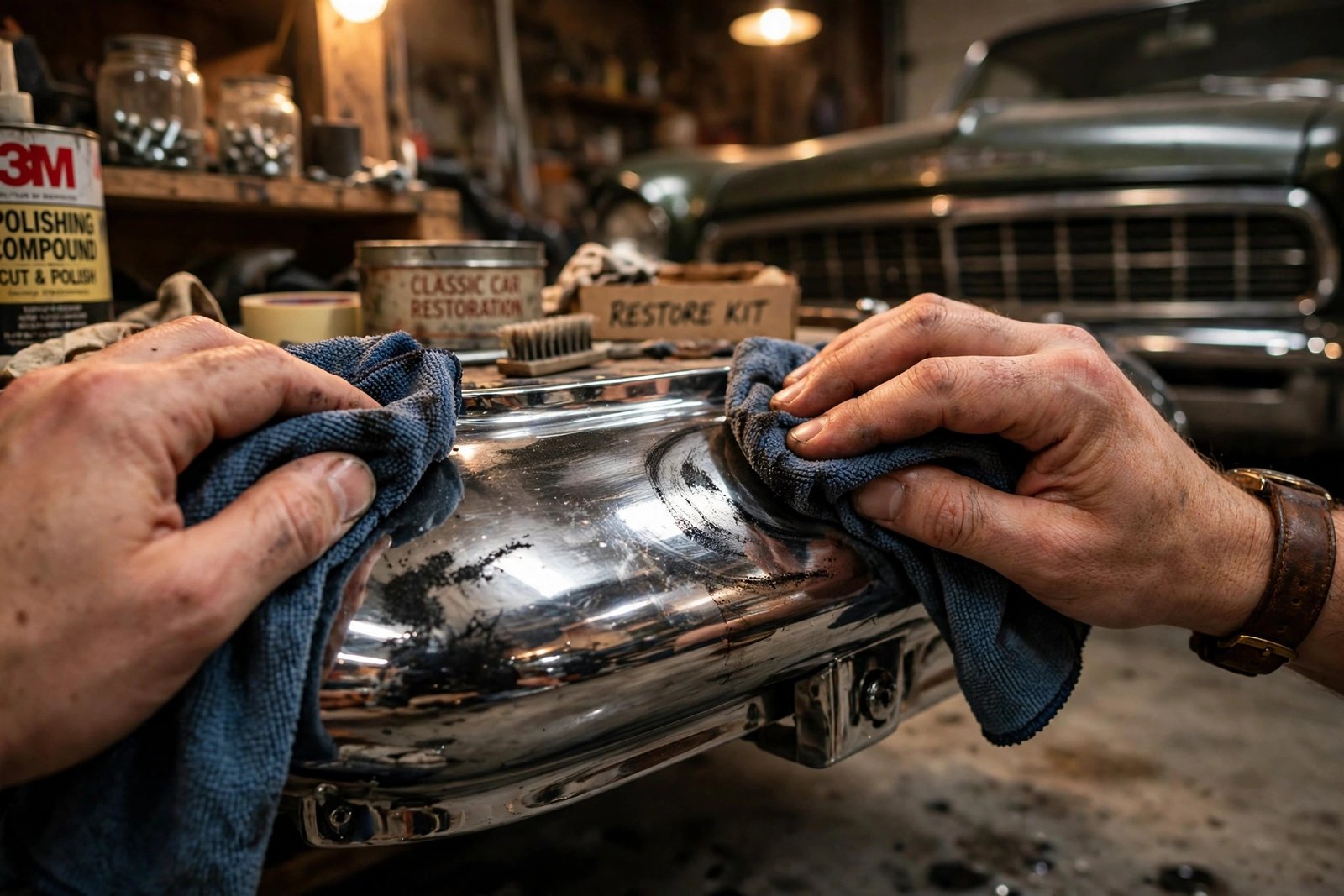
Work through this list before money changes hands. It takes an hour and can save you thousands.
- Set a total budget first. The purchase price is only the start — allow at least as much again for parts, paint and the jobs you will pay a professional to do.
- Inspect for rust, not shine. Check the floors, sills, boot and wheel arches with a magnet and a torch. Fresh paint can hide a multitude of sins.
- Check parts availability. Before you buy, confirm that the panels and trim your car needs are actually in production — a quick search for your model will tell you in minutes.
- Confirm the paperwork. A clear title and matching numbers protect your investment and make registration straightforward.
- Be honest about space and time. A restoration needs a dry, covered space and regular weekends. A car that sits outside for a year will cost you more than one that sits in a garage.
- Join the community before you buy. A model-specific club or forum will tell you what to look for, what to pay and who to trust — restoration rewards the same patience and craft as fine work with materials, as our guide to knife handle materials shows. And long garage hours go better with good sound, so sort out a music streamer for the workshop early.
FAQs
How much does it cost to restore a classic car?
It depends on the car and how much work you do yourself. A Beetle restoration typically runs $10,000 to $20,000, a Cutlass $15,000 to $30,000, and a Camaro $20,000 to $50,000. Always budget more than your first estimate — every restorer does.
Which classic car is cheapest to restore?
The Chevrolet C10 pickup, with project cars from around $7,200, and the Volkswagen Beetle, with projects under $10,000 and restoration costs of $10,000 to $20,000. Both have cheap parts and simple mechanicals, which keeps the total bill down.
Should I buy a running car or a project car?
For a first restoration, buy the most complete, best-running car your budget allows. A running car teaches you how it should feel, and you can improve it piece by piece.
How long does a first restoration take?
Longer than you think. A simple Beetle or Dart done on weekends can take a year or two; a full Mustang or Chevelle restoration often takes two to four years.
Do I need a professional for any of it?
Yes, for safety-critical work. Brakes, steering, fuel lines and structural welding should be checked or done by a qualified mechanic, even if you handle the rest yourself. It is the one place where saving money is never worth it.
Sources
- SlashGear, “5 Of The Best Classic Cars To Restore As A Beginner” — slashgear.com
- iGuides, “Best Classic Cars to Restore Easily” — iguides.org
- Neighbor, “The 6 Best Classic Cars to Restore By Yourself” — neighbor.com
- Headlights, “Best Cars to Restore Yourself Without Spending a Fortune” — headlights.com
- Wilson Auto Repair, “The 10 Easiest Classic Cars to Restore” — wilsonauto.com
The bottom line
The right first classic is not the rarest or the fastest — it is the one you can finish. A Beetle teaches you the craft for the least money, a Mustang gives you an icon with parts on every shelf, and a C10 gets you driving while you work.
Pick one car from this list, inspect it for rust, join its community, and start with the job in front of you. A year from now, you will be driving something no showroom can sell you.
Safety note: restoration involves fuel, electrical and braking systems. Have all safety-critical work — brakes, steering, fuel lines and structural repairs — checked by a qualified mechanic before the car is driven.














