

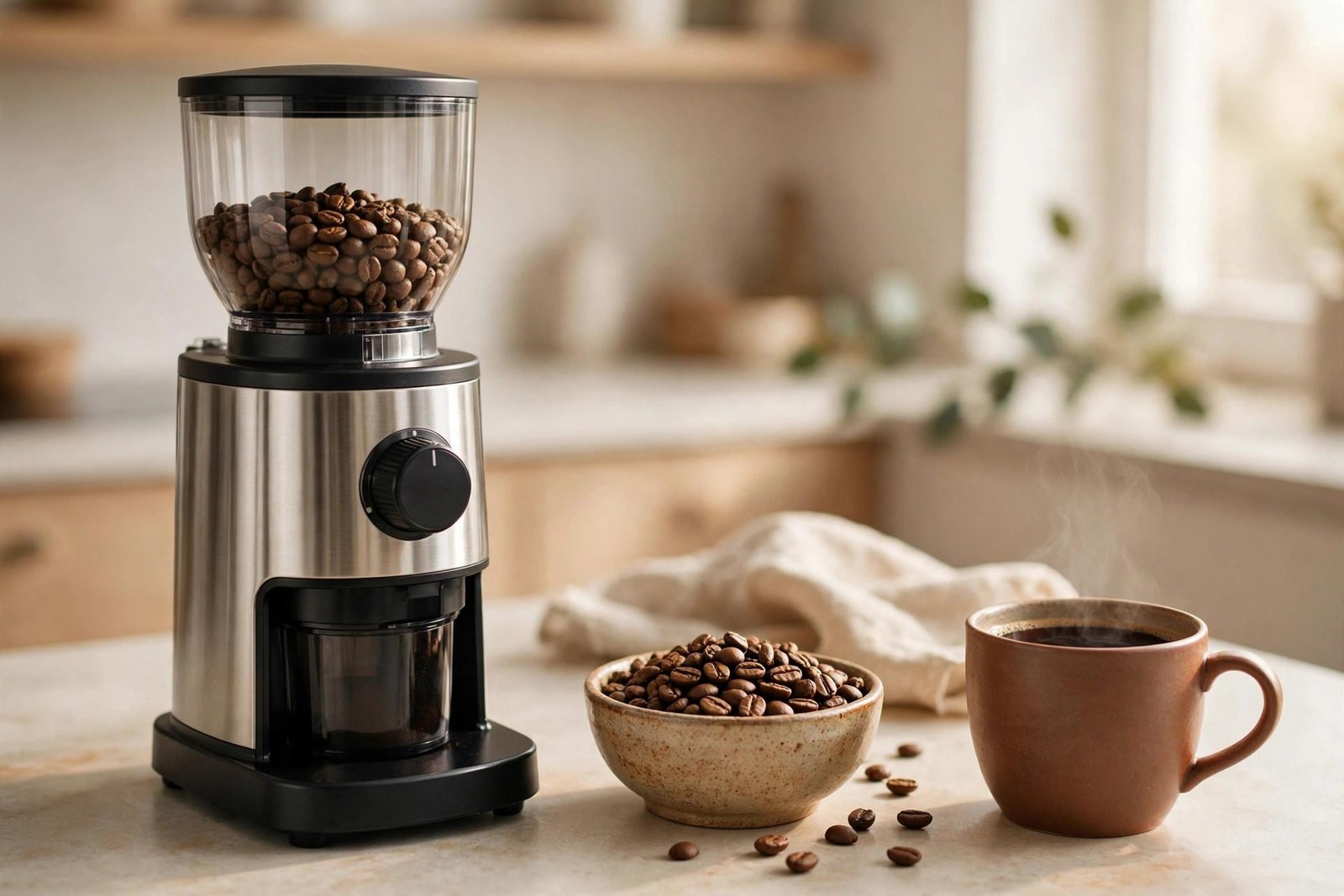

The best coffee grinder is the one upgrade that changes every cup you make. Freshly ground beans release aroma and flavour that pre-ground coffee loses within days, and a grinder that produces an even grind lets water extract evenly, so the coffee tastes sweet and balanced instead of bitter or sour.
So what is the best coffee grinder in 2027? A good conical burr grinder is the safest all-rounder for most kitchens, a flat burr grinder is the choice for espresso lovers chasing consistency, and the right answer depends on how you brew.
Key takeaways:
- A burr grinder beats a blade grinder every time, because it crushes beans to an even size instead of chopping them unevenly.
- A conical burr grinder is the best all-rounder for filter, cafetiere and pour-over brewing.
- Espresso needs a fine, consistent grind, so choose a grinder with small, precise grind steps.
- Manual grinders suit travel and small kitchens, but an electric grinder is easier for daily brewing.
- Grind only what you need, just before you brew, and store beans airtight, away from light.
Burr vs blade: the choice that matters most

A burr grinder crushes coffee beans between two ridged surfaces, called burrs, set a fixed distance apart. That fixed gap is what makes the grind even: every particle comes out roughly the same size, so the water extracts flavour from all of it at the same rate.
A blade grinder works like a small food processor, spinning a blade that chops the beans into pieces of many different sizes. Some pieces end up as dust and some stay as large chunks, so the dust over-extracts and tastes bitter while the chunks under-extract and taste sour.
There are two kinds of burr. Conical burrs are cone-shaped, run quietly and are the common choice in home grinders, because they are forgiving and handle a wide range of grind sizes well. Flat burrs are two parallel discs, and they tend to produce a very uniform grind, which is why they are popular with espresso lovers.
Grind size matters as much as the grinder itself. Espresso needs a fine grind, like caster sugar, because the water passes through the coffee quickly under pressure. Pour-over and filter coffee need a medium grind, like coarse sand. Cafetiere needs a coarse grind, like rough breadcrumbs, because the coffee steeps for several minutes.
Price is the last thing to weigh. Grinders range from modest hand mills to serious electric machines, and prices vary widely between brands and retailers, so check current prices before you buy.
The 10 best coffee grinders in 2027
1. The best all-round conical burr grinder
This is the grinder to buy if you only want to buy one. A conical burr set, a wide range of grind settings and a simple dial make it easy to move from cafetiere in the morning to pour-over in the afternoon.
It suits almost every home brewer, because it does nothing badly and most things well.
Best for: most kitchens, and every brew method except the most demanding espresso.
2. The best flat burr grinder for espresso
This is the espresso pick, and it earns its place on grind quality alone. Flat burrs produce a very even fine grind, and small, precise adjustment steps let you dial in the shot: a touch finer when the coffee runs too fast, a touch coarser when it chokes.
It pairs naturally with a good machine, and our guide to the best espresso machines covers what to look for on that side.
Best for: espresso lovers who want consistent, dialled-in shots.
3. The best budget burr grinder
A budget burr grinder proves that you do not need to spend a fortune to escape the blade. It still grinds far more evenly than any blade grinder, which alone lifts filter and cafetiere coffee noticeably.
It is the right choice for a first grinder, or for a second home, a student flat or an office desk.
Best for: a first burr grinder on a tight budget.
4. The best manual hand grinder
A manual grinder is a simple, satisfying thing: a burr set, a handle and a small jar, with no plug and no noise beyond a quiet crunch. Modern hand grinders use steel conical burrs that grind evenly enough for pour-over and even espresso, and they fold away into a bag for travel.
The trade-off is effort. Grinding enough beans for a cafetiere takes a minute or two of steady cranking, which is fine for one cup and tedious for four.
Best for: travel, camping and quiet mornings.
5. The best espresso grinder on a budget
Espresso on a budget is a real challenge, because the grinder needs fine, stepped adjustment that cheap grinders often lack. This pick is the most affordable grinder that genuinely manages it: a sturdy burr set, small adjustment steps and a low-retention design, so yesterday’s grounds do not stale today’s shot.
It is the natural partner for an affordable machine, and our guide to the best budget espresso machines covers that pairing.
Best for: espresso on a budget, paired with an entry-level machine.
6. The best quiet electric grinder
Some grinders sound like a small power tool, which matters when the rest of the house is asleep. This pick uses a slower motor and a well-damped body, so it grinds with a low hum rather than a scream.
It is the grinder for early risers, open-plan flats and anyone who brews before the household wakes.
Best for: early mornings and open-plan living.
7. The best single-dose grinder
A single-dose grinder is built for people who weigh their beans for every brew. You load one dose, grind it, and almost nothing is left behind in the grinder, so each cup starts fresh and you can switch beans between brews without waste. Low retention is the feature that defines this category.
It suits the enthusiast who keeps several bags open at once: a fruity Ethiopian for pour-over today, a chocolatey Brazilian for espresso tomorrow.
Best for: enthusiasts who switch beans often and weigh every dose.
8. The best grinder for filter and pour-over
Filter and pour-over brewing reward a grinder that excels at medium grinds, and this pick is tuned for exactly that. Its burr geometry produces very few fine particles at medium settings, so the cup tastes clean and sweet rather than muddy, and the flavours of the beans come through clearly.
It will still grind fine enough for a moka pot, but espresso is not its strength, and that is fine: a specialist that does one job beautifully beats a generalist that does everything adequately.
Best for: pour-over and filter coffee drinkers.
9. The best grinder for cafetiere and cold brew
Cafetiere and cold brew need a coarse, even grind, and this pick delivers it. Its burr set stays consistent at the coarse end of the range, where many grinders produce too many fines, and the grounds come out uniform enough that the cup tastes sweet rather than silty.
It is also a practical choice for a household that brews in bulk, because it holds a generous amount of beans and grounds.
Best for: cafetiere and cold brew, especially in larger batches.
10. The best premium grinder for the serious home barista
This is the grinder for the person who has already chosen their machine and wants the grinder to match it. Large flat burrs, stepless adjustment, low retention and a heavy, stable body give it the consistency and control that serious espresso demands, and it handles filter grinds well too.
It is the most expensive pick here, and prices vary, so check current prices before committing.
Best for: serious home baristas who want the best espresso they can make at home.
How do the best coffee grinders compare?
| Grinder | Burr type | Best brew method | Best for |
|---|---|---|---|
| All-round conical burr | Conical burr | Filter, cafetiere, pour-over | Most kitchens |
| Flat burr for espresso | Flat burr | Espresso | Dialled-in shots |
| Budget burr | Conical burr | Filter, cafetiere | A first grinder |
| Manual hand grinder | Conical burr | Pour-over, travel brews | Travel and camping |
| Budget espresso grinder | Conical burr | Espresso | Espresso on a budget |
| Quiet electric | Conical burr | Filter, pour-over | Early mornings |
| Single-dose | Flat burr | Espresso, pour-over | Switching beans often |
| Filter and pour-over | Conical burr | Pour-over, filter | Clean, sweet cups |
| Cafetiere and cold brew | Conical burr | Cafetiere, cold brew | Larger batches |
| Premium home barista | Flat burr | Espresso, filter | Serious home baristas |
Your coffee grinder checklist
Work through this list before you buy, and the grinder will rarely disappoint.
- Choose burr over blade: an even grind is the single biggest upgrade a grinder can give you.
- Match the grinder to your brew: espresso needs fine, precise adjustment; cafetiere needs a consistent coarse grind.
- Check the grind range: a grinder that covers fine to coarse lets you try new brew methods later.
- Think about noise: a quiet grinder matters if you brew while others sleep.
- Look for easy cleaning: a removable hopper and a burr set you can brush out keep the flavour fresh.
- Grind fresh: grind only what you need, just before brewing, for the best aroma.
- Store beans well: keep whole beans in an airtight container, away from light and heat.
Frequently asked questions
Is a burr grinder really better than a blade grinder?
Yes. A burr grinder crushes beans to an even size, so the water extracts flavour evenly and the cup tastes balanced. A blade grinder chops unevenly, so some grounds over-extract and taste bitter while others under-extract and taste sour.
What grind size do I need for espresso?
Espresso needs a fine grind, like caster sugar, because the water passes through the coffee quickly under pressure.
Do I need a different grinder for espresso and filter coffee?
No, a good all-round burr grinder handles both, though it will not match a dedicated espresso grinder for fine adjustment. If you brew espresso every day, a dedicated grinder is worth it; if you mostly brew filter, one good grinder is enough.
How much should I spend on a coffee grinder?
Spend as much as your brewing deserves. A modest burr grinder transforms filter and cafetiere coffee, while espresso rewards a bigger spend on grind adjustment and consistency. Prices vary, so check current prices before you buy.
How do I clean a coffee grinder?
Brush out the burrs and the grounds container regularly, and wipe the hopper clean. Many grinders come apart without tools for this. Avoid water inside the burr chamber, and run a small handful of beans through after cleaning to clear any dust.
Should I grind my beans the night before?
It is better to grind just before brewing. Ground coffee loses aroma quickly once it is exposed to air, so grinding fresh each morning gives a noticeably better cup than grinding the night before.
Sources
This guide reflects widely published guidance on coffee grinding and brewing. For more on coffee at home, our guides to the best espresso machines, the best budget espresso machines and the best bagel and coffee pairings cover the rest of the morning table.
The bottom line
The best coffee grinder in 2027 is the one that matches how you brew. A conical burr grinder is the safest all-rounder for most kitchens, a flat burr grinder is the choice for espresso lovers, and a manual grinder is the pick for travel and quiet mornings.
Your next step is simple: choose burr over blade, match the grind to your brew method, and grind fresh just before you brew.














