The air inside a well-kept home is not always as clean as it looks. Dust settles on shelves within a day of cleaning, cooking leaves a faint haze that lingers into the evening, and pollen drifts in through windows open for only an hour. For anyone who wakes up congested, whose eyes itch through spring, or who wants the bedroom to feel as fresh as it looks, the best luxury air purifier brands offer something a basic box fan with a filter cannot: quiet, powerful filtration designed to sit in a beautiful room without ruining it.
Luxury in this category is not about a gold finish or a designer logo. It is about filtration that genuinely captures the smallest particles, sensors that read the air in real time, motors quiet enough for a bedroom at night, and a design you are happy to leave visible in a living room.
This guide profiles nine brands worth considering in 2027, from the Swiss engineering of IQAir to the design-led Dyson and the quiet value of Levoit and Winix. Each profile explains what the brand does well, what to watch for, and who it suits best, so you can match a purifier to your room, your allergies, and your tolerance for noise.
Key takeaways
- True HEPA filtration, ideally H13 grade, is the baseline for a luxury purifier, capturing 99.97 percent of particles down to 0.3 microns.
- Room size matters more than brand name: a purifier rated for a small bedroom will not clean an open-plan living room.
- Noise at sleep speed is the detail most buyers regret ignoring: check the decibel rating on the lowest setting, not just on high.
- Filter replacement cost is part of the real price: check how often filters need changing and what a set costs.
- No purifier removes every pollutant, and none replaces ventilation, regular cleaning, or medical advice for asthma and allergies.
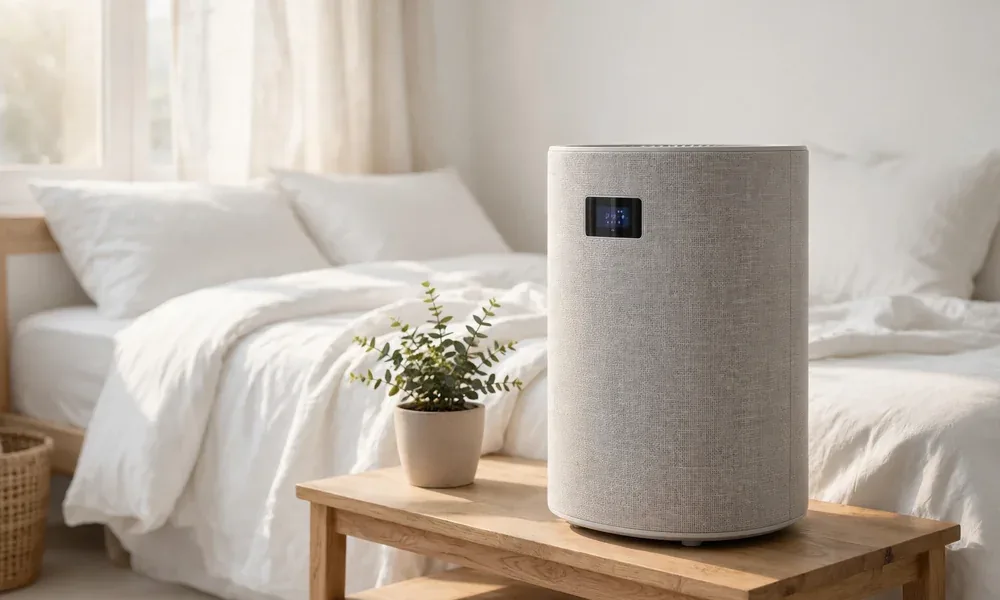
What to look for in a luxury air purifier
Start with the filter. A true HEPA filter is the standard to insist on, and H13 grade is the level most luxury brands now use, capturing fine dust, pollen, pet dander, mould spores and many smoke particles. An activated carbon layer in most premium models handles odours and gases, and a washable pre-filter catches larger dust and hair first, extending the main filter’s life.
Next, look at clean air delivery rate, usually written as CADR, and the room size the manufacturer states. A higher CADR means the purifier moves more clean air per minute. A purifier that covers 1,500 square feet sounds impressive, but that figure usually assumes a standard ceiling height and a closed room, so treat it as a guide and size up if your ceilings are high or the space is open plan. Our guide to the best silk pillowcases covers the other half of that equation, because clean air and comfortable bedding work together for better sleep.
Finally, consider noise, sensors and running costs together. A purifier silent on low but loud on high is only useful if its automatic mode rarely needs high speed, which is where a good particle sensor earns its keep. Look for a real-time particle display, an automatic mode, and a filter life indicator, and check the replacement filter cost: a cheap purifier with expensive filters can cost more over three years than a premium one with long-lived filters.
Dyson
What we like: A bladeless fan and purifier in one, with a 360-degree HEPA H13 filter, a sealed system, and an LCD display reporting particle levels, gases and humidity. The Purifier Cool Formaldehyde model adds a catalytic filter that destroys formaldehyde from furniture and flooring.
What to consider: Premium pricing, a larger unit than a purifier alone, and replacement filters priced at the luxury end. Filtration: HEPA H13 plus activated carbon, sealed system. Room size: Up to around 600 square feet. Noise: Quiet on low, with a night mode that dims the display. Smart features: MyDyson app, voice control, air quality display.
Dyson is the choice for a visible living room, where the purifier must look like furniture.
IQAir
What we like: Swiss-made, medical-grade filtration led by the HealthPro Plus, whose HyperHEPA filter captures particles down to 0.003 microns, far smaller than the standard HEPA test size. It is widely used in clinics, schools and homes where air quality is a health priority.
What to consider: One of the most expensive brands here, heavy to move, and the HealthPro Plus has no Wi-Fi or app control. Filtration: HyperHEPA plus gas and odour control. Room size: Up to around 1,125 square feet. Noise: Quiet on low speeds, audible on the highest setting. Smart features: Basic control panel, no app on the flagship model.
IQAir is the choice when filtration performance is the whole point.
Molekule
What we like: A different approach from every other brand here: its PECO technology uses light to break down pollutants at a molecular level rather than only trapping them, and the Air Pro model received FDA clearance as a medical device. The design is slim, modern and quiet, with a touchscreen and app control.
What to consider: Expensive, with a filter subscription that adds ongoing cost, and room coverage smaller than the big Coway and Alen models. Filtration: PECO plus HEPA in the Tri-Power filter. Room size: Up to around 1,000 square feet for the Air Pro. Noise: Very quiet, designed for bedrooms and offices. Smart features: App control, auto mode, filter subscription.
Molekule suits buyers who want the newest technology in a bedroom or home office.
Coway Airmega
What we like: The Airmega 400 and 400S cover up to 1,560 square feet with a HEPA filter and activated carbon, among the most capable large-room purifiers available. Real-time air quality is shown on a clear display, the smart model adds app control and voice commands, and an eco mode switches the fan off when the air stays clean.
What to consider: Large and heavy, better in a living room than a small bedroom, and the replacement filter set is a real ongoing cost. Filtration: HEPA plus activated carbon, with a washable pre-filter. Room size: Up to 1,560 square feet for the 400 series. Noise: Quiet on low, noticeable on high. Smart features: App and voice control on the S model, air quality display.
Coway is the practical luxury pick for open-plan living.
Blueair
What we like: Swedish design with HEPASilent technology, combining electrostatic and mechanical filtration to capture particles while keeping noise and energy use low. The Blue Pure 211i Max covers large rooms, has a washable fabric pre-filter in a choice of colours, and runs quietly enough for a bedroom.
What to consider: Replacement filters are proprietary, changed roughly every six to nine months, and the largest models are substantial pieces of furniture. Filtration: HEPASilent, HEPA plus carbon. Room size: Up to around 1,800 square feet for the largest models. Noise: Among the quietest at this size. Smart features: App control, air quality display, voice control on selected models.
Blueair is the choice for Scandinavian design, low noise and large-room coverage in one package.
Alen
What we like: The BreatheSmart 75i covers up to 1,300 square feet with medical-grade H13 HEPA filtration, and Alen backs its purifiers with a lifetime warranty, rare in this category. Customisable front panels let the unit match a room, and the design is clean and understated.
What to consider: Premium pricing, a substantial largest model, and an app that is functional rather than polished. Filtration: Medical-grade H13 HEPA plus carbon. Room size: Up to 1,300 square feet for the 75i. Noise: Very quiet on sleep mode. Smart features: App control, air quality sensor, filter life indicator.
Alen suits buyers who plan to keep a purifier for many years.
Rabbit Air
What we like: The MinusA2 uses six stages of filtration, including HEPA, activated carbon and a customisable filter for pet allergies, odours or germs, and covers up to 815 square feet. It is exceptionally quiet, can be wall-mounted to save floor space, and comes with a five-year warranty.
What to consider: A distinctive design, custom filters that add cost, and coverage smaller than the Coway and Alen flagships. Filtration: Six stages, HEPA plus carbon, customisable filter. Room size: Up to 815 square feet. Noise: Among the quietest in this guide. Smart features: Auto mode, air quality indicator, remote control.
Rabbit Air is the choice for a bedroom or nursery where silence matters most.
Levoit
What we like: The Core 400S and Core 600S bring H13 HEPA filtration, app control, voice commands and a clear air quality display to a far lower price than the luxury flagships. They are quiet and compact, with a washable pre-filter and a sleep mode that runs almost silently.
What to consider: Smaller coverage than the big Coway and Blueair models, so a large open-plan room may need a bigger unit or two purifiers. Filtration: H13 HEPA plus activated carbon. Room size: Up to around 600 square feet for the Core 600S. Noise: Very quiet on sleep mode. Smart features: VeSync app, Alexa and Google control, air quality display.
Levoit is the smart-value pick: most of the luxury experience without the luxury price.
Winix
What we like: The 5500-2 pairs a true HEPA filter with activated carbon and PlasmaWave technology, which breaks down odours and gases, and it is independently certified for room coverage. It is one of the best-value purifiers for a medium room, with an air quality light and a quiet sleep mode.
What to consider: Coverage is limited to around 360 square feet, so it suits bedrooms and offices rather than open-plan living, and the design is practical rather than premium. Filtration: True HEPA plus carbon and PlasmaWave. Room size: Up to around 360 square feet. Noise: Quiet on sleep mode. Smart features: Auto mode, air quality indicator, remote control on selected models.
Winix is the choice for a bedroom or home office where a proven, affordable purifier is enough.
How room size and filtration shape the choice
The most common mistake is buying a purifier too small for the room. A compact bedroom unit moved into a large living room will run on high all day, make more noise, wear its filter faster, and still leave the far corners barely cleaned. Measure the room, check the ceiling height, and choose a purifier rated for at least that space. If the room is open plan, size for the whole connected area.
Filtration type matters too. A true HEPA filter is the workhorse, and H13 is the grade to look for, while carbon handles smells and gases that HEPA cannot catch, which is why almost every premium model pairs the two. Extra stages such as ionisers or UV lights add marketing appeal more than measurable cleaning in most homes, and some produce small amounts of ozone, so a purifier that lets you switch those features off is a safer choice. A bedroom is where all of this matters most, because you spend eight hours breathing its air, and the same care that goes into choosing the best cashmere blankets for a comfortable night applies to the air you breathe while you sleep.
Running costs deserve the same attention as the purchase price. A replacement filter set typically costs between a quarter and a third of the purifier itself, and most need changing every six to twelve months, so work out the three-year cost before buying. That number, not the headline price, is the honest comparison between brands.
The caveats that matter
An air purifier cleans the air that passes through it, which is a narrower job than most advertising suggests. It does not remove carbon dioxide, replace fresh air from an open window, or clean surfaces, bedding or curtains, where dust and allergens also settle. A home with a purifier still needs regular vacuuming, dusting and washing of bedding, and a purifier in one room does very little for the rooms next door unless doors are open.
Some everyday habits also work against a purifier. Scented candles, incense and cooking without an extractor fan all add particles and gases faster than a purifier can remove them. That does not mean giving up candles altogether, and our guide to the best luxury candles is worth reading alongside this one, but use them in a ventilated room and let the purifier run on automatic afterwards. Anyone with asthma or severe allergies should treat a purifier as one part of a plan agreed with a clinician, not as a replacement for medication.
| Detail | What is known |
|---|---|
| Filtration to insist on | True HEPA, ideally H13, plus an activated carbon layer for odours and gases |
| Room size | Match the purifier to the room; open-plan spaces need the largest models or two units |
| Noise at night | Check the decibel rating on sleep mode, not only on high, before buying |
| Best for severe allergies | IQAir HealthPro Plus, with HyperHEPA filtration down to 0.003 microns |
| Best for large living rooms | Coway Airmega 400 and Blueair Blue Pure 211i Max, both covering over 1,500 square feet |
| Best for quiet bedrooms | Rabbit Air MinusA2 and Levoit Core 600S, both near-silent on sleep mode |
| Running costs | Replacement filters typically cost a quarter to a third of the purifier, every 6 to 12 months |
| What a purifier cannot do | It does not remove carbon dioxide, replace ventilation, or clean surfaces and bedding |
Placement matters as well. A purifier needs clear space around its intake and outlet, so keep it out of corners and behind curtains, and run it on automatic rather than only when the air feels bad.
Checklist: choosing a luxury air purifier honestly
Use these checks before you buy, and again after a week of use.
- Measure the room and the ceiling height, then choose a purifier rated for at least that space.
- Confirm true HEPA filtration, ideally H13, plus an activated carbon layer for odours and gases.
- Check the noise level on sleep mode, not only on the highest speed.
- Price the replacement filter set and work out the three-year cost.
- Look for a real-time air quality sensor, an automatic mode, and a filter life indicator.
- Place it with clear space around the intake and outlet, and run it on automatic rather than only when the air feels bad.
Frequently asked questions
Do luxury air purifiers work better than cheap ones?
Often yes. The real gains are a higher-grade HEPA filter, a stronger motor that still runs quietly, accurate air quality sensors, and a design that lasts. A cheap purifier with a genuine HEPA filter can clean a small room well, but it is usually louder and more expensive to run over time.
What size air purifier do I need for my bedroom?
For a standard bedroom of 150 to 250 square feet, a purifier rated for 300 to 600 square feet is a comfortable choice, because it can clean the air on a low, quiet speed rather than running flat out. If the ceiling is high or the bedroom opens into another room, size up.
How often should I replace the filters?
Most HEPA filters last six to twelve months, and carbon filters often need changing sooner if the home has pets, cooking odours or smoke nearby. Follow the filter life indicator rather than a fixed calendar date, because heavy use shortens filter life.
Can an air purifier help with allergies?
Yes, for airborne allergens such as pollen, dust mite debris and pet dander, a true HEPA purifier can reduce what you breathe in, especially overnight. It does not help with allergens already settled on bedding or furniture, so it works best alongside regular cleaning. Anyone with asthma or severe allergies should discuss it with a clinician.
Is it safe to run an air purifier all night?
Yes, provided the model is designed for it. Use sleep mode, which runs the fan quietly and dims the display, and keep the purifier a short distance from the bed with clear airflow around it.
Do I need a purifier in every room?
Not necessarily. Start with the bedroom, where you spend the most continuous hours, and the living room, where the household gathers. A closed door limits a purifier’s reach, so one large unit in an open-plan space is often better than several small ones.
The bottom line
The best luxury air purifier brands in 2027 are separated less by marketing than by how they handle the three things that matter every day: filtration, noise and running costs. IQAir leads on filtration, Rabbit Air and Levoit on quiet operation, and Coway and Blueair on large-room coverage, while Dyson offers the most complete package for a visible living room. The right choice depends on your room, your allergies and how much silence matters at night.
Measure the room, insist on true HEPA filtration with a carbon layer, check the sleep-mode noise and the three-year filter cost, and choose the brand that fits those numbers. Bought that way, a luxury purifier is not a gadget for a shelf. It is a quiet, long-lived part of the home that makes the air feel as clean as the room looks.