What if the container you pack lunch in matters as much as what you put inside it? That sounds like an exaggeration until you’ve watched a $14 salad leak across a work bag, or pulled a plastic box out of the microwave and noticed it had warped into a shallow, useless bowl. Meal prep already takes planning, cooking, and portioning. The container should be the easy part.
Yet the shelf is crowded with options that look nearly identical and promise nearly everything. The trick is knowing which claims are regulated, which are marketing, and which features genuinely change how a container performs after the fiftieth wash. This guide walks through the materials, the labeling traps, and the practical tests that separate a workhorse from a drawer-filler.
Why the Container Choice Matters More Than People Think
A good meal prep container does three jobs at once: it keeps food safe, it survives heat and washing, and it makes the food appealing enough that someone actually eats it. Fail at any of those and the whole prep routine quietly collapses. (Party hair that survives night styles prep timing)
Food safety is the part people underestimate. Perishable food should be refrigerated within two hours of cooking, or within one hour when the temperature is above 90°F. Cooked leftovers keep for roughly three to four days in the fridge. That timeline only works if containers seal well enough to hold moisture in and odors out, and if they’re easy to label with a date. A loose lid doesn’t just cause leaks; it shortens the window in which the food is at its best.
Then there’s the practical reality of a busy week. A container that’s awkward to open, stains after one batch of tomato sauce, or can’t go from fridge to microwave to dishwasher will get pushed to the back of the cabinet. The best container is the one that gets used, not the one with the longest feature list.
The Materials, Ranked by What They Do Well
Glass: The Heavyweight That Wins on Trust
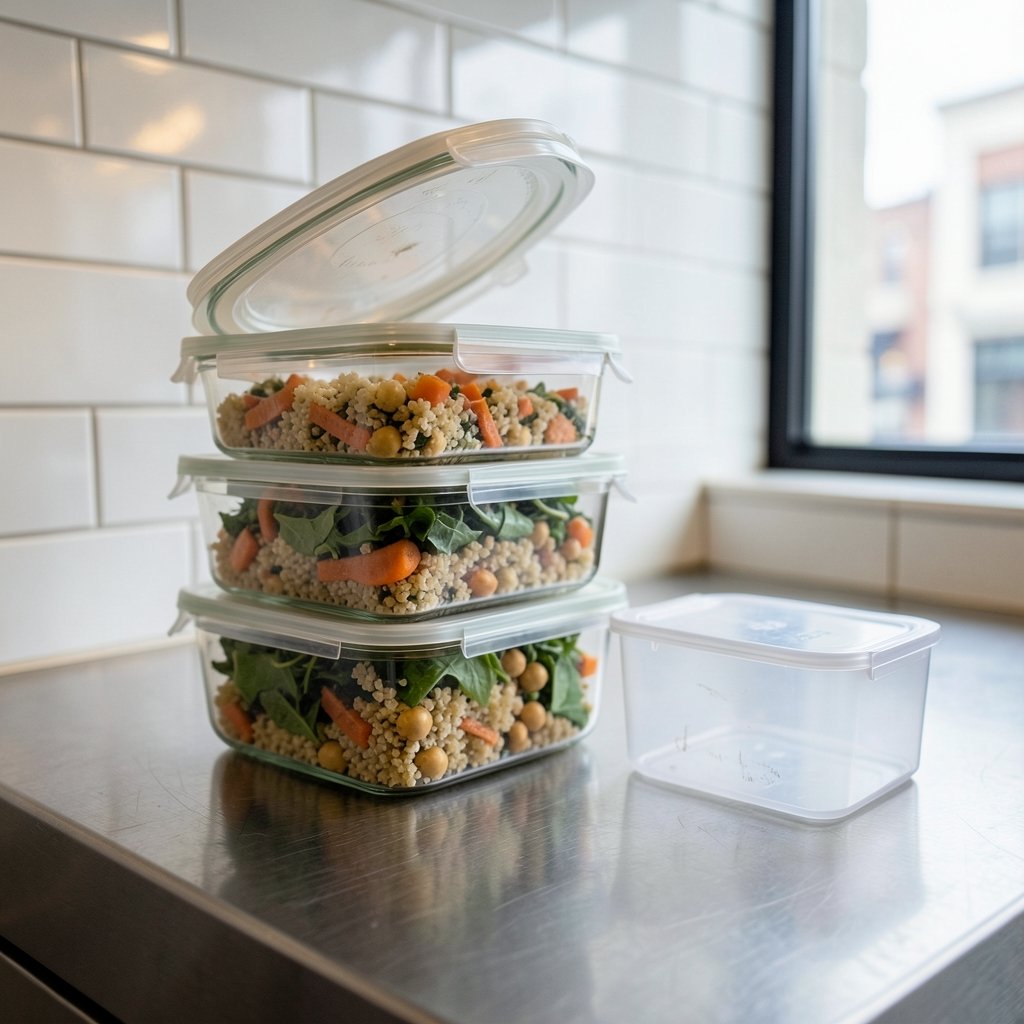
Borosilicate glass is the reference point for anyone who wants to stop thinking about chemical migration. It doesn’t absorb stains or odors, it tolerates sudden temperature changes far better than soda-lime glass, and it doesn’t carry plasticizers that can leach into fatty foods. It’s also the only common option that lets you see exactly what’s inside without opening the lid.
The trade-offs are real. Glass is heavy in a commuter bag, and dropping a full container on a tile floor is a genuinely bad moment. Lids are usually the weak point: many glass sets pair a tough base with a plastic or silicone lid that eventually cracks or loses its seal. Look for lids with a proper gasket and a locking clip rather than a friction fit.
Polypropylene (Code 5): The Practical Default
Most reusable meal prep containers are made of polypropylene, the plastic marked with a 5 inside the recycling triangle. It’s lightweight, cheap, and generally considered microwave-safe when the product is labeled that way.
That last qualifier matters. The resin identification code inside the chasing-arrows triangle was introduced in 1988 to identify resin type for recycling purposes. It says nothing about whether a specific container is safe for repeated reheating or long-term food storage. A code 5 tub from a takeout order and a code 5 container designed for meal prep are not the same product, even though the number matches. The label on the product, not the number, is what tells you how it’s meant to be used.
Stainless Steel: Durable, But Not for the Microwave
Food-grade stainless steel, typically grades like 304 (also called 18/8), is inert, nearly indestructible, and doesn’t hold onto smells. It’s the best choice for anyone who packs cold lunches, grain bowls, or salads and wants a container that will outlast several cars.
The catch is obvious: metal and microwaves don’t mix. Steel also conducts heat, so a container left in a warm car will warm its contents faster than glass or plastic would. If a lunch routine depends on reheating at a desk, steel is the wrong tool.
Silicone and Collapsible Options: Clever, With Limits
Silicone containers collapse flat, which makes them brilliant for travel and terrible for anyone who wants to stack a week’s worth of meals in a tidy grid. They’re flexible enough that a full container can buckle when lifted by one corner. They work best as a supplement, not a foundation.
A Quick Comparison of the Main Options
| Material | Microwave safe | Oven safe | Weight | Stain and odor resistance | Best for |
|---|---|---|---|---|---|
| Borosilicate glass | Yes, if labeled | Often yes, lid off | Heavy | Excellent | Home fridge, oven-to-table |
| Polypropylene (code 5) | Yes, if labeled | No | Light | Good | Daily commutes, batch cooking |
| Stainless steel (304) | No | No | Medium | Excellent | Cold lunches, travel |
| Silicone | Yes, if labeled | No | Very light | Fair | Collapsible travel, snacks |
Reading the Label Without Getting Fooled
“Microwave-Safe” and “Dishwasher-Safe” Are Claims, Not Standards
There is no single regulated definition of either term. They are manufacturer claims, and they vary in what they actually mean. A container labeled microwave-safe may be rated for reheating only, not for cooking, and may expect the lid to be removed or vented. A dishwasher-safe claim may cover the base but not a silicone gasket that degrades in high heat.
The practical move is to read the small print once, then write the rules on a sticky note inside the cabinet door. “Lid off, 2 minutes max, top rack only” is the kind of instruction that saves a set from an early death.
“BPA-Free” Is Not the Reassurance It Sounds Like
Bisphenol A has been restricted in baby bottles and sippy cups in the United States since a 2012 action, and banned in baby bottles in the European Union since 2011. Those rules were aimed at infant products, not adult meal prep containers, and they don’t mean every plastic container on the shelf is free of related compounds.
More importantly, BPA-free doesn’t guarantee that no other bisphenols, such as BPS or BPF, are present. Some manufacturers swapped one for another. For anyone who wants to stop worrying about the question entirely, glass and steel sidestep it. For everyone else, buying from brands that publish material specifications is a reasonable middle path.
“Leak-Proof” Deserves Skepticism
There’s no consumer standard for leak-proof meal prep containers. Claims are manufacturer-specific, and some brands cite internal testing that isn’t published. A container that survives a gentle tilt may still fail in a bag that gets tossed into a car footwell.
The honest test is a home one: fill it halfway with water, seal it, wrap it in a towel, and shake it for ten seconds. Then put it in a bag and carry it around for an hour. If the towel is dry, the claim holds for real life.
Features That Earn Their Keep
Four-clip locking lids beat snap-on lids for soups and sauces, because the pressure is distributed evenly around the rim. Silicone gaskets make the seal, and they’re also the first part to fail, so containers with removable, replaceable gaskets last longer.
Vented lids matter more than people expect. Steam needs somewhere to go, and a lid with a small flip vent prevents the vacuum seal that makes containers hard to open after microwaving.
Stackable, uniform footprints turn a chaotic shelf into a system. Buying one size in quantity usually beats a mixed set, because identical containers nest, stack, and share lids.
Clear bases reduce the number of times a container gets opened “just to check.” That sounds trivial until it’s the fourth time in a week.
Date panels or label-friendly surfaces support the three-to-four-day leftover rule. A strip of masking tape and a marker works fine on glass and steel; some plastics resist tape adhesive and need a dedicated label.
Matching the Container to the Routine
Someone who cooks five lunches on Sunday and reheats them at a desk has different needs than someone who assembles a cold salad each morning. The first group should prioritize microwave-safe glass or labeled polypropylene with vented lids. The second group can lean on steel and insulated options.
Portion size deserves a mention too. A container that’s too large encourages overfilling, and one that’s too small leads to second lunches. Measuring the actual volume of a favorite bowl once, then buying containers that match, removes a lot of guesswork.
There’s also a social dimension to all this. Shared meals carry meaning beyond calories, and the vessel matters when food is packed to be eaten away from home. A container that travels well and opens without a struggle makes the whole ritual feel less like an emergency and more like a small act of care. The same principle shows up in how food language and shared meals really do connect people, whether the table is a dining room or a break-room couch. (Salvadoran meals eat its served order first)
Common Mistakes That Shorten a Container’s Life
Putting lids in the bottom rack of a dishwasher is the classic error. High heat warps them, and a warped lid never seals properly again. Hand-washing lids takes thirty seconds and doubles their lifespan.
Microwaving fatty, sugary, or tomato-heavy foods in plastic without ventilation is another. These foods reach higher temperatures than water-based ones, and trapped steam plus heat stresses the material. Glass handles this far more gracefully.
Using a container past the point where the seal visibly fails is a quiet food-safety risk. Gaskets that have gone hard, cracked, or milky should be replaced or the container retired.
And storing strong-smelling foods in plastic for days at a time is a mistake that no amount of washing fully undoes. Curry, garlic, and fish tend to leave a permanent signature in polypropylene. Glass and steel don’t.
What to Look For When Buying
A short checklist, in order of importance:
- A material clearly labeled for the intended use, including microwave and dishwasher instructions.
- A lid with a replaceable gasket and at least two locking points.
- A vent, or a lid designed to be left ajar during reheating.
- A footprint that matches other containers already in the cabinet.
- A capacity that matches actual portion sizes, not aspirational ones.
- A base that’s easy to label and easy to see through.
Price correlates loosely with quality here. The mid-range glass sets with clip lids often outperform both the cheapest plastic and the most expensive designer options, because the design is boring and the parts are simple. Anyone who wants to plan a full week of meals around these containers may also find that pairing the prep system with a freezer meal service changes the calculus, since pre-portioned meals often arrive in containers designed for single use. The same logic applies to any routine built on batch cooking: the storage plan has to come before the shopping list.
Conclusion
The best meal prep containers aren’t the ones with the boldest claims. They’re the ones whose labels are honest, whose lids still seal after a year, and whose material matches how the food will actually be reheated and eaten. Glass wins on trust and visibility, polypropylene wins on weight and cost, and steel wins on durability for anyone who never needs a microwave. The resin number in the triangle tells you what a container is made of, not what it’s safe for, and “BPA-free” and “leak-proof” are marketing phrases until a home test proves otherwise.
Buy fewer containers, buy them in matching sizes, and treat the lids like the precision parts they are. A modest set that gets used every week beats a cabinet full of clever designs that never leave the shelf.
Frequently Asked Questions
Are glass meal prep containers worth the extra weight?
For most home-based routines, yes. Glass doesn’t stain, doesn’t hold odors, tolerates heat well, and doesn’t raise questions about chemical migration into fatty foods. The weight only becomes a real problem for commuters who carry lunch on public transit or in a backpack. A common compromise is glass at home and a lighter labeled plastic or steel container for days on the move.
Is it safe to microwave plastic meal prep containers?
It depends on the specific product. Polypropylene containers labeled microwave-safe are generally considered suitable for reheating, but the label is a manufacturer claim rather than a regulated standard. Remove or vent the lid, avoid reheating for long periods, and don’t microwave containers that aren’t labeled for it. Fatty and sugary foods reach higher temperatures and put more stress on plastic.
What does the number inside the recycling triangle actually mean?
It identifies the resin type for recycling purposes and was introduced in 1988 for that reason. It is not a food-safety rating and says nothing about whether a container can be safely reheated or reused. A code 5 tub from takeout and a code 5 meal prep container share a resin but not necessarily a design or a safety rating.
Does BPA-free mean a container is chemical-free?
No. BPA-free means bisphenol A wasn’t intentionally used, but some manufacturers have substituted related compounds such as BPS or BPF. BPA itself is restricted in baby bottles and sippy cups in the US and EU, but those rules target infant products. Anyone who wants to avoid the question entirely should choose glass or food-grade stainless steel.
How long can prepped meals stay in the fridge?
Cooked leftovers generally keep for three to four days when refrigerated promptly. Perishable food should go into the fridge within two hours of cooking, or within one hour if the room is above 90°F. Label containers with the date they were packed so the oldest meals get eaten first.
How can I tell if a container really is leak-proof?
Test it at home rather than trusting the box. Fill it halfway with water, seal it, wrap it in a towel, and shake it firmly for about ten seconds. Then carry it in a bag for an hour. A dry towel after both tests is a far better signal than any claim printed on the packaging.