


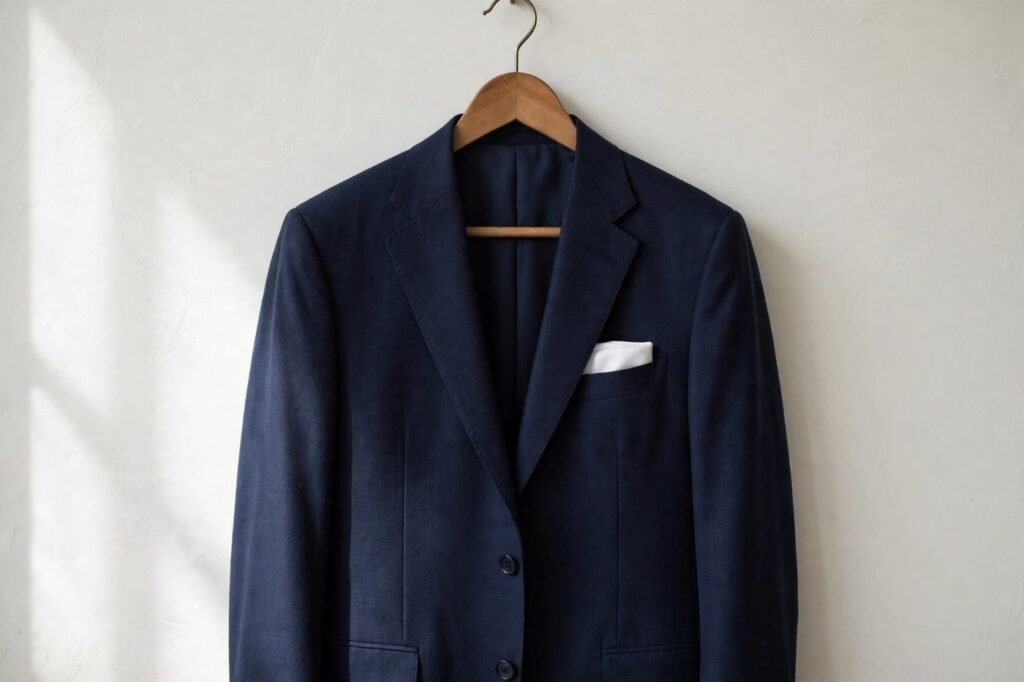
You have the suit, the shirt and the tie, and then you look in the mirror and something is missing: an empty breast pocket. Learning how to fold a pocket square is the smallest change you can make to a suit, and it is the one people notice first.
The good news is that you do not need to learn seven folds. Start with one: the presidential fold, a clean white line that takes thirty seconds and suits every formal occasion. Once you can do that without thinking, the rest are variations on the same few moves.
This guide covers the seven classic folds step by step, how to choose the right fabric and colour, which fold suits which occasion, and the mistakes to avoid.
Key takeaways:
- Start with the presidential fold: a straight white edge that takes thirty seconds and suits every formal occasion.
- Silk holds structured folds best, while linen and cotton suit relaxed, puffed shapes.
- Your pocket square should complement your tie, never match it exactly.
- Less is more: the square should sit just above the pocket, never tower over it.
What is a pocket square, and why wear one?
A pocket square is a small square of fabric, usually silk, linen or cotton, worn in the breast pocket of a suit jacket. It has no practical job beyond the decorative one, which is exactly the point: it shows you thought about the details. A well-chosen square adds colour, texture and a sense of occasion to an outfit that would otherwise look unfinished.
The pocket square is not a handkerchief, and the two should never be confused. A handkerchief belongs in a trouser pocket, while a pocket square is for display and never comes out during the day.
Size matters more than most people realise. A standard pocket square measures around 30 to 40 centimetres across, large enough to fold and tuck securely without disappearing into the pocket. Smaller squares slip down during the day, so fold them slightly wider to grip the pocket lining.
The 7 classic pocket square folds, step by step
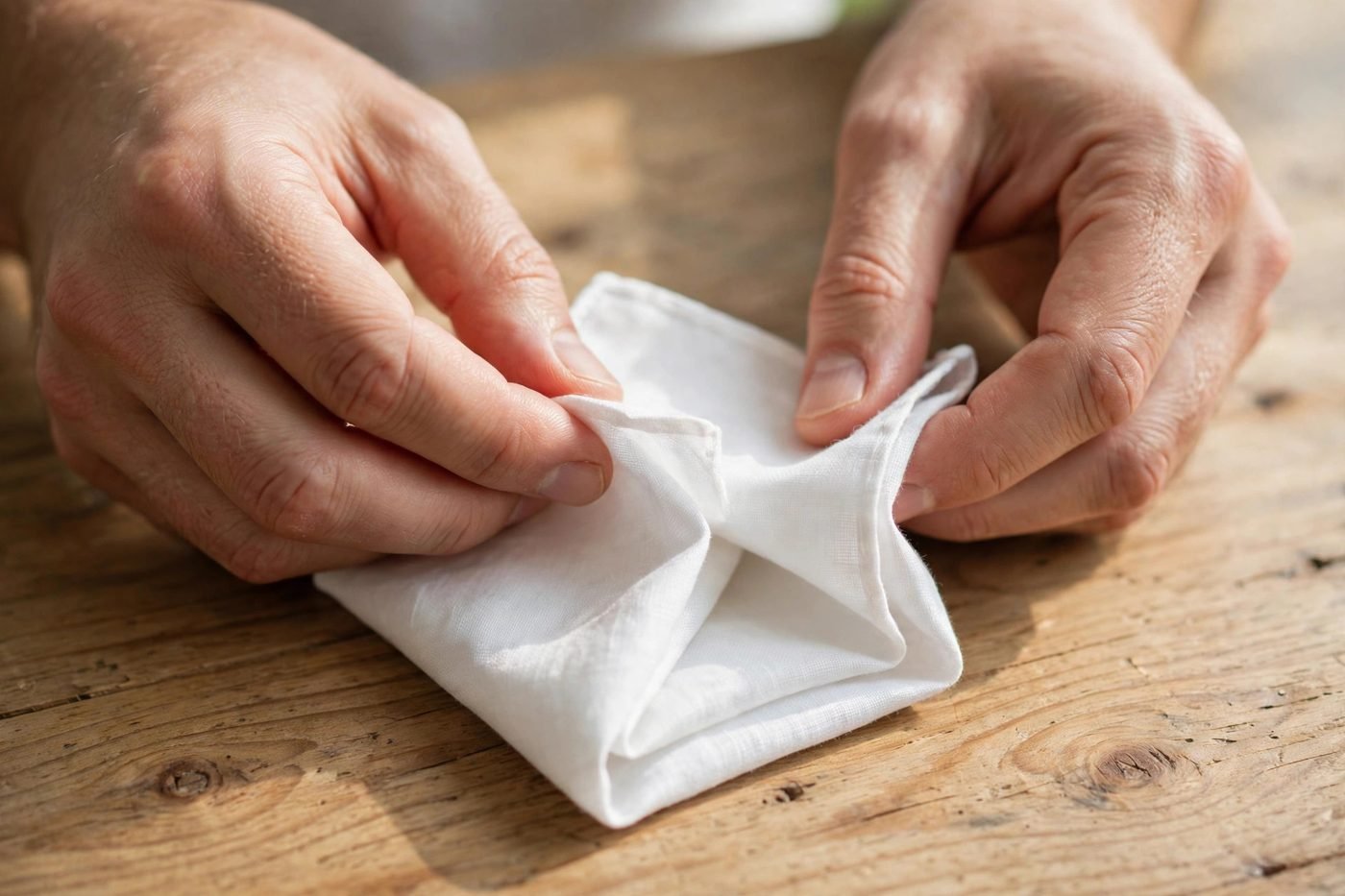
Every fold below starts the same way: work on a flat, clean surface, smooth the fabric as you go, and fold firmly so the shape holds. Take your time the first few times, and the moves will become automatic.
1. The presidential fold
The presidential fold, also called the flat fold, is the most formal and the easiest to learn. It shows a single straight edge of fabric above the pocket, like a clean white line.
- Lay the square flat and fold it in half from left to right.
- Fold it in half again the same way, so it is now a quarter of its original width.
- Fold the bottom up so the finished height is just taller than your pocket is deep.
- Slip it into the pocket with the folded edge showing about half a centimetre.
2. The one-point fold
The one-point fold shows a single neat triangle above the pocket: formal enough for business and weddings, but softer than the presidential fold.
- Lay the square flat, turned so one corner points up like a diamond.
- Fold the bottom corner up to meet the top corner, making a triangle.
- Fold the left and right corners inwards until the shape fits your pocket.
- Fold the bottom up, then tuck it in with the single point showing.
3. The two-point fold
The two-point fold shows two peaks side by side, like a small mountain range. It suits weddings and celebrations, where a little more flair is welcome.
- Lay the square flat as a diamond, with one corner pointing up.
- Fold the bottom corner up, stopping just short of the top corner, so the two points sit slightly apart.
- Fold the left and right corners inwards until the shape fits your pocket.
- Fold the bottom up and tuck it in, adjusting the two peaks until they sit evenly.
4. The puff fold
The puff is the relaxed, romantic fold, and the easiest of all once you know the trick. It suits linen and cotton squares, and it is the best choice for summer weddings.
- Pinch the centre of the square between your thumb and forefinger and lift it up.
- Let the fabric fall and gather naturally around your hand.
- With your other hand, gently gather the hanging fabric below your grip.
- Tuck the gathered end into the pocket, leaving the puffed top showing.
5. The crown fold
The crown fold, sometimes called the three-point fold, shows three peaks and is the most decorative of the classic folds. It works best with silk.
- Lay the square flat as a diamond and fold the bottom corner up to meet the top.
- Fold the left corner up and across to form a second peak beside the first.
- Fold the right corner up to form a third peak.
- Fold the side corners in, fold the bottom up, and tuck it in with all three points showing.
6. The winged puff
The winged puff combines the softness of the puff with the structure of a pointed fold, and it suits silk squares at formal evening events.
- Pinch the centre of the square and lift it, as you would for a puff.
- With your other hand, fold the two hanging points upwards and outwards, like wings.
- Hold the shape gently and tuck the base into the pocket.
- Adjust the wings so they sit symmetrically, with the puffed centre between them.
7. The Dunaway fold
The Dunaway fold is a neat, structured shape with a single diagonal point, and it suits business settings where the presidential fold feels too plain.
- Lay the square flat as a diamond and fold the bottom corner up to meet the top.
- Fold the left and right bottom corners up to meet the top point.
- Fold the left and right edges inwards until the shape fits your pocket.
- Fold the bottom up and tuck it in, with the diagonal point showing.
How do you choose the right fabric and colour?
Fabric decides which folds will work. Silk is the classic choice: it holds structured folds like the crown and the one-point crisply, and its sheen suits evening wear. Linen has a dry texture that suits relaxed folds like the puff, and it is the best choice for summer. Cotton sits in the middle, easy to fold and easy to wash, and wool adds warmth in winter.
Colour is where most people go wrong, and the rule is simple: complement, never match. Your pocket square should pick up a secondary colour from your outfit, such as the blue in a checked shirt, rather than repeating the tie’s exact colour and pattern. A matching tie and pocket square set looks like it came from the same box, because it did. White linen goes with everything.
Pattern is a matter of confidence. A plain white square is always correct, a subtle pattern adds interest, and a bold pattern is a statement. If your tie is patterned, keep the square plain, and if your tie is plain, the square can carry the pattern. Our guide to wedding ideas in 2027 has more on pulling an outfit together.
Which fold suits which occasion?
The right fold depends on the formality of the event and the fabric in your hand. A straight edge suits a boardroom, a puff suits a garden party, and anything in between suits a wedding.
| Fold | Formality | Best fabric | Best for |
|---|---|---|---|
| Presidential | Very formal | White linen or cotton | Business, black tie, funerals |
| One-point | Formal | Silk or linen | Weddings, job interviews |
| Two-point | Smart | Silk | Weddings, celebrations |
| Puff | Relaxed | Linen or cotton | Summer weddings, garden parties |
| Crown | Formal | Silk | Evening events, celebrations |
| Winged puff | Formal | Silk | Evening events, black tie |
| Dunaway | Smart | Silk or cotton | Business, smart dinners |
What are the most common pocket square mistakes?
Most pocket square mistakes are small, and all of them are easy to fix. The first is showing too much fabric: the square should sit just above the pocket, around half a centimetre for a flat fold and a little more for a puff.
The second is matching the tie exactly: a square that repeats the tie’s colour and pattern looks bought as a set, so pick up a secondary colour instead, or wear white. The third is using the wrong fabric for the fold: stiff silk will not puff, and soft linen will not hold a sharp point.
The fourth is letting the square slip. If it keeps sinking, your folds are too narrow or the square is too small: fold it a little wider so it grips the pocket, or tuck a small piece of card behind it. A good table deserves the same attention, and our guide to the best silverware sets covers the rest of the setting.
Your pocket square checklist
Run through this list before you leave the house.
- Choose the fold first: match it to the occasion, not to your mood.
- Match fabric to fold: silk for points, linen and cotton for puffs.
- Complement, never match: pick up a secondary colour from your outfit.
- Show a little, not a lot: half a centimetre for a flat fold, a little more for a puff.
- Iron the square: creases from storage will show above the pocket.
- Check the fit: the folded square should sit snugly, not rattle around.
- Carry a spare: a second square in your bag covers spills and surprises.
Frequently asked questions
Do you have to wear a pocket square with a suit?
No, but it is the easiest way to finish an outfit. For weddings and black tie it is expected; for everyday business, it is a pleasant extra.
Should your pocket square match your tie?
No. It should complement your tie by picking up a secondary colour from your outfit, not repeat the tie’s exact colour and pattern. White linen is the safe choice when you are unsure.
What size should a pocket square be?
Most pocket squares measure around 30 to 40 centimetres across, large enough to fold and tuck securely without disappearing into the pocket. Smaller squares slip down, so fold them wider to help them grip.
Can you wear a pocket square without a tie?
Yes, and it often looks better that way. A pocket square with an open-collared shirt adds colour and structure to a relaxed outfit, and a puff fold suits this look well. Choose linen or cotton rather than shiny silk for a casual setting.
How do you stop a pocket square from slipping down?
Fold it slightly wider so it grips the pocket lining, and make sure the folded height is just taller than the pocket is deep. Stiffer fabrics like linen grip better than slippery silk.
Is a pocket square the same as a handkerchief?
No. A pocket square is decorative and stays in the breast pocket all day, while a handkerchief is for practical use and belongs in a trouser pocket.
Sources
The folds in this guide follow the standard methods taught in traditional menswear guides. For a slow morning after a formal evening, our guide to the best bagel and coffee pairings is a good place to start the day.
The bottom line
A pocket square is a small detail with an outsized effect. It takes thirty seconds, costs little, and turns a suit from something you are wearing into something you have put together. Start with the presidential fold and a white linen square.
Your next step is simple: take one square, fold it flat, and put it in your jacket pocket before your next event.














