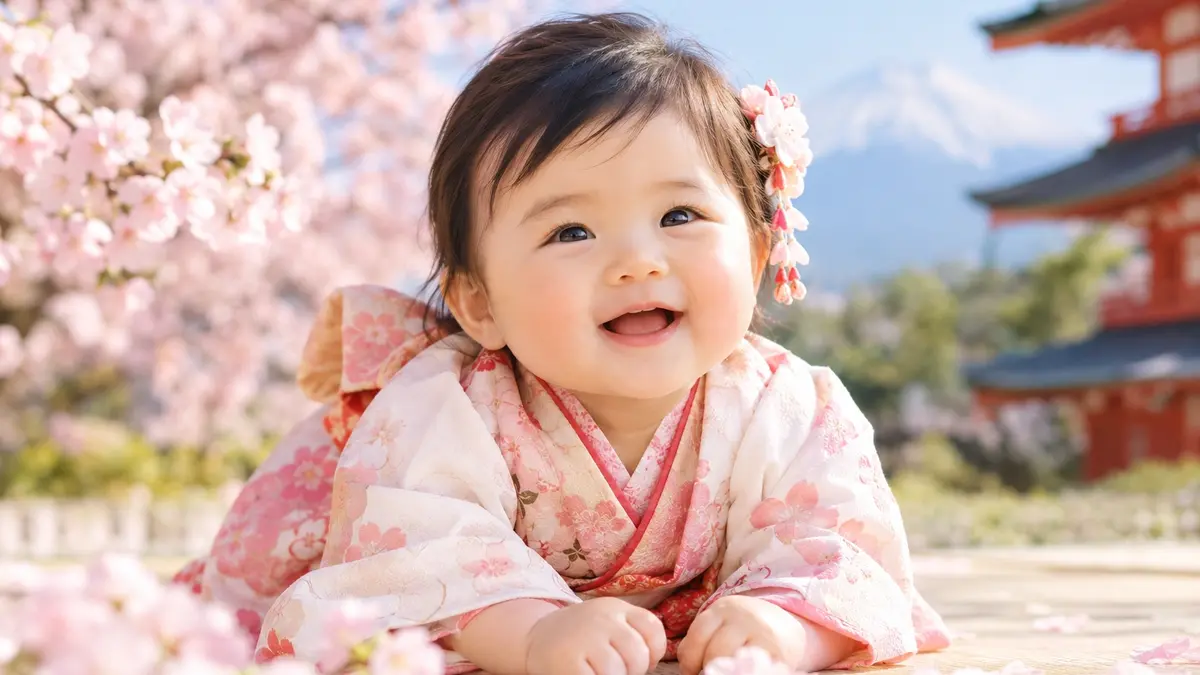
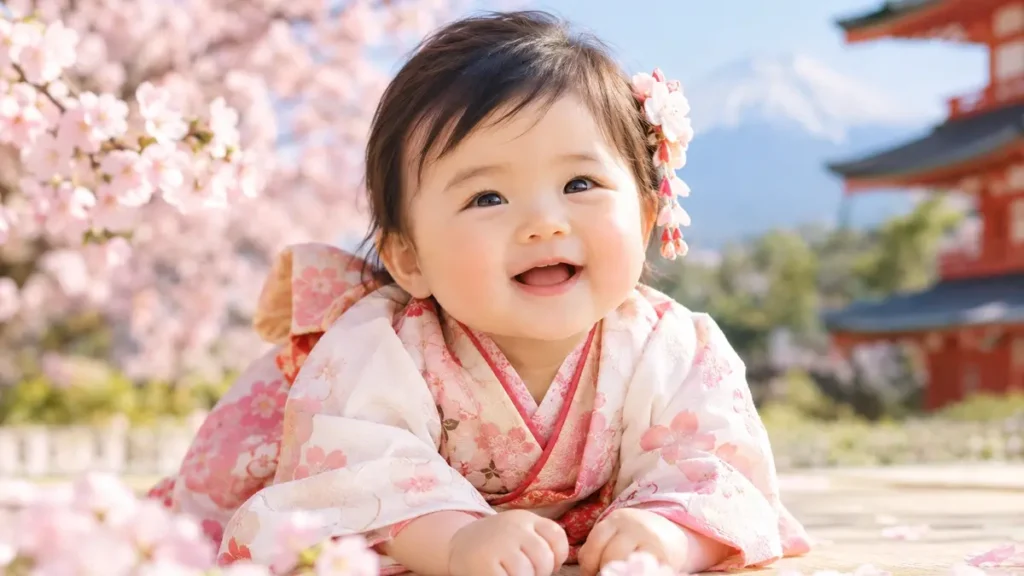
A Japanese baby name can hold a whole world of meaning in just a few characters. Some names evoke cherry blossoms in spring, others suggest strength, wisdom, or the quiet beauty of the moon. Many are inspired by nature, while others express hopes parents have for their child’s future.
One fascinating feature of Japanese names is that their meanings often depend on the kanji used to write them. The same pronunciation can have several possible meanings, depending on the characters chosen. This makes Japanese naming both expressive and deeply personal.
Whether you love traditional names or prefer something short and modern, these 45 Japanese baby names offer beautiful inspiration for boys and girls, along with their commonly associated meanings.
Japanese Baby Names for Girls

Japanese girls’ names often draw inspiration from flowers, seasons, light, and positive qualities. Their meanings can be gentle, poetic, or powerful.
1. Sakura (さくら)
Meaning: Cherry blossom.
Sakura is one of the best-known Japanese names, inspired by the cherry blossoms that appear across Japan in spring. These flowers are associated with renewal, beauty, and the fleeting nature of life.
2. Hana (はな)
Meaning: Flower, depending on the kanji.
Short and graceful, Hana is a lovely choice for parents who appreciate floral names. Depending on how it is written, it can carry other meanings, so the selected kanji matters.
3. Yui (ゆい)
Meaning: Can include connections to tying, binding, or gentleness, depending on the kanji.
Yui is a short, contemporary-sounding name used in Japan. Its simple pronunciation makes it appealing to families who want a name that travels easily between languages.
4. Aiko (あいこ)
Meaning: Often interpreted as “beloved child” when written with the kanji for love and child.
Aiko has a warm, affectionate meaning. It is a traditional Japanese name that expresses a parent’s love and hopes for their child.
5. Himari (ひまり)
Meaning: Varies according to the kanji used.
Himari is a modern Japanese girls’ name often associated with bright, sunny imagery through some kanji choices. Its popularity and interpretation depend on the characters selected.
6. Hikari (ひかり)
Meaning: Light, when written as 光.
Hikari evokes brightness, hope, and clarity. It can be used as a girls’ name and is also a Japanese word for light.
7. Akari (あかり)
Meaning: Light or brightness, depending on the kanji.
Akari has a soft, welcoming sound. It is an appealing option for parents who want a name associated with warmth and illumination.
8. Yuna (ゆな)
Meaning: Depends on the kanji; possible interpretations vary.
Yuna is a gentle-sounding name used in modern Japan. Because several kanji combinations can produce the same pronunciation, its intended meaning should be checked against the chosen spelling.
9. Rin (りん)
Meaning: Can suggest dignity, refinement, or other qualities depending on the kanji.
Rin is short, crisp, and memorable. It suits parents who prefer a simple name with a strong sound and a range of possible written meanings.
10. Mei (めい)
Meaning: May mean “bright” when written with 明; other kanji can give it different meanings.
Mei is compact and easy to pronounce in many languages. Its simple sound and bright associations make it an appealing choice internationally.
11. Nanami (ななみ)
Meaning: Depends on the kanji; can be written using characters associated with “seven” and “sea.”
Nanami has a flowing rhythm and can evoke imagery of the ocean when written with 海 for sea. Its exact meaning depends on the full combination of characters.
12. Momoka (ももか)
Meaning: Can be associated with peach blossoms or the peach, depending on the kanji.
Momoka is inspired by the soft, cheerful imagery associated with peaches and flowers in some written forms. It is a sweet option for parents drawn to nature-themed names.
13. Kaori (かおり)
Meaning: Fragrance or scent, when written as 香 or with related kanji combinations.
Kaori has an elegant, understated quality. Its association with fragrance gives it a subtle connection to flowers, gardens, and the natural world.
14. Natsuki (なつき)
Meaning: Varies by kanji; some combinations can include “summer.”
Natsuki can evoke warm weather and bright summer days when written with 夏. Other kanji combinations may convey different meanings, making the choice of characters important.
15. Koharu (こはる)
Meaning: Often associated with “little spring” when written as 小春.
Koharu evokes the gentle warmth of a mild day in late autumn or early winter in Japanese usage. Its seasonal associations make it a poetic choice.
Japanese Baby Names for Boys

Japanese boys’ names often express qualities such as courage, harmony, wisdom, or a connection to nature. Many have several possible meanings based on their kanji. If you’re exploring names for a son beyond Japanese naming traditions, browse our guide to the best baby boy names for more inspiration.
16. Haruto (はると)
Meaning: Varies according to the kanji; some combinations evoke sunlight or spring.
Haruto is a familiar modern Japanese boys’ name. It has an energetic, open sound, and its written meaning depends on the characters parents choose.
17. Ren (れん)
Meaning: Lotus, when written as 蓮.
Ren is a short and distinctive name inspired by the lotus flower. In Buddhist traditions, the lotus is associated with purity and spiritual awakening.
18. Haruki (はるき)
Meaning: Depends on the kanji; some combinations can evoke spring or brightness.
Haruki has a gentle but confident sound. It is also familiar internationally through Japanese author Haruki Murakami.
19. Sota (そうた)
Meaning: Varies with the kanji; some combinations suggest strength or a broad, expansive quality.
Sota is a modern-sounding name that feels lively and approachable. Its precise meaning depends on the written characters selected.
20. Daiki (だいき)
Meaning: Can include meanings such as “great” and “radiance” or “hope,” depending on the kanji.
Daiki has a strong, upbeat sound. It is an established Japanese boys’ name with multiple possible written interpretations.
21. Takumi (たくみ)
Meaning: Skill or craftsmanship when written as 匠.
Takumi is an appealing choice for parents who value creativity and practical ability. The kanji 匠 directly refers to an artisan or skilled craftsperson.
22. Kaito (かいと)
Meaning: Depends on the kanji; some combinations can evoke the sea and flight.
Kaito has an adventurous sound that suits parents drawn to ocean or sky imagery. The precise meaning depends on the characters used to write it.
23. Itsuki (いつき)
Meaning: Can refer to a tree when written with 樹; other kanji give other meanings.
Itsuki is a nature-inspired option when written with the character for tree. It has a calm, contemporary feel.
24. Yuto (ゆうと)
Meaning: Varies according to the kanji; possible associations include gentleness, excellence, or flight.
Yuto is a familiar Japanese boys’ name with a smooth, easy-to-pronounce sound. Its meaning can be tailored through the written characters.
25. Akira (あきら)
Meaning: Clear or bright when written as 明.
Akira is a well-established Japanese name with a confident, memorable sound. It has also become recognizable internationally through Japanese film, animation, and popular culture.
26. Hiroto (ひろと)
Meaning: Depends on the kanji; some combinations suggest breadth, greatness, or flight.
Hiroto has a balanced sound that feels both traditional and modern. The chosen kanji determine its intended meaning.
27. Riku (りく)
Meaning: Land or continent, when written as 陸.
Riku is a short, strong name connected to the land. Its straightforward pronunciation makes it easy to use in multilingual families.
28. Minato (みなと)
Meaning: Harbor or port, when written as 港.
Minato is a natural choice for parents who love the sea. The image of a harbor can suggest shelter, safe arrival, and a welcoming place.
29. Toma (とうま)
Meaning: Depends on the kanji; several combinations are possible.
Toma has a clean, modern sound and can be written in different ways. Families choosing this name should decide which kanji best expresses their intended meaning.
30. Yuki (ゆき)
Meaning: Can mean “snow” when written as 雪.
Yuki is used as a name for different genders in Japan. The snow-related meaning creates a peaceful, wintry image, although other kanji can give it different interpretations.
Japanese Baby Names Inspired by Nature

Nature has a special place in Japanese art, poetry, and everyday culture. These names draw on flowers, trees, the sky, and the seasons.
31. Aoi (あおい)
Meaning: Often associated with hollyhock or blue-green hues, depending on the kanji.
Aoi is a name used for boys and girls. Its natural associations and short pronunciation make it a versatile option.
32. Kaede (かえで)
Meaning: Maple, when written as 楓.
Kaede is inspired by the maple tree, whose leaves become vivid shades of red and gold in autumn. It is a beautiful choice for families who love trees and seasonal colors.
33. Tsubaki (つばき)
Meaning: Camellia, when written as 椿.
Tsubaki is a floral name associated with the camellia, a flowering plant valued for its striking blooms. It has a distinctive sound and a clear botanical connection.
34. Sumire (すみれ)
Meaning: Violet, when written as 菫.
Sumire is inspired by the violet flower. Its gentle sound and floral meaning make it an appealing choice for parents who prefer traditional botanical names.
35. Ayame (あやめ)
Meaning: Iris, when written as 菖蒲.
Ayame is associated with the iris, a flower with a long history in Japanese gardens and seasonal imagery. It is elegant without feeling overly complicated.
36. Hotaru (ほたる)
Meaning: Firefly, when written as 蛍.
Hotaru brings to mind tiny lights glowing on a summer evening. The name has a poetic quality and a strong connection to the natural world.
37. Sora (そら)
Meaning: Sky, when written as 空.
Sora is a popular gender-neutral option. It evokes open space, freedom, and possibility, making it appealing to parents who like short names with expansive imagery.
38. Asahi (あさひ)
Meaning: Morning sun, when written as 朝日.
Asahi is a bright, optimistic name associated with sunrise. It is used for boys and can also be found in other naming contexts.
39. Izumi (いずみ)
Meaning: Spring or fountain, when written as 泉.
Izumi evokes fresh water bubbling from the earth. It is a nature-inspired name with a calm, timeless quality.
40. Mizuki (みずき)
Meaning: Depends on the kanji; possible combinations can include characters associated with water and brightness or hope.
Mizuki is used for different genders in Japan. It can appeal to parents who enjoy water-inspired names, although the exact meaning must be checked against the chosen characters.
Short and Modern Japanese Baby Names

If you prefer a name that is easy to spell and say, these options offer a mix of simplicity, character, and cultural depth.
41. Ken (けん)
Meaning: Can mean “healthy,” “strong,” or “wise,” depending on the kanji.
Ken is short and familiar in several countries. In Japanese, its exact meaning depends on the written characters, so it is worth selecting the kanji intentionally.
42. Rei (れい)
Meaning: May mean “beautiful,” “courteous,” “spirit,” or other things depending on the kanji.
Rei is a concise name used for different genders. Its minimalist sound makes it easy to pronounce, while its written forms allow for different interpretations.
43. Jun (じゅん)
Meaning: Can suggest purity, obedience, or a sincere quality depending on the kanji.
Jun is a traditional short name used in Japan. It is also recognized internationally, making it a practical choice for multilingual families.
44. Nao (なお)
Meaning: Depends on the kanji; possible meanings include honesty or straightforwardness.
Nao is a compact name used for boys and girls. Its simplicity is appealing, but its meaning should be confirmed through the intended kanji.
45. Makoto (まこと)
Meaning: Sincerity or truth, when written as 誠.
Makoto is a traditional Japanese name used for different genders. It expresses a positive quality and has a thoughtful, enduring feel.
How to Choose the Right Japanese Baby Name

Choosing a Japanese name involves more than finding a pronunciation you like. The writing, meaning, and cultural context can all influence how the name is understood.
- Choose the meaning first. Decide whether you want a name connected to nature, light, strength, wisdom, or another quality.
- Check the kanji carefully. The same pronunciation can be written with different characters, producing different meanings.
- Consider pronunciation. Say the name aloud with your family name and think about how people in your community may pronounce it.
- Understand the cultural context. Look into whether a name is traditionally masculine, feminine, or used for different genders in Japan.
- Check official naming rules. If you plan to register the name in Japan, verify the current rules for permitted name characters and readings.
- Ask a fluent speaker when needed. A Japanese speaker can help you check natural usage, pronunciation, and the impression a particular kanji combination may create.
Japanese names can have beautiful meanings, but a meaning attached to one spelling should not automatically be applied to every version of the same pronunciation.
Frequently Asked Questions
What are the most beautiful Japanese baby names?
Sakura, Hana, Aiko, Hikari, Ren, Haruto, Akira, and Sora are appealing choices. Each offers a distinctive sound, and many have associations with nature or positive qualities.
What Japanese names mean light?
Hikari means “light” when written as 光, while Akari is associated with brightness in some kanji combinations. Akira can mean “clear” or “bright” when written as 明.
What Japanese baby names are inspired by nature?
Sakura means cherry blossom, Kaede means maple, Sumire means violet, Hotaru means firefly, Sora means sky, and Izumi means spring or fountain when written with the corresponding kanji.
Are Japanese baby names gender-neutral?
Some names, including Sora, Yuki, Aoi, Rei, Jun, Nao, and Makoto, are used for different genders. Usage can vary by generation, region, and the kanji selected.
Why can one Japanese name have several meanings?
Japanese names may use different kanji characters to represent the same pronunciation. Each character has its own meaning and reading possibilities, so the full written name determines the intended interpretation.
Final Thoughts
Japanese baby names offer a rich combination of sound, imagery, and meaning. From Sakura’s cherry blossoms to Ren’s lotus flower and Asahi’s morning sun, many names create a connection to the natural world. Others, such as Makoto and Aiko, express sincerity and affection.
If you’re exploring names from other cultures, these Irish baby names offer another collection of meaningful choices with their own cultural history and traditions. As you narrow down your list, choose the pronunciation you love, explore the kanji that express your hopes, and confirm the name’s meaning with a reliable Japanese-language source.
The most meaningful name is one that feels right for your family and carries a story you will be happy to share as your child grows.
Disclaimer: This article is intended for informational purposes only.