The best juicer machine in 2027 is the one that matches how you actually juice at home. This guide covers the best juicer choices for home use, from fast centrifugal machines to slow cold-press models, and it ranks ten types so you can choose with confidence.
So which type should you buy? If you want a quick glass of juice on a busy morning, a centrifugal juicer is the natural choice. If you juice leafy greens, wheatgrass or soft fruit, and you value a smoother, slower extraction, a cold-press juicer will serve you better. If you mainly juice oranges and lemons, a citrus press may be all you need.
Key takeaways:
- There is no single best juicer machine: the right type depends on what you juice, how often, and how much time you want to spend cleaning up.
- Centrifugal juicers are fast and easy for hard fruit and vegetables; cold-press juicers are slower and better for leafy greens and soft fruit.
- Citrus presses are the simplest choice if you mainly juice oranges, lemons and grapefruit.
- Cleaning matters as much as juicing: a machine you dread washing will sit unused, however good its juice tastes.
How juicers work: centrifugal vs cold-press
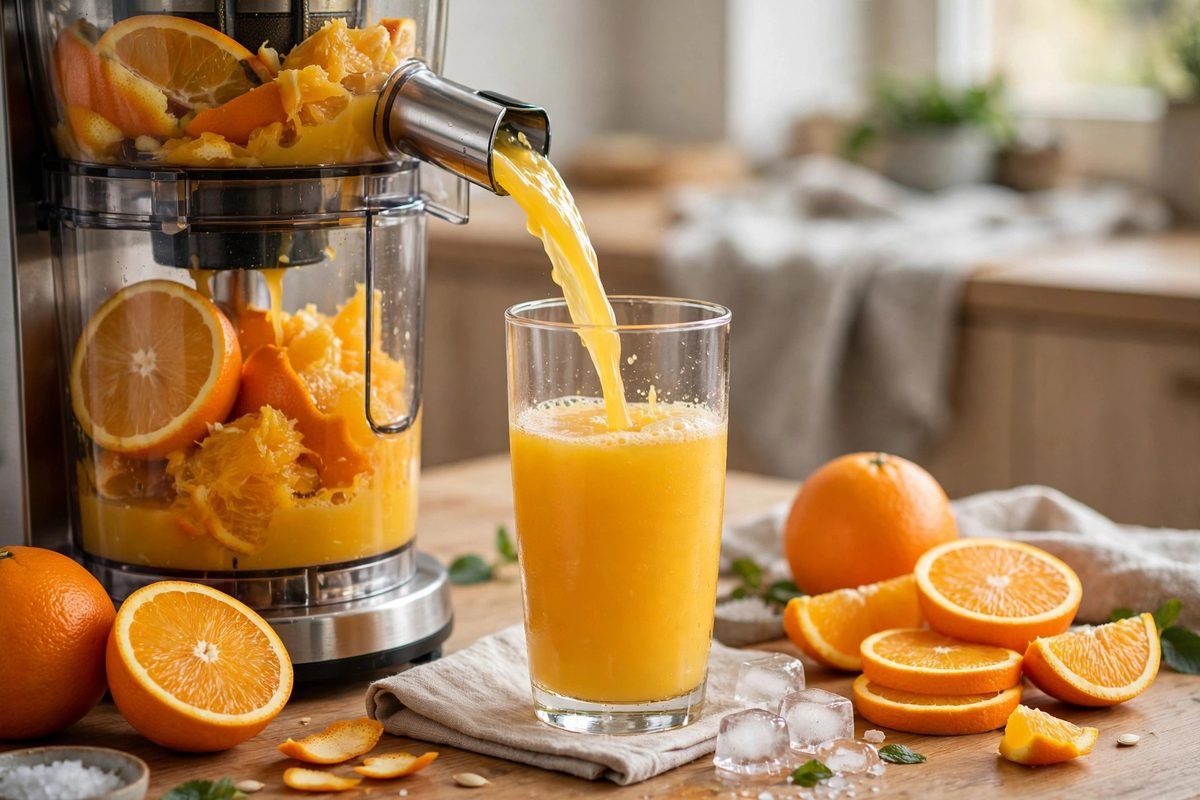
Almost every juicer falls into one of two families, and understanding the difference makes the whole choice easier. A centrifugal juicer spins produce at high speed against a fine grating disc, flinging the juice out through a strainer while the pulp is collected separately. It is fast, loud and straightforward, and it handles apples, carrots and other hard produce with ease.
A cold-press juicer, also called a masticating or slow juicer, works in the opposite way. It crushes and presses produce slowly with an auger, squeezing the juice out rather than spinning it out. The process takes longer, but it is quieter, and it is kinder to leafy greens, herbs and soft fruit that a centrifugal machine can struggle with.
1. Centrifugal juicer — the fast everyday choice
Best for: quick morning juice from apples, carrots and other hard produce.
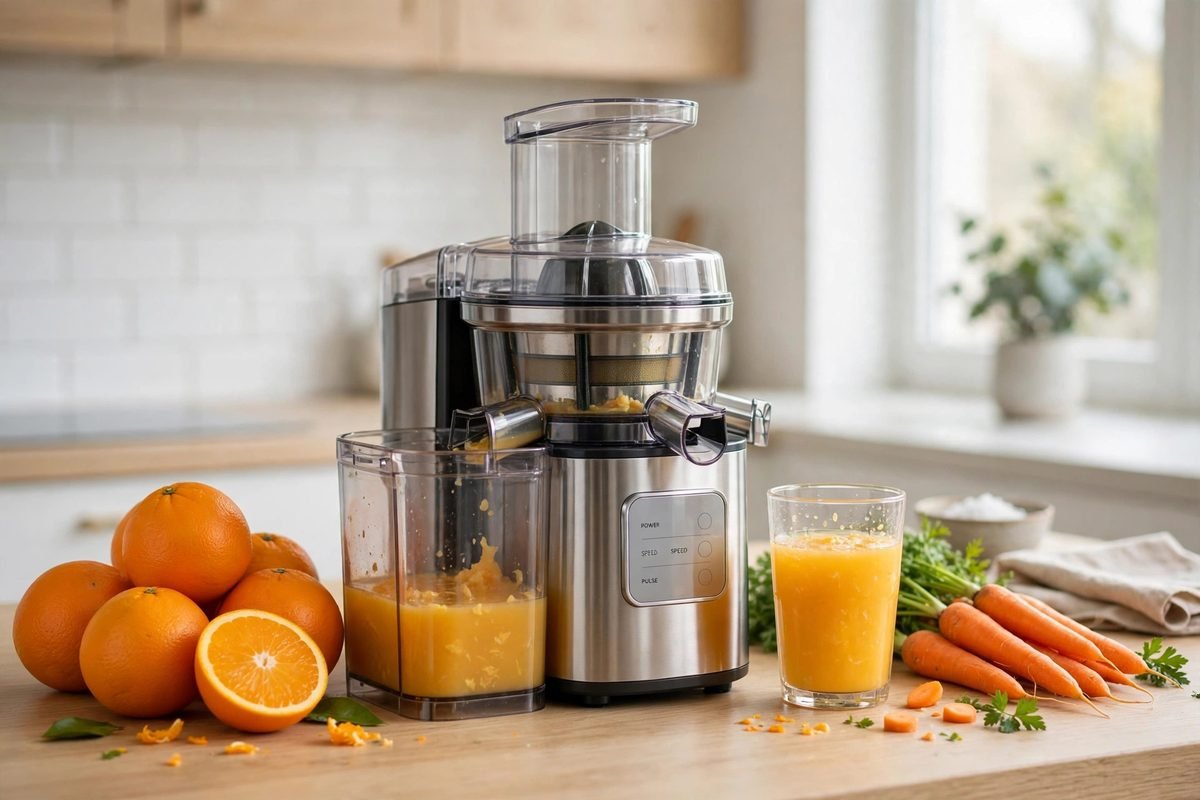
A centrifugal juicer is the most familiar type of juicer, and for many households it is the right one. You feed produce into the top, the machine spins it fast, and juice appears in seconds. It is the closest thing juicing has to a plug-in-and-go appliance.
2. Vertical cold-press juicer — the versatile slow juicer
Best for: a mix of fruit, vegetables and leafy greens, with quieter operation.
A vertical cold-press juicer stands upright on the counter, with produce fed in from the top and pressed slowly by an auger. It is the most common cold-press design in home kitchens, and it balances versatility with a footprint that fits most counters.
3. Horizontal masticating juicer — the leafy-green specialist
Best for: leafy greens, herbs and wheatgrass, and for cooks who also want to make nut butters or pasta.
A horizontal masticating juicer lies flat, with a long auger that crushes produce along a horizontal chamber. It is the most deliberate of the juicer types, and it is the one serious green-juice fans usually choose.
4. Twin-gear juicer — the thorough press
Best for: the most thorough extraction from greens and hard vegetables.
A twin-gear juicer, also called a triturating juicer, uses two interlocking gears to crush produce between them. It is the most thorough of the cold-press designs, pressing produce in two stages rather than one.
The result is a very dry pulp and a high yield of juice, especially from leafy greens and fibrous vegetables. For people who juice a lot of greens, or who want to get the most from expensive produce, that efficiency is the point. It is also the most involved type to use and clean, with more parts and a slower feed.
5. Electric citrus press — the simplest juicer of all
Best for: oranges, lemons, limes and grapefruit, with almost no cleaning.
An electric citrus press is the simplest juicer you can buy. You halve a citrus fruit, press it onto a spinning cone, and juice flows into a jug below. There is no feeding tube, no pulp container to empty, and almost nothing to wash.
6. Manual citrus press — the quiet, power-free option
Best for: a single glass of citrus juice, a small kitchen, or a home without counter space to spare.
A manual citrus press works by hand, usually with a lever that presses a halved fruit against a cone or a plate. It needs no electricity, makes no noise, and stores in a drawer.
7. Wide-feed centrifugal juicer — less chopping, faster mornings
Best for: busy mornings, when you want to feed whole fruit with less preparation.
A wide-feed centrifugal juicer is a variation on the standard centrifugal design, with a larger feeding tube that accepts bigger pieces of produce. The idea is simple: less chopping before you start, and a faster path from fruit bowl to glass.
8. Compact personal juicer — the small-kitchen pick
Best for: a single person, a small kitchen, or a first juicer.
A compact personal juicer is a smaller, lighter machine designed for one or two glasses at a time. It takes up less counter space, is easier to store, and is often simpler to clean than a full-size model.
9. Juicer with pulp control — the texture choice
Best for: households where one person likes clear juice and another likes a little texture.
Some juicers offer pulp control, letting you choose how much pulp reaches the glass. It sounds like a small feature, but it matters more than most people expect, because juice texture divides households sharply.
A clear, smooth juice suits a light breakfast drink, while a juice with a little pulp feels more substantial and closer to eating the fruit itself. A machine that lets you adjust this avoids the argument entirely, and it lets the same juicer serve different tastes.
10. Juicer-blender combination — the two-in-one kitchen tool
Best for: a kitchen that wants both fresh juice and smoothies from one appliance.
A juicer-blender combination pairs a juicing attachment with a blending jug, so one base serves two purposes. It is a practical choice for a kitchen that is short on space, or for a household that cannot decide between juice and smoothies.
The advantage is flexibility. You can make a clear juice one morning and a thick smoothie the next, using the same motor and the same counter space. The compromise is that a combination rarely matches a dedicated machine at either job. Our guide to the best espresso machine covers another counter-top choice where space and habit should drive the decision, and our guide to the best bread machine covers matching an appliance to your household.
The ten types at a glance
| Type | Best for | Strengths | Watch out for |
|---|---|---|---|
| Centrifugal juicer | Quick morning juice | Fast and easy to use | Less good with leafy greens |
| Vertical cold-press | Mixed fruit and greens | Versatile and quiet | Slower feeding |
| Horizontal masticating | Leafy greens and herbs | Excellent with greens | Takes up more space |
| Twin-gear juicer | Thorough green juicing | Very high extraction | More parts to clean |
| Electric citrus press | Oranges and lemons | Simple and easy to clean | Citrus only |
| Manual citrus press | A single glass | Quiet and power-free | Slow for large batches |
| Wide-feed centrifugal | Busy mornings | Less chopping | Still best with hard produce |
| Compact personal juicer | One or two glasses | Small and easy to store | Limited capacity |
| Juicer with pulp control | Mixed texture tastes | Adjustable texture | Check it is easy to clean |
| Juicer-blender combination | Juice and smoothies | Two tools in one | Compromise on each job |
How to choose: a practical checklist
- List what you will juice most: hard fruit and vegetables point to centrifugal; leafy greens point to cold-press; citrus alone points to a press.
- Be honest about time: if you have five minutes in the morning, choose a fast machine; if you juice at weekends, a slower machine is fine.
- Check the cleaning: count the parts, look at how they come apart, and ask yourself whether you will wash them every time.
- Measure your counter: a juicer that does not fit where you will use it will live in a cupboard, unused.
- Consider capacity: a compact machine suits one person; a larger machine suits a family batch.
Frequently asked questions
What is the best juicer for home use?
The best juicer for home use is the type that matches your habits, and this guide covers the best juicer choices for home use across all ten types. For quick juice from hard produce, a centrifugal juicer is the practical pick. For leafy greens and a wider range, a vertical cold-press juicer is usually the better choice.
Is a cold-press juicer better than a centrifugal juicer?
It depends on what you juice. A cold-press juicer is better for leafy greens, herbs and soft fruit, and it is quieter. A centrifugal juicer is faster and simpler for hard fruit and vegetables. Neither is better for everything, so the right choice is the one that suits your produce and your mornings.
Do I need a juicer if I already have a blender?
Not necessarily. A blender keeps the whole fruit, including fibre, and makes a thicker drink. A juicer removes the pulp and makes a clear, light juice. Many households enjoy both, and a juicer-blender combination is one way to have both without two full appliances. Our guide to the best blender covers a different way to use fruit at breakfast, if you prefer a thicker drink.
How do I clean a juicer?
Rinse the parts straight after use, before pulp dries on them. Most juicers come apart into a few pieces that wash in warm soapy water, and a small brush helps with the strainer. A machine that is easy to take apart is a machine you will actually clean, so check this before you buy.
Can I juice leafy greens in a centrifugal juicer?
You can, but the yield is often low. Leafy greens tend to pass through a centrifugal machine without giving up much juice. For regular green juice, a vertical cold-press, horizontal masticating or twin-gear juicer will give you a much better result.
How long does fresh juice last?
Fresh juice tastes best drunk straight away. If you need to store it, keep it in a sealed container in the fridge and drink it the same day. Cold-press juice often keeps its flavour a little longer than centrifugal juice, but neither is at its best the next day.
Sources
Juicer types and working principles in this guide reflect general manufacturer and kitchen-guide descriptions of centrifugal, masticating, twin-gear and citrus juicers. No brand or model is named here.
The bottom line
The best juicer machine in 2027 is not the most expensive type, or the one with the longest list of features. It is the type you will use three or four times a week, without dreading the cleaning, and that turns the produce you actually buy into juice you actually enjoy.
Your next step is simple: write down what you will juice most, how much time you have in the morning, and how much counter space you can spare. Match those three answers to the table above, and you will have your type. Then choose a machine in that type, and start with a simple glass of orange or apple juice.
Food-safety note: wash all produce well before juicing, and drink fresh juice promptly. Juice made at home has no preservatives, so it is best enjoyed the same day it is made.