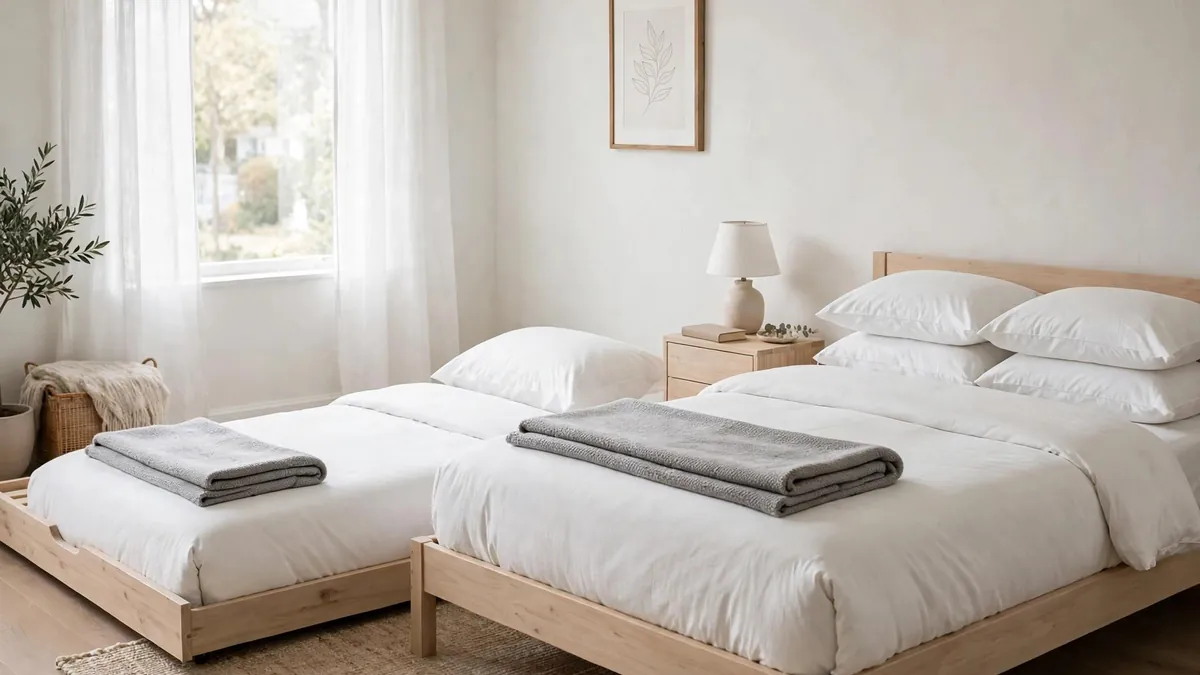

A trundle bed is the spare bed that hides in plain sight: a low bed on wheels that slides underneath a standard bed, ready to be pulled out when an extra person needs somewhere to sleep.
So what is a trundle bed, and is it the right answer for your home? It is one of the simplest space-saving ideas in furniture: two beds in the footprint of one, with no folding or inflating each time a guest arrives.
This guide covers how trundle beds work, the main types, sizes and materials, where they work best, and what to check before buying.
Key takeaways:
- A trundle bed is a low, wheeled bed that stores underneath a standard bed.
- Pop-up trundles rise to the main bed’s height; standard trundles stay low, near the floor.
- The trundle mattress must be thinner than a normal one, usually around 15 cm or less.
- Measure your room and the space under the main bed before buying, and test the pull-out mechanism if you can.
What Is a Trundle Bed?
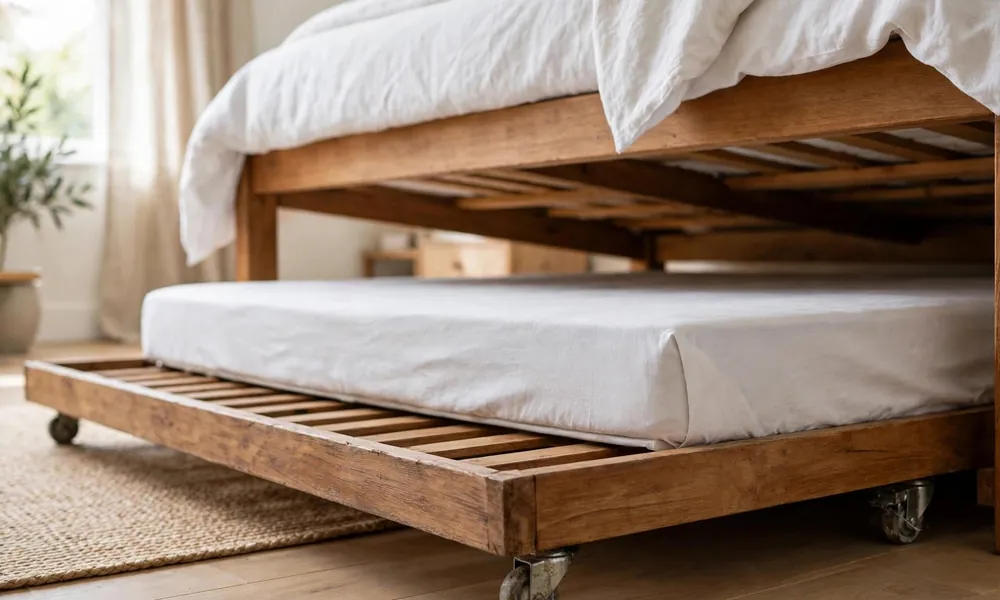
A trundle bed is a second bed that lives underneath a first one. The main bed sits at normal height with enough clearance beneath it, and the trundle — a low frame on small wheels, with its own thin mattress — rolls out on demand and slides back when it is not needed.
What makes a trundle different is that it needs no storage space of its own. A folding bed needs a cupboard and an air mattress needs a shelf; a trundle needs only the empty space under a bed you already own.
A trundle is not a replacement for a proper bed. The low position and thin mattress suit children, teenagers and occasional guests better than nightly adult use, but used as intended it is one of the most practical pieces of furniture a small home can own.
Types of Trundle Bed
There are four main types.
Standard pull-out trundle: the simplest type. The lower bed rolls out on castors and stays low, close to the floor. It is the cheapest and most reliable design and suits children well, though adults may find the low height awkward.
Pop-up trundle: the most versatile type. Once pulled out, the lower bed rises on a spring or scissor mechanism to the same height as the main bed, so the two can sit side by side as a double or as two matching singles. They cost more and have more moving parts, but they are the most comfortable option for adult guests.
Drawer trundle: the lower bed sits inside a drawer-style frame, sometimes with storage drawers built in. It looks tidier when closed, but the mechanism must be well made or it can stick, so check that it runs smoothly and locks open.
Bunk bed trundle: a trundle fitted underneath the lower bunk of a bunk bed, giving three sleeping places in the footprint of one. It suits children’s rooms and holiday homes, and the same rules apply: the mattress must be thin, and the pull-out easy enough for a child to manage with help.
| Type | How it works | Sleeping height | Best for |
|---|---|---|---|
| Standard pull-out | Rolls out on castors, stays low | Low, near the floor | Children, occasional guests |
| Pop-up | Rises to match the main bed | Same as the main bed | Adult guests, two beds as a double |
| Drawer | Slides out in a drawer-style frame | Low, near the floor | Tidy looks, extra storage |
| Bunk bed trundle | Fits under the lower bunk | Low, near the floor | Children’s rooms, holiday homes |
Choosing the Right Size and Mattress
Most trundles are built around a single bed, so the mattress is usually the same size as the main bed’s, though some designs use a slightly narrower trundle to fit inside the frame. Always check the exact size.
The mattress is where trundles differ most: it must be thin enough to slide under the main bed with the bedding on, usually around 15 cm or less, since a standard mattress of 20 cm or more will not fit. Measure the clearance first, and leave room for a sheet and a light blanket.
A thinner mattress need not mean an uncomfortable night: a good foam or sprung mattress of 13 to 15 cm can be perfectly comfortable for a child or an occasional adult guest. What matters is the quality of the fill and support, not thickness alone.
Bedding needs a little thought too: a trundle made up with a thick duvet will not slide back underneath, so keep it light — a fitted sheet and a light blanket, or a thin duvet that folds away. For softer bedding, our guide to how to wash a wool blanket covers keeping blankets fresh between guests.
Materials: Wood, Metal and Upholstered Frames
Trundles come in three main materials, and the right choice depends on the room, the budget and how hard the bed will be used. Whatever the material, look for solid joints and smooth-rolling castors.
Solid wood: the most popular choice for a main bedroom or guest room: wooden frames look warm and substantial, suit traditional and modern rooms, and last well. Pine is lighter and more affordable, while hardwoods such as oak are heavier and more durable.
Metal: usually steel with a painted or powder-coated finish: lighter, slimmer and often cheaper than wood, suiting a modern room or a child’s bedroom. Cheaper ones can squeak if the joints loosen, so check the fixings and tighten them now and then.
Upholstered: frames covered in fabric, often with a padded headboard: soft and inviting, suiting a guest room or a teenager’s bedroom. The fabric needs more care than wood or metal and shows marks easily, so choose a hard-wearing fabric in a forgiving colour.
Where a Trundle Bed Works Best
A trundle earns its place in rooms that do more than one job: a child’s bedroom, where it gives a friend somewhere to sleep and disappears in the morning, or a guest room that doubles as a study.
Small flats and holiday homes are another good setting: a trundle lets a one-bedroom flat sleep three, or a holiday cottage sleep an extra guest. If you let your home to visitors, our guide to pet-friendly vacation rentals has ideas for making a small space welcoming.
A trundle is a poor fit where thick carpet makes the castors drag, or where there is little floor space in front of the bed. Measure the floor area as well as the bed: you need the full length of the trundle, plus room to walk around it.
What to Check Before Buying
Start with measurements: the space under the main bed and the clear floor area in front of it, then the trundle itself, including its mattress. One that fits only just will catch on the frame every time it is pulled out.
Test the mechanism: pull the trundle out and push it back several times. It should roll smoothly and straight, without catching or wobbling, and stay put when open. For a pop-up, raise and lower it and check that it holds its height firmly.
Check the weight limit and the slats: the frame should state a maximum user weight, and the slats should be close together and properly supported, since wide gaps make a thin mattress sag.
Think about who will use it. For young children, a standard pull-out is usually enough, and safety matters more than height: no sharp edges, no gaps where small fingers can catch, and locking castors. For adults, a pop-up is usually worth the extra cost for the comfort of a normal sleeping height.
Looking After a Trundle Bed
A trundle needs little care, but regular attention keeps it rolling smoothly and sleeping well: keep the mechanism clean, the mattress fresh and the frame tight.
Vacuum under the main bed regularly: dust and small objects gather there and are the most common reason a trundle starts to stick. Wipe the castors now and then and check that they turn freely; a drop of light oil usually fixes a stiff one, but replace any castor that is cracked or wobbling.
Air the mattress whenever the bed is pulled out: one stored under a bed can smell musty if the room is damp, so pull it out on a dry day now and then. Turn it every few months so it wears evenly, and add a washable protector to make spills easier to clean. For marks on the floor, our guide to how to remove stains from carpet covers the most common fixes.
Check the fixings twice a year: bolts and screws loosen over time on a bed that moves, so tighten them gently and check the joints for wear. A small wobble caught early is a quick fix; left alone, it can become a cracked joint.
Your Trundle Bed Checklist
- Measure first: the space under the main bed, the floor in front of it, and the trundle.
- Pick the right type: standard pull-out for children, pop-up for adult guests, drawer for a tidy look.
- Check the mattress: thin enough to fit, around 15 cm or less, and good quality.
- Test the mechanism: smooth rolling, no catching, and a pop-up that holds its height.
- Check the base: close-spaced slats or a solid base, and a weight limit that suits the user.
- Keep bedding light: a fitted sheet and a light blanket, so the bed slides back made up.
- Think about safety: no sharp edges, locking castors, no gaps for small fingers.
- Plan the care: vacuum under the bed, air the mattress, tighten the fixings twice a year.
Frequently Asked Questions
Can an adult sleep on a trundle bed?
Yes, for occasional use: a standard single trundle fits most adults, and a good thin mattress is comfortable for a night or two. For regular adult use, a pop-up is better, rising to normal bed height.
How thick can a trundle mattress be?
Usually around 15 cm or less, depending on the clearance under the main bed. Measure the gap from the floor to the underside of the frame, allowing room for the sheet and blanket: too thick, and the trundle will not slide back underneath.
Can I put a trundle under any bed?
No. The main bed needs enough clearance underneath, and the frame must leave the space open on at least one side. Many beds are sold with a matching trundle, the safest option; a divan or a bed with a solid base usually cannot take one.
Is a trundle bed good for everyday use?
It is best as an occasional bed. The low height and thin mattress suit children and guests, but most adults would find a standard trundle uncomfortable night after night. A pop-up at full height is the exception and can work well as a daily bed.
The Bottom Line
A trundle bed is a quiet solution to a common problem: how to sleep an extra person without giving up a room to a bed that is rarely used. It hides away when not needed, pulls out in seconds when it is, and asks for little beyond a thin mattress and a clear floor.
Your next step is simple: measure the space under the bed and the floor in front of it, then decide who will sleep on the trundle most often. Children and occasional guests will be happy with a standard pull-out, while adult guests deserve a pop-up.