


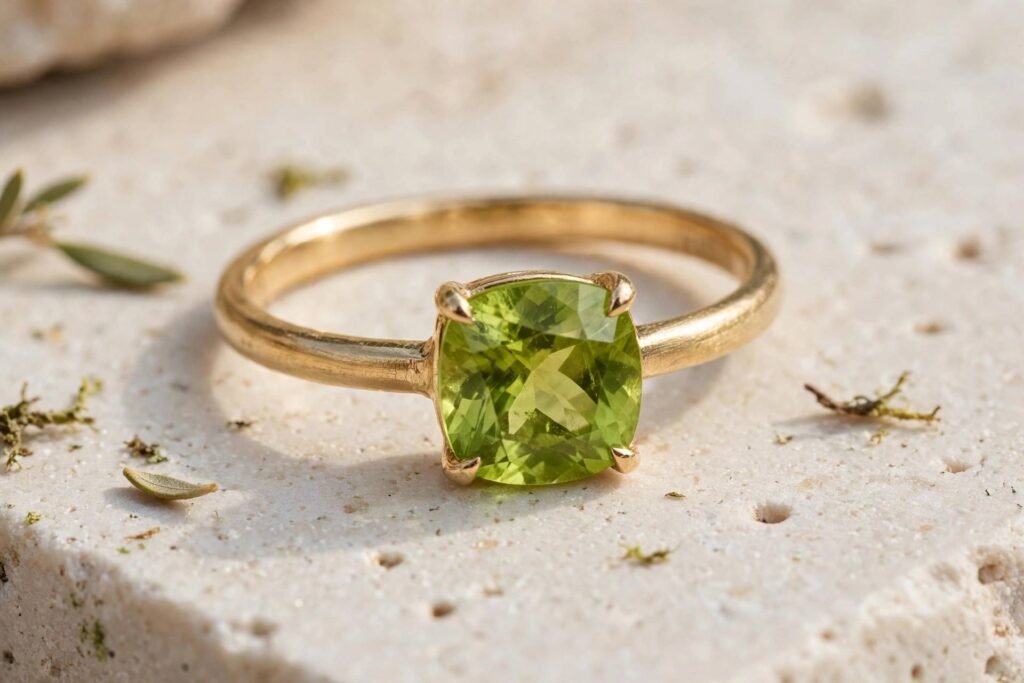
An August birthday is coming, and you want a gift that means something. A bunch of flowers fades in a week, and a voucher says nothing at all. That is why so many people turn to the August birthstone, a small green gem with a history that stretches back more than 4,000 years.
So what is the August birthstone? Peridot, a yellowish green gemstone that the ancient Egyptians called the gem of the sun. Two other stones share the month, spinel and sardonyx, but peridot is the stone most jewellers will offer first, and the one most birthstone charts show.
This guide covers all three August birthstones, the history and meaning of peridot, how to judge its quality, how to buy it well, and how to care for it once it is yours. By the end, you will know exactly what to look for, and what to avoid.
Key takeaways:
- Peridot is the primary modern August birthstone, a yellowish green variety of the mineral olivine.
- August has three official birthstones: peridot, spinel (added in 2016) and sardonyx, the original stone.
- The finest peridot is a pure grass green with little or no brownish tint, and it rates 6.5 to 7 on the Mohs hardness scale.
- Peridot is also the gem given to celebrate a 16th wedding anniversary.
What is the August birthstone?
August is one of only three months on the modern birthstone list with more than one official stone, alongside June and December. The three August birthstones are peridot, spinel and sardonyx, as listed by the Gemological Institute of America (GIA). Peridot is the primary stone, the one most people mean when they say the August birthstone.
Peridot is the gem-quality variety of the mineral olivine, and its colour comes from iron in its chemical structure. It is one of only a few gemstones formed deep within the Earth’s mantle rather than near the surface, and some peridot has even arrived on Earth inside meteorites. The ancient Egyptians mined it on the Red Sea island of Zabargad, the oldest recorded source, where mining may have begun around 340 to 279 BCE.
Spinel joined the official list in 2016, when the American Gem Trade Association and Jewelers of America added it alongside peridot and sardonyx. Sardonyx is the original August birthstone, with a history stretching back more than 4,000 years, and it remains the traditional choice for anyone who prefers a stone with the longest story.
What is the history of peridot?
Peridot has been valued for more than two thousand years, and its history is full of mistaken identity. The word peridot comes from the Arabic faridat, meaning gem. The Egyptians called it the gem of the sun, believing it was brought to Earth from an exploding sun, and they mined it at night on the theory that the stone absorbed sunlight by day and released it after dark.
Throughout history, peridot has often been confused with other green gems, especially topaz and emerald. The Red Sea island of Topazios, a purported source of the name topaz, actually produced peridot. The Shrine of the Three Holy Kings in Cologne Cathedral is decorated with 200 carats of gems that were believed to be emeralds but are, in fact, peridot.
Peridot appeared in priests’ jewellery as early as the second century BCE, and later in the chalices and churches of medieval Europe. For centuries it was also worn as a protective talisman against evil spirits and the terrors of the night. Today it is the gem given to celebrate a 16th wedding anniversary.
What does peridot look like?
Peridot is one of the few gemstones whose identity is inseparable from a single colour: green. Its colour ranges from yellowish green to greenish yellow, and the finest stones are a richly saturated pure grass green with little or no brownish tint, according to GIA. Brownish tints can lower the value, so a clean, vivid green is what to look for.
Unlike many gems, peridot is rarely treated to improve its colour. Larger stones tend to show a deeper green, because the colour builds with size, while very small stones can look pale.
Peridot rates 6.5 to 7 on the Mohs hardness scale, which makes it softer than sapphire, ruby and diamond. That matters for everyday wear, and it is the reason GIA notes that peridot is not recommended for daily use in a ring. It is better suited to necklaces, earrings and brooches, or to rings worn on special occasions rather than every day.
Where does peridot come from?
Most of the peridot in jewellery today comes from China, Myanmar, Pakistan, Tanzania, Vietnam and the United States. Arizona is the main source in the United States, particularly material from the San Carlos Apache Reservation. The Egyptian island of Zabargad, also known as St John’s Island, supplied peridot for centuries and remains one of the oldest recorded sources of the stone.
Peridot has an unusually dramatic geological story. Most gem-quality peridot forms deep in the Earth’s upper mantle, carried to the surface in volcanic rock. Some has also reached Earth inside pallasite meteorites, made of nickel-iron and olivine.
Buyers should not assume that a stone from a famous source is automatically superior. GIA advises judging each stone on its own colour, clarity and cut, rather than paying a premium for a place name.
How do you buy a good peridot?
Buying peridot well comes down to four things: colour, clarity, cut and size. Colour matters most, and the best stones are a pure grass green with no brownish tint. Hold the stone in daylight, not under shop lighting, and look at it against a white background, where any brown or yellow cast shows clearly.
Clarity comes next. Peridot is usually fairly clean, and eye-clean stones are common, so a stone with visible inclusions should cost less. Cut matters because a good cut brings out the colour and the gentle sparkle; a shallow or lopsided cut makes the stone look dull. Size affects price and colour together, since larger stones show a deeper green and cost more per carat.
Set a budget before you shop, and compare stones of similar size rather than falling for the biggest stone in the case. Ask whether the stone is natural and untreated, and buy from a jeweller who will put that in writing. Our guide to the best jewellery brands can help you find a reputable seller.
What August birthstone jewellery should you choose?

Peridot’s soft green suits warm metals beautifully. Yellow gold brings out the warmth in the stone, while white gold and platinum give it a cooler, more modern look.
Necklaces and earrings are the safest choices for peridot, because they take far less wear than rings. A simple pendant on a fine chain shows the colour beautifully, and stud earrings are a classic birthday gift. Rings are lovely, but because peridot is relatively soft, a ring should be worn with care and taken off for gardening, cleaning and the gym.
For a 16th anniversary, a peridot pendant or a pair of earrings is a thoughtful choice that will be worn often. For an August birthday, a birthstone ring with a protective bezel setting, which wraps metal around the stone’s edge, is a practical compromise. Our guide to the best lab-grown diamonds explains how to judge quality and value.
What about spinel and sardonyx?
Spinel is the newest August birthstone, added to the official list in 2016. It comes in red, pink, blue, violet and black, and it rates 8 on the Mohs scale, which makes it harder and more durable than peridot. If you want an August birthstone for a ring worn every day, spinel is the practical choice.
Sardonyx is August’s original birthstone, a banded variety of chalcedony with alternating red and white layers. The Romans favoured it for cameos and signet rings. It rates 6.5 to 7 on the Mohs scale, the same as peridot, and it suits bold, carved pieces better than small faceted stones.
| Stone | Colour | Hardness (Mohs) | Best for |
|---|---|---|---|
| Peridot | Yellowish green to grass green | 6.5 to 7 | Birthdays, 16th anniversaries, pendants |
| Spinel | Red, pink, blue, violet, black | 8 | Everyday rings, bold colour |
| Sardonyx | Red and white bands | 6.5 to 7 | Cameos, signet rings, history lovers |
How do you care for peridot?
Peridot needs gentler care than harder gems, but the routine is simple. Clean it with warm water, a mild soap and a soft brush, then rinse and dry it with a soft cloth. Avoid ultrasonic cleaners and steam cleaners, which can damage the stone, and keep it away from harsh chemicals.
Store peridot separately from harder gems such as diamonds and sapphires, which can scratch it. A soft pouch or a lined jewellery box is ideal. Take peridot rings off before gardening, cleaning, swimming or exercise.
Your August birthstone buying checklist
Work through this list before you buy.
- Choose the stone: peridot for the classic choice, spinel for everyday rings, sardonyx for history.
- Check the colour: look for a pure grass green with no brownish tint, viewed in daylight.
- Check the clarity: eye-clean stones are common, so visible inclusions should mean a lower price.
- Match the setting: necklaces and earrings suit peridot best; choose a bezel setting for rings.
- Ask about treatment: peridot is rarely treated, but ask for it in writing anyway.
- Set a budget: compare stones of similar size, and remember larger stones show deeper colour.
- Buy from a reputable jeweller: one who will certify the stone and check the setting annually.
Frequently asked questions
What is the August birthstone?
Peridot is the primary modern August birthstone, a yellowish green variety of the mineral olivine. August also has two other official birthstones: spinel, added in 2016, and sardonyx, the original stone with a history of more than 4,000 years.
What does peridot mean?
Peridot has long been associated with protection, prosperity, strength and light. The ancient Egyptians called it the gem of the sun, and it was worn for centuries as a protective talisman against evil spirits and the terrors of the night.
Is peridot expensive?
Peridot is one of the more affordable birthstones, and good-quality stones are widely available. Price rises with size and colour: a pure grass green stone costs more than a pale or brownish one.
Can you wear peridot every day?
Peridot is best in necklaces, earrings and brooches, which take little wear. For rings, GIA notes that peridot is not recommended for daily use, because it rates only 6.5 to 7 on the Mohs scale and can scratch. A ring with a protective bezel setting, worn on special occasions, is a practical compromise.
Is peridot the same as emerald?
No, although the two have been confused for centuries. Peridot is a variety of olivine, while emerald is a variety of beryl. The most famous mix-up is at Cologne Cathedral, where 200 carats of gems long believed to be emeralds are now known to be peridot. Some historians even speculate that some of Cleopatra’s emeralds may have been peridot.
Sources
Facts in this guide were checked against the Gemological Institute of America (GIA) birthstone pages for August, including its notes on peridot history, sources, colour and care, and the Farmers’ Almanac guide to the August birthstone.
The bottom line
The August birthstone is peridot, a green gem with a history that runs from an Egyptian island in the Red Sea to meteorites older than the Earth itself. It is affordable, beautiful and full of meaning, and it is the gem given for a 16th wedding anniversary as well as for August birthdays.
Your next step is simple: decide whether peridot, spinel or sardonyx suits the person you are buying for, then look for a pure grass green stone, viewed in daylight, set in a piece that will actually be worn. A birthstone gift chosen with care is one that will be kept, and that is the whole point.














