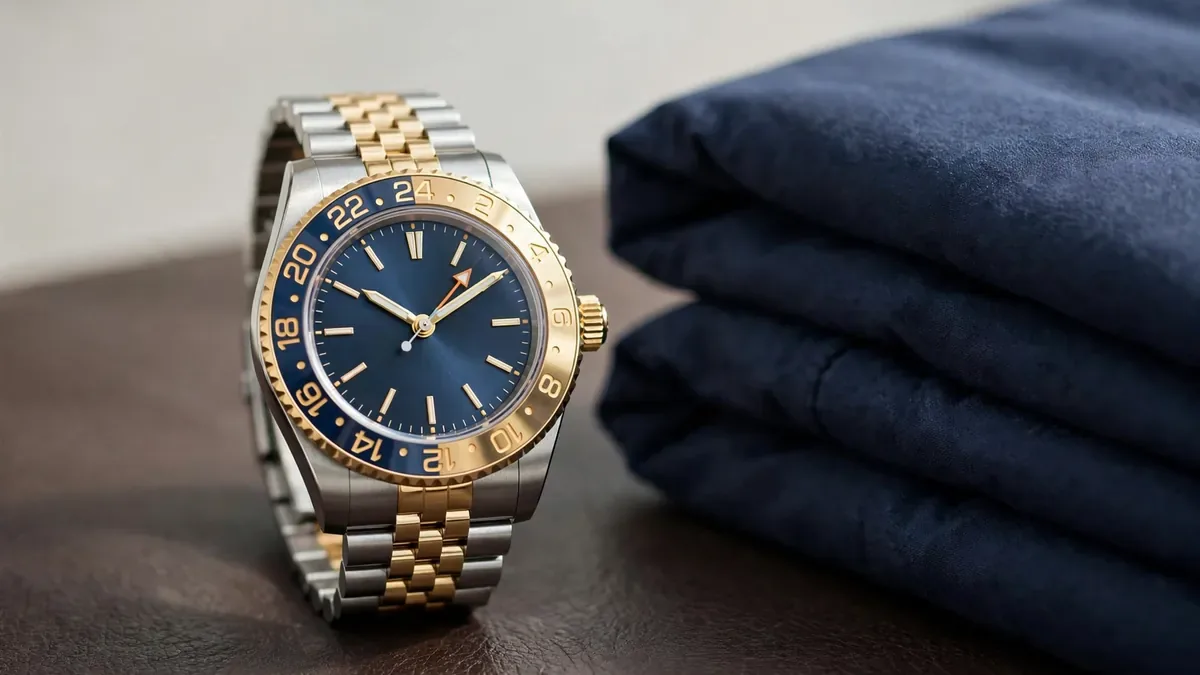
Best Luxury GMT Watch Brands earn their place on the wrist of anyone who crosses time zones often, because they solve a small daily problem with quiet mechanical elegance. A true GMT watch shows two time zones at once, so home time and local time sit side by side without a phone, an app, or a mental calculation at the airport. The best examples pair that useful complication with the materials, finishing, and proportions that define a luxury watch in the first place.
The appeal goes beyond travel. A GMT hand turns a watch into a companion for family in another city, colleagues on another continent, and markets that open while you sleep. Today the category spans steel sports models, slim dress pieces, and grand complications from the finest Swiss and Japanese houses.
This guide covers ten brands that do the GMT properly, from the two-tone icon that defined the category to under-the-radar Japanese and independent-minded Swiss makers. For each brand you will find the key models, the materials and movements behind them, realistic price ranges, and honest notes on fit and care.
Key takeaways
- A GMT watch tracks a second time zone with a dedicated 24-hour hand and a rotating 24-hour bezel or a second hour scale.
- True traveller GMT movements let you jump the local hour hand in one-hour steps without stopping the watch.
- Steel cases with ceramic bezels are the most practical daily choice, while gold and two-tone models suit formal wear.
- Expect to pay from about $4,000 for an entry-level luxury GMT to more than $40,000 for a high-complication piece.
- Fit matters as much as the movement, so check case diameter, thickness, and lug-to-lug length against your wrist before buying.
GMT Watches at a Glance
The table below summarises the ten brands in this guide, with the model to look for first, the case material most buyers choose, and the price range you should expect at retail. Prices are approximate and vary with material, bracelet, and market demand.
| Brand | Key GMT Model | Usual Materials | Price Range |
|---|---|---|---|
| Rolex | GMT-Master II | Oystersteel, two-tone, gold | $11,000–$45,000 |
| Omega | Seamaster Aqua Terra GMT | Steel, Sedna gold | $6,500–$9,000 |
| Patek Philippe | Aquanaut Travel Time | Steel, rose gold | $40,000–$85,000 |
| Grand Seiko | SBGN and SBGJ GMT models | Steel, titanium, gold | $5,500–$12,000 |
| Tudor | Black Bay GMT | Steel, gold and steel | $4,000–$4,800 |
| Breitling | Chronomat GMT 40 | Steel, gold | $5,000–$9,500 |
| Jaeger-LeCoultre | Polaris Geographic | Steel, pink gold | $12,000–$16,000 |
| IWC | Pilot’s Watch Timezoner | Steel, ceramic, bronze | $8,000–$15,000 |
| Cartier | Santos Dual Time | Steel, gold, ADLC | $8,000–$11,500 |
| Vacheron Constantin | Overseas Dual Time | Steel, pink gold | $28,000–$40,000 |
What a GMT Watch Actually Does
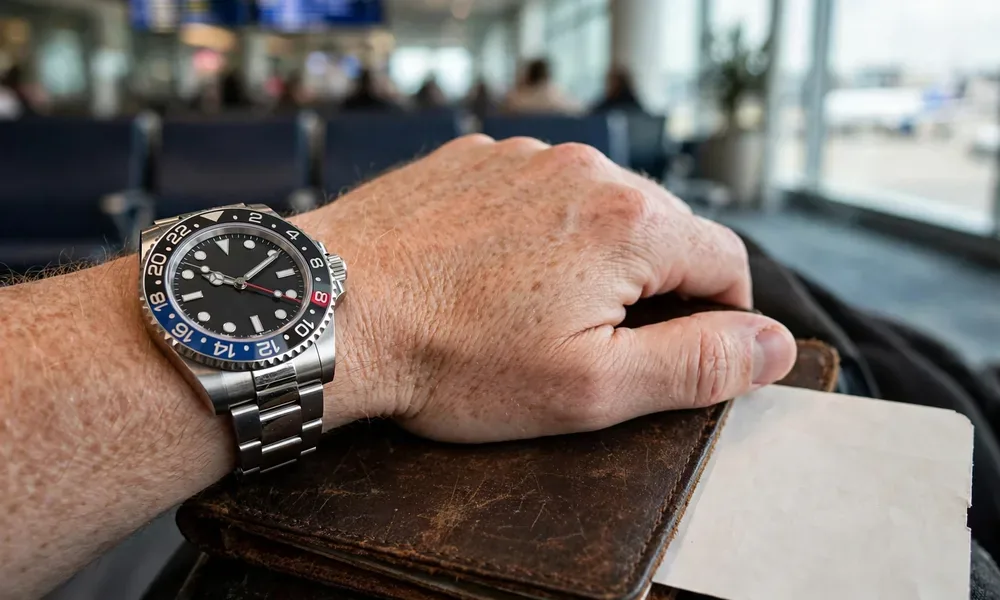
A GMT watch displays a second time zone using a fourth hand that circles the dial once every 24 hours, pointing at a 24-hour scale on the bezel or the dial itself. The regular hour hand shows local time, while the GMT hand shows home time, or any second zone you choose. Because the scale runs to 24, you can tell at a glance whether it is day or night in the other city, which a simple dual-dial display cannot do as clearly.
The most useful versions use a traveller movement, where the local hour hand jumps forward or backward in one-hour steps. You land, turn the crown, and the date follows automatically, all while the watch keeps running and the GMT hand stays fixed on home time. When comparing models, ask which type of movement sits inside, because it shapes the daily experience more than the dial colour does.
Water resistance, legibility, and build quality matter just as much. Most luxury GMT watches offer at least 100 metres of water resistance, luminous hands and markers, and a scratch-resistant sapphire crystal. A rotating 24-hour bezel should click firmly into place and stay put, while a fixed 24-hour scale on the dial suits slimmer dress watches. If you want a broader view of how these models sit within the wider luxury market, our guide to the best luxury watches of 2027 puts GMT models alongside dress watches, chronographs, and everyday icons.
The Ten Best Luxury GMT Watch Brands
Each brand below earns its place for a different reason: heritage, movement, value, finishing, or sheer wearability. Read the fit notes carefully, because a 42 mm case wears very differently from a 40 mm one, and a thick travel watch can struggle under a shirt cuff.
Rolex
Rolex invented the modern GMT watch with the GMT-Master, built for Pan Am pilots in the 1950s, and the current GMT-Master II remains the reference point for the whole category. The two-tone Cerachrom bezel, in blue and black, blue and red, or black and grey, is instantly recognisable, and the in-house calibre 3285 offers a 70-hour power reserve with a true traveller hour hand. Cases measure 40 mm across and wear comfortably on most wrists.
Materials range from Oystersteel to yellow gold, white gold, and two-tone steel and gold, with prices from about $11,000 in steel to more than $45,000 in solid gold. For most buyers, this is the safest first luxury GMT and the hardest to regret.
Omega
Omega brings its Master Chronometer standards to the GMT category, with movements resistant to magnetic fields up to 15,000 gauss and accuracy certified to within a few seconds a day. The Seamaster Aqua Terra GMT pairs a clean, teak-patterned dial with a rubber strap or steel bracelet, while the Planet Ocean GMT adds 600 metres of water resistance for those who want a tougher travel companion.
Steel is the natural choice, with Sedna gold versions for buyers who want warmth without the full price of a gold Rolex. Prices typically run from about $6,500 to $9,000, which makes Omega one of the strongest value propositions in luxury GMT watches. Care follows the usual routine of regular washing and a service every five to eight years.
Patek Philippe
Patek Philippe treats the second time zone as a high complication, and the Aquanaut Travel Time shows why. Two apertures display local and home time, two skeletonised hour hands track both zones, and a single pusher advances the local hour in one-hour steps.
Steel Aquanaut models start from about $40,000 at retail, with rose gold versions reaching $85,000 and beyond, and demand far exceeds supply, so expect a waiting list. The 40.8 mm Aquanaut wears lighter than its size suggests thanks to the composite strap, while the 37.5 mm Calatrava suits slimmer wrists and formal dress.
Grand Seiko
Grand Seiko offers some of the finest finishing at any price, with hand-polished Zaratsu cases, textured dials inspired by Japanese landscapes, and movements assembled to exacting standards.
Steel dominates the range, with high-intensity titanium for lighter wear and gold for special editions. Prices run from about $5,500 for quartz GMT models to roughly $12,000 for Hi-Beat and Spring Drive versions. Care is straightforward, and the dials reward a soft cloth rather than harsh cleaning products.
Tudor
Tudor is the entry point to serious luxury GMT watches, and the Black Bay GMT is the model that proves it. The burgundy and blue bezel nods to the Rolex GMT-Master of the 1950s, while the in-house calibre MT5652 delivers a 70-hour power reserve, a silicon balance spring, and a true traveller hour hand.
The 41 mm steel case is the standard choice, with a steel and gold version for buyers who want a dressier look. Prices run from about $4,000 to $4,800, which undercuts every Swiss rival in this guide by a wide margin. The case wears thick at just under 15 mm, so it suits casual wear better than a tight shirt cuff.
Breitling
Breitling builds GMT watches for pilots and frequent flyers who want a bold, instrument-like presence on the wrist. The Chronomat GMT 40 pairs a 40 mm case with a 24-hour scale and the brand’s signature rider tabs on the bezel, while the larger Superocean and Avenger GMT models add serious water resistance.
Steel is the default, with 18-karat red gold for the top of the range, and the Rouleaux bracelet is one of the most comfortable steel bracelets available. Prices typically run from about $5,000 to $9,500 depending on the model and material. The 40 mm Chronomat GMT fits most wrists well, while the 44 mm and 46 mm models suit larger wrists and casual dress.
Jaeger-LeCoultre
Jaeger-LeCoultre is the watchmaker’s watchmaker, supplying movements to other houses for decades, and its GMT watches show that expertise in a refined package. The Polaris Geographic pairs a lacquered blue dial with a second time zone aperture and a 24-hour indicator, while the Master Control Geographic adds a world-time display for travellers who track more than two cities.
Steel is the usual choice, with pink gold versions for dressier occasions, and prices run from about $12,000 to $16,000. The 41 mm Polaris Geographic wears slim and elegant, making it one of the best GMT watches for a suit, while the Master Control models suit collectors who value complications over sportiness.
IWC
IWC takes a different approach to the second time zone, and the Pilot’s Watch Timezoner is the most ingenious GMT in this guide. Turn the bezel to your destination city and the hour hand, the 24-hour display, and the date all jump together, with no crown work at all.
Materials include steel, ceramic, and bronze, with prices from about $8,000 to $15,000. The Timezoner wears large at 46 mm, so it suits bigger wrists and casual wear, while the 43.5 mm Yacht Club World Time is the more versatile choice. Avoid the bronze case if you dislike patina, since it darkens with wear.
Cartier
Cartier brings Parisian elegance to the GMT category, and the Santos Dual Time is the pick of the range. The square case, exposed screws, and sword-shaped hands are unmistakably Cartier, while the second time zone appears as a sub-dial with a day and night indicator.
Steel is the most popular choice, with ADLC black coatings and gold versions for buyers who want more presence. Prices run from about $8,000 to $11,500, which places Cartier between Tudor and the Swiss heavyweights. The 40 mm Santos Dual Time fits most wrists well, and the bracelet is easy to size.
Vacheron Constantin
Vacheron Constantin is the oldest continuously operating watchmaker in the world, and the Overseas Dual Time carries that heritage into a modern sports watch. The 41 mm case, fluted bezel, and Maltese cross bracelet are instantly recognisable, while the in-house calibre 5110 DT offers a 60-hour power reserve and a day and night indicator for the second zone.
Steel models start from about $28,000, with pink gold versions reaching $40,000 and beyond. The Overseas wears slim for a sports watch and slips under a cuff more easily than most rivals, which suits buyers who want one watch for business and travel.
GMT vs Dive, Field and Pilot Watches
GMT watches are often confused with dive, field, and pilot watches, because they share a sporty look and a rotating bezel. The difference lies in what the bezel and the extra hand actually do. A GMT bezel carries a 24-hour scale for reading a second time zone, while a dive bezel carries a 60-minute scale for timing a dive, and the two are not interchangeable. If the bezel counts minutes, it is a dive watch; if it counts hours to 24, it is a GMT watch.
Dive watches prioritise water resistance, often 300 metres or more, with a unidirectional bezel that can only turn one way for safety. Field watches are simpler still, with a fixed bezel, a highly legible dial, and a tough case built for outdoor use. Pilot watches sit closest to GMT watches, since many include a second time zone, but they usually emphasise large, luminous numerals and a slide-rule or countdown bezel rather than a 24-hour scale. Our guide to the best dive watches explains the dive category in detail if you want to compare the two side by side.
For travel, a GMT watch is the more practical choice, since it answers the question you actually ask on a trip: what time is it at home. A dive watch is the better choice for water sports, and a field watch suits rough outdoor use where simplicity matters.
How to Choose the Right GMT Watch
Start with the movement, because it decides how the watch feels to use. A traveller movement with a jumping local hour hand is worth paying for if you fly more than a few times a year. Next, consider the case: 40 mm to 41 mm suits most wrists, 42 mm and above suits larger wrists, and thickness matters as much as diameter when a cuff is involved.
Materials shape both the look and the upkeep. Steel is the most practical and the easiest to maintain, two-tone steel and gold adds warmth for formal wear, and solid gold is a statement that also adds weight and cost. Ceramic bezels resist scratches and fading, while aluminium bezels develop a softer patina over time. If you want the full picture of the brands behind these watches, our overview of the best watch brands compares the houses in this guide with the wider luxury market.
Finally, think about service and resale. Established brands with global service networks are easier to maintain, and models with strong demand hold their value better. A GMT watch is a long-term purchase, so choose the one you will still enjoy wearing in ten years, not the one that impresses for a season.
Checklist
Use this checklist before you buy, and work through it in order. It covers the decisions that matter most, from the movement inside to the fit on your wrist.
- Movement type: confirm a traveller movement with a jumping local hour hand if you fly often, or a caller movement if you travel rarely.
- Case size: check diameter, thickness, and lug-to-lug length, and try the watch on your own wrist before committing.
- Material: choose steel for daily wear, two-tone for versatility, or solid gold for formal occasions and long-term value.
- Bezel: check that the 24-hour bezel clicks firmly, aligns exactly, and stays in place during normal wear.
- Water resistance: confirm at least 100 metres for travel, and 200 metres or more if you swim with the watch on.
- Service and papers: buy from an authorised dealer, keep the box and papers, and confirm the warranty and service intervals.
Frequently Asked Questions
What is a GMT watch?
A GMT watch is a watch that shows two time zones at once. A dedicated 24-hour hand points to a 24-hour scale on the bezel or dial, so you can read home time and local time together.
How do you set a GMT watch?
On a traveller GMT, pull the crown to the first position and jump the local hour hand forward or backward in one-hour steps until it matches local time. The GMT hand stays fixed on home time, and the date adjusts automatically. On a caller GMT, you move the GMT hand instead, which takes longer when you change zones often.
Are GMT watches worth the money?
For frequent travellers, yes, because the complication is genuinely useful several times a week and the watches hold their value well.
What is the difference between a GMT and a dual-time watch?
The terms overlap, but a GMT watch uses a 24-hour hand and a 24-hour scale, while a dual-time watch may use a second hour hand on a 12-hour scale or a separate sub-dial. GMT watches make it easier to tell whether it is day or night in the second zone, which is why travellers usually prefer them.
Can you wear a GMT watch every day?
Yes, most luxury GMT watches are built for daily wear, with steel cases, sapphire crystals, and at least 100 metres of water resistance. Rotate straps to keep leather fresh, and rinse the watch after swimming in salt water.
Which GMT watch holds its value best?
Steel Rolex GMT-Master II models hold their value best, often trading near or above retail on the secondary market. Steel Patek Philippe travel-time models also retain value strongly, while Omega, Tudor, and Grand Seiko offer better value at purchase but depreciate more.
The Bottom Line
The best luxury GMT watch brands prove that a useful complication can also be a beautiful one. Rolex sets the standard, Omega and Tudor offer the best value, Grand Seiko delivers the finest finishing for the money, and Patek Philippe and Vacheron Constantin reward collectors who want the highest level of watchmaking. Choose the movement that suits how often you travel, the case that fits your wrist, and the material that matches your wardrobe, and the right GMT will serve you on every trip for decades.