A silk scarf is the smallest item in a wardrobe that can change an outfit completely. One square of printed silk, folded the right way, can turn a plain blazer into a finished look, give a simple coat a point of colour, The problem is not finding a beautiful silk scarf. It is knowing what to do with it once it is in your hands, because a scarf that is tied badly, in the wrong size, or with the wrong outfit looks fussy rather than polished.
That is why this guide is organised by look, not by scarf. Each of the nine ways below works with a different outfit and a different mood, from a neat neckerchief at work to a scarf worn as a belt on a summer dress. The scarf itself does not need to be expensive. What matters is the size and the weight, and the way it is folded, because a 90 cm square behaves very differently from a long, narrow scarf, and a heavy twill drapes very differently from a light, fluid silk.
Below are nine ways to style a silk scarf in 2027. Each tip is described plainly, so you can try one this week with a scarf you already own.
Key takeaways
- Match the size to the look: a 90 cm square for neck knots, a long narrow scarf for belts and bag handles, a large square for headscarves and tops.
- Fold and press the scarf before you tie it; a creased scarf looks untidy no matter how expensive the silk is.
- Let the scarf be the accent: one strong print at a time, with the rest of the outfit kept simple.
- Silk is delicate, so keep it away from rough jewellery, velcro, and sharp hardware that can snag it.
- No scarf suits every outfit or occasion, and a look that feels fussy will not look polished.
What styling a silk scarf actually involves
Styling a silk scarf is mostly about folding. A silk square straight out of the drawer is a flat piece of cloth, and the shape it takes depends entirely on how it is folded before it is tied. Folded into a narrow band, it becomes a neckerchief or a belt. Folded into a triangle, it becomes a headscarf or a shawl. Left open and draped, it becomes a soft layer over a blazer or a coat.
Size matters more than brand. A 90 cm square is the most versatile size, large enough for a headscarf and a neck knot, small enough to carry in a handbag. A 65 cm square suits neck knots and bag handles but is too small for most headscarves. A long, narrow scarf is made for belts, bag handles, and hair, not for the neck. A large square of 110 cm or more drapes beautifully as a shawl or a top, but it can overwhelm a small frame if it is not folded down first.
Weight matters too. A silk twill, the slightly heavier weave used for most printed scarves, holds a fold and a knot well, which is why it is the standard for neckerchiefs. A lighter silk, such as a silk satin or a silk chiffon, drapes and flows, which suits wearing a scarf as a top or draped over shoulders, but it slips more easily. If you are buying your first silk scarf, a medium-weight twill in a 90 cm square is the most useful starting point, because it works for the most looks in this guide.
How we chose these tips and what to look for
Look first at the scarf you already own, or the one you are thinking of buying. Check the size, the weight, and the print, because those three things decide which looks will work. A busy, multi-colour print is an accent on its own and suits simple outfits. A plain or two-colour scarf is easier to pair with patterned clothes.

Look next at the outfit the scarf has to work with. A silk scarf adds polish to simple, well-fitting clothes, and it fights with clothes that are already busy. A plain blazer, a simple coat, a white shirt, or a plain dress are the best partners. If your outfit already has a strong print, a bold collar, or heavy jewellery, the scarf will compete rather than complete, and it is better left in the drawer that day.
Finally, look at the occasion. A neat neckerchief suits work and formal settings. A scarf tied on a handbag or worn as a belt suits casual days and holidays. A headscarf suits wind, sun, and bad-hair days, and a scarf worn as a top suits warm evenings and holidays, not an office.
The 9 ways to style a silk scarf in 2027
The classic neckerchief knot
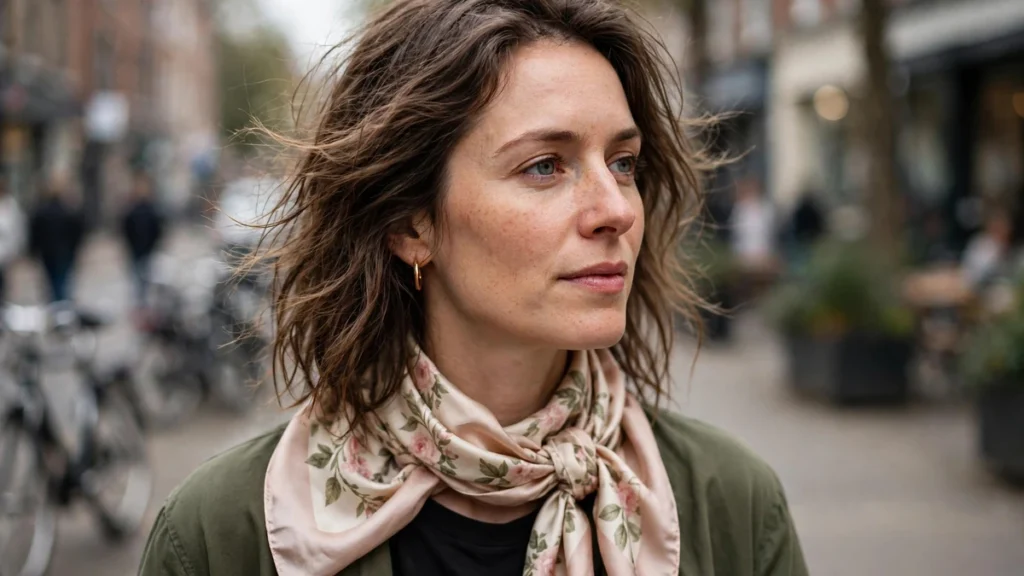
What we like: The most useful silk scarf look there is. A 90 cm square folded into a narrow band, wrapped once around the neck, and tied in a small knot at the front or the side, instantly finishes a shirt, a blazer, or a simple dress. What to consider: The knot needs to sit neatly, with even ends, or it looks careless. Best for: Work, formal days, and smart outfits. Cost: Nothing beyond the scarf itself. Time needed: Two minutes.
Draped loosely over a blazer
What we like: The easiest way to wear a silk scarf, and the most forgiving. A large square opened out and draped over the shoulders, with the ends hanging down the front, adds colour and softness to a structured blazer without any tying at all. What to consider: A light silk will slip off the shoulders, so this works best with a twill, or with a small pin at the front. Best for: Smart-casual days, meetings, and evenings out. Cost: Nothing beyond the scarf itself. Time needed: One minute.
Worn as a headscarf
What we like: Practical and elegant at once. A large square folded into a triangle, worn over the head and tied under the chin or at the nape, protects hair from wind and sun and adds a deliberate, vintage polish to a simple coat. What to consider: It needs a large scarf, at least 90 cm, and a few discreet pins help on fine hair. Best for: Windy days, travel, and bad-hair days. Cost: Nothing beyond the scarf itself, plus a few hairpins. Time needed: Three minutes.
Tied on a handbag handle
What we like: The lowest-effort way to use a silk scarf, and a good use for a small or narrow scarf. A twilly or a small square tied around one handle of a handbag adds colour and personality to a plain bag, and it is easy to remove and wear another way. What to consider: The scarf will get dirty faster on a bag, and rough hardware can snag silk, so check the handle for sharp edges first. Best for: Casual days, holidays, and plain leather bags. Cost: Nothing beyond the scarf itself. Time needed: One minute.
Styled as a belt
What we like: A silk scarf threaded through belt loops, or tied around the waist over a dress, adds colour and definition where a leather belt would look heavy. It suits summer dresses, linen trousers, and loose shirts that need a waist. What to consider: The scarf needs to be long enough to go around your waist, so a long narrow scarf or a folded large square works best. Best for: Summer dresses, holidays, and loose outfits. Cost: Nothing beyond the scarf itself. Time needed: Two minutes.
Worn as a top
What we like: The boldest look in this guide, and a good use for a large square. A silk scarf folded into a triangle and tied as a halter or bandeau top is a striking holiday and evening look that costs nothing beyond the scarf. What to consider: It needs a large scarf, at least 110 cm, and it is not secure enough for a busy day. Best for: Holidays, warm evenings, and parties. Cost: Nothing beyond the scarf itself. Time needed: Five minutes.
The French twist around a ponytail
What we like: A narrow scarf wrapped around the base of a ponytail or a low bun hides the hair tie and adds a polished, French finish to a simple hairstyle. It takes a minute and makes an ordinary ponytail look deliberate. What to consider: A narrow scarf works best here; a wide square will be too bulky around the hair. Best for: Work, everyday days, and second-day hair. Cost: Nothing beyond the scarf itself. Time needed: Two minutes.
Layered under a coat collar
What we like: The warmest way to wear a silk scarf in winter. A scarf folded into a band and worn under a coat collar, with the ends tucked inside the coat, adds a layer of warmth and a flash of colour at the neck without the bulk of a wool scarf. What to consider: Silk on its own is not warm enough for a cold day, so think of it as a finishing layer over a fine knit, not a replacement for a winter scarf. Best for: Cold days, smart coats, and work. Cost: Nothing beyond the scarf itself. Time needed: Two minutes.
As a wrist wrap
What we like: The smallest silk scarf look, and a good use for a narrow scarf or a small square. Wrapped twice around the wrist and tied in a small knot, a silk scarf works like a bracelet, adding colour to a plain sleeve without the weight of jewellery. What to consider: It gets in the way of washing hands and typing, so it suits occasions rather than a working day. Best for: Evenings out, parties, and special occasions. Cost: Nothing beyond the scarf itself. Time needed: One minute.
Which silk scarf look is right for you
Start with the scarf you own. If you have one 90 cm square, the neckerchief, the headscarf, and the drape over a blazer are the looks that will work best, . If you have a long, narrow scarf, the bag handle, the belt, and the ponytail wrap are the natural choices. If you have a large square, the headscarf, the drape, and the top are open to you. Our roundup of the best silk scarves for women is a useful place to compare sizes and prints before you buy, because it shows how different scarves behave in practice.
Then think about your day. A work day calls for the neckerchief, the drape, or the ponytail wrap. A casual day calls for the bag handle, the belt, or the headscarf. A holiday or an evening calls for the top, the wrist wrap, or the drape. A cold day calls for the layer under a coat collar, and our guide to how to wear a scarf with a coat covers the heavier winter versions of that look, where the same flat, neat fit matters.
Finally, think about comfort. A scarf around the neck bothers some people, and no amount of styling advice changes that. If you do not like the feeling, skip the neck looks entirely and use the bag, belt, hair, and wrist looks instead, which give you the colour and the print without anything around your neck.
The caveats that matter
Silk is a delicate fabric, and styling it means handling it more than wearing it. The most common damage comes from snagging: rough jewellery, velcro, sharp bag hardware, and even rough skin can pull a thread in silk, and a pulled thread cannot be fixed neatly. Check your jewellery and your bag before you tie a scarf to either, and keep silk away from velcro closures. The second most common problem is staining. Silk marks easily with perfume, deodorant, and makeup, so apply those first, let them dry, and only then put the scarf on.
| Detail | What is known |
|---|---|
| Most versatile size | A 90 cm square works for the most looks |
| Best weight for tying | Silk twill holds a fold and a knot well |
| Biggest risk | Snagging on rough jewellery, velcro, and sharp bag hardware |
| What to avoid | Perfume, deodorant, and makeup applied after the scarf is on |
| When to skip the scarf | When the outfit already has a strong print, a bold collar, or heavy jewellery |
| Cleaning | Hand wash in cool water with a gentle detergent, or dry clean; never wring silk |
| Storage | Folded flat in a drawer, away from sunlight, not hung on a hook |
| What it does not do | It adds little warmth and does not suit every occasion |
Cleaning matters too. Silk should be hand washed in cool water with a gentle detergent, or dry cleaned, and it should never be wrung out, which distorts the weave. Press it gently with a towel to remove water, then lay it flat to dry, away from direct sun. Store scarves folded flat in a drawer, not hung on a hook, where they can stretch and crease.
Checklist: styling a silk scarf honestly
Use these checks before you leave the house.
- Check the size: the scarf should be large enough for the look, and folded down if it is too large.
- Check the fold: press the scarf into a neat band or triangle before tying, and smooth out creases.
- Check the outfit: the scarf should be the one strong accent, with the rest of the outfit kept simple.
- Check for snags: look at your jewellery, bag hardware, and coat closures before the silk goes near them.
- Check the knot: it should sit flat and secure, with even ends, and it should still feel comfortable after an hour.
- Check the occasion: a neat neckerchief for work, a relaxed look for casual days, and nothing fussy for a busy day.
Frequently asked questions
What size silk scarf should I buy first?
A 90 cm square in a medium-weight twill. It is large enough for a headscarf and a neck knot, small enough to carry in a handbag, and it holds a fold well. A narrow scarf is a good second purchase, for bag handles, belts, and hair.
How do I stop a silk scarf from slipping?
Choose a twill rather than a slippery satin, fold the scarf neatly before tying, and tie a knot that holds, such as a double knot for a neckerchief. A small, discreet pin can help with a drape, and hairpins help with a headscarf. Our guide to layering in winter covers the same principle for heavier layers: a layer that sits flat and secure is a layer that stays put.
Can I wear a silk scarf with a patterned outfit?
Sometimes, but keep one of them quiet. A plain or two-colour scarf works with a patterned outfit, and a printed scarf works with a plain outfit. Two strong prints together usually compete.
How do I clean a silk scarf?
Hand wash in cool water with a gentle detergent, or dry clean it. Never wring silk, and never put it in a hot wash. Press out water gently with a towel, lay it flat to dry away from direct sun, and store it folded in a drawer.
Is a silk scarf suitable for work?
Yes, if the look is neat and the scarf is not too bold. A neckerchief, a drape over a blazer, or a ponytail wrap all suit work. A scarf worn as a top, a wrist wrap, or a bright belt is better saved for holidays and evenings.
Can men wear silk scarves?
Yes. A silk scarf worn as a neckerchief, draped under a coat collar, or tucked into a jacket pocket as a pocket square suits men well. The same rules apply: a neat fold, a simple outfit, and a scarf that fits the occasion.
The bottom line
The best way to style a silk scarf in 2027 is the one that fits the scarf you own, the outfit you are wearing, and the day you are having. A 90 cm twill square, folded neatly and tied in a simple knot, will take you further than a drawer full of scarves you never wear, because the skill is in the fold, not in the purchase. Start with the neckerchief, practise it until the knot sits flat, and then try one new look a week.
Keep the rest of the outfit simple, keep the silk away from anything that can snag it, and take the scarf off if it feels fussy or uncomfortable. A silk scarf should be the easiest finishing touch in your wardrobe, not the hardest.