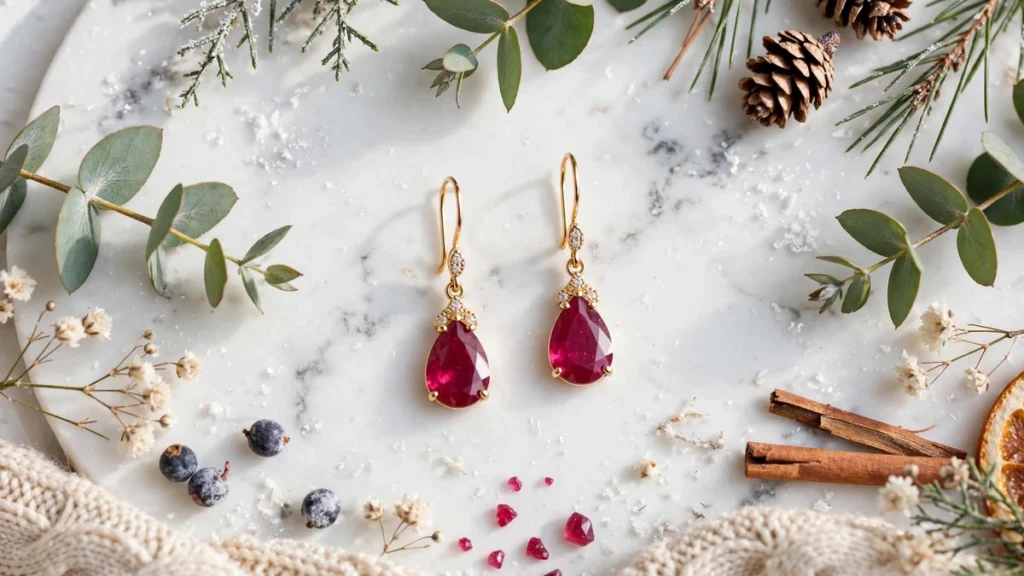
Ruby is the warmest of the classic gemstones, and winter is when it looks its best. Against dark wool, deep navy and the low light of short days, a ruby earring glows in a way that pale stones cannot. The problem is not finding ruby earrings. It is finding a pair whose stones are genuine, well cut and securely set, at a price that reflects the stone rather than the name on the box.
That is why this guide is organised by stone quality and setting, not just by brand. A small, well-cut ruby in a secure setting will outshine a larger, poorly cut stone every time. A heated ruby, which is standard practice and permanent, is a sensible buy. A glass-filled ruby, which is fragile and needs special care, is a different purchase entirely, and it should be priced and sold as such.
Below are nine ruby earrings worth considering for winter 2027, from classic studs to elegant drops. Each one is described by what it is good at, what to watch for, and who it suits best, so you can choose with your ears and your budget in mind, not just a bestseller list.
Key takeaways
- Ruby is the red variety of corundum, the same mineral family as sapphire, and it is hard enough at 9 on the Mohs scale for daily wear.
- Heat treatment is standard, permanent and widely accepted; glass filling is not the same thing and should be disclosed and priced lower.
- Studs are the most versatile winter choice, while drops suit evenings and special occasions.
- Yellow gold warms a ruby and suits most skin tones; white gold and platinum give a cooler, more modern look.
- No ruby earring is an investment on its own, and a pair whose stones are cloudy, cracked or loosely set is not worth keeping.
What ruby actually is and why it suits winter
Ruby is the red variety of the mineral corundum, the same family as sapphire. Its colour comes from chromium, and the finest rubies are a vivid, slightly pinkish red that gem dealers call pigeon blood. Ruby sits at 9 on the Mohs hardness scale, second only to diamond, which means it resists scratching well and is a practical choice for earrings worn every day.
Winter suits ruby because the stone needs contrast to show its colour. In summer, bright light can wash out a pale ruby. In winter, against dark coats, scarves and evening light, even a modest ruby holds its glow. It is also a warm stone in a cold season, which is why it pairs so naturally with the deep colours of winter dressing: navy, charcoal, forest green, burgundy and black.
Most rubies on the market today are heat-treated, and that is normal. Heat treatment is permanent, stable and accepted across the trade, and it improves colour and clarity. It is not the same as glass filling, where fractures are filled with lead glass to improve appearance. A glass-filled ruby is more fragile, cannot be cleaned in an ultrasonic cleaner, and should cost far less. A reputable seller will tell you which treatment a stone has received, and if they will not, that is your answer.
How we chose these earrings and what to look for
Look first at the stone. A good ruby is a vivid red with even colour and no large, visible cracks. Small inclusions are normal and often a sign the stone is genuine rather than synthetic. A stone that is too dark looks almost black in winter light, while a stone that is too pink is closer to a pink sapphire. Hold the earrings under ordinary indoor light, not just under a shop spotlight, because that is how you will actually wear them.

Look next at the setting and the clasp. The stone should sit level in its setting, with prongs that are even and not catching on fabric. A bezel setting protects the stone best and suits daily wear. A prong setting shows more of the stone but leaves the edges exposed. Our guide to diamond earrings makes the same point about settings, because a secure setting matters more than a famous name. Check the clasp too: a butterfly back should grip firmly, and a screw back is worth having for valuable studs.
Finally, look at the metal and the size. Yellow gold warms a ruby and suits warm skin tones. White gold and platinum give a cooler, more contemporary look and suit cool skin tones. For winter, a stud between 5 and 7 millimetres is versatile enough for day and evening. Larger drops are lovely for occasions, but they are not a daily earring for most people.
The 9 best ruby earrings for winter 2027
Tiffany & Co. Ruby Studs
What we like: Classic round ruby studs in a clean four-prong setting, with well-matched stones and a secure screw back. What to consider: Luxury price, and the stones are modest in size for the cost. Stone: Heat-treated ruby, matched pair. Setting: Four-prong, 18k gold. Best for: A first pair of fine ruby studs. Price range: Luxury.
This is the pair other ruby studs are measured against. It is not the largest, and it is not the cheapest, but for a classic, well-made stud that will be worn for decades, it remains a strong first choice.
Cartier Ruby Studs
What we like: Elegant round studs with vivid, evenly coloured rubies and a refined, low-profile setting that sits close to the ear. What to consider: Luxury price, and the setting is best suited to smaller stones. Stone: Heat-treated ruby, matched pair. Setting: Four-prong, 18k gold. Best for: Evening wear and special occasions. Price range: Luxury.
A polished, understated pair that works best when the rest of the jewellery stays quiet: a plain gold chain, no competing stones.
David Yurman Ruby Studs
What we like: Round ruby studs in a signature cable-inspired setting, with good colour and a secure, comfortable back. What to consider: Premium price, and the setting is a distinctive house style that not everyone wants. Stone: Heat-treated ruby, matched pair. Setting: Prong, sterling silver or 18k gold. Best for: Everyday luxury with a recognisable design. Price range: Premium.
For people who like a designer signature without a loud logo, this is a practical sweet spot: recognisable, comfortable, and easy to wear daily.
Mejuri Ruby Stud Earrings
What we like: Small, well-cut ruby studs in solid gold at a fair price, with a simple setting that lets the stone speak. What to consider: The stones are small, so they suit a subtle look rather than a statement. Stone: Heat-treated ruby, matched pair. Setting: Four-prong, 14k solid gold. Best for: Daily wear and first fine jewellery. Price range: Mid-range.
A reliable, no-fuss pair that pairs with almost everything you already own, from a gold chain to a plain winter coat.
Monica Vinader Ruby Studs
What we like: Round ruby studs in a clean, modern setting, with good colour for the price and a comfortable butterfly back. What to consider: The stones are modest, and the setting is simple rather than ornate. Stone: Heat-treated ruby, matched pair. Setting: Prong, 18k gold vermeil or solid gold. Best for: Gifting and everyday wear. Price range: Mid-range.
If you want a modern, minimal pair of ruby studs without a luxury price, this is the pair that fits best, and it is an easy gift.
Missoma Ruby Stud Earrings
What we like: Small ruby studs in a delicate setting, with a warm red colour and a light, comfortable feel on the ear. What to consider: The stones are small, so they read as an accent rather than a feature. Stone: Heat-treated ruby, matched pair. Setting: Prong, 18k gold vermeil. Best for: Layering with other earrings and daily wear. Price range: Affordable to mid-range.
Missoma does delicate jewellery unusually well, and this pair is a good example: honest colour, a clean setting, and nothing to regret at the till.
Maria Black Ruby Studs
What we like: Contemporary ruby studs with a slightly edgier setting, good colour and a secure back that stays put all day. What to consider: The design is modern rather than classic, so it suits a contemporary wardrobe best. Stone: Heat-treated ruby, matched pair. Setting: Prong, sterling silver or 18k gold. Best for: Modern dressing and second piercings. Price range: Mid-range.
This is the budget-friendly, style-forward entry point. It will not feel like a heritage piece, but it will get worn constantly, which is the real test.
Astrid & Miyu Ruby Drops
What we like: Elegant ruby drop earrings with a soft, fluid movement, good colour and a comfortable hook that does not pull. What to consider: Drops are an occasion earring rather than a daily one, and they need a secure hook. Stone: Heat-treated ruby. Setting: Drop, gold vermeil. Best for: Winter parties and evening dinners. Price range: Mid-range.
If your winter involves more dinners than desk days, these are the ruby earrings to reach for first.
Thomas Sabo Ruby Drops
What we like: Classic ruby drop earrings with a warm red stone and a secure, well-made hook, at a fair price for the size. What to consider: The drops are longer than studs, so they suit evenings and occasions more than daily wear. Stone: Heat-treated ruby. Setting: Drop, sterling silver or gold. Best for: Special occasions and festive dressing. Price range: Affordable to mid-range.
A relaxed, festive pair that does the work of a necklace without the fuss of one, and it suits the deep colours of winter dressing.
Which ruby earrings are right for you
Warm skin tones usually suit ruby in yellow gold, because the warm metal and the warm stone flatter each other. Cool skin tones often suit ruby in white gold or platinum, where the cool metal makes the red look sharper and more modern. Neutral skin tones can wear either, and the choice comes down to the rest of your jewellery: match the metal to what you already wear most.
For daily wear, choose studs between 5 and 7 millimetres in a bezel or a low prong setting, with a secure screw back if the pair is valuable. For evenings, choose drops or a larger stud, and let the earrings be the feature of the outfit. A guide to gold jewellery for everyday wear is a useful companion here, because the same rules about metal, size and proportion apply to all fine jewellery.
Winter dressing also changes how earrings are seen. A scarf, a high collar or a hood can hide a small stud entirely, which is why drops and slightly larger studs earn their keep in the cold months. If you wear scarves often, choose a stud with a smooth, low setting that will not catch on wool, or a drop with a closed hook that cannot snag. A bezel-set stud is the safest choice under a scarf, because there are no prongs to catch on knitwear, and it will still be sitting neatly when you take the scarf off indoors.
For gifting, studs are the safest choice, because they suit every ear and every occasion. Drops are a better gift when you know the recipient wears them. For a first pair of ruby earrings, choose a modest stud in solid gold rather than a large drop in vermeil: the gold will last, and the stud will be worn far more often.
The caveats that matter
Ruby is hard, but it is not indestructible. It can chip at the girdle, the thin edge of the stone, if it is knocked against a hard surface. A bezel setting protects that edge best. It is also worth knowing that many rubies on the market are synthetic, which is not the same as fake: a laboratory-grown ruby is a real ruby, made by people rather than by the earth, and it should be sold as such and priced lower.
| Detail | What is known |
|---|---|
| Hardness | 9 on the Mohs scale, second only to diamond, suitable for daily wear |
| Standard treatment | Heat treatment is permanent, stable and widely accepted |
| Treatment to check | Glass filling is fragile, needs special care and should cost far less |
| Best winter metal | Yellow gold warms ruby; white gold and platinum give a cooler look |
| Most versatile size | Studs between 5 and 7 millimetres suit day and evening |
| Cleaning | Warm soapy water and a soft brush; never use an ultrasonic cleaner on a glass-filled stone |
| What to avoid | Harsh chemicals, steam cleaners, and knocking the stone against hard surfaces |
| What it does not do | It does not hold its value like a diamond, and no earring is an investment on its own |
Cleaning deserves a word of its own. Warm soapy water and a soft brush are enough for most ruby earrings, and they are the safest method for any stone whose treatment you do not know. An ultrasonic cleaner is fine for a solid, untreated or heat-treated ruby, but it can damage a glass-filled stone, so ask the seller before you use one.
Checklist: choosing ruby earrings honestly
Use these checks before you buy, and again after the first month of wear.
- Check the stone: even red colour, no large visible cracks, and a cut that catches the light.
- Check the treatment: ask whether the ruby is heat-treated or glass-filled, and expect a clear answer.
- Check the setting: prongs should be even and not catching on fabric, and the stone should sit level.
- Check the clasp: a butterfly back should grip firmly, and a screw back is worth having for valuable studs.
- Check the metal: match it to the jewellery you already wear, and choose solid gold over vermeil for a pair you will keep.
- Check the certificate: for a valuable pair, ask for a gemmological report that states the treatment.
Frequently asked questions
Are ruby earrings suitable for everyday wear?
Yes. Ruby is hard enough at 9 on the Mohs scale for daily wear, especially in a bezel or low prong setting. Choose a modest stud with a secure back, and take the earrings off for sport, gardening or heavy manual work.
How can I tell if a ruby is real?
A genuine ruby has small natural inclusions and an even red colour. A stone that is perfectly clear and very cheap is likely synthetic or glass. A gemmological report from a reputable laboratory is the reliable way to confirm what you are buying.
Is heat treatment bad for a ruby?
No. Heat treatment is standard, permanent and accepted across the trade, and it improves colour and clarity. It is very different from glass filling, which is fragile and should be disclosed and priced lower.
What metal suits ruby best?
Yellow gold warms a ruby and suits warm skin tones. White gold and platinum give a cooler, more modern look and suit cool skin tones. The best choice is the metal you already wear most, so the earrings fit your jewellery box.
Can I wear ruby earrings with other gemstones?
Yes, but keep it simple. Ruby pairs well with diamonds and with plain gold, but it competes with other strong colours such as emerald or sapphire. If in doubt, let the ruby be the only coloured stone in the outfit. Our winter diamond jewellery guide shows how diamonds sit alongside coloured stones.
How should I clean ruby earrings?
Warm soapy water and a soft brush are enough for most pairs. Rinse well, dry with a soft cloth, and store the earrings separately so the stones do not scratch each other or softer jewellery.
The bottom line
The best ruby earrings for winter 2027 are not the largest or the most expensive. They are the pair whose stones are a vivid, even red, whose setting is secure, and that you reach for without thinking. For daily wear, a modest stud in solid gold is a strong choice. For evenings and occasions, a drop in yellow or white gold is the smarter buy.
Choose one pair, check the treatment, wear them with the deep colours of winter, clean them gently, and judge them on how they look in ordinary light at the end of a long day, not only under a shop spotlight. That is the honest way to find ruby earrings that earn their place in your jewellery box.