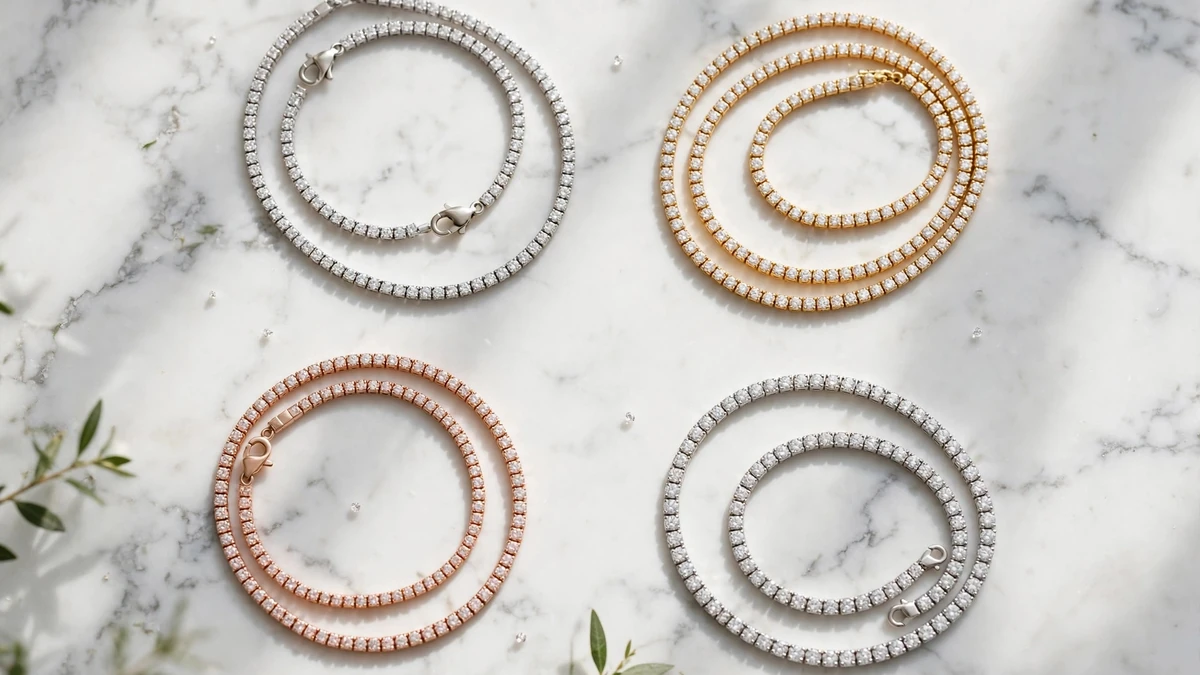
A tennis necklace is the quietest kind of showpiece in jewellery. It is a single, unbroken line of matched stones that sits close to the neck and catches the light with every small movement, without needing a pendant, a charm or a bold design to justify itself. The classic version is diamonds in a row, but in 2027 the best tennis necklaces come in lab-grown diamonds, moissanite, sapphires, emeralds, white sapphires and gold, at prices that range from a few hundred pounds to five figures.
The problem is that a tennis necklace is easy to buy badly. A line of stones that looks brilliant in a photograph can sit stiffly on the neck, pinch at the clasp, or lose stones one by one if the settings are weak. The difference between a necklace you wear weekly and one that lives in a box is rarely the size of the stones. It is the quality of the settings, the flexibility of the chain, the security of the clasp, and whether the stones are graded and certified.
Below are nine tennis necklaces worth considering in 2027, from a classic diamond line to a graduated sapphire version and a gold tennis necklace for everyday wear. Each one is described by what it does well, what to watch for, and who it suits best, so you can choose a necklace that fits your neck, your wardrobe and your budget, not just a photograph.
Key takeaways
- A tennis necklace is a continuous line of matched stones, usually diamonds, set in a flexible chain that sits close to the neck.
- Four-prong settings are the most secure for daily wear; bezel settings protect stones better but show less sparkle.
- Lab-grown diamonds and moissanite buy far more size for the money than natural diamonds, but they hold little resale value.
- Check the clasp before you buy: a box clasp with a safety latch is the minimum for a necklace you will wear often.
- No tennis necklace is an investment, and a cheap line with weak settings will cost more in repairs than it saved at purchase.
What a tennis necklace actually is
The tennis necklace takes its name from a famous on-court moment in 1987, when tennis player Chris Evert stopped a match to search for her diamond line bracelet. The necklace version follows the same idea: a row of individually set stones, each in its own setting, joined into a flexible line that moves with the body. There is no centrepiece and no focal point. The whole necklace is the point.
That simplicity is also what makes the design demanding. Every stone must match its neighbours in size, colour and cut, or the line looks uneven. A well-made tennis necklace uses stones that graduate very slightly, larger at the front and smaller toward the clasp, so the line looks balanced on the neck. A poorly made one uses stones of visibly different sizes, or sets them at slightly different heights, which shows up as a wobble in the line.
The settings matter more than the stones. Each stone is held by prongs, a bezel, or a shared setting, and each setting is a separate point of failure. Four prongs hold a stone more securely than three, and a bezel wraps the stone completely, which protects it from knocks but covers more of the stone. For a necklace worn daily, security should come before sparkle, because a lost stone from a tennis necklace is expensive to replace and hard to match.
How we chose these necklaces and what to look for
Look first at the stones and their grading. For diamonds, colour grade G to H and clarity VS2 to SI1, eye-clean, is the sensible sweet spot. Paying for D colour and VVS clarity in a row of small stones buys very little visible difference and a lot of cost. For lab-grown diamonds, ask for a GIA or IGI grading report. For coloured stones, ask whether the stone is heated, because heat treatment is standard for sapphires and must be disclosed.

Look next at the metal and the construction. Fourteen-karat gold is harder and more practical for daily wear than 18-karat, and solid gold outlasts vermeil or plating by years. Hold the necklace by its ends and let it drape: it should curve smoothly, without kinks or stiff sections. Check the clasp, which should close with a firm click and have a safety latch or figure-eight catch as a backup. A necklace with a weak clasp will be lost, not worn out.
Finally, look at the length and the fit. Sixteen inches sits high on the neck and suits open necklines, while 18 inches is the most versatile length and works with most outfits. Measure your neck before ordering, because a tennis necklace that is too tight will pinch and a loose one will slide. Our guide to the best diamond necklaces covers the same length and fit questions in more detail, and it is worth reading before you choose between a 16-inch and an 18-inch line.
The 9 best tennis necklaces of 2027
Tiffany & Co. Classic Diamond Tennis Necklace
What we like: A classic line of round brilliant diamonds in platinum, with a box clasp and safety latch, and a graduation that keeps the line balanced on the neck. What to consider: Premium price, and the platinum setting is heavier than gold. Metal: Platinum. Setting: Four-prong. Best for: A milestone gift or a once-in-a-lifetime purchase. Price range: High.
This is the reference point for the whole category. It is not the cheapest, and it is not the most adventurous, but for a classic diamond line made to last decades, it remains a strong first choice.
Cartier Diamond Tennis Necklace
What we like: A refined line of matched diamonds in 18-karat white gold, with a discreet clasp and a smooth, flexible drape. What to consider: The white gold will need re-plating every few years to stay bright. Metal: 18k white gold. Setting: Four-prong. Best for: Evening wear and formal occasions. Price range: High.
A polished, understated line that sits beautifully with a black dress or a tailored suit. The craftsmanship is evident in the way the necklace curves without a single stiff link.
David Yurman Lab-Grown Diamond Tennis Necklace
What we like: Lab-grown diamonds that buy noticeably more size for the money, set in a cable-inspired line with a secure box clasp. What to consider: Lab-grown diamonds hold little resale value, so buy it to wear, not to keep as an asset. Metal: 14k yellow gold. Setting: Four-prong. Best for: A larger look on a mid-range budget. Price range: Mid to high.
The lab-grown stones are chemically identical to natural diamonds, and in a row of small stones the difference is invisible to the eye. The value is in the size you get for the price.
Mejuri Lab Diamond Tennis Necklace
What we like: A clean, modern line of lab-grown diamonds in 14-karat gold, with a simple clasp and a price that suits a first tennis necklace. What to consider: The stones are smaller than in a luxury line, so the sparkle is subtler. Metal: 14k gold. Setting: Four-prong. Best for: Everyday wear and a first tennis necklace. Price range: Mid-range.
A sensible entry point. It is well made, honestly priced, and easy to wear with a shirt, a knit or a simple dress without feeling overdressed.
Monica Vinader Sapphire Tennis Necklace
What we like: A line of blue sapphires that brings colour to a classic design, set in 18-karat gold vermeil over sterling silver. What to consider: Vermeil wears through in one to three years of daily wear, and sapphires should be checked for heat treatment. Metal: 18k gold vermeil. Setting: Four-prong. Best for: Colour lovers and occasional wear. Price range: Affordable.
The deep blue of the sapphires makes this the most eye-catching necklace on the list. Treat it as a beautiful fashion piece rather than a lifetime purchase, and it will serve you well.
Missoma Emerald Tennis Necklace
What we like: A line of green emeralds with a fresh, modern feel, set in gold vermeil with a delicate chain. What to consider: Emerald is softer and more brittle than diamond or sapphire, so this necklace needs gentle handling and should never go in an ultrasonic cleaner. Metal: 18k gold vermeil. Setting: Four-prong. Best for: Occasional wear and green-stone lovers. Price range: Affordable.
Emerald brings a richness that no white stone can match, but it is the most delicate stone here. Wear it for evenings and special days, not for the gym or the garden.
Maria Black Moissanite Tennis Necklace
What we like: Moissanite stones that sparkle with more rainbow fire than diamond, at a fraction of the price, in a sculptural modern setting. What to consider: Larger moissanite stones can show a faint warm tint in some lights, and moissanite is not a diamond. Metal: Sterling silver. Setting: Four-prong. Best for: Maximum sparkle on a modest budget. Price range: Affordable.
Moissanite is the hardest and most durable of the diamond alternatives, and in a tennis line its extra fire is genuinely eye-catching. It is the best value sparkle in this guide.
Astrid & Miyu White Sapphire Tennis Necklace
What we like: White sapphires that give a clean, diamond-like look at a very accessible price, in a slim, wearable line. What to consider: White sapphire is less brilliant than diamond or moissanite, and it can look slightly cloudy over time if not cleaned. Metal: 18k gold vermeil. Setting: Four-prong. Best for: A first tennis necklace on a small budget. Price range: Affordable.
A good way to try the tennis style before committing to diamonds. Clean it regularly with warm soapy water and it will keep its brightness far longer.
Thomas Sabo Gold Tennis Necklace
What we like: A solid gold line with small pavé-set stones, warm in tone and easy to layer with other necklaces. What to consider: The stones are small, so the sparkle is subtle, and the pavé settings need checking for loose stones. Metal: 14k gold. Setting: Pavé. Best for: Layering and everyday wear. Price range: Mid-range.
This is the necklace to choose if you want gold first and stones second. It layers well with a pendant or a chain, and it does not demand a special occasion.
Which tennis necklace is right for you
Start with your budget, because it decides the stone. Under a few hundred, moissanite or white sapphire in vermeil is the honest choice. In the mid-range, lab-grown diamonds in 14-karat gold give the best balance of size, durability and price. At the top end, natural diamonds in platinum or 18-karat gold are the classic choice, and they are the only ones likely to hold any meaningful value.
Then think about how you will wear it. A daily necklace needs four-prong settings, a box clasp with a safety latch, and 14-karat gold or platinum. An occasional necklace can be more delicate, with a finer chain and a simpler clasp, because it will not face the same knocks and pulls. Our guide to the best gold tennis necklaces is a useful comparison if you are deciding between a white-stone line and a gold one, since the two styles suit different wardrobes.
Finally, consider colour. A white-stone line is the most versatile and the easiest to wear with everything. A sapphire or emerald line is more distinctive and more memorable, but it suits fewer outfits and asks for more care. If you already own a diamond line, a coloured-stone version is a good second necklace. If you are buying your first, white is the safer choice.
The caveats that matter
A tennis necklace is only as strong as its weakest setting, and a line of thirty or forty stones has thirty or forty points of failure. That is why regular checks matter more here than with any other necklace. A jeweller can spot a loose stone in seconds, and tightening a prong costs far less than replacing a lost diamond. Build a check into your routine, once or twice a year, or after any hard knock.
| Detail | What is known |
|---|---|
| Best setting for daily wear | Four-prong, which holds each stone more securely than three prongs |
| Most protective setting | Bezel, which wraps the stone completely but shows less sparkle |
| Best metal for daily wear | 14k gold or platinum, both harder and more durable than 18k gold |
| Clasp to look for | Box clasp with a safety latch or figure-eight catch as a backup |
| Best length for most people | 18 inches, which suits most necklines; 16 inches sits higher and closer |
| Who should avoid vermeil | Daily wearers, because the gold layer wears through in 1 to 3 years |
| Cleaning | Warm soapy water and a soft brush; never use an ultrasonic cleaner on emerald |
| What it does not do | It does not hold resale value, and lab-grown stones and moissanite hold the least |
Length is the other common mistake. A tennis necklace that is too short will ride up and pinch, while one that is too long will swing and tangle with pendants. Measure your neck, add two inches for comfort, and check the return policy before you buy, because sizing is the most common reason tennis necklaces are returned.
Checklist: choosing a tennis necklace honestly
Use these checks before you buy, and again after the first month of wear.
- Check the stones: ask for a grading report on diamonds, and ask whether coloured stones are heat-treated.
- Check the settings: four prongs for daily wear, and a bezel if you want maximum protection.
- Check the clasp: it should close with a firm click and have a safety latch as a backup.
- Check the drape: hold the necklace by its ends and let it hang, looking for kinks or stiff sections.
- Check the length: measure your neck and add two inches, and try 16 and 18 inches if you can.
- Check the metal: solid 14k gold or platinum for daily wear, and avoid vermeil if you will wear it every day.
Frequently asked questions
How much should a tennis necklace cost?
Anything from under a hundred for a vermeil and white sapphire line to five figures for natural diamonds in platinum. The price follows the stones, not the design, so decide your stone and metal first and the price will follow.
Are lab-grown diamonds good for a tennis necklace?
Yes. They are chemically identical to natural diamonds, they cost far less per carat, and in a row of small stones the difference is invisible. Ask for a GIA or IGI grading report, and buy it to wear, because lab-grown diamonds hold little resale value.
Can I wear a tennis necklace every day?
Yes, if it is well made. Choose four-prong settings, solid 14k gold or platinum, and a box clasp with a safety latch. Have the settings checked once or twice a year, and take it off for the gym, swimming and heavy housework.
What length tennis necklace should I buy?
Eighteen inches suits most people and most necklines. Sixteen inches sits high and close, which suits open necklines and smaller frames. Measure your neck and add two inches for a comfortable fit.
Is moissanite a good choice for a tennis necklace?
Yes, especially on a modest budget. Moissanite is very hard, very brilliant, and far cheaper than diamond. It has more rainbow fire than diamond, which some people love and others find too much. Our diamond buying guide explains how to compare stones by cut, colour and clarity, which applies just as well to moissanite and lab-grown diamonds.
How do I clean a tennis necklace?
Warm soapy water and a soft brush, then rinse and dry with a soft cloth. Do not use an ultrasonic cleaner on emerald, opal or any stone with a fracture filling, and do not use harsh chemicals on vermeil.
The bottom line
The best tennis necklace in 2027 is not the most expensive one. It is the one with secure settings, a reliable clasp, stones that match, and a length that fits your neck. For daily wear, that means four-prong settings in 14-karat gold or platinum, with lab-grown diamonds or moissanite if you want size without a five-figure price. For special occasions, a natural diamond line in platinum is the classic choice, and it will last for decades if it is checked regularly.
Choose the stone that fits your budget, the metal that fits your life, and the length that fits your neck, then wear it often. A tennis necklace kept in a box is a wasted purchase, and the best ones are the ones that earn their keep every week.