
A diamond necklace changes an outfit without changing anything else about it. It catches the light when you move, sits close to the face, and works with a plain white shirt, a silk dress, or an evening gown. The problem is not finding one. It is finding one that suits your neckline, your skin tone, your everyday life, and your budget, and that you will still love in ten years.
That is why this guide is organised by style and by how a necklace is actually worn, not just by carat weight. A delicate solitaire can be more flattering, and more useful, than a heavy tennis necklace that stays in its box. A choker can be striking on a long neck and uncomfortable on a short one. The setting, the metal, and the chain matter as much as the diamond itself.
Below are nine diamond necklaces worth considering in 2027, from a classic solitaire to a tennis necklace, a choker, and a vintage-inspired pendant. Each one is described by what it is good at, what to watch for, and who it suits best.
Key takeaways
- A diamond necklace should suit your neckline, your skin tone, and how often you will actually wear it, not just the size of the stone.
- Cut and setting matter more than carat weight alone: a well-cut, well-set smaller diamond often looks brighter than a larger, poorly cut one.
- White gold and platinum suit cool skin tones and a modern look, while yellow gold warms up warm skin tones and suits vintage and classic styles.
- Check the chain, the clasp, and the length before you buy, because comfort and security decide whether a necklace is worn or kept in a box.
- No necklace suits every neckline and every occasion, and a diamond that looks cloudy, yellow, or loose in its setting should be checked by a jeweller before you buy.
What a diamond necklace actually does for an outfit
A necklace sits in the most visible place in an outfit, just below the face. A small, bright pendant draws the eye up, lengthens the neck, and adds a point of light to a plain top. A longer necklace draws the eye down and adds movement. A tennis necklace adds sparkle from every angle, but it also adds weight, and it needs a neckline that leaves it room to show.
The diamond itself is only part of the story. Cut is what makes a diamond sparkle, because a well-cut stone returns light to the eye instead of letting it leak away. Colour is how white, or how warm, the stone looks, and clarity is how clean it looks under magnification. For a necklace, seen at a normal distance and in movement, cut and setting are often more visible than a tiny difference in clarity. A stone that is eye-clean, with no marks visible without magnification, is usually enough for a pendant, while a tennis necklace needs stones that match each other in colour and size. Metal changes the look too: white gold and platinum give a cool, modern finish, yellow gold gives warmth and suits classic styles, and rose gold sits in between.
How we chose these necklaces and what to look for
Look first at length. A choker sits at 35 to 40 centimetres, a princess length at 45 centimetres, and a matinee length at 50 to 60 centimetres. A 45-centimetre chain is the most useful starting point, because it sits on the collarbone and suits most necklines. Try the length with the neckline you will actually wear it with, not just in a shop mirror.

Look next at the setting and the chain. A prong setting holds the stone high and lets light in, which makes it sparkle, but it can catch on knitwear. A bezel setting, where metal wraps around the stone, is more protective and suits an active life, but it can make a stone look slightly smaller. A halo setting makes the centre look larger, but it adds weight. A fine chain is elegant but tangles easily, so choose a slightly stronger chain with a secure clasp, and ask for an adjustable chain if you want flexibility. Our guide to styling a yellow dress shows the same principle: the right length and the right simple accessory let the main piece do the work.
The 9 best diamond necklaces of 2027
Classic solitaire pendant
What we like: One bright diamond on a fine chain, timeless, light, and easy to wear every day. What to consider: A small stone can look lost on a long chain, and a prong-set stone needs checking once a year. Metal: White, yellow or rose gold, or platinum. Stone: Round brilliant, usually 0.3 to 1 carat. Setting: Four-prong or bezel. Best for: Everyday wear, a first diamond necklace, and gifting.
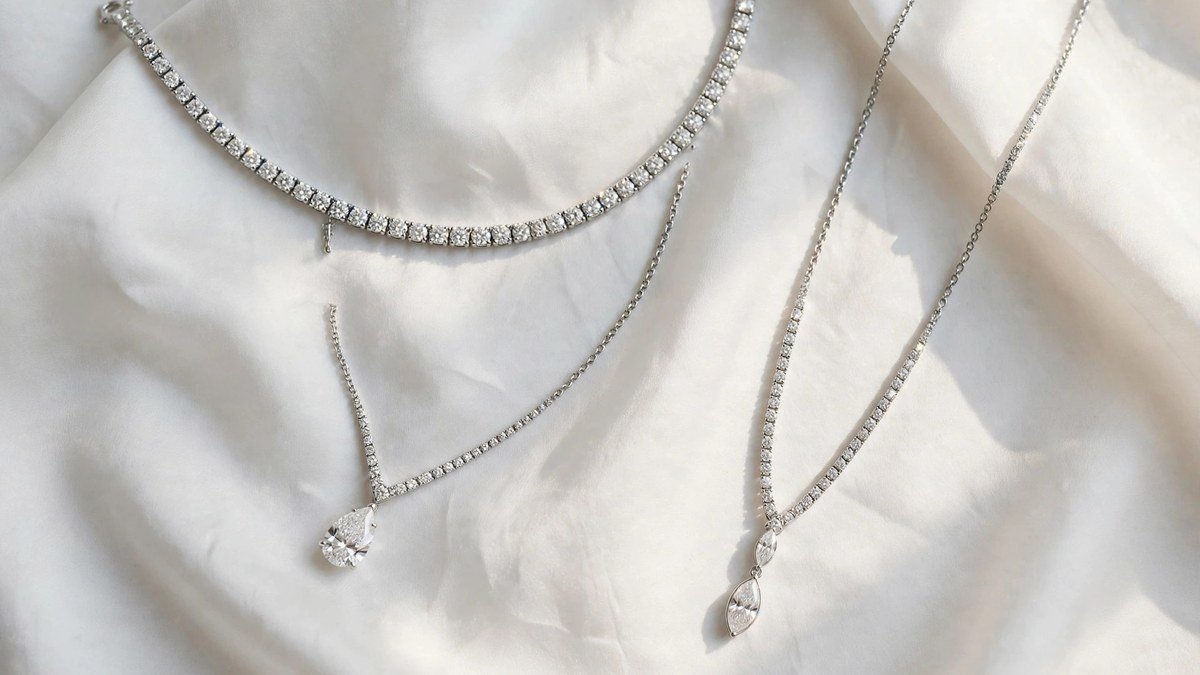
Diamond tennis necklace
What we like: A continuous line of matched diamonds, with sparkle from every angle, and a clean, luxurious look that needs no other jewellery. What to consider: Premium price, heavier than a pendant, and it needs an open neckline. Metal: White gold or platinum. Stone: Round brilliant diamonds, usually 2 to 5 carats in total. Setting: Prong-set line. Best for: Evening wear, weddings, and milestone occasions.
Diamond choker
What we like: Sits high on the neck, frames the face, and looks striking with strapless, off-the-shoulder, and V-neck styles. What to consider: Can feel tight if the length is wrong, and it suits a longer neck better. Metal: White or yellow gold. Stone: Small round diamonds, often in a line or a cluster. Setting: Prong or bezel. Best for: Evening wear and special occasions.
Diamond lariat necklace
What we like: A long, Y-shaped drop that lengthens the torso, suits high necklines and deep V-necks, and moves beautifully when you walk. What to consider: The drop can swing and catch, and the length needs to suit your height. Metal: White or yellow gold. Stone: A central diamond drop, with smaller diamonds along the chain. Setting: Prong-set drop. Best for: Evening wear, tall frames, and long dresses.
Diamond station necklace
What we like: Small diamonds spaced along a fine chain, light, modern, and easy to layer, with sparkle that is subtle rather than showy. What to consider: The spacing needs to be even, and a very fine chain can tangle if stored badly. Metal: White, yellow or rose gold. Stone: Small round diamonds, usually 0.05 to 0.15 carats each. Setting: Bezel-set stations. Best for: Everyday wear and layering.
Diamond halo pendant
What we like: A central diamond surrounded by smaller diamonds, which makes the centre look larger and brighter, with a romantic finish. What to consider: Heavier than a solitaire, needs more cleaning, and the halo can dominate a very small centre stone. Metal: White gold or platinum. Stone: Central round or oval diamond, usually 0.5 to 1 carat, with a halo of small diamonds. Setting: Halo, prong-set. Best for: Engagement-style pendants and special gifts.
Diamond bar necklace
What we like: A horizontal bar of diamonds, modern, clean, and graphic, with a strong line that suits crew necks and shirts. What to consider: Can look stark on its own, and the bar needs to sit flat, not twist. Metal: White or yellow gold. Stone: Small round or baguette diamonds in a line. Setting: Pavé or channel-set bar. Best for: Modern everyday wear and work.
Vintage-inspired diamond pendant
What we like: Milgrain edges, filigree, and an old-cut diamond give warmth, character, and a sense of history that a modern pendant does not have. What to consider: Detailed settings trap dirt and need gentle cleaning, and an old-cut stone sparkles differently from a modern brilliant. Metal: Yellow gold or platinum. Stone: Old European or old mine cut, usually 0.5 to 1 carat. Setting: Milgrain, filigree, or bezel. Best for: Vintage lovers, heirloom-style gifts, and bridal wear.
Layered diamond necklace set
What we like: Two or three chains at different lengths, ready-layered, with a pendant, a station chain, and a fine chain that work together without tangling. What to consider: More expensive than a single necklace, and the set only works if the lengths are right for your neck. Metal: Matching gold, usually yellow or white. Stone: Mixed small diamonds across the chains. Setting: Mixed prong and bezel. Best for: A complete look, gifting, and people who love layering but hate tangles.
Which diamond necklace is right for you
Start with your neckline, not the stone. A V-neck suits a pendant that follows the V, a crew neck suits a shorter necklace that sits above the collar, and a strapless dress suits a choker or a tennis necklace. A high neck suits a longer necklace, a lariat, or a layered set. If you wear the same neckline most days, choose the necklace that suits that neckline, not the one that suits a dress you wear twice a year.
Next, think about your skin tone and how often you will wear it. Cool skin tones, with blue veins, usually suit white gold and platinum. Warm skin tones, with green veins, usually suit yellow gold. Rose gold suits most skin tones. A bright, glowing complexion also helps a necklace look its best, and a vitamin C serum for brightening is often part of a polished, finished look. A necklace you wear every day should be light, secure, and easy to clean; a necklace for special occasions can be heavier and more dramatic.
The caveats that matter
Diamonds are durable, but they are not indestructible. A diamond can chip if it is hit hard at the edge, a prong can loosen, and a chain can wear thin. That is why a yearly check by a jeweller matters, especially for a necklace you wear every day. Ask for the prongs, the clasp, and the chain to be checked, and for the necklace to be cleaned professionally. Between checks, clean it gently with warm water, a mild soap, and a soft brush, and dry it carefully.
| Detail | What is known |
|---|---|
| Most useful length | 45 centimetres, on the collarbone, suits most necklines |
| What makes a diamond sparkle | Cut, more than carat weight alone; a well-cut stone returns more light |
| Best metal for cool skin | White gold or platinum, which keep a diamond looking white |
| Best metal for warm skin | Yellow gold, which adds warmth and suits classic and vintage styles |
| Most protective setting | Bezel, which wraps metal around the stone; prong lets in more light |
| What to check before buying | Chain strength, clasp security, stone security, and a certificate for the diamond |
| How to clean it | Warm water, mild soap, soft brush; professional clean and check once a year |
| What it does not do | It does not suit every neckline, and a cloudy or loose stone should be checked before buying |
Buy from a jeweller who gives you a certificate for the diamond, a clear returns policy, and a written description of the metal, the stone, and the setting. Keep the certificate, the receipt, and the care instructions together, and photograph the necklace for insurance.
Checklist: choosing a diamond necklace honestly
Use these checks before you buy, and again when you try the necklace on at home.
- Check the length with the neckline you will actually wear it with, not just in a shop mirror.
- Check the stone in daylight: it should look bright and lively, not cloudy, yellow, or dull.
- Check the setting: the stone should not move, the prongs should feel smooth, and the clasp should close securely.
- Check the certificate: it should match the stone, the metal, and the description you were given.
- Check the weight and comfort: wear it for ten minutes, sit down, and move your head before you decide.
- Check the care: ask how to clean it, how often to have it checked, and what the warranty covers.
Frequently asked questions
What length diamond necklace should I buy?
A 45-centimetre chain is the most useful starting point, because it sits on the collarbone and suits most necklines. A choker is 35 to 40 centimetres, and a matinee length is 50 to 60 centimetres.
Is a solitaire pendant or a tennis necklace better?
A solitaire is better for everyday wear: it is lighter, less expensive, and easier to style. A tennis necklace is better for evening wear and special occasions, when you want a continuous line of sparkle.
Which metal is best for a diamond necklace?
White gold and platinum suit cool skin tones and a modern look. Yellow gold suits warm skin tones and classic or vintage styles. Rose gold suits most skin tones.
How do I stop a layered necklace from tangling?
Choose chains at least five centimetres apart in length, use a layering clasp that keeps them separate, and store each chain flat or hanging, not in a pile.
Can I wear a diamond necklace every day?
Yes, if it is light, secure, and in a protective setting such as a bezel. A solitaire, a station necklace, or a bar necklace is usually suitable for daily wear.
How should I clean a diamond necklace?
Use warm water, a mild soap, and a soft brush, then dry it carefully. Have it cleaned and checked professionally once a year. Apply perfume and lotion first, let them dry, and put your necklace on last, as in a skincare routine by age, so it stays bright for longer.
The bottom line
The best diamond necklace in 2027 is not the largest or the most expensive. It is the one that suits your neckline, your skin tone, and your life, that feels comfortable after ten minutes, and that you will reach for again and again. For most people, that is a classic solitaire pendant or a station necklace in the metal they already wear.
Choose the length first, the setting second, and the stone third, and buy from a jeweller who gives you a certificate and a clear care plan. Wear it, enjoy it, and have it checked once a year. That is the honest way to buy a piece you will still love in ten years.
Note: This guide is general jewellery information, not financial or investment advice. Diamond prices vary by cut, colour, clarity, carat, and setting, so compare like with like, ask for a certificate, and check the returns policy before you buy.