
Choosing an engagement ring used to be a simple question: how big a diamond can you afford. In 2027, it is a more interesting question, because moissanite has become a serious alternative, not just a cheaper copy. It sparkles, it is durable, and it costs far less than a diamond of the same size. That leaves couples with a real choice, and a real need to understand what they are actually buying.
The confusion comes from the way the two stones are described. Moissanite is sometimes called a diamond alternative, sometimes a diamond simulant, and sometimes, incorrectly, a fake diamond. Diamond is sometimes described as the only real choice, and sometimes as an overpriced tradition. Neither description is fair. Diamond and moissanite are different stones, with different chemistry, different sparkle, and different strengths, and the right choice depends on what you value most: tradition and resale, sparkle and size, budget, or ethics.
Below is a plain, practical comparison for 2027, organised by what matters when you wear a ring every day: how it looks, how it lasts, how much it costs in general terms, and how it feels to choose it. There is no single winner. There is a best choice for your hand, your life, and your budget.
Key takeaways
- Diamond and moissanite are different stones: diamond is carbon, moissanite is silicon carbide, and they sparkle in different ways.
- Moissanite usually looks brighter and more fiery than a diamond of the same size, and it usually costs far less, so you can choose a larger stone for the same budget.
- Diamond is harder and has a longer tradition as an engagement stone, and it usually holds its resale value better than moissanite.
- Both stones suit everyday wear, but the setting, the metal, and the care matter as much as the stone itself.
- No stone suits every person and every budget, and a ring that looks cloudy, yellow, or loose in its setting should be checked by a jeweller before you buy.
What diamond and moissanite actually are
A diamond is a crystal of pure carbon, formed under heat and pressure, and cut to return light. Its hardness is 10 on the Mohs scale, the hardest natural gemstone, which is why it is used for a ring worn every day for decades. A natural diamond is mined, a lab-grown diamond is grown in a laboratory, and both are chemically the same stone. A lab-grown diamond is a diamond, not a simulant, and it usually costs less than a natural diamond of the same size and quality.
Moissanite is silicon carbide, a crystal first found in a meteor crater and now grown in a laboratory. Its hardness is 9.25 on the Mohs scale, very hard, second only to diamond among common engagement stones, and hard enough for everyday wear. It is not a diamond, and it is not glass or cubic zirconia. It is a stone in its own right, with its own sparkle, and it is usually sold as a diamond alternative because it looks similar at a glance, but behaves differently in the light.
The difference you will notice first is sparkle. Diamond sparkles with white light, called brilliance, and with flashes of colour, called fire. Moissanite has more fire than diamond: it throws back more rainbow flashes, especially in sunlight, which some people love and some people find too much. In a shop, under bright lights, moissanite often looks brighter than a diamond. In soft, indoor light, a diamond often looks calmer and whiter. Neither is better in an absolute sense. It is a matter of taste.
How to compare them and what to look for
Compare the stones in the same light, in the same setting, and at the same size, if you can. A small moissanite next to a large diamond is not a fair comparison, and a diamond under a shop spotlight is not how it will look in your kitchen. Ask to see both stones in daylight, by a window, and in ordinary indoor light. Look at the stone from the side as well as from the top, because colour and warmth are easier to see from the side, especially in a larger stone.

Look next at colour and setting. Diamonds are graded from D, colourless, to Z, visibly yellow or brown, and most engagement diamonds are in the near-colourless range. Moissanite is usually near-colourless, but it can show a warm or grey tint in larger sizes, especially in sunlight. A white gold or platinum setting makes a stone look whiter, a yellow gold setting adds warmth, a halo setting makes a centre stone look larger, and a bezel setting protects the stone and suits an active life. The ring should suit your hand, your work, and your wardrobe, not just the stone. A polished, finished look helps here too, and a vitamin C serum for brightening is part of the same idea: the ring is photographed on your hand, so healthy-looking skin and nails make any stone look better.
Diamond vs moissanite: the two stones in detail
Diamond
What we like: The hardest gemstone, with a long tradition as an engagement stone, a calm white sparkle, and the best resale value of the two stones. What to consider: Premium price, especially for a natural diamond, and a larger stone quickly becomes a much larger investment. Stone: Carbon crystal, natural or lab-grown. Hardness: 10 on the Mohs scale. Colour: D to Z, most engagement rings near-colourless. Sparkle: White brilliance with moderate fire. Best for: Tradition, longevity, and resale value.
Diamond is the stone to choose if tradition matters to you, if you want the hardest stone available, and if you want a ring recognised everywhere as an engagement ring. A lab-grown diamond gives you the same stone at a lower price than a natural diamond, which makes it a useful middle ground. Choose a well-cut stone, because cut is what makes a diamond sparkle, and a smaller, well-cut diamond often looks brighter than a larger, poorly cut one.
Moissanite
What we like: Brilliant, fiery sparkle, very hard and durable, and far less expensive than a diamond of the same size, so you can choose a larger stone. What to consider: More rainbow fire than a diamond, which some people love and some find too bright, and a possible warm tint in larger stones. Stone: Silicon carbide, lab-grown. Hardness: 9.25 on the Mohs scale. Colour: Usually near-colourless, with a possible warm or grey tint in larger sizes. Sparkle: High brilliance with strong fire. Best for: Size, sparkle, and budget.
Moissanite is the stone to choose if you want a large, bright stone for a mid-range budget, if you love rainbow sparkle, and if you are comfortable choosing a stone that is not a diamond. It is durable enough for everyday wear, it does not cloud over time in the way cubic zirconia can, and it is a practical choice for a ring that will be worn hard. Choose a reputable seller, because the quality of cut and colour varies more with moissanite than with a certified diamond.
The side-by-side comparison
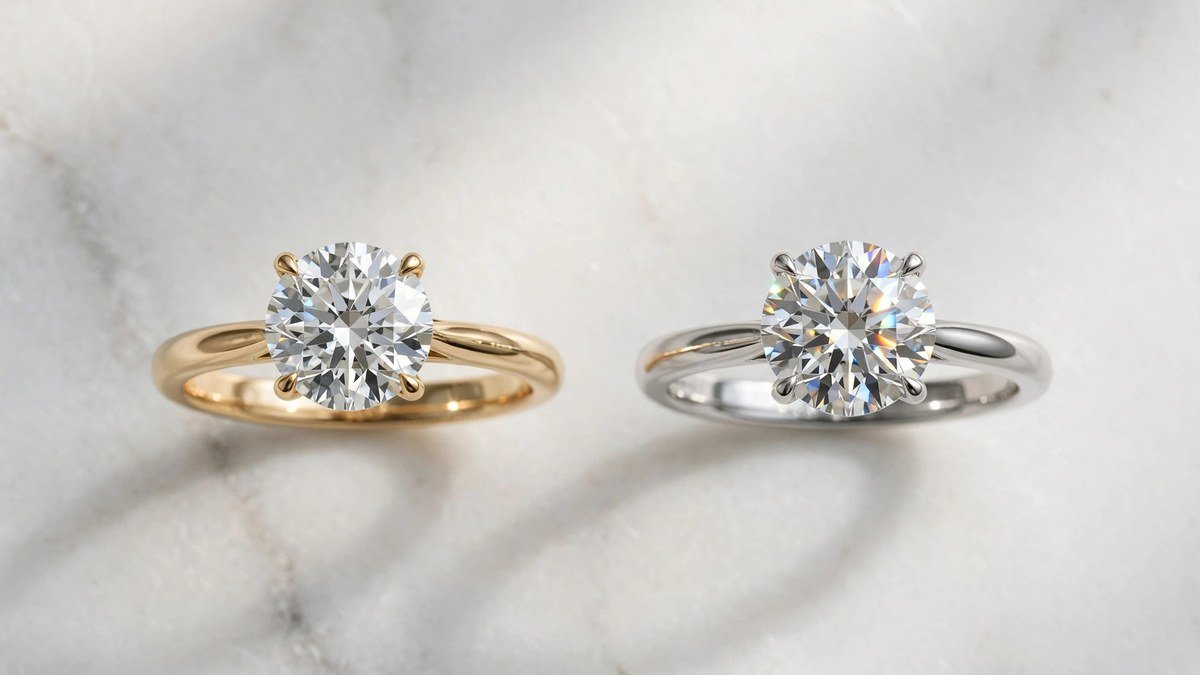
What we like: Seeing both stones together makes the choice clearer than any description: the diamond looks calmer and whiter, the moissanite looks brighter and more fiery. What to consider: A shop spotlight flatters moissanite more than diamond, so ask for daylight and indoor light before you decide. Size for the same budget: Moissanite usually gives a larger stone. Durability: Diamond is harder, moissanite is close behind. Resale: Diamond usually holds value better. Ethics: Both lab-grown diamond and moissanite avoid mining, while natural diamond needs a clear sourcing story. Best for: A final decision, made with your own eyes.
If you cannot decide from a description, do not decide from a description. See both stones, on your hand, in the setting you like, in daylight. The stone that makes you smile when you look down at it, in ordinary light, is the right stone for you.
Which stone is right for you
Start with your budget, honestly. If your budget is mid-range and you want a large stone, moissanite will give you more size for the same money, and that size is visible. If your budget is premium and you want a diamond, a smaller, well-cut diamond will look better than a larger, poorly cut one, and a lab-grown diamond will give you more size than a natural diamond at the same price. Do not stretch a budget for a stone you will worry about losing or damaging. A ring you wear without worry is a better ring than a ring you keep in a box.
Next, think about your life and what the ring means to you. If you work with your hands, a bezel setting and a durable stone matter more than size. If you want a ring that looks traditional in photographs, diamond is the safer choice. If you want a ring that sparkles in sunlight, moissanite is the more dramatic choice. Your dress and styling matter too: a classic, simple dress, like a yellow dress for a summer occasion, suits a simple solitaire, while a more dramatic outfit can carry a larger, more fiery stone. Some people want a diamond because it is what their family wore; some want moissanite because it is modern and lab-grown. Both reasons are valid.
The caveats that matter
Both stones need care, and both can be damaged if treated badly. A diamond can chip at the edge if hit hard, a moissanite can chip too, and a prong can loosen on either stone. Have the ring checked by a jeweller once a year, ask for the prongs and the setting to be checked, and have it cleaned professionally. At home, clean it gently with warm water, a mild soap, and a soft brush, and dry it carefully. Avoid harsh chemicals, and put the ring on after perfume, lotion, and hairspray, so the stone stays bright.
| Detail | What is known |
|---|---|
| What it is | Diamond is carbon; moissanite is silicon carbide, lab-grown |
| Hardness | Diamond 10 on the Mohs scale; moissanite 9.25, both suitable for daily wear |
| Sparkle | Diamond is calmer and whiter; moissanite is brighter with more rainbow fire |
| Colour | Diamond D to Z; moissanite usually near-colourless, possible warm tint in large stones |
| Price in general terms | Moissanite is usually far less than a diamond of the same size; lab-grown diamond sits in between |
| Resale value | Diamond usually holds value better; moissanite resale is more limited |
| Ethics and sourcing | Lab-grown diamond and moissanite avoid mining; natural diamond needs a clear sourcing story |
| What it does not do | Neither stone suits every taste, and a cloudy or loose stone should be checked before buying |
Buy from a jeweller who gives you a certificate or a clear written description for the stone, a clear returns policy, and a care plan. For a diamond, ask for a grading certificate. For moissanite, ask for a written description of the stone, the cut, and the colour, and for the warranty. Keep the certificate, the receipt, and the care instructions together, and photograph the ring for insurance.
Checklist: choosing between diamond and moissanite honestly
Use these checks before you buy, and again when you try the ring on at home.
- Check both stones in daylight and in ordinary indoor light, not just under a shop spotlight.
- Check the colour from the side: a warm or grey tint is easier to see from the side, especially in a larger stone.
- Check the setting: the stone should not move, the prongs should feel smooth, and the ring should feel comfortable after ten minutes.
- Check the paperwork: a certificate for a diamond, a clear written description and warranty for moissanite.
- Check the size for your hand: a large stone can overwhelm a small hand, and a small stone can look lost on a larger hand.
- Check the care: ask how to clean it, how often to have it checked, and what the warranty covers.
Frequently asked questions
Is moissanite a fake diamond?
No. Moissanite is a different stone, silicon carbide, with its own chemistry and sparkle. It is not glass, it is not cubic zirconia, and it is not a diamond, but it is a real gemstone in its own right, sold as a diamond alternative, not as a diamond.
Will people be able to tell my moissanite is not a diamond?
Most people will not, at a normal distance and in ordinary light. A jeweller, or someone looking closely in sunlight, may notice the stronger rainbow fire of moissanite. If that worries you, a smaller moissanite, or a diamond, may suit you better.
Is moissanite durable enough for an engagement ring?
Yes. At 9.25 on the Mohs scale, moissanite is very hard and suitable for everyday wear. It does not cloud over time in the way cubic zirconia can. Like a diamond, it still needs a secure setting and a yearly check.
Is a lab-grown diamond a real diamond?
Yes. A lab-grown diamond is chemically the same stone as a natural diamond, carbon crystal, grown in a laboratory instead of mined. It is a diamond, not a simulant, and it usually costs less than a natural diamond of the same size and quality.
Which stone holds its value better?
Diamond usually holds its resale value better than moissanite, especially a natural diamond with a certificate. Moissanite resale is more limited. If resale matters to you, diamond is the safer choice.
How should I care for my engagement ring?
Clean it gently with warm water, mild soap, and a soft brush, dry it carefully, and have it checked professionally once a year. Put it on after perfume, lotion, and hairspray, and take it off for heavy manual work, sport, and cleaning. Keeping your hands in good condition helps too, and a simple routine, such as our skin barrier guide, is a useful reminder: healthy, moisturised skin makes any ring look better in photographs.
The bottom line
There is no single winner between diamond and moissanite in 2027. Diamond is harder, more traditional, and better for resale, with a calm, white sparkle. Moissanite is brighter, more fiery, and far less expensive for the same size, with a modern, lab-grown story. A lab-grown diamond sits in between, giving you a real diamond at a lower price than a natural stone.
Choose the stone that suits your budget, your hand, and your values, and choose it with your own eyes, in daylight, in the setting you like. Then buy from a jeweller who gives you paperwork and a care plan, wear the ring, and have it checked once a year. That is the honest way to choose an engagement ring you will still love in ten years.
Note: This guide is general jewellery information, not financial or investment advice. Prices vary by stone, size, quality, setting, and seller, so compare like with like, ask for a certificate or written description, and check the returns policy before you buy.