What fits in a jacket pocket, weighs less than a paperback, and can turn a blurry shape on a distant ridge into a clearly identified bird? Compact binoculars. They are the most-carried, most-misunderstood piece of outdoor gear on the market. People buy them expecting magic, then get frustrated when the view looks dim or shaky. The problem is rarely the binocular. It is the mismatch between what the buyer expected and what a small optical instrument can actually do.
This guide cuts through the spec sheets. It explains what compact binoculars are genuinely good at, where they fall short, and which numbers on the box actually matter. There is no single “best” model, because the right pick depends entirely on whether the user is hiking at noon, birding at dawn, or watching a concert from the cheap seats.
What Counts as “Compact” in the First Place
There is no official standards body that defines a compact binocular. The term is industry convention, not regulation. In practice, most people mean a binocular with an objective lens diameter between roughly 20 mm and 32 mm, paired with magnification of about 7x to 10x. That is the size class that slips into a coat pocket or a small hip pouch.
That definition matters because it sets expectations. A smaller front lens gathers less light. That is physics, not a manufacturing flaw. Compact binoculars are daylight tools first. They can work at dusk, but they will never match a full-size 42 mm glass for brightness in low light.
The typical configurations look like this:
| Size | Magnification | Typical Use | Main Trade-off |
|---|---|---|---|
| 8×20 / 10×25 | 8x or 10x | Travel, hiking, concerts | Dim in low light, fussy eye placement |
| 8×32 | 8x | Birding, general outdoor use | Slightly bulkier, heavier |
| 10×32 | 10x | Open-country wildlife watching | Narrower field of view, harder to hold steady |
| 7×26 | 7x | Close-range birding, forest walks | Less reach at distance |
A traveler who wants something in a daypack will be happiest with the 8×20 or 10×25 class. A serious birder who wants one instrument for everything should look hard at an 8×32. It is the sweet spot most experienced users land on.
The Numbers That Actually Matter
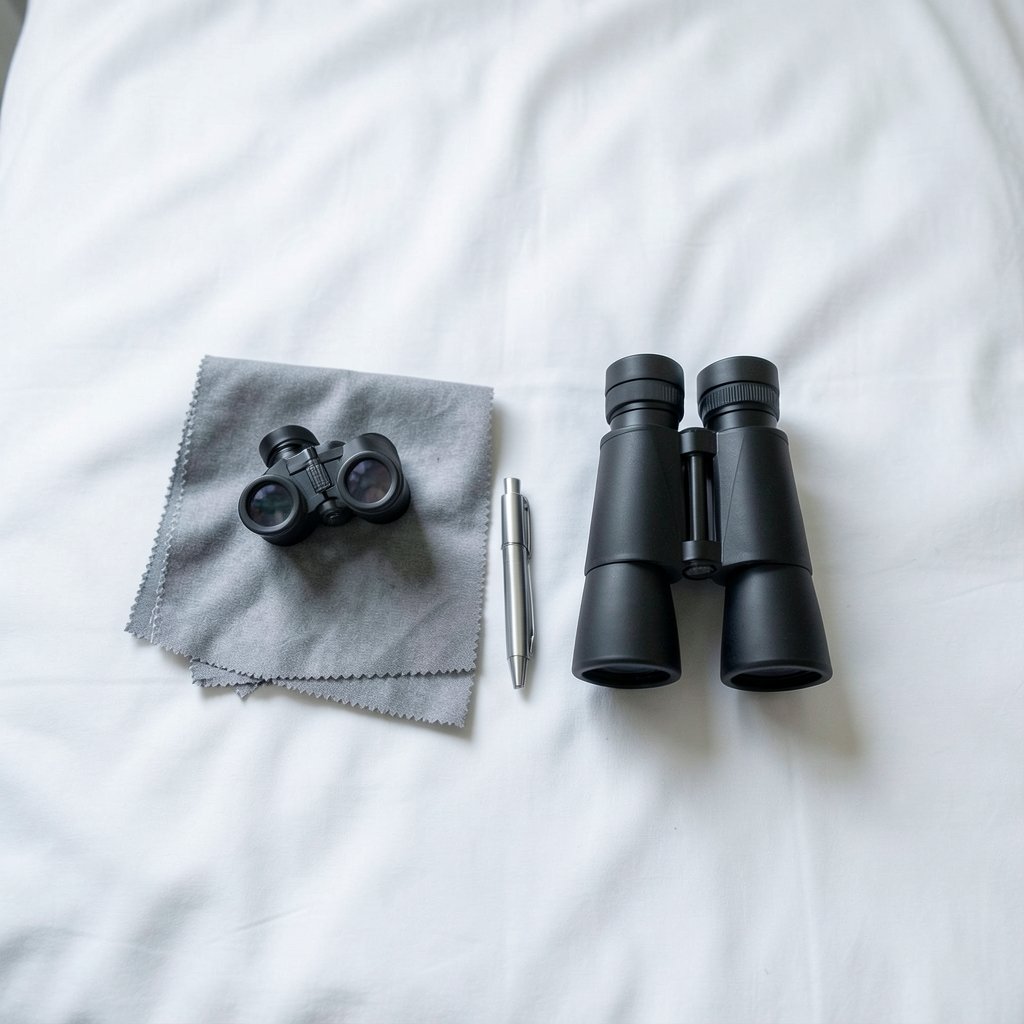
Spec sheets are crowded with figures, and some of them are marketing decoration. A few are genuinely decisive.
Exit pupil: the brightness math
Exit pupil is the objective diameter divided by the magnification. A 10×25 binocular has a 2.5 mm exit pupil. An 8×32 has 4 mm. That single number predicts two things: how bright the image looks in poor light, and how forgiving the binocular is about where the eyes sit behind the eyepiece.
A 2.5 mm exit pupil is fine at midday. At dusk it gets dim fast, and the user has to line their eyes up precisely or the view blacks out at the edges. A 4 mm exit pupil is noticeably more relaxed. This is why so many birders accept the extra bulk of an 8×32.
Eye relief: the eyeglass wearer’s number
Eye relief is the distance from the eyepiece at which the full field of view is visible. Roughly 15 mm or more is the commonly cited threshold for comfort with glasses. This is a rule of thumb, not a standard, but it holds up in practice. Anyone who wears spectacles should check this figure before buying anything. A binocular with short eye relief and no adjustable eyecups is a frustrating object for glasses wearers, no matter how good the glass is.
Field of view: how much sky you see
Field of view is quoted either as angular degrees or as feet or meters at 1,000 yards or meters. Higher magnification generally means a narrower field. That matters enormously when tracking a warbler flitting through branches or a hawk on the move. A wide field makes finding a fast subject far easier. A narrow field gives more detail once the subject is found. There is no free lunch, only priorities.
Prism type and coatings
Modern compact binoculars are dominated by roof-prism designs, because the straight-through light path allows a slim, pocketable body. Porro-prism models use offset prisms, which makes them bulkier but often cheaper for equivalent optical quality.
On roof-prism models, look for phase correction coatings. These reduce a phase shift that degrades contrast and resolution. They are a reliable marker of mid-tier and upper-tier quality. A roof-prism binocular without phase coating will usually look flat and soft next to one that has it.
Waterproofing and fogproofing
Waterproofing is often specified to IPX7 under IEC 60529, which means protection against immersion up to one meter for 30 minutes. Many makers claim “waterproof” without stating an IP rating, so the claim is not always comparable between brands.
Fogproof usually means the optical tube has been purged with nitrogen or argon to prevent internal condensation. It is a manufacturing claim, not a standardized test. Treat it as a good sign rather than a guarantee.
Where Compact Binoculars Shine, and Where They Don’t
Honest expectations save money and disappointment.
Compact binoculars are excellent for daylight hiking, travel, stadium events, and casual birding from a trail. They are genuinely good for anyone who would otherwise carry nothing because full-size binoculars feel like a burden. The best binocular is the one that is actually with you.
They are poor choices for astronomy, serious dawn and dusk wildlife watching, and any situation where the light is marginal. A 10×25 will show the moon’s craters, but it will not show faint star fields with any pleasure. That is not a defect. It is the design brief.
A practical note from field use: many people buy too much magnification. A 10x compact is harder to hold steady than an 8x, and the shake is amplified. For most hands, 8x delivers more usable detail than 10x because the image is calmer. Buyers who insist on 10x should look for a model with good balance and a wide strap.
Mistakes Buyers Make Again and Again
A few errors show up so often they are worth naming directly.
Buying on magnification alone. The biggest number on the box is the least useful guide to quality. A well-made 8×32 will outperform a cheap 12x compact in every condition that matters.
Ignoring eye relief. Glasses wearers who skip this spec often end up with a binocular they cannot use comfortably. Check it before anything else.
Skipping the return window test. The only real test is looking through the thing. Buy from a seller with a generous return policy, take it outside at dusk, and look at a backlit branch. If the view is muddy or the edges black out constantly, send it back.
Forgetting the strap and case. A compact binocular with a flimsy strap will swing and clatter. A decent padded case protects the coatings, which are delicate. These accessories are not glamorous, but they determine whether the instrument survives a season.
Assuming “compact” means “toy.” Modern compact roof-prism binoculars with phase coatings and decent glass are serious optical instruments. The category has improved enormously, and a good 8×32 today beats premium compacts from twenty years ago.
Matching the Binocular to the User
The most useful way to shop is to start from the use case, not the spec sheet.
For a day hiker or traveler, an 8×20 or 10×25 roof-prism model with phase coatings and a stated IP rating is ideal. Light, pocketable, and good enough in daylight. Weight matters more than brightness here.
For a birder who wants one instrument, an 8×32 is the pragmatic answer. It balances brightness, field of view, and portability. It handles dawn better than any 25 mm model and still fits in a large pocket.
For open-country wildlife watching, a 10×32 gives extra reach for scanning distant ridges, at the cost of a narrower field and a shakier image.
For forest walks and close-range birding, a 7×26 offers a wide field, a bright image for its size, and very steady viewing. It is an underrated configuration.
Analogy from other gear categories is not usually applied to optics, but the principle is familiar to anyone who has learned that the right product depends on the specific job rather than the biggest label. The same logic that makes 4c hair care different from 2b hair routines applies here: match the tool to the actual conditions, not to a generic recommendation.
What to Check in the First Five Minutes of Ownership
Once the box is open, a short checklist catches most problems before the return window closes.
- Look through both barrels at a plain, bright surface. The image should be a single clean circle, not two overlapping ones.
- Check the focus wheel. It should turn smoothly with no gritty spots or excessive play.
- Twist the eyecups up and down. They should click firmly into position and stay there.
- Look at a high-contrast edge, such as a roofline against the sky. Colors should stay clean, with no strong purple or green fringing at the edges.
- Take it outside at dusk and look at a backlit branch. This is the honest test of brightness and contrast.
- Weigh it in a jacket pocket. If it feels like a brick, it will stay home.
That last point deserves emphasis. The best compact binoculars are the ones that get carried. A marginally sharper instrument left in a drawer loses to a good-enough one that goes on every walk. This is the same lesson that shows up across gear categories, whether the topic is optics or the styling choices discussed around the row: practical fit beats theoretical superiority almost every time.
Conclusion
There is no objective ranking of the best compact binoculars, because “best” depends on the job. A traveler needs light weight and pocketability. A birder needs brightness and a forgiving exit pupil. A stadium-goer needs a wide field and steady handling. The specifications that matter most are exit pupil, eye relief, field of view, phase-corrected roof prisms, and a stated waterproofing rating. Everything else is detail.
The practical path is simple. Decide the main use, pick the size class that fits it, check the numbers that affect comfort, and buy from a seller who allows returns. Then take the binocular outside at dusk and look at a backlit branch. That single test will tell more than any review.
FAQ
What size compact binoculars are best for travel?
For travel, 8×20 and 10×25 models are the most practical. They fit in a jacket pocket and weigh very little. The trade-off is a small exit pupil, so they perform best in daylight. Anyone who expects to use them at dawn or dusk should step up to an 8×32. (2b hair)
Is 8x or 10x better for compact binoculars?
For most people, 8x is the better choice. It produces a calmer image that is easier to hold steady, and it usually offers a wider field of view for finding subjects quickly. A 10x compact gives more reach but amplifies hand shake and narrows the field.
What does exit pupil mean on binoculars?
Exit pupil is the objective lens diameter divided by the magnification. A 10×25 binocular has a 2.5 mm exit pupil, while an 8×32 has 4 mm. A larger exit pupil gives a brighter image in low light and makes eye placement more forgiving.
How much eye relief do eyeglass wearers need?
Roughly 15 mm or more is the commonly cited comfort threshold for people who wear glasses. This is a rule of thumb rather than a formal standard, but it is a reliable guide. Buyers should check the figure before purchasing and confirm the eyecups adjust.
Are compact binoculars waterproof?
Many are, but the claim varies in meaning. Some models are specified to IPX7 under IEC 60529, meaning protection against immersion up to one meter for 30 minutes. Others simply say “waterproof” without an IP rating, which makes comparisons between brands difficult.
Can compact binoculars be used for stargazing?
They can show the moon and a few bright objects, but they are not well suited to astronomy. Small objective lenses gather little light, and the resulting views of faint star fields are dim. Full-size binoculars with larger objectives are the better tool for night sky viewing.