Every great soup starts long before the soup itself, and that is why learning how to make soup stock is one of the most useful skills in any kitchen. A pot of stock turns bones, vegetable peelings and a few hours of gentle heat into a rich, savoury liquid that makes everything it touches taste better.
So how do you make soup stock? Simmer bones or vegetables with water and aromatic vegetables for several hours, strain the liquid, and cool it quickly. This guide covers the method for chicken, beef and vegetable stock, and how to store it safely.
Key takeaways:
- Simmer bones or vegetables in water with onion, carrot and celery, then strain the liquid.
- Chicken stock needs three to four hours, beef stock needs six to eight hours, and vegetable stock needs about one hour.
- Keep the pot at a gentle simmer, never a rolling boil, and skim off any foam that rises to the surface.
- Cool stock quickly, refrigerate it within two hours, use it within three to four days, or freeze it for longer storage.
What is soup stock?
Soup stock is a flavoured liquid made by simmering bones, meat or vegetables in water with aromatic vegetables and herbs. It is the foundation of soups, stews, sauces, risottos and gravies.
Bones release gelatine, which gives stock its body, while vegetables and herbs add sweetness and aroma.
What is the difference between stock and broth?
Stock and broth are often used as if they mean the same thing, but there is a real difference. Stock is made mainly from bones, simmered for a long time to extract gelatine, and it is usually left unsalted. Broth is made mainly from meat, simmered for a shorter time, and it is usually seasoned and ready to eat as it is.
What do you need to make soup stock?
The equipment is simple. You need a large, tall pot, a fine sieve or colander lined with muslin, a ladle, and containers for storage. A tall pot is better than a wide one, because less surface area means less evaporation.
The ingredients are equally simple. For a chicken or beef stock you need bones, water, and the classic trio of onion, carrot and celery, plus a bay leaf and a few peppercorns. For a vegetable stock you need a good mix of vegetables and the same aromatics. Stock is about time and technique.
Which bones make the best stock?
The best bones for stock are the ones with joints and connective tissue, where the gelatine comes from. For chicken stock, a raw carcass, wings, backs and necks are ideal, and the leftover bones from a roast chicken work beautifully. For beef stock, marrow bones, knuckle bones and oxtail give the richest result.
If you roast a chicken at the weekend, our guide to how to roast a chicken leaves you with a carcass that is perfect for stock.
How do you make chicken stock, step by step?
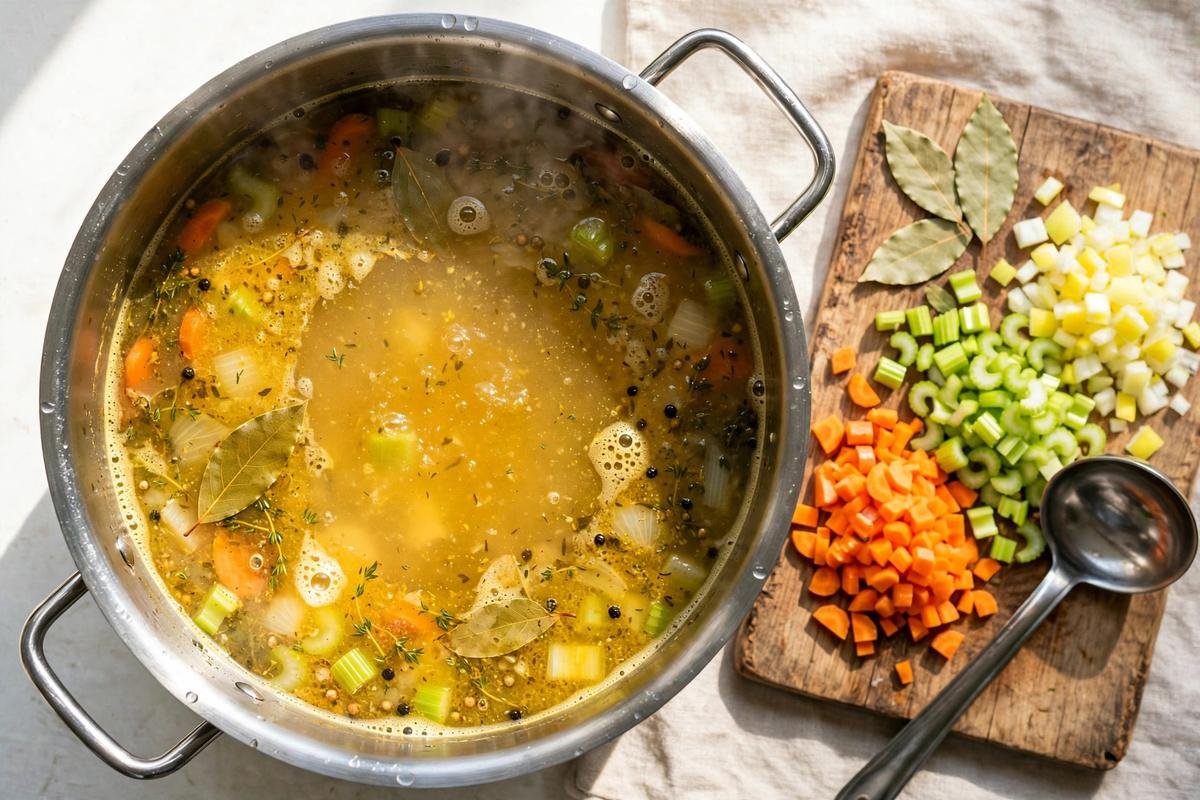
Put the bones in a large pot and cover them with cold water, about four litres for a chicken carcass and a couple of wings. Cold water matters: it draws the flavour out of the bones gradually, while hot water can seal the surface and cloud the stock. Bring the pot slowly to the boil, then turn the heat down at once.
As the water heats, a grey foam will rise to the surface. Skim it off with a spoon and throw it away. Removing it keeps the finished stock clear and clean-tasting. Once the foam stops appearing, add a chopped onion, two carrots, two sticks of celery, a bay leaf and a few whole peppercorns.
Now leave the pot alone. Keep it at the gentlest simmer, with only the occasional bubble breaking the surface, for three to four hours. Do not let it boil hard, and do not stir it. When the time is up, strain the stock through a fine sieve into a clean bowl or jug.
How do you make beef stock?
Beef stock follows the same method, with one extra step at the start. Roast the bones in a hot oven until they are deeply browned, about forty-five minutes at 200 degrees Celsius, and roast the onion, carrots and celery alongside them for the last twenty minutes. Browning gives beef stock its deep colour and rich flavour.
Transfer the roasted bones and vegetables to the pot, cover with cold water, and add a splash of water to the roasting tray to loosen the browned bits, pouring that in too. Bring the pot slowly to the boil, skim the foam, and simmer gently for six to eight hours.
How do you make vegetable stock?
Vegetable stock is the quickest of the three, and it needs no bones at all. Chop a generous mix of vegetables, such as onion, carrot, celery, leek and mushrooms, with garlic, a bay leaf, thyme and peppercorns. Avoid strong-flavoured vegetables such as cabbage, broccoli and cauliflower, which can make the stock bitter.
Cover the vegetables with cold water, bring the pot to the boil, skim if needed, then simmer gently for about an hour. Strain the stock through a fine sieve, pressing the vegetables gently with the back of a spoon to get the last of the liquid out.
Should you add salt to stock?
Most cooks leave stock unsalted, and there is a good reason. Stock is an ingredient, not a finished dish, and it will be reduced, combined with other ingredients, and seasoned later. If you salt the stock now and then reduce it in a sauce, the sauce can end up far too salty.
Season the finished dish instead, tasting as you go. The one exception is a stock you plan to drink as a light broth, which can be salted lightly at the end. For a classic use, our guide to how to make mashed potatoes shows how a splash of warm stock can make mash richer without extra butter.
What are the most common mistakes?
The most common mistake is boiling the stock hard, which makes it cloudy and greasy. The second is starting with hot water, which seals the bones and gives a thinner stock. The third is skipping the skim, which leaves the stock murky with a slightly bitter edge.
Adding too many strong vegetables, such as cabbage or turnip, can overpower the stock. Simmering vegetable stock for hours, like a beef stock, makes it dull and tired. And salting early limits what you can do with the stock later. A good heavy pot helps too, and our guide to best cookware sets covers the kind of pot that holds a steady simmer.
How do you store soup stock safely?
Stock is a perishable food, and safe storage matters as much as good cooking. Cool the stock quickly after straining: pour it into shallow containers, or stand the pot in a sink of cold water, and get it into the fridge within two hours. Do not leave hot stock out overnight.
In the fridge, stock keeps for three to four days in a sealed container. To freeze it, pour the cooled stock into containers or ice cube trays, leaving room for expansion, and label each one. Frozen stock keeps well for three to four months.
How do you use homemade stock?
Homemade stock earns its place in almost every savoury dish you cook. Use it as the base for soups and stews, to cook rice and grains, and to make sauces and gravies. A ladle of stock turns a simple pan sauce into something special.
Keep a few portions in the freezer and you will reach for stock constantly. Ice cube trays are ideal for small amounts: a couple of cubes is enough to enrich a sauce or loosen a risotto, while larger containers suit soups and stews. Leftover roast chicken is another good starting point, and our guide to rotisserie chicken covers a bird whose bones are made for the stockpot.
Soup stock at a glance
| Stock | Main ingredient | Simmering time | Best for |
|---|---|---|---|
| Chicken stock | Chicken bones and carcass | 3 to 4 hours | Soups, risottos, sauces |
| Beef stock | Roasted beef bones | 6 to 8 hours | Stews, gravies, rich sauces |
| Vegetable stock | Mixed vegetables and herbs | About 1 hour | Vegetarian soups, grains |
| Fish stock | Fish bones and heads | 30 to 45 minutes | Fish soups and sauces |
Times are for a gentle simmer. A hard boil will cloud the stock, whatever type you are making.
Your soup stock checklist
Work through this list before you start your first pot.
- Choose your stock: chicken, beef or vegetable, and gather the bones or vegetables.
- Use a tall pot, cover the ingredients with cold water, and bring it slowly to the boil.
- Skim off the foam, then add onion, carrot, celery, a bay leaf and peppercorns.
- Simmer gently, never boil hard, and do not stir the pot.
- Strain through a fine sieve and discard the bones and vegetables.
- Cool quickly, refrigerate within two hours, use within three to four days, or freeze for up to three to four months.
Frequently asked questions
Can you make stock from a roast chicken carcass?
Yes, and it is one of the best uses for it. A leftover roast chicken carcass makes a rich stock in three to four hours. Add the same onion, carrot, celery, bay leaf and peppercorns, cover with cold water, and simmer gently. It is the thriftiest stock there is, because the main ingredient would otherwise be thrown away.
Why is my stock cloudy?
Cloudy stock is usually caused by boiling too hard or stirring the pot during simmering. A rolling boil churns fat and protein into the liquid, and stirring does the same. Keep the heat low, skim the foam, and leave the pot alone.
Can you reuse the bones for a second pot of stock?
You can, but the second pot will be noticeably weaker. The first simmer extracts most of the flavour and gelatine, so a second stock is best used for cooking grains or as a light base rather than as a soup.
How do you defat stock?
Let the stock cool in the fridge until the fat sets into a solid layer on top, then lift it off with a spoon. This is the easiest method and it works every time.
Is homemade stock better than shop-bought?
Homemade stock usually tastes richer and cleaner, because it is made from real bones and vegetables with no added flavourings, and you control the salt. Shop-bought stock is convenient and perfectly good for everyday cooking, but it rarely has the body of a homemade stock.
Can you make stock in a slow cooker?
Yes. Put the bones or vegetables, water and aromatics in the slow cooker, cook on low for eight to ten hours for chicken stock, or ten to twelve for beef, then strain. Vegetable stock still only needs about two hours on low.
The last ladle
Stock is one of those kitchen skills that repays itself every week. A single pot on a quiet afternoon gives you the base for soups, stews, sauces and grains for months, and it costs almost nothing if you save your bones.
Your next step is simple: save the bones from your next roast, put a pot on the hob, and give it three unhurried hours. A well-stocked freezer, like a well-organised kitchen, is the quiet foundation of good cooking, and our guide to fridge storage will help you keep it all in order.