

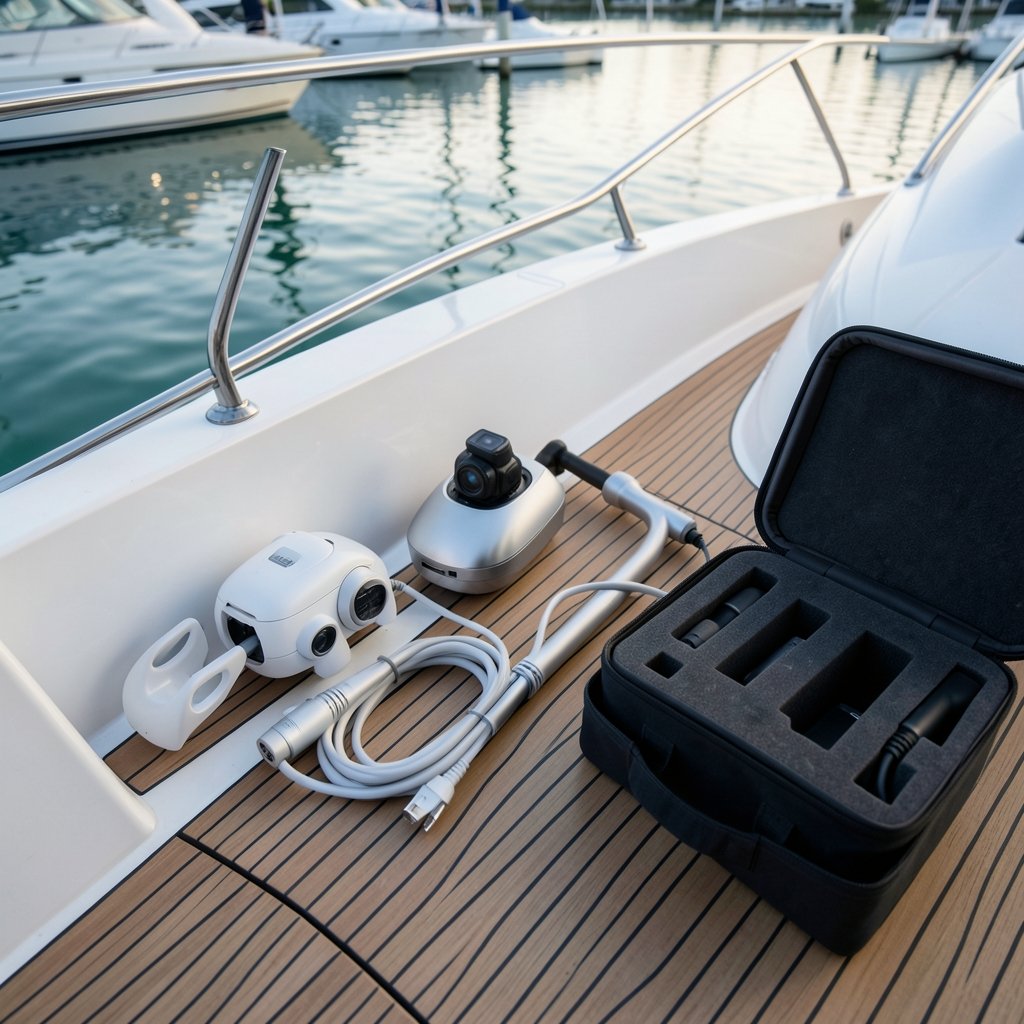
Ever watched a charter guest stare at a floating mat for twenty minutes, then ask the crew if there’s “anything else”? That moment explains the entire submersible toy market. Floating loungers are fine. Toys that disappear below the surface, glide past a reef at speed, or park themselves on the seabed and film the hull are what guests actually talk about at dinner.
The category is shifting fast. Battery chemistry is improving, depth ratings are creeping upward, and manufacturers are packing cameras and lights into hulls that weighed twice as much five years ago. Below are eight submersible yacht toys that look strongest for 2027, judged on practical factors crews care about: launch weight, charging logistics, maintenance, and how well each toy survives a full charter season.
How These Eight Were Chosen
No single spec sheet tells you whether a toy belongs on a yacht. A seabob with a brilliant top speed is useless if it needs two crew to launch it. A submersible with a 100-metre depth rating is a liability if nobody aboard is trained to run it. The picks below weigh four things: realistic launch and recovery, battery and charging practicality, guest skill floor, and serviceability in the cruising grounds most yachts actually visit.
One caution worth stating plainly. Model-year lineups for 2027 are still firming up as this is written, and specs can change between announcement and delivery. Treat every number here as a starting point for a conversation with a dealer, not a contract.
1. Seabob F5 Series: The Toy That Still Sets the Standard

The Seabob remains the default submersible toy on most charter yachts, and for good reason. It is a tow-along, hand-held diver propulsion vehicle that pulls a rider through the water rather than requiring swimming effort. The F5 family sits at the practical end of the range: lighter than the high-performance SR models, easier for a nervous guest to handle, and simple to charge overnight.
What makes it work in practice is the low skill floor. A guest can be briefed in five minutes and be gliding in ten. The common mistake is buying the most powerful model in the range and then discovering half the charter party is intimidated by it. For family-heavy bookings, two mid-range units beat one flagship every time.
2. High-Performance Seabob SR Models: For the Speed-Obsessed
The SR variants trade some ease of use for thrust and pace. They suit yachts whose guests are repeat charterers, watersports-fit, and bored by anything that doesn’t hit a decent clip underwater.
The practical catch is battery discipline. High-draw sessions drain cells quickly, and a charter with back-to-back users needs a charging rotation planned before the first guest touches the water. Crews that get this right run a simple board: who rode, when, and which unit is on charge. Crews that don’t end up with two dead toys and an unhappy afternoon.
3. Underwater Scooters: The Lightweight Alternative
Not every guest wants a full seabob session. Compact underwater scooters fill the gap: light enough for one person to carry down a passerelle, simple twist-and-go controls, and a battery that covers a relaxed reef cruise rather than a sprint.
These are the toys that get used most on quiet afternoons, precisely because the barrier to entry is so low. The trade-off is depth capability and range. They are snorkel-depth tools, not exploration vehicles, and any crew member who markets them as the latter will be answering awkward questions later.
4. eFoils: The Submersible-Adjacent Crowd-Pleaser
Strictly speaking, an eFoil rides above the water, not below it. In practice it belongs in this conversation because it has displaced submersible toys in the guest popularity stakes on many yachts. The hydrofoil mast and wing sit submerged, the rider flies above the surface, and the sensation is unlike anything else in the toy locker.
The honest assessment: eFoils have a steep learning curve and a real injury risk for the overconfident. They also demand flat water and a safety-conscious operator. Where they work, they dominate the schedule. Where they don’t, they sit in the garage. If a yacht is weighing a submersible purchase against an eFoil, the deciding question is guest profile, not spec sheets. Anyone planning a 2027 season around watersports should also look at how broader luxury travel expectations are shifting, since luxury yacht charters you actually pay for increasingly hinge on the toy inventory as much as the itinerary.
5. Personal Submersibles: The Serious Exploration Option
At the top of the market sit compact personal submersibles capable of carrying a pilot and passenger well below recreational diving limits. These are not toys in any casual sense. They require trained operators, certification, insurance review, and a support plan that most yachts cannot improvise.
For the small number of vessels that can support one, a personal submersible changes what a charter can offer: wreck visits, deep reef structures, and dives no snorkeller will ever see. For everyone else, the honest advice is to charter a support vessel or book a dedicated expedition rather than bolt a submersible onto a yacht that isn’t built around it. The logistics of a full charter week, including how toys fit into the daily rhythm, are covered well in this breakdown of what a luxury yacht charter in Indonesia really involves.
6. Towable Dive Torpedoes: The Budget Workhorse
Tow-behind dive torpedoes let a guest hold on while the tender pulls them under and along the surface. They are cheap relative to powered toys, almost indestructible, and genuinely fun for teenagers who find a seabob intimidating.
The limitation is control. The rider goes where the tender driver goes, which means the experience is only as good as the driver. Crews who treat towables as a fill-in activity rather than a headline one get the most out of them.
7. Underwater Camera Rigs and Housings: The Force Multiplier
A camera in a proper underwater housing is not glamorous, but it may be the highest-return item on this list. Every guest wants footage. A crew-operated rig that captures seabob runs, reef passes, and hull inspections turns a good day into content guests share for years.
The practical point most buyers miss: the housing matters more than the camera. A mid-range body in a well-maintained housing with a decent light outperforms a flagship body in a cheap case with no illumination. Budget for lights and a spare battery set before upgrading the camera itself.
8. Seabed Exploration ROVs: The Quiet Utility Player
Remotely operated vehicles have crossed from commercial tool to yacht accessory. A compact ROV can inspect the hull and running gear, check an anchor set, film the seabed under the stern at anchor, and give guests a live feed of a reef wall from the comfort of the aft deck.
The appeal is that an ROV earns its keep even when nobody is playing with it. Hull inspections that once meant a diver call become a twenty-minute task. The catch is tether management and piloting skill; a tangled tether in current is a frustrating way to spend an afternoon.
Comparison at a Glance
| Toy | Best for | Skill floor | Key practical concern |
|---|---|---|---|
| Seabob F5 | General charter use | Low | Charging rotation across guests |
| Seabob SR | Fit, repeat guests | Medium | Fast battery drain |
| Underwater scooters | Casual snorkel days | Very low | Range and depth limits |
| eFoil | Adrenaline seekers | High | Injury risk, flat water needed |
| Personal submersible | Expedition yachts | Very high | Certification and support crew |
| Towable dive torpedo | Families, teenagers | Low | Depends entirely on driver |
| Camera rig and housing | Every yacht | Low | Housing quality, lighting |
| Compact ROV | Utility plus guest viewing | Medium | Tether handling |
Mistakes Buyers Make Again and Again
The first is buying for the brochure rather than the guest list. A toy that impresses on a spec sheet but intimidates half the charter party becomes garage ballast. The second is underestimating charging infrastructure. Lithium battery packs need proper storage, ventilation, and a charging plan that doesn’t overload the yacht’s systems, and air transport of spare packs is governed by strict rules that vary by carrier and route.
The third mistake is skipping training. Every powered submersible toy on this list has a failure mode that a five-minute briefing prevents. The fourth is forgetting storage: toys that live in a damp locker without rinse-and-dry discipline corrode, seize, and fail within a season.
Matching Toys to the Charter Week
A family week in calm water wants seabobs, scooters, and towables. An adventure itinerary with strong currents and deep walls wants ROVs, camera rigs, and trained operators. A fashion-forward charter where guests care about the aesthetic of the experience as much as the activity may respond better to a curated toy selection than a crowded garage. The same logic that shapes 2027 bridal hair trends that actually work down the aisle applies here: what looks good in a showcase is not always what holds up under real conditions.
Conclusion
The best submersible yacht toy for 2027 is not the one with the deepest rating or the highest top speed. It is the one your guests will actually use, your crew can actually maintain, and your charging setup can actually support. Seabobs remain the safest all-round bet, scooters cover the casual end, ROVs and camera rigs earn their space through utility, and submersibles and eFoils reward yachts built around them. Buy for the guest list, plan the charging, train the crew, and the toy locker will earn its place in the charter brochure.
Frequently Asked Questions
What is a submersible yacht toy?
A submersible yacht toy is any powered or towed device that takes a guest below the surface or along it, such as a seabob, underwater scooter, dive torpedo, or personal submersible. The category also covers remotely operated vehicles used for inspection and viewing.
How much does a seabob cost?
Prices vary widely by model and specification, and they change between model years. The practical approach is to request a current quote from an authorized dealer and factor in spare batteries, a charging station, and service costs, which together can add a meaningful percentage to the purchase price.
Can you fly with lithium batteries for water toys?
Most powered water toys use lithium battery packs that are subject to air transport rules, and large packs are frequently restricted or prohibited in passenger baggage. Always check with the specific airline and freight forwarder before shipping packs separately from the toy.
Do you need training to use a personal submersible?
Yes. Personal submersibles require trained operators, and most manufacturers run formal pilot courses. Insurance providers typically expect documented training, and yachts without a trained operator should not carry one as a guest toy.
How do you maintain submersible toys between charters?
Freshwater rinsing after every use, proper drying before storage, periodic inspection of seals and battery contacts, and adherence to the manufacturer’s service intervals. Corrosion and seal failure are the most common causes of premature failure.
Are eFoils worth it for a charter yacht?
They can be, if the guest profile suits them and the yacht has flat water, a safety-conscious operator, and storage space. For families with young children or guests who prefer low-effort activities, the money is usually better spent on seabobs and scooters.









