

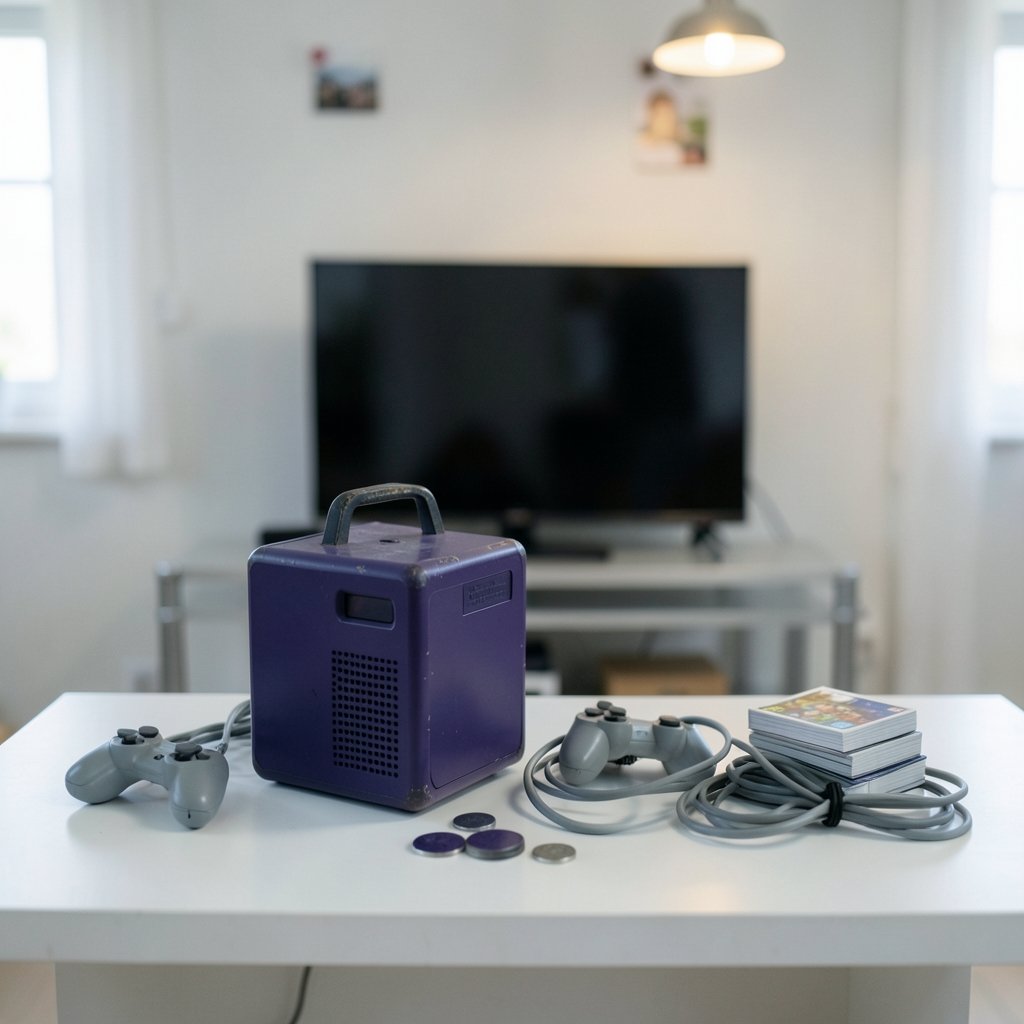
What if the smallest, weirdest-looking console of its generation quietly built one of the strongest game libraries of all time? That is the story of the Nintendo GameCube. The purple cube with a carry handle launched in Japan on September 14, 2001, reached North America on November 18, 2001, and arrived in Europe on May 3, 2002. Nintendo discontinued it in 2007 after roughly 21.7 million units sold worldwide, far behind the PlayStation 2’s estimated 155 million. Yet here players are, decades later, still arguing about the best GameCube games and still hunting down copies.
That gap between commercial performance and lasting affection tells you something. The GameCube lost the sales war, but it won a lot of hearts. This guide breaks down the games that matter, why they hold up, and how to approach the library without wasting money on the wrong discs.
Why the GameCube library still matters
The GameCube’s library is small compared with its rivals, but it is unusually dense with quality. Nintendo treated the console as a laboratory. It produced bold, strange experiments like Pikmin and Eternal Darkness alongside polished flagship titles like The Legend of Zelda: The Wind Waker and Metroid Prime.
Hardware shaped the games too. The console used 1.5 GB proprietary miniDVD discs, which limited storage compared with the PS2’s DVD format. Developers had to be economical, and that constraint often produced tighter, more focused games rather than bloated ones. Four controller ports built in meant couch multiplayer was a default assumption, not an afterthought.
One practical warning for newcomers: many “best GameCube games” lists mix in games that were merely ported to the system. A great game that plays better elsewhere is not the same as a great GameCube game. The list below favors titles where the GameCube version is either definitive or historically important.
The top tier: games that define the console
The Legend of Zelda: The Wind Waker
When it launched, the cel-shaded art style caused genuine outrage among fans who wanted a realistic Link. Time proved the critics wrong. The Wind Waker’s expressive animation has aged better than almost any game of its era, and its Great Sea overworld rewards curiosity in a way few open worlds manage. The sailing can feel slow by modern standards, and the late-game Triforce hunt is a legitimate complaint. Still, this is the GameCube’s signature adventure and the first game most people should play.
Metroid Prime
Retro Studios took a 2D side-scrolling series and rebuilt it as a first-person adventure, and somehow it worked. Scanning, backtracking, and atmosphere do the heavy lifting here. Metroid Prime is regularly cited as one of the highest-rated GameCube titles, with scores around 96 to 97 on review aggregators. The control scheme feels unusual at first on original hardware, but the world design remains a masterclass in environmental storytelling.
Resident Evil 4
Capcom’s reinvention of survival horror arrived in January 2005 in North America and Japan, and in March 2005 in Europe. The over-the-shoulder camera became an industry standard almost overnight. It has been ported to nearly everything since, so the GameCube version is not the only way to play it. What makes it essential here is context: this is where that formula was born, and the GameCube original still plays cleanly.
Super Smash Bros. Melee
Melee is the rare party game that became a competitive institution. Its speed and movement options created a scene that outlived the console by decades. For casual players, it is a fantastic four-player brawler. For competitive players, it is a lifelong pursuit. Either way, it belongs near the top of any honest ranking.
Super Mario Sunshine
This one divides people. The FLUDD water pack mechanic is inventive, the setting is sunny and confident, and the difficulty spikes are real. Some players find the camera and certain shine sprites frustrating. Others consider it the most underrated 3D Mario. It is worth playing precisely because it takes risks the series later avoided.
The second tier: brilliant games people forget to mention
Paper Mario: The Thousand-Year Door
Released in 2004, this is widely regarded as the best entry in the Paper Mario series. The writing is genuinely funny, the audience-in-the-theater battle gimmick is clever, and the partner characters have actual personalities. If someone asks for a GameCube role-playing game, this is the answer.
Pikmin and Pikmin 2
The original Pikmin (2001) is a gentle strategy game about managing tiny plant creatures against a 30-day time limit. Pikmin 2 (2004) removed the time pressure and added caves and two-player modes. The first game is tighter and more tense. The second is friendlier and much longer. Play the first for the design, the second for the content.
Eternal Darkness: Sanity’s Requiem
Silicon Knights built a horror game around a sanity meter that messes with the player as well as the character. Fake crashes, phantom controller disconnects, and unsettling audio tricks are part of the design. It is rough around the edges in 2000s ways, but nothing else on the console does what it does.
F-Zero GX
Made with Sega’s Amusement Vision studio, F-Zero GX is brutally fast and brutally hard. The story mode is punishing. The sense of speed is unmatched on the platform. If you want a racing game that respects your reflexes and nothing else, this is it.
Viewtiful Joe
A stylish side-scrolling action game with a slow-motion and speed-up mechanic that turns combat into choreography. It is short, sharp, and confident. The difficulty is steep, but the presentation carries you through.
Animal Crossing
The 2001 Japanese release, which reached other regions in 2002, introduced a whole genre of gentle daily routine. There is no real goal. You fish, you dig, you talk to neighbors, you pay off a mortgage to a raccoon. It sounds dull on paper and becomes quietly addictive in practice.
A quick comparison of the heavy hitters
| Game | Year | Best for | Main caveat |
|---|---|---|---|
| The Legend of Zelda: The Wind Waker | 2002/2003 | Adventure and exploration | Slow sailing, late-game fetch quest |
| Metroid Prime | 2002 | Atmosphere and world design | Unusual controls on original hardware |
| Resident Evil 4 | 2005 | Action horror | Widely ported elsewhere |
| Super Smash Bros. Melee | 2001 | Multiplayer, competitive play | Steep skill ceiling |
| Paper Mario: The Thousand-Year Door | 2004 | Humor and turn-based combat | Slow opening hours |
| F-Zero GX | 2003 | Pure challenge | Punishing difficulty |
| Pikmin 2 | 2004 | Relaxed strategy | Loses the first game’s tension |
Hidden gems and regional curiosities
The deeper you go, the stranger the GameCube gets. Doshin the Giant, a god-game about a yellow giant, reached Europe in 2002 but never came to North America. Nintendo Puzzle Collection, a 2003 compilation, stayed in Japan. These regional gaps are a real headache for collectors, and they are worth knowing about before you pay import prices for something you cannot play without a modified console.
Soulcalibur II deserves a mention for a different reason. The GameCube version included Link as a guest fighter, which makes it the version many players still prefer. That kind of platform-specific bonus was common in the era and is a good reminder to check which version of a multiplatform game you are actually buying.
The Legend of Zelda: Twilight Princess arrived in November 2006 in North America and December 2006 in Japan and Europe, and it also launched alongside the Wii. It is a GameCube game by origin and a Wii game by marketing, which makes it a strange footnote rather than a pure console exclusive.
Practical tips before you start buying
First-hand experience in the collector scene points to a few consistent mistakes. People overpay for loose discs with heavy scratches, then discover the console’s laser struggles to read them. Always ask for photos of the disc surface as well as the case.
Second, memory cards are not optional. The GameCube had no internal storage for saves, so budget for a card alongside the console and at least one game. Third, the controller matters more than people expect. Third-party pads are cheap for a reason, and games like Melee and F-Zero GX demand precise inputs.
Finally, be realistic about what you want. If you want to play, a modest setup with a few top-tier discs will serve you better than a shelf full of rare titles you never touch. If you want to collect, accept that prices fluctuate and that condition drives value more than rarity alone.
For players who enjoy naming things, the community around retro gaming has produced plenty of entertaining lists, including funny names for people, pets, games and more that make good inspiration for save files and multiplayer profiles. It is a small thing, but naming your Melee crew or your Animal Crossing town is part of the fun.
How to build a starter library
If you are starting from zero, a sensible order looks like this:
- Pick one adventure game. The Wind Waker is the safest choice.
- Add one multiplayer game. Super Smash Bros. Melee covers this permanently.
- Add one shorter, sharper experience. Viewtiful Joe or F-Zero GX.
- Add one long game for slow evenings. Paper Mario: The Thousand-Year Door or Pikmin 2.
- Only then start chasing rare or regional titles.
That sequence keeps costs reasonable and gives you variety across genres. It also protects you from the most common trap: buying five similar games in one enthusiastic weekend and playing none of them.
Players who like to personalize their setups often look for cool game nicknames when setting up profiles, and there is a broader collection of 333 game nicknames covering cool, funny, sweaty and unique options if you want ideas that suit a competitive Melee session or a relaxed Animal Crossing town.
Conclusion
The best GameCube games are not simply the ones with the highest review scores. They are the ones that used the console’s oddities as strengths: four controller ports, tight storage limits, and a willingness to try things that seemed risky at the time. The Wind Waker, Metroid Prime, Resident Evil 4, and Super Smash Bros. Melee form a core that justifies owning the hardware on their own. Paper Mario, Pikmin, Eternal Darkness, F-Zero GX, and Viewtiful Joe turn that core into a genuinely deep library.
Start with the essentials, buy carefully, and do not assume that a game being ported elsewhere makes the GameCube version irrelevant. Sometimes the original is where the idea was sharpest. And sometimes the strangest game on the shelf, the one nobody talks about, turns out to be the one you keep coming back to.
Frequently asked questions
What is the single best GameCube game?
There is no universal answer, but The Legend of Zelda: The Wind Waker and Metroid Prime are the two names that come up most often. Wind Waker wins on charm and adventure, while Metroid Prime wins on atmosphere and design precision. Pick based on whether you want exploration or immersion.
How many GameCube games were released?
The library is generally described as roughly 600 titles across all regions, though exact counts vary by source and by whether regional and promotional releases are included. Compared with the PlayStation 2’s massive catalog, it is small, which is part of why the quality density feels so high.
Is the GameCube still worth buying in 2025?
For most players, yes, if you want original hardware and couch multiplayer. Keep in mind that many top titles have been re-released on newer systems, so check whether a modern port suits you before paying collector prices for a disc.
Which GameCube games are hardest to find?
Regional exclusives tend to be the toughest. Doshin the Giant never reached North America, and Nintendo Puzzle Collection stayed in Japan. Popular first-party titles are common but often expensive in good condition, so condition matters as much as rarity.
Do GameCube games work on the Wii?
Yes. Early Wii models included GameCube controller ports and memory card slots, so most GameCube discs play natively. Later Wii revisions removed that hardware, so check the specific model before assuming compatibility.
Why did the GameCube sell so poorly?
Several factors combined. The console launched after the PlayStation 2 had already built momentum, its miniDVD format held less data than DVD, and its family-friendly image clashed with the era’s trend toward mature action games. It still sold around 21.7 million units, which is respectable but far behind its rivals.









