


What does a piece of cloth with a cross, two colors, and a small shield tell you about a nation? In the case of the Dominican Republic, quite a lot. The Dominican flag is one of the most recognizable banners in the Caribbean, and it carries a story that reaches back to a single day in February 1844. It is also one of the few national flags in the world with an open Bible printed right in the middle.
That combination makes it worth a closer look. This article walks through the design, the meaning behind each color, the coat of arms at its center, and the rules that govern how it is flown. It also clears up a few things people commonly get wrong.
The design: a white cross and four quarters
The basic layout is simple enough to describe in one sentence. A white cross divides the flag into four rectangular quarters. The top-left and bottom-right quarters are blue, while the top-right and bottom-left quarters are red. In the center of the cross sits the national coat of arms.
That alternating pattern is not random. It creates a diagonal balance, so the eye moves across the flag rather than settling on one corner. Compared with flags that stack horizontal stripes, the cross-and-quarters design reads as more formal and ceremonial, which fits a banner that doubles as a state symbol.
The Dominican Republic distinguishes between two versions of its flag. The civil flag is the plain design without the coat of arms, and it is what private citizens typically fly. The state and naval flag includes the shield at the center. Many countries make this same split, and it is a practical one: the emblem is detailed and expensive to reproduce, so everyday use calls for the simpler form.
Who created the flag, and when
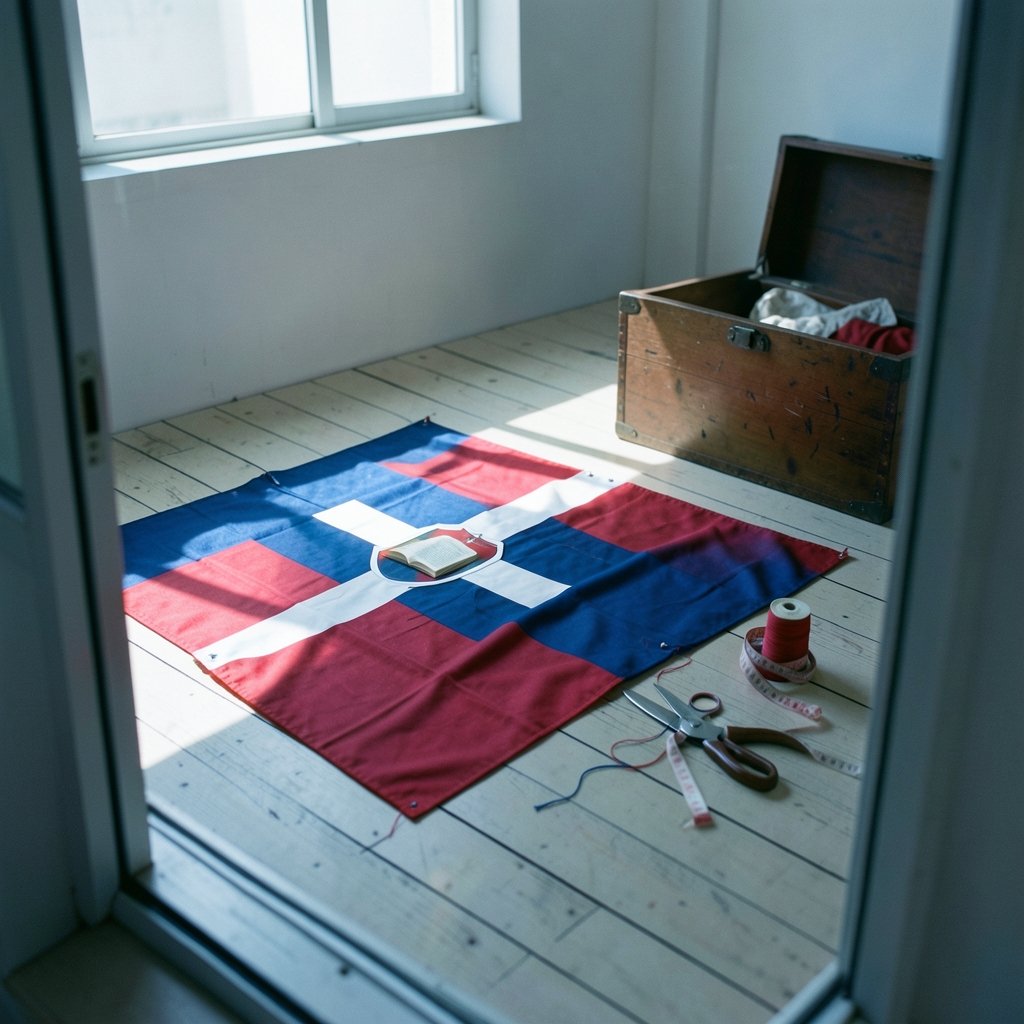
The flag was created by Juan Pablo Duarte, one of the country’s founding fathers, and it was first raised on 27 February 1844. That date is not a coincidence. It is the day the Dominican Republic declared independence from Haiti, and it remains the country’s most important national holiday.
The precise drafting process behind the design is less thoroughly documented than the date itself. What is well established is the connection to Duarte and to the independence movement he led. The flag and the founding of the nation are effectively the same story told in fabric.
This is why Flag Day in the Dominican Republic falls on 27 February. The country observes Día de la Bandera on the same day as Independence Day, which means the banner and the birth of the nation are celebrated together rather than on separate dates.
What the colors mean
Color symbolism on national flags is often repeated more confidently than it is documented, and the Dominican flag is a good example. The meanings below are the traditional interpretations. They are widely taught and widely repeated, but their exact origin is not firmly established, so it is fair to treat them as tradition rather than settled fact.
| Color | Traditional meaning |
|---|---|
| Red | The blood shed by the liberators who fought for independence |
| Blue | The sky above the nation, and the ideals of progress and liberty |
| White | The cross of faith, and the pursuit of peace and union |
Read together, the three colors form a compact statement: sacrifice, aspiration, and faith. That is a common trio on flags around the world, but the Dominican version places the white cross at the structural center rather than treating it as a stripe, which gives the faith element more visual weight.
One practical note for anyone reproducing the flag: exact shades matter more than people expect. Cheap printed flags often drift toward a bright primary red and a light sky blue, which reads very differently from a properly specified banner. If you are buying or making one, ask for the official specification rather than trusting a screen preview.
The coat of arms at the center
The shield in the middle of the flag is where most of the detail lives. It contains several elements stacked together:
- A Bible open to John 8:32, the verse that reads “the truth shall make you free.”
- A gold cross above the Bible.
- A laurel branch on one side and a palm frond on the other.
- The national motto, Dios, Patria, Libertad, which translates to God, Fatherland, Liberty.
The open Bible is the detail that surprises most people. Very few national flags include one, which makes the Dominican banner stand out in any lineup of world flags. The book is not decorative filler; it is the visual anchor of the whole emblem, and the verse it displays is essentially a political statement about truth and freedom.
The laurel and palm carry their own weight. Laurel is a classical symbol of victory, while the palm is associated with triumph and endurance. Together they frame the shield the way a wreath frames a medal.
Legal status and official rules
The flag is one of the country’s three national symbols, alongside the coat of arms and the national anthem. Its form is set out in law rather than left to custom, and the current design details are governed by Dominican legislation, commonly cited as Law No. 210 of 1943 with later amendments. Anyone who needs the exact legal citation for an official purpose should confirm the current instrument through the Presidency of the Dominican Republic’s official portal rather than relying on secondary summaries, since laws get amended and secondary sources lag behind.
The same caution applies to precise measurements. The flag is usually given as a 2:3 ratio, with the white cross arms set at a fixed width relative to the field. But exact figures vary between sources, and if you are producing a flag for an official setting, the official specification is the only one that counts. (The row)
Common mistakes people make
A few errors show up again and again when the Dominican flag is reproduced, displayed, or described.
Swapping the blue and red quarters. The top-left is blue and the top-right is red. Mirrored versions are everywhere online, and they are wrong.
Using the shield version for casual display. The plain civil flag is the appropriate choice for most everyday purposes. The coat of arms version is the state flag.
Guessing at the colors. Vague descriptions like “red and blue” are not enough. Reproductions should follow the official shades.
Treating the symbolism as settled history. The color meanings are traditional interpretations. Presenting them as documented fact overstates what is actually known.
Ignoring proportion. A flag stretched to the wrong ratio looks subtly off even to people who cannot say why. The cross arms end up too thin or too thick, and the whole design loses its balance.
None of these are catastrophic on their own, but together they explain why so many flags sold online look slightly wrong next to an official one.
How the flag fits into a wider visual culture
The Dominican flag shows up far beyond government buildings. It appears on clothing, in music videos, on car windows, and in the background of countless family photos. For members of the Dominican diaspora, it functions as a portable piece of home.
That everyday visibility connects it to a broader visual culture around hair, style, and identity. Texture and appearance are part of how Dominican identity gets discussed and displayed, and the same conversations that touch on 4c hair and looser patterns like 2b hair sit alongside flag imagery as ways people signal where they come from. Visual markers of identity tend to cluster together, and the flag is one of the most direct.
The banner also travels well because its design is legible at small sizes. A cross and four blocks read clearly on a pin, a sticker, or a phone case, which is more than can be said for flags crowded with detail. That scalability is part of why it has become such a common sight in diaspora communities.
Why the flag still carries weight
National symbols can feel like formalities, but the Dominican flag does real work. It marks independence on the calendar, it appears at the center of public ceremonies, and it gives people abroad a simple way to say where they are from.
There is also something to be said for a design that has barely changed in more than 180 years. The flag raised in 1844 is recognizably the flag flown today. In a region where borders and governments have shifted repeatedly, that continuity is meaningful. It suggests a nation that settled on its identity early and kept it.
For anyone researching the flag, the honest summary is this: the broad strokes are well documented, and the fine details deserve verification. The date, the designer, the layout, and the coat of arms are all solid. The exact legal citation, the precise proportions, and the origins of the color symbolism are the areas where sources diverge. Knowing which is which is the difference between repeating a fact and repeating a guess.
Conclusion
The Dominican flag is a compact piece of design with an unusually rich payload. A white cross splits the field into alternating red and blue quarters. A shield at the center carries an open Bible, a gold cross, laurel and palm, and the motto Dios, Patria, Libertad. It was created by Juan Pablo Duarte and raised for the first time on 27 February 1844, the day the nation declared independence, and that date still anchors both Flag Day and Independence Day.
The symbolism matters, and so does the discipline behind it. The civil and state versions serve different purposes. The proportions and colors follow a specification rather than a mood. The meanings attached to red, blue, and white come from tradition rather than documented fact, and that distinction is worth keeping straight. Get those details right, and the flag reads as it was meant to: a clear, balanced statement of sacrifice, aspiration, and faith.
Frequently asked questions
What do the colors of the Dominican flag mean?
Red traditionally represents the blood shed by the liberators, blue stands for the sky and the ideals of progress and liberty, and white represents the cross of faith and the pursuit of peace and union. These are the widely taught interpretations, though their exact origin is not firmly documented.
Who designed the Dominican flag?
The flag was created by Juan Pablo Duarte, one of the country’s founding fathers and a leader of the independence movement. It was first raised on 27 February 1844, the day the Dominican Republic declared independence from Haiti.
Why does the Dominican flag have a Bible on it?
The coat of arms at the center of the state flag shows an open Bible at John 8:32, the verse reading “the truth shall make you free.” It sits beneath a gold cross and between a laurel branch and a palm frond, with the motto Dios, Patria, Libertad below. The flag is one of very few national flags that include an open Bible.
What is the difference between the civil and state versions of the flag?
The civil flag is the plain cross-and-quarters design without the coat of arms, and it is what private citizens normally fly. The state and naval flag includes the shield at the center. This split between a simple everyday version and a detailed official version is common among national flags.
When is Dominican Flag Day?
Flag Day, or Día de la Bandera, is observed on 27 February. It falls on the same date as Independence Day, so the flag and the founding of the nation are celebrated together.
What are the proportions of the Dominican flag?
The flag is commonly given as a 2:3 ratio, with the white cross arms set at a fixed width relative to the field. Exact figures vary between sources, so anyone producing a flag for official use should confirm the measurements against the official specification rather than relying on secondary descriptions.









