

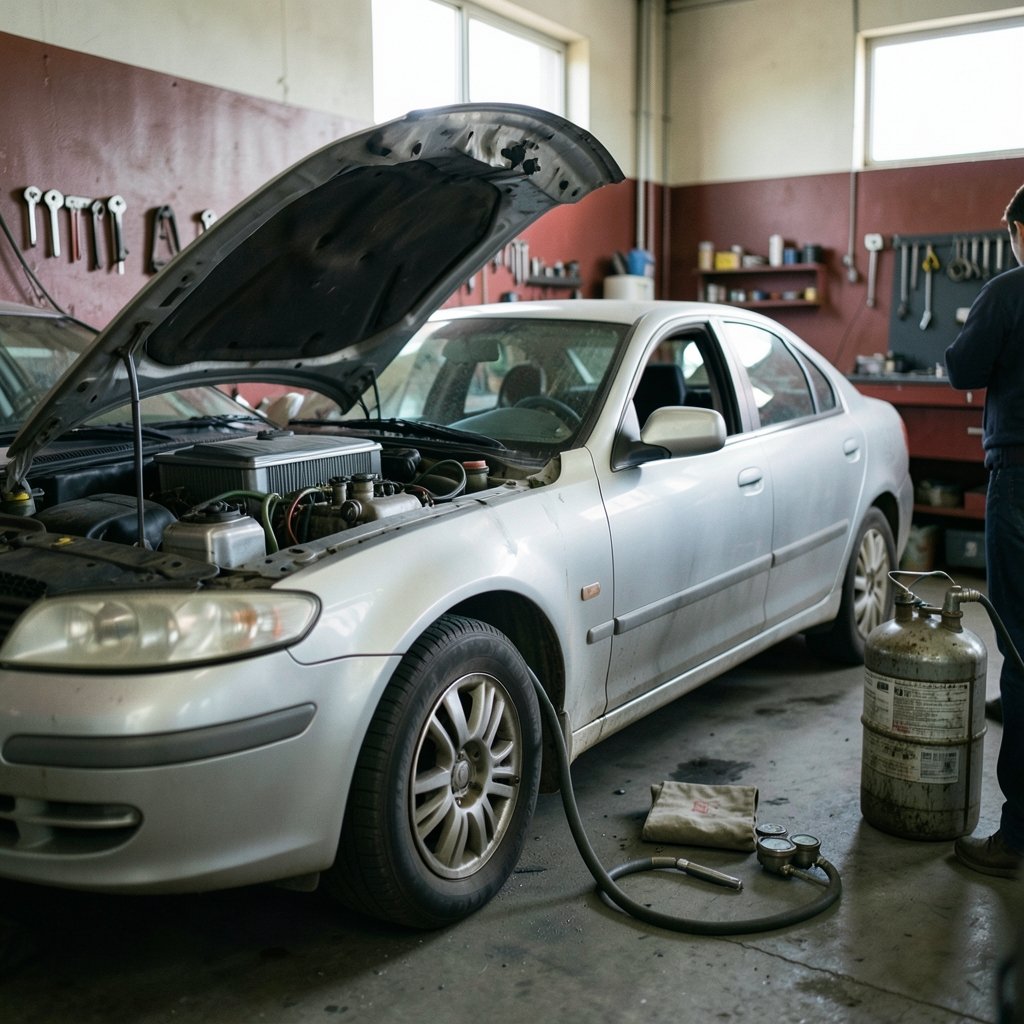
Warm air from the vents while you sit in traffic on a hot afternoon usually points to an A/C fault. A/C trouble is one of the most common reasons vehicles end up in the shop, and it is also one of the most misunderstood. Many drivers assume a quick can of refrigerant will solve everything. Sometimes it helps for a week. Often it makes things worse.
This guide walks through what actually goes wrong with car air conditioning, how a proper diagnosis works, what repairs cost in time and money, and where do-it-yourself efforts tend to fail. Whether you drive a mainstream sedan or a premium model from one of the luxury car brands, the physics are the same: a sealed loop of refrigerant, a compressor, a condenser, and an evaporator that must all work together. Fix the actual fault, and cold air returns. Guess at it, and you will keep paying.
How a Car A/C System Actually Works
A vehicle air conditioner moves heat rather than creating cold. Refrigerant circulates through four main stages:
- Compression. The compressor pressurizes refrigerant gas, raising its temperature.
- Condensation. Hot gas passes through the condenser at the front of the car, where airflow carries heat away and the refrigerant turns to liquid.
- Expansion. The liquid passes through an expansion valve or orifice tube, dropping pressure and temperature sharply.
- Evaporation. The cold, low-pressure refrigerant absorbs heat from the cabin air inside the evaporator, then returns to the compressor to start again.
Any weak link in that loop, whether a leaking O-ring, a clogged orifice tube, or a failing compressor clutch, breaks the whole cycle. That is why a proper car A/C fix starts with finding the fault, not simply topping up gas.
Why Your A/C Blows Warm Air

Several faults produce the same symptom, and they need very different repairs.
| Symptom | Most likely cause | Typical fix |
|---|---|---|
| Warm air from day one of ownership | Low refrigerant charge from a leak | Leak test, repair, recharge |
| Cold at speed, warm in traffic | Weak condenser fan or airflow | Fan or relay repair, condenser clean |
| Cold then warm within minutes | Compressor clutch or control valve fault | Clutch, valve, or compressor replacement |
| Musty smell, weak airflow | Clogged cabin filter, dirty evaporator | Filter change, evaporator cleaning |
| Rapid cycling, poor cooling | Overcharge or moisture in system | Recover, vacuum, recharge correctly |
Notice how many of these have nothing to do with refrigerant quantity. A system can be perfectly charged and still fail because the condenser cannot shed heat or the compressor cannot build pressure.
Leak Detection Is the Heart of Any Real Fix
Refrigerant does not get “used up” like fuel. In a healthy system it stays sealed for years. If the charge is low, refrigerant escaped somewhere, and recharging without locating that leak is a temporary patch at best.
Professional diagnosis usually follows this order:
- Recover any remaining refrigerant into a recycling machine.
- Pressurize the system with nitrogen or trace gas and watch for pressure drop.
- Inspect known weak points: O-rings, Schrader valves, hose crimps, condenser face, and compressor shaft seal.
- Confirm with UV dye or an electronic leak detector before opening the wallet.
- Repair, evacuate, and recharge by weight, then verify vent temperature.
The most common leak sites are condenser stone damage, dried-out O-rings, and service port valves. A condenser that looks fine from outside can be weeping at a pinhole behind the bumper.
Refrigerant Rules Have Changed, and They Affect Your Repair
The gas inside your system depends on the model year. Older vehicles used R-12, which was phased out for environmental reasons. From the 1990s onward, R-134a became standard. Newer vehicles increasingly use R-1234yf, a refrigerant with far lower global warming impact.
Regulation drives this shift. In Europe, rules limiting refrigerants above a set GWP pushed new vehicle types toward low-GWP gas from 2011, with all new vehicles covered from 2017. In the United States, the AIM Act, signed in December 2020, sets an 85 percent phase-down of HFC production and consumption by 2036, which affects R-134a supply and pricing.
What does that mean in practice? Two things. First, never assume your car takes the cheap can on the shelf; check the underhood label. Second, mixing refrigerants or using the wrong gas can destroy performance and create a hazardous, expensive mess. Handling refrigerant also requires recovery and recycling rather than venting, and technicians servicing vehicle A/C are certified to do it. That is one strong argument for professional service on this particular job.
The Repairs That Actually Fix Warm Air
Condenser Replacement
The condenser sits at the front of the car and takes the brunt of road debris. Corrosion and stone strikes cause leaks that no amount of gas will cure. Replacement is usually straightforward, though bumper removal varies by model.
Compressor Repair or Replacement
A compressor can fail mechanically, leak at the shaft seal, or simply refuse to engage because of a bad clutch, relay, or pressure switch. Diagnose the control side first; many “dead compressors” are actually electrical faults.
Expansion Valve and Orifice Tube
These metering devices clog with debris or fail open. Symptoms include poor cooling and unusual pressure readings on both sides of the system.
Receiver-Drier or Accumulator
This component traps moisture and filters debris. It should be replaced whenever the system is opened for major work, because a saturated drier allows moisture to form acids that attack the loop from inside.
Cabin Filter and Evaporator Cleaning
If airflow is weak or the vents smell like a damp basement, the cabin filter is the first suspect. A dirty evaporator core can also harbor mold. Cleaning restores airflow and removes odour.
What a Proper Repair Costs You
Costs vary widely by region and vehicle, but the pattern is consistent: diagnosis is cheap relative to guessing.
| Job | Typical time | Notes |
|---|---|---|
| Leak test and recharge | 1 to 2 hours | Cheapest path if no leak is found |
| Condenser replacement | 2 to 4 hours | Part cost varies a lot by model |
| Compressor replacement | 3 to 5 hours | Always replace the drier too |
| Expansion valve or orifice tube | 1 to 3 hours | Often bundled with other work |
| Cabin filter | Under 30 minutes | The easiest DIY win |
Premium vehicles can cost noticeably more because parts are dearer and access is tighter. If you are weighing a repair against a newer car, it helps to compare overall ownership pictures; a resource like this guide to Mercedes electric cars 2026: models, range shows how newer platforms handle climate systems differently, with heat pumps rather than conventional compressors in many cases.
DIY Recharge Cans: What Works and What Backfires
Store shelves are full of recharge kits, and they are tempting. Here is the honest picture.
What can work: On an older vehicle with a slow, minor seep, a gauge-equipped can with the correct refrigerant can restore cooling for a while. If you follow the label exactly and the system is genuinely low, it may buy you a season.
What usually backfires:
- Overcharging. Too much refrigerant raises pressures and reduces cooling. Without manifold gauges, you cannot see this happening.
- Sealants. Stop-leak products can gum up expansion valves and contaminate recovery equipment, which means the next professional repair costs more.
- Wrong gas. Filling an R-1234yf system with R-134a, or vice versa, damages performance and can be unsafe.
- Ignoring the leak. The gas escapes again, and the underlying fault worsens.
Practical rule: if the system is empty or the compressor will not engage, do not add gas. Get it diagnosed. If you do top up, use a gauge, add only to the specified pressure at the specified ambient temperature, and never mix products.
Common Mistakes Drivers Make
Even careful owners trip over the same few issues.
- Assuming low gas is the diagnosis. It is a symptom. The leak is the problem.
- Skipping the cabin filter. Weak airflow gets blamed on the refrigerant when a clogged filter is the culprit.
- Running the A/C only in summer. Regular use in winter keeps seals lubricated and the compressor exercised. Systems that sit idle for months tend to leak.
- Parking in the sun and blaming the car. Cabin temperatures above 60°C overwhelm any system for the first few minutes. Shade and window shades help more than any repair.
- Ignoring strange noises. A rattling compressor or hissing expansion valve is an early warning; catching it early is cheaper.
- Choosing the cheapest recharge. A shop that recharges without leak testing is selling you a repeat visit.
What to Ask Before You Approve a Repair
A good shop will happily answer these questions, and the answers tell you a lot.
- What was the system pressure before and after diagnosis?
- Did you find a leak, and where exactly?
- Will you replace the receiver-drier as part of this job?
- How much refrigerant does my car take, and which type?
- What warranty covers the repair?
If the answers are vague, get a second opinion. A/C work is measurable; pressures, temperatures, and leak locations are all objective facts.
When to Repair and When to Live With It
Not every A/C fault demands immediate attention. A weak vent temperature on a ten-year-old commuter car may be tolerable if you mostly drive with windows down. But a leaking system loses refrigerant continuously, and moisture entering an open loop accelerates corrosion of internal parts. A small leak fixed early is almost always cheaper than a compressor failure later.
Drivers comparing long-term reliability across premium models often find that climate system design differs meaningfully between makes. Resources like this comparison of the most reliable luxury car options can help set expectations about service frequency, while a broader look at best luxury car brands in 2026 rounds out the ownership picture.
Conclusion
A car A/C fix is rarely about adding refrigerant. It is about finding the leak, restoring airflow, or replacing the one component that broke the cycle. The drivers who spend the least are the ones who insist on diagnosis first, use the correct refrigerant for their model year, replace the drier when the system is opened, and keep the cabin filter clean. Cold air is not luck; it is a sealed loop working as designed. Treat the system with that respect, and it will keep you comfortable through every heatwave.
Frequently Asked Questions
How much does a car A/C fix usually cost?
It depends entirely on the fault. A leak test and recharge is the cheapest outcome. Condenser or compressor replacement costs considerably more because of parts and labour. Diagnosis is the smallest line item and the one that saves the most money, since it prevents paying twice for the same problem.
Can I just recharge my A/C myself?
Sometimes, if the system is only slightly low, you have the correct refrigerant, and you use a gauge. But if the system is empty, the compressor will not engage, or you cannot confirm the refrigerant type, stop. DIY cans cause overcharging and sealant damage that make professional repairs more expensive.
Why does my A/C blow cold while driving but warm in traffic?
That pattern points to airflow over the condenser. At speed, natural airflow carries heat away; in traffic, the condenser fan must do the job. A weak fan, a blown relay, or a condenser clogged with debris will cause exactly this symptom. It is usually a fan or cleaning fix, not a refrigerant issue.
How often should car A/C be serviced?
Run the system for a few minutes regularly, even in winter, to keep seals lubricated. Have the refrigerant charge and vent temperature checked every couple of years, and replace the cabin filter according to the manufacturer schedule. There is no need for annual recharges on a healthy, sealed system.
Which refrigerant does my car use?
Check the label under the bonnet or on the radiator support. Older vehicles typically use R-134a; many newer ones use R-1234yf. The two are not interchangeable, and using the wrong one damages performance. The label is the authority, not the age of the car alone.
Is it bad to leave a leaking A/C unrepaired?
Yes, over time. A leaking system lets moisture and air into the loop, which corrodes internal parts and can lead to compressor failure. What starts as a cheap O-ring fix can become a major repair. If you plan to keep the car, fix the leak rather than topping up repeatedly.









