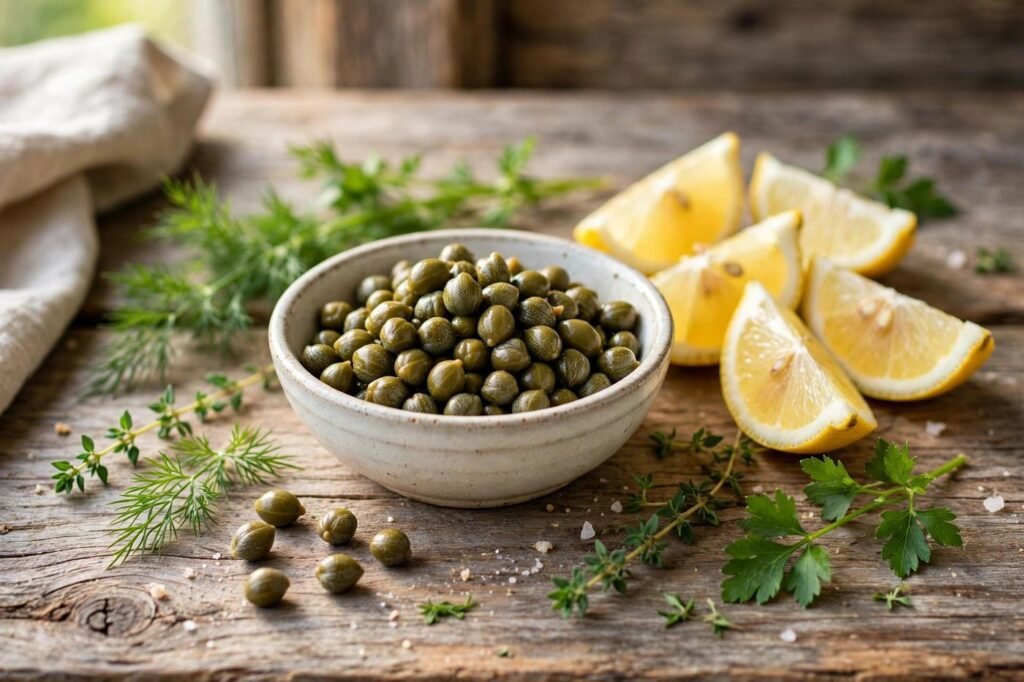
You are eating a chicken piccata in a restaurant, and there is a sharp, salty, lemony pop in every other bite. You ask the waiter what it is, and the answer is a word you have seen on menus a hundred times but never quite understood: capers. What are they, and why do chefs love them so much?
So what are capers? They are the unopened flower buds of the caper bush, picked by hand and cured in salt or brine, and they add a salty, tangy, floral sharpness that cuts through rich food like almost nothing else. This guide explains what capers are, how they are made, how to cook with them, and what to use when the jar is empty.
Key takeaways:
- Capers are the unopened flower buds of the caper bush (Capparis spinosa), picked by hand and cured in salt or brine.
- They taste salty, tangy and floral, a little like green olives with a sharper, lemony edge, and a little goes a long way.
- Nonpareils are the smallest and most prized capers, at about 7 millimetres across, while larger types are stronger and more acidic.
- Rinse capers before cooking to wash off excess salt, and store brined capers in the fridge, where they keep for about nine months.
What are capers?

Capers are the unopened flower buds of a prickly Mediterranean shrub called Capparis spinosa. The bush grows wild across the Mediterranean, North Africa and parts of Asia, often in dry, rocky places where little else will grow, and it has been eaten for thousands of years. The buds are picked by hand just before they open into flowers, because once they bloom, they are no longer capers.
The buds you buy in a jar do not taste like the fresh buds on the bush. Fresh capers are bitter and not pleasant to eat, so they are cured before they reach the shops, either pickled in a brine of water, salt and vinegar, or packed in dry salt. That curing creates the flavour everyone recognises: salty, briny, tangy and faintly floral, and it is what sets capers apart from olives, peas and pickles.
What is the difference between capers and caper berries?
Capers and caper berries come from the same plant, but they are harvested at different times, and that changes everything. A caper is the small, unopened bud, picked before the flower blooms. A caper berry is what happens when the bud is left on the bush: it flowers, is pollinated, and grows into a fruit about the size of a small olive, attached to the bush by a long stem, almost like a cherry.
The berries are much larger than capers, milder in flavour, and softer in texture, with small crunchy seeds inside. They are usually served whole, as a garnish or on an antipasto platter, or dropped into a cocktail such as a Bloody Mary. Capers, by contrast, are small and punchy, and they disappear into sauces and dressings, where their flavour spreads through the whole dish, so the two should not be used interchangeably.
How are capers made?
Making capers starts with picking. Workers walk the bushes in the early morning and pick the buds by hand, one by one, choosing only the tight, unopened ones. It is slow work, and it is the main reason good capers cost more than you might expect for such a small jar, and the buds are then sorted by size, because size decides the grade and the price.
Next comes the curing. The fresh buds are first soaked in water to soften their natural bitterness, then left to dry in the sun, and after that they are preserved in brine or cured in dry salt. Both methods make the buds safe to eat and give them their characteristic salty, tangy flavour, though brined capers are sharper and more acidic, while salt-cured capers taste more concentrated and floral once rinsed.
What do capers taste like?
A caper tastes salty, tangy and faintly floral, with a lemony sharpness that is hard to pin down. The closest comparison is a green olive, but a caper is smaller, sharper and more pungent, with a herbal edge that olives do not have. The flavour comes largely from the curing: the salt and vinegar concentrate the bud’s natural pungency into something bright and bracing.
Size changes the flavour. Nonpareils, the smallest capers at about 7 millimetres across, are the most delicate and prized, with a gentle, almost sweet sharpness, while larger types are stronger and more acidic. For most cooking, nonpareils or surfines are the best choice, because they spread their flavour evenly without overwhelming the dish, and the curing method matters too: brined capers are sharper, while salt-cured capers taste rounder once rinsed.
| Size | Diameter | Flavour | Best for |
|---|---|---|---|
| Nonpareils | About 7 mm | Delicate, gently sharp | Sauces, dressings, fish |
| Surfines | 7 to 8 mm | Balanced, tangy | Everyday cooking |
| Capucines | 8 to 9 mm | Stronger, more acidic | Robust pasta sauces |
| Capotes | 9 to 11 mm | Assertive, sharp | Stews and rich dishes |
| Grusas | Over 11 mm | Strongest, most acidic | Chopping into sauces |
How do you cook with capers?
Cooking with capers is mostly about restraint. A tablespoon or two is usually enough for a dish that serves four, because their flavour is concentrated and they are very salty. Add them late in the cooking, so their sharpness stays bright, and taste the dish before you add any more salt: the capers have often seasoned it already.
Always drain capers before you use them, and rinse them if the recipe calls for it. Rinsing is worth doing for a delicate sauce, a salad dressing or a dish that is already salty, because it takes the edge off the brine. For a robust pasta sauce or a stew, use them straight from the jar, brine and all, and the extra salt will simply season the dish.
Frying capers is a trick worth knowing. Drop drained capers into hot oil for thirty seconds or so, and they puff up, turn crisp and taste almost nutty. Fried capers make a wonderful garnish for fish, chicken or a simple salad, and they are the fastest way to make a plain dish feel like it came from a restaurant.
What dishes pair best with capers?
Capers shine brightest with rich food, because their acidity cuts through fat. The classic pairing is fish: salmon, sea bass, tuna and white fish all benefit from a spoonful of capers, whether in a lemon butter sauce or scattered over the top. Chicken piccata, the Italian dish of chicken in a lemon and caper sauce, is the most famous example, and it works because the capers balance the butter.
Pasta is the second home of capers. Pasta puttanesca, with tomatoes, olives, anchovies and capers, is built around them, and a simple spaghetti aglio e olio with capers and lemon is a weeknight version of the same idea. They also belong in salads and sauces, where they lift a tomato salad and give tartar sauce its sharp edge, and they are the traditional partner for smoked salmon on a bagel, as our guide to the best bagel and coffee shows.
How do you store capers?
Storage depends on how your capers are packed. Brined capers should be kept in the fridge once opened, with the capers submerged in their brine, and they will keep for about nine months. The brine is what protects them, so do not drain the jar and put dry capers back in the fridge: they will dry out and lose flavour.
Salt-packed capers are hardier. An unopened packet keeps at room temperature, and once opened they keep for about six months in a cool, dry cupboard. Before you use them, rinse them well or soak them briefly in cold water, because they carry far more salt on the surface than brined capers do, and always use a clean spoon and keep the lid on tightly.
What can you use instead of capers?
If the jar is empty, the best substitute is chopped green olives. They share the same salty, briny character, though they are milder and fruitier, so use a little more than the recipe calls for. Chopped pickles or cornichons are the next best option: they bring the same vinegary sharpness, though they lack the floral note that makes capers distinctive.
Nasturtium buds, pickled in the same way as capers, are a traditional substitute sometimes called poor man’s capers, and they grow easily in a garden. Green peppercorns in brine can work in a sauce, though they are hotter. The honest answer is that nothing replaces capers exactly, so if a recipe depends on them, as puttanesca and piccata do, it is worth buying a jar: a small one costs little and keeps for months.
Your capers checklist
Work through this list before you cook with capers, and they will behave themselves.
- Buy nonpareils or surfines: the smallest capers are the most delicate and the most versatile.
- Drain before you use them: tip the capers into a small sieve and shake off the brine.
- Rinse for delicate dishes: a quick rinse under cold water takes the edge off the salt.
- Add them late: stir capers in near the end of cooking so their sharpness stays bright.
- Hold back the salt: taste the dish after the capers go in, before you season further.
- Use a tablespoon, not a handful: a little goes a long way, and too many capers will dominate the dish.
- Keep them in their brine: brined capers stay fresh in the fridge for about nine months if they stay submerged.
Frequently asked questions
Are capers olives?
No. Capers are the unopened flower buds of the caper bush, while olives are the fruit of the olive tree. They taste similar because both are cured in brine, but they are botanically unrelated, and capers are smaller, sharper and more floral than olives.
Do you need to rinse capers before cooking?
It depends on the dish. Rinse them for delicate sauces, dressings and salads, where excess salt would show. For robust pasta sauces and stews, you can use them straight from the jar, and the brine will simply season the dish.
What is the difference between capers and caper berries?
Capers are small, unopened flower buds, picked before they bloom. Caper berries are the larger fruit that grows when the flower is left to bloom and be pollinated, and they are about the size of a small olive, with a stem and a milder flavour. The two are not interchangeable in recipes.
How long do capers last once opened?
Brined capers keep for about nine months in the fridge, as long as they stay submerged in their brine. Salt-packed capers keep for about six months at room temperature. Throw away any jar that smells off or has mould on the surface.
Are capers healthy?
Capers are very low in calories and contain antioxidants, including quercetin, but they are also very high in salt, because they are cured in brine or salt. Enjoy them as a flavouring rather than a health food, and rinse them if you are watching your sodium intake.
Can you eat capers raw?
Yes, once they have been cured. The capers in a jar are ready to eat straight away, and they are often scattered raw over salads, fish and smoked salmon. Fresh, uncured caper buds straight from the bush are bitter and unpleasant, so never eat those.
Sources
Botanical and culinary details in this guide reflect widely published food writing, including EatingWell, Food Network and Tasting Table, which agree on the size grades, curing methods and storage times given here. For the rest of the plate, our guide to how to make mashed potatoes covers a side dish that capers lift well.
The bottom line
Capers are one of the smallest ingredients in the kitchen and one of the most useful. A spoonful of them turns butter into a sauce, lifts a piece of fish, and gives a pasta dish the sharpness it was missing. The rule to remember is simple: buy nonpareils, rinse them when the dish is delicate, add them late, and hold back the salt.
Your next step is simple: buy a small jar of nonpareil capers, keep it in the fridge, and try a spoonful in the next lemon butter sauce or tomato salad you make. You will wonder why the jar sat unopened for so long.