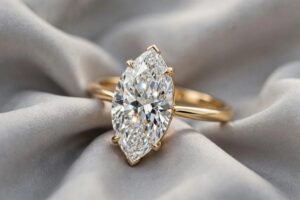
A marquise diamond is the most dramatic of the classic diamond shapes. Long, pointed at both ends and full of sparkle, it looks larger than a round stone of similar weight and gives a ring a striking, elegant silhouette. It is also the shape most often misunderstood, and that is where this guide begins.
So what is a marquise diamond? It is a diamond cut into an elongated oval with pointed ends, like a boat or an eye, with a faceted top and a pointed base. This guide covers its history, its shape and proportions, the settings that suit it, how to choose one well, and how to care for it once it is yours.
Key takeaways:
- A marquise diamond is an elongated oval with pointed ends. Its length makes it look larger than a round diamond of similar weight.
- The cut is said to date from eighteenth-century France, and to be named for the Marquise de Pompadour.
- Look for a symmetrical shape, even points, a lively sparkle and no dark shadow, known as a bow tie, across the centre.
- Protect the pointed ends with a setting that covers them, since the tips are the most fragile part of the stone.
- Choose the length and width that suit the wearer’s hand, and judge the stone in person, in daylight, before you decide.
The History of the Marquise Cut
The marquise cut is widely said to have its roots in eighteenth-century France. The story most often told is that the shape was created to resemble the lips of Jeanne Antoinette Poisson, the Marquise de Pompadour, a leading figure at the court of King Louis XV. It is the account repeated in jewellery writing for many years.
What is clear is that the marquise became a recognised fancy cut, meaning a shape other than round, and that it has been used in rings, brooches and necklaces ever since. It found a new audience in the twentieth century as an engagement ring shape.
What Does a Marquise Diamond Look Like?
A marquise diamond is an elongated oval that tapers to a point at each end. Viewed from above, it has a curved belly in the middle and two sharp tips, giving it the outline of a boat or an eye. From the side, it has a faceted crown on top and a pointed pavilion below, like most cut diamonds.
The length of the stone is its most obvious feature. A marquise is noticeably longer than it is wide, and that length is what makes it look large. The same weight spread over a longer shape covers more of the finger, so a marquise can appear bigger than a round diamond of the same weight.
Proportions and Symmetry
Proportions matter more in a marquise than in many other shapes, because the eye notices unevenness at once. The two halves should mirror each other, with the same curve on each side and points that line up. If one side is fuller than the other, the stone will look lopsided even at a glance.
The points deserve close attention. They should be sharp and even, not rounded, chipped or blunted. The tips are the thinnest part of the stone and the most likely to chip, so a well-cut marquise protects them in its setting. When you look at a marquise, check both points in turn, and look at the stone from the side as well as from above.
Length and width are a matter of taste, and there is no single right answer. A longer, slimmer marquise looks more dramatic and elongates the finger, while a shorter, wider one looks bolder and shows more sparkle across its centre. Try both on the hand, and choose the shape that looks balanced there rather than the one that looks best loose on a tray.
| Shape | Look | Effect on the hand | Best for |
|---|---|---|---|
| Long and slim | Dramatic, elegant, very elongated | Lengthens the finger | A striking solitaire, a bold statement |
| Classic length | Balanced, graceful, evenly curved | Flattering on most hands | An everyday engagement ring |
| Short and wide | Bolder, brighter across the centre | Looks larger from above | Maximum sparkle, a fuller look |
| With side stones | Framed by smaller diamonds | Extra width and brilliance | A three-stone or halo design |
The Bow-Tie Effect
One feature to look for in a marquise is the bow tie, a dark, bow-shaped shadow that can appear across the centre of the stone. It is caused by the way light passes through an elongated cut, and it is common in marquise, oval and pear-shaped diamonds. A faint bow tie is normal, and many stones have one that is barely noticeable.
A strong bow tie is a different matter. If a dark band cuts across the middle of the stone and dulls its sparkle, the diamond will look less lively, and the shadow will be visible in most lights. Look at the stone in daylight and in indoor light, and move it slowly. If the bow tie stays dark and obvious, consider another stone.
Marquise, Oval and Pear: How They Compare
The marquise is often compared with the oval and the pear, the other elongated fancy cuts, and the comparison is useful. An oval has the same long shape but with rounded ends, giving it a softer, more forgiving outline. A pear combines a rounded end with a single point, like a teardrop, and it is usually worn with the point facing the fingertip or the wrist.
The marquise is the most pointed of the three, and the most dramatic. Its two sharp ends give it a stronger outline and a more formal feel, while the oval reads as softer and the pear as more romantic. The marquise also shows its size most clearly, since its length is uninterrupted by curves at the ends.
Settings That Suit a Marquise Diamond
The setting matters more for a marquise than for most shapes, because the pointed ends need protection. A solitaire with prongs that cover both tips, often called V-prongs, is the classic choice. The V shape wraps around each point, holding it securely and shielding it from knocks, while leaving the rest of the stone open to the light.
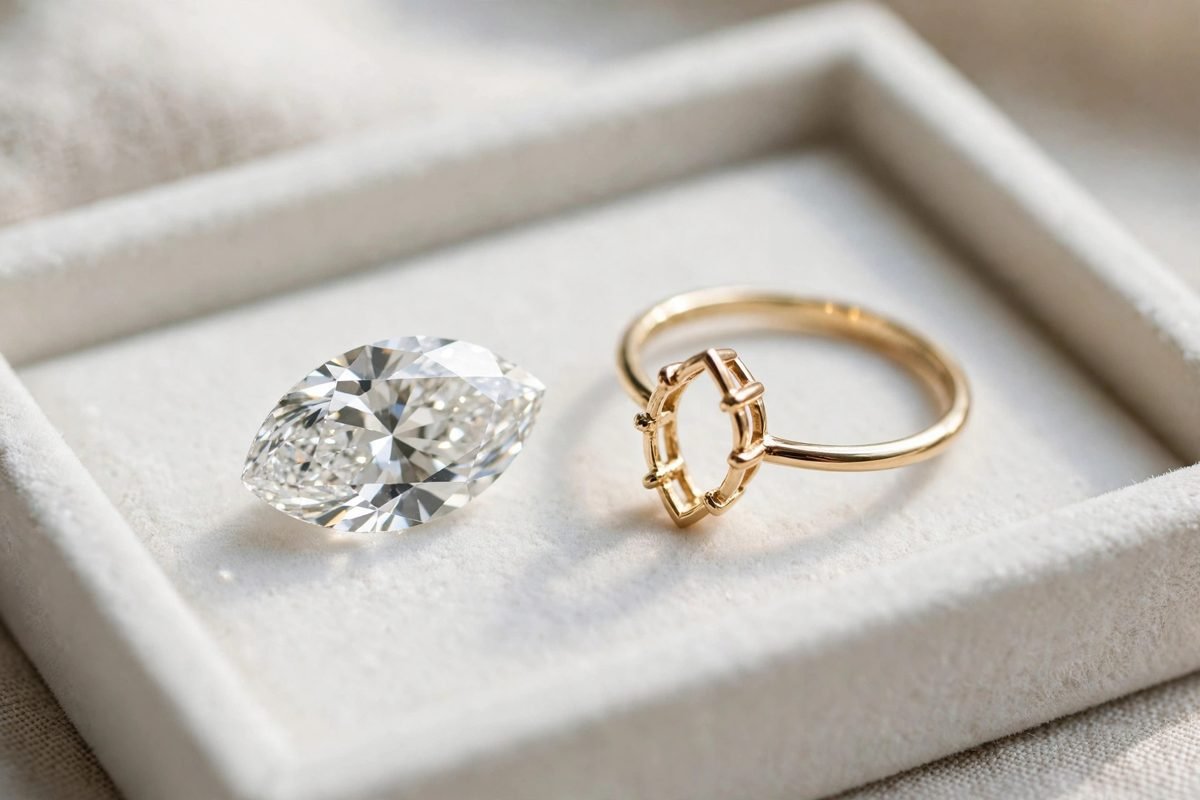
A bezel setting, where a rim of metal runs around the whole stone, gives the most protection of all. It covers the points completely and gives the ring a smooth, modern outline. A bezel can make the stone look slightly smaller from above, since the rim covers its edge, but it is a practical choice for a ring that will be worn every day.
Halo and three-stone settings suit a marquise well, too. A halo of small diamonds around the centre stone adds width and brilliance, while side stones in a three-stone design frame the marquise and add balance. In either case, make sure the side stones do not crowd the points, and that the centre stone remains the clear focus of the ring.
How to Choose a Marquise Diamond
Start with the shape, since it is what you will see every day. Look for even curves, matching halves and sharp, undamaged points. Hold the stone up to the light and check that it sparkles evenly across its surface, without a dark patch in the middle or dull areas near the tips.
Colour and clarity matter in a marquise, and the shape can show both more clearly than a round stone. A marquise spreads its weight over a larger surface, so any tint is easier to see, especially near the points. A near-colourless stone is a safe choice, and a warmer stone can look lovely in yellow gold.
Clarity is worth the same care. Inclusions near the points can weaken the stone, and visible marks near the centre will be easy to spot. Look for a stone that appears clean to the eye, and ask the jeweller to show you any inclusions under magnification. Our guide to where to buy gold and silver covers choosing a reputable seller.
Caring for a Marquise Diamond
A marquise diamond is no harder to care for than any other diamond, but its points need respect. Take the ring off for heavy work, gardening and sport, and store it on its own, so it cannot be scratched by other jewellery or scratch softer stones. Diamonds are hard, yet their points can chip if they catch a hard edge.
Clean the ring regularly with warm water, a little mild washing-up liquid and a soft brush, then rinse and dry it with a soft cloth. Have the setting checked by a jeweller once a year, so a loose prong is caught before a stone is lost.
Marquise Diamond Checklist
Use this checklist when you are choosing a marquise diamond, and keep it with you when you visit a jeweller.
- Check the symmetry: the two halves should mirror each other, with points in line.
- Inspect the points: they should be sharp, even and free from chips.
- Look for a bow tie: a faint shadow is normal, a strong dark band is not.
- Judge it in daylight: look at the stone indoors and out before deciding.
- Check colour and clarity: look for a clean stone, and view inclusions under magnification.
- Protect the tips: choose V-prongs or a bezel that covers both points.
- Try it on the hand: check the length, width and comfort, not just the loose stone.
Frequently Asked Questions
Does a marquise diamond look bigger than a round diamond?
Yes, in most cases it does. A marquise spreads its weight over a longer, narrower shape, so it covers more of the finger and looks larger from above than a round diamond of the same weight.
What is the bow tie in a marquise diamond?
The bow tie is a dark, bow-shaped shadow across the centre of the stone, caused by the way light passes through an elongated cut. A faint bow tie is normal; a strong, dark one dulls the sparkle, so look at the stone in daylight before you buy.
Are marquise diamonds fragile?
The stone itself is as hard as any diamond, but its pointed ends are thin and can chip if they catch a hard edge. V-prongs or a bezel that cover both points protect them, and taking the ring off for heavy work reduces the risk.
Which setting is best for a marquise diamond?
A solitaire with V-prongs is the classic choice, since it protects both points while leaving the stone open to light. A bezel gives the most protection, while a halo or three-stone setting adds width and brilliance.
Does a marquise diamond suit every hand?
A marquise suits most hands, and it can make a finger look longer and slimmer. Try long, classic and short shapes on before deciding, since a very long stone can overwhelm a small hand.
How should I clean a marquise diamond ring?
Clean it with warm water, a little mild washing-up liquid and a soft brush, then rinse and dry it with a soft cloth. Have the setting checked by a jeweller once a year, so a loose prong is caught in time.
The Bottom Line
A marquise diamond is a confident choice. It is longer, more dramatic and more distinctive than the usual round stone, and it carries a history that stretches back to eighteenth-century France. Its beauty depends on symmetry, lively sparkle and a setting that protects its points.
Your next step is simple: visit a jeweller, try a marquise in a few lengths and settings, and look at each stone in daylight. For more on choosing jewellery, see our guide to the August birthstone, and our guide to engagement photos.