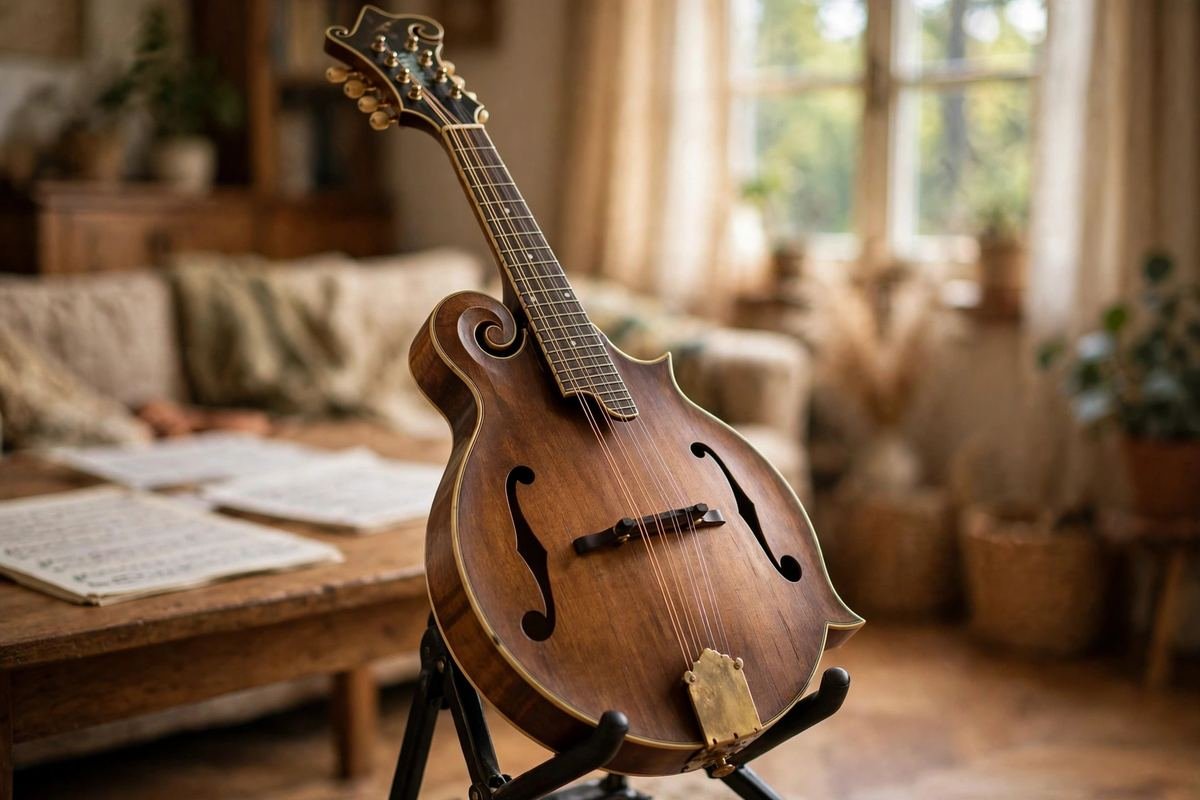

The mandolin is the bright instrument you have heard driving bluegrass tunes, dancing through Italian folk songs and sparkling in classical pieces. A mandolin has eight steel strings arranged in four pairs, and it is played with a small plectrum, or pick. It is tuned the same as a violin, from low to high G, D, A and E.
So is the mandolin a good instrument to learn? For most people, yes. It is small and light, it is tuned in fifths like the violin, which makes scales and chords fall into logical patterns, and a beginner can usually play a simple tune within the first few weeks.
Key takeaways:
- A mandolin has eight steel strings in four pairs, tuned G, D, A and E like a violin.
- The three main types are the A-style, the F-style and the bowl-back.
- Most beginners start on an A-style mandolin, the most affordable and versatile choice.
- Short daily practice and a good set-up matter more than price.
What is a mandolin?
The mandolin belongs to the lute family, a group of stringed instruments with a neck and a hollow body that have been played in Europe for centuries. The modern mandolin took shape in Italy in the eighteenth century, and the Neapolitan mandolin, with its rounded bowl back, became the classic form. From Italy it travelled the world, finding a home in folk music and American bluegrass.
It is a small instrument, usually around 70 centimetres long, with a short neck and a fretted fingerboard. The body is much smaller than a guitar’s, which is why it is so light and easy to carry. Despite its size, it is a loud little instrument, with a bright, ringing tone.
The mandolin’s voice comes from its doubled strings. Each pair is tuned to the same note, and the player strikes both strings at once with the pick. That doubling gives the mandolin its shimmering, chorus-like sound, and it is also why the instrument is played with a tremolo, a rapid picking that lets a note ring on.
How does a mandolin work?

A mandolin works like a small guitar with doubled strings. The strings run from the tuning pegs, down the neck, over the bridge and to the tailpiece. Pressing a string against a fret shortens the part that vibrates, which raises the pitch. The body is hollow and acts as a soundbox: the vibrating strings move the top, and the air inside amplifies the sound.
The four pairs of strings, or courses, are tuned in fifths: G, D, A and E, from lowest to highest. Tuning in fifths means the fingering pattern for a scale is the same on every pair of strings.
The pick is part of the sound. Mandolin players use a small, fairly stiff plectrum, held between thumb and forefinger, and the pick strikes both strings of a pair together. A heavier pick gives a louder, fuller tone, while a lighter pick is softer and easier for a beginner to control.
The main types of mandolin
Most players start on one type and meet the others later, so it helps to know the family before you buy. The differences are mostly about the shape of the body and the soundhole.
The A-style mandolin
The A-style mandolin has a simple teardrop-shaped body, with no scroll or points, and it is the most common and most affordable type. It is named for its shape, which looks like the letter A. The A-style is light and comfortable to hold.
The F-style mandolin
The F-style mandolin has a decorative scroll on the upper body and a pointed lower bout, and it is the instrument most people picture when they think of bluegrass. The scroll and points are mostly decorative: they add cost and weight, but they do not change the sound very much.
The bowl-back mandolin
The bowl-back, or Neapolitan, mandolin is the oldest form of the instrument, with a deep, rounded back made from strips of wood, like half a bowl. It has a sweet, delicate tone that suits classical music and Italian folk songs. It is less suited to bluegrass, and it can be harder to hold, because the rounded back slides on the lap.
Other members of the mandolin family
The mandolin has larger relatives that share its tuning in fifths. The mandola is tuned a fifth lower, with a deeper, viola-like voice, and the mandocello plays the bass lines in a mandolin orchestra. Beginners do not need to worry about these.
Mandolin types compared
The three main types look different, sound different and cost different amounts, so it is worth comparing them side by side before you buy.
| Type | Body shape | Sound | Best for |
|---|---|---|---|
| A-style | Teardrop, no scroll | Bright and balanced | Beginners, all styles |
| F-style | Scroll and points | Bright and punchy | Bluegrass players |
| Bowl-back | Deep rounded bowl | Sweet and delicate | Classical, Italian folk |
The soundhole matters too. A mandolin has either an oval soundhole or two f-shaped holes, like a violin. Oval holes give a warmer, rounder tone, while f-holes give a brighter, sharper sound that cuts through a band, which is why bluegrass players usually prefer them.
How to choose a mandolin
Choosing a first mandolin is simpler than the catalogues make it look. The main decision is between an A-style and an F-style, and for a beginner the A-style usually wins. Spend the money you save on a proper set-up and a few lessons, which will make far more difference than a scroll on the body.
The second decision is new or second-hand. A new mandolin is the safest buy, because it comes with a warranty. A second-hand mandolin can be excellent value, but only if a repairer or a teacher has checked it: the neck can warp, the frets can wear, and a mandolin with a high action is painful to play.
The set-up deserves more attention than most buyers give it. A good set-up by a repairer adjusts the bridge, the string height and the nut so the instrument plays in tune all the way up the neck. A cheap mandolin with a good set-up plays better than an expensive one without it.
Check the details before you buy. The tuning pegs should turn smoothly and hold their position, the frets should be level and smooth, and the neck should be straight when you sight along it. The body should have no cracks, and the top should be flat rather than bulging or sinking.
Finally, think about the case. A mandolin is small enough to travel anywhere, which is one of its charms, but it is also easy to damage. A padded gig bag is enough for carrying it to lessons, while a hard case is better for travel and storage. A strap is worth having too, because it frees your hands. Like the clarinet, the mandolin rewards good posture.
Learning the mandolin: the basics
The first lesson is about holding the instrument and the pick. The mandolin rests on your lap or hangs from a strap, with the neck angled slightly upward. The pick is held between the thumb and the side of the forefinger, with only a small tip showing, and the wrist does the work, not the whole arm.
Fingering follows a logical pattern, because the strings are tuned in fifths. Most beginners learn the open strings first, then the first few frets, then simple scales. The left hand fingers press the strings just behind the frets, not on top of them, and the fingertips will be sore for the first week or two.
Reading music is part of learning the mandolin, though not everyone starts at the same time. Some beginners learn tunes by ear first and add reading later. Mandolin music is written in treble clef, the same as violin music. What matters most is regular practice: twenty to thirty minutes a day, five or six days a week.
Chords come next, and the mandolin’s tuning makes them easier than they look. A two-finger chord is enough to accompany a simple song, and three-finger chords cover most folk and bluegrass tunes. The tremolo is worth practising slowly from the start, with a relaxed wrist, before trying to play it fast.
How to look after a mandolin
A mandolin needs a few minutes of care after every session. Wipe the strings and the body with a soft, dry cloth to remove sweat and dust, which corrode strings and dull the finish. Keep it in its case when you are not playing, and never leave it in a hot car or next to a radiator.
Strings are the one part of the mandolin that wears out regularly. A set lasts a few weeks of daily playing, and fresh strings make the instrument sound brighter and stay in tune better. Changing mandolin strings is fiddly, because there are eight of them, so change them one at a time.
Your mandolin buying checklist
Work through this list before you buy.
- Choose an A-style mandolin as your first instrument.
- Check that the neck is straight, the frets are level, and the tuning pegs turn smoothly.
- Look for a solid wood top, and check the body for cracks.
- Decide between an oval soundhole for a warm tone or f-holes for a brighter sound.
- Budget for a proper set-up by a repairer, which matters more than the price.
- Try the mandolin if you can, and check that it feels comfortable.
- Buy a gig bag or a hard case, a strap, spare strings and a few picks.
- If buying second-hand, have a teacher or a repairer check it first.
- Check the returns policy if you buy online.
Frequently asked questions
Is the mandolin hard to learn?
The mandolin is one of the easier stringed instruments to start on. It is small and light, its tuning in fifths makes scales and chords logical, and a beginner can usually play a simple tune within a few weeks.
What is the difference between an A-style and an F-style mandolin?
The A-style has a plain teardrop body, while the F-style has a decorative scroll and points. The scroll adds cost and weight but changes the sound very little. Most beginners start on an A-style, which is cheaper and lighter.
Can I learn the mandolin if I already play the guitar?
Yes, and guitar players often pick it up quickly. The fretting and picking skills transfer, though the tuning is different: the mandolin is tuned in fifths, like a violin, rather than in fourths like a guitar.
How often should I change mandolin strings?
A set of strings lasts a few weeks of daily playing, or a few months of occasional playing. Change them when they sound dull, feel rough or will not stay in tune.
Is a bowl-back mandolin a good first mandolin?
A bowl-back can be a lovely instrument, but it is not the best first choice for most beginners. It is harder to hold, it is quieter, and it suits classical music more than folk or bluegrass. An A-style mandolin is more comfortable and more versatile.
Do I need a teacher to learn the mandolin?
A teacher is not essential, but it helps a great deal, especially in the first few months. A teacher can check your pick hold, your posture and your tuning, and stop bad habits before they set in. If lessons are not possible, a structured online course is the next best thing.
A small instrument with a big voice
The mandolin is a small instrument with a big voice, and it rewards anyone who picks it up. The right one is not the most expensive or the most ornate, but the one that fits your hands, stays in tune and gets played every day.