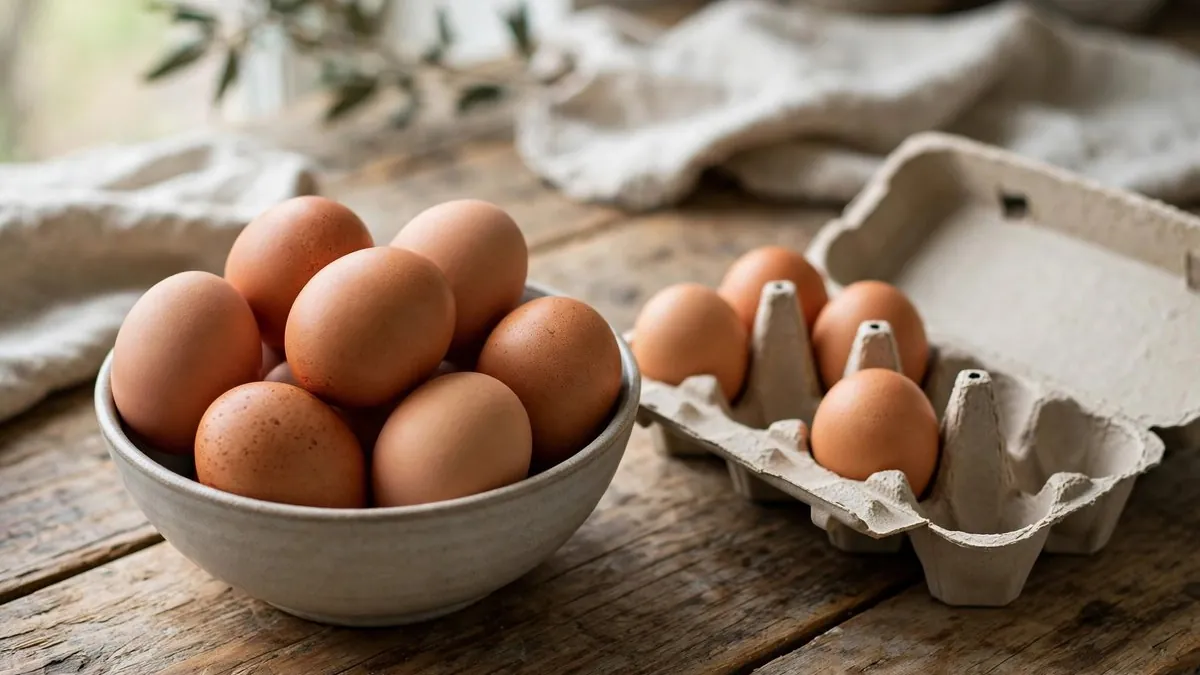

Pasture raised eggs come from hens that spend their days outdoors on grass, and the label has become one of the most talked-about phrases in the egg aisle. Shoppers reach for the carton because it promises a better life for the hens and a better egg for the table.
So what do pasture raised eggs actually mean? They are eggs laid by hens that live outdoors on pasture, where the birds can roam, scratch, peck and forage in the open air, rather than living indoors or in a fenced yard. This guide explains the label, the comparisons, what to look for when you buy, and how to cook and store them.
Key takeaways:
- Pasture raised means the hens live outdoors on grass, where they can roam, scratch and forage during the day.
- Pasture raised is not the same as free-range or cage-free: the hens get far more outdoor space and genuine access to pasture.
- Look for a clear label and a certification seal, and check the eggs are clean and uncracked.
- Cook eggs until both the white and the yolk are firm, and refrigerate them promptly after buying.
What does pasture raised actually mean?

Pasture raised describes a way of keeping laying hens, not a breed of hen or a type of egg. The hens live outdoors on pasture for much of the day, moving across grass in mobile shelters or open fields, and they are brought into a coop or barn at night. During the day they scratch, peck, chase insects, dust-bathe and rest in the shade.
The pasture itself matters as much as the fresh air. A genuine pasture system rotates the birds across different areas of grass, so the ground has time to recover and the hens always have fresh ground to forage on. The birds eat grain feed alongside whatever they find while foraging, and the farmer moves shelters and fences as the grass is grazed down.
Pasture raised vs free-range vs cage-free: what is the difference?
The egg aisle is full of labels that sound similar but describe very different lives for the hens. Cage-free, free-range and pasture raised all describe systems without cages, but the outdoor access differs greatly.
Cage-free hens live indoors, usually in a large barn, without cages: they can move around, perch and nest, but they do not necessarily go outside at all. Free-range hens live indoors too, but they also have access to an outdoor area, often a fenced yard beside the barn. Pasture raised hens go a step further: they live outdoors on grass for much of the day, with real space to roam and forage, rather than a small yard attached to a barn.
| Label | Where the hens live | Outdoor access | What to expect |
|---|---|---|---|
| Cage-free | Indoors in a barn, without cages | None required | Hens move around the barn but may never go outside |
| Free-range | Indoors with access to an outdoor area | A fenced yard or run beside the barn | Hens can go outside, but the outdoor space may be small |
| Pasture raised | Outdoors on grass during the day, sheltered at night | Open pasture with room to roam and forage | Hens spend the day outside, scratching and foraging on grass |
| Organic | Cage-free or free-range, with organic feed | Outdoor access required in many schemes | A separate label about feed and farming, not a guarantee of pasture |
Organic is a separate label altogether, and it is easy to confuse with pasture raised. Organic describes how the hens are fed and how the farm is run: the feed is grown without synthetic pesticides and fertilisers, and the hens are not given routine antibiotics. An organic egg is not automatically a pasture raised egg, and a pasture raised egg is not automatically organic.
What to look for when you buy pasture raised eggs
Start with the carton itself. A good producer prints more than the words “pasture raised” on the box: look for a short description of the farming method, the name and location of the farm, and a third-party certification seal. A seal means an independent organisation has checked the farm against published standards.
Next, check the eggs. Open the carton before you buy if you can, and look for clean, uncracked shells. A cracked egg should stay on the shelf, because a crack in the shell lets bacteria in and shortens the egg’s life. Shell colour, usually white or brown depending on the breed, says nothing about quality or flavour.
Check the date on the carton too, and buy the freshest carton you can. The date is a guide to quality, not a sudden deadline. Store the carton in the fridge as soon as you get home, and keep the eggs in the carton rather than loose in the fridge door.
Price is part of the picture, and pasture raised eggs are usually the most expensive eggs on the shelf. The higher price reflects the extra land, labour and smaller flocks that pasture systems need. Farm shops, farmers’ markets and box schemes often sell them directly from the farm, and the person selling them can usually tell you how the hens live.
How do pasture raised eggs taste and cook?
Many people who switch say the yolks look deeper in colour, often a rich golden orange rather than pale yellow. That colour comes from the carotenoids in the grass and plants the hens eat while foraging, and it varies with the season and the pasture.
As for flavour, the honest answer is that the difference is subtle. A fresh egg from a foraging hen will often taste a little richer than a standard egg, but freshness and cooking matter at least as much. The biggest difference most cooks notice is the feel: the whites are often firmer and the yolks sit higher, holding their shape better in the pan. Our guide to the best breakfast burrito is a good place to put a well-fried egg to work, and our guide to the best breakfast casserole shows how eggs carry a whole dish.
How to cook pasture raised eggs
Frying is the simplest test of a good egg. Warm a little butter or oil in a pan over a medium heat, crack the egg in gently, and cook until the white is fully set and the yolk is as firm as you like it.
For boiled eggs, start with eggs at room temperature if you can, and lower them gently into boiling water with a spoon. A medium egg needs around six minutes for a soft yolk and around ten for a fully firm one, while a large egg needs a minute or so more. Cool them under cold water straight away to stop the cooking.
For scrambled eggs, low and slow is the rule. Whisk the eggs with a pinch of salt, pour them into a pan with a knob of butter over a low heat, and stir gently and constantly. Take the pan off the heat just before they look done. Serve scrambled eggs with toast made from good bread, and our guide to the best bread for French toast covers the loaves that work best for a slow weekend breakfast.
How to store pasture raised eggs
Eggs keep best in the fridge, in their carton, with the pointed end down. The carton protects the shells from knocks and from absorbing strong smells from other foods, and the fridge keeps them at a steady, cool temperature. Use a middle shelf, not the door, where the temperature swings.
Once an egg is cracked, use it straight away, and skip any egg that smells off: a fresh egg should smell of nothing at all. If you are unsure about an egg’s freshness, crack it into a separate bowl first, so a bad egg does not spoil the rest of your cooking. Cooked eggs need care too: hard-boiled eggs keep in the fridge for a few days in their shells, and egg dishes such as quiches and frittatas should be refrigerated within two hours of cooking and eaten within a couple of days. Reheat them until they are steaming hot all the way through. Egg dishes in our guide to high protein foods are best eaten fresh, so cook what you need and store the rest promptly.
Your pasture raised eggs checklist
Use this list the next time you shop for eggs.
- Read the whole label: look past the words pasture raised for a description of the farm and its methods.
- Look for a certification seal: a third-party seal means the claim has been checked independently.
- Check the eggs: clean, uncracked shells only; leave cracked eggs on the shelf.
- Check the date: buy the freshest carton you can and use the eggs before their best-before date.
- Refrigerate promptly: get the carton into the fridge as soon as you are home.
- Cook eggs through: cook until the white and the yolk are firm.
- Buy from a farm you can trace: a farm shop or market stall beats a vague label every time.
Frequently asked questions
What does pasture raised mean for eggs?
It means the hens live outdoors on grass during the day, where they can roam, scratch, peck and forage, and are sheltered at night. It is the strongest of the common welfare labels, above free-range and cage-free.
Are pasture raised eggs the same as free-range eggs?
No. Free-range hens have access to an outdoor area, which may be a small fenced yard, while pasture raised hens live outdoors on open grass with far more space to roam and forage.
Are pasture raised eggs the same as organic eggs?
No, they are separate labels. Organic describes the feed and farming method, such as feed grown without synthetic pesticides and no routine antibiotics, while pasture raised describes how the hens live.
Do pasture raised eggs taste different?
The difference is subtle. The yolks are often a deeper golden colour from the grass the hens eat, and the whites are often firmer, so the eggs hold their shape well when fried or poached.
Why are pasture raised eggs more expensive?
Pasture systems need more land, more labour and smaller flocks than barn systems. The hens are moved across fresh grass and the work is hands-on, so the cost of producing each egg is higher.
How should I store pasture raised eggs?
In the fridge, in their carton, pointed end down, on a middle shelf rather than in the door. Refrigerate them as soon as you get home.
A note on food safety
Eggs are a wonderful food, but they need the same care as any fresh animal product. Cook eggs until both the white and the yolk are firm, or until the dish is steaming hot all the way through, and refrigerate eggs and egg dishes promptly, within two hours of cooking or buying. Take extra care when cooking for young children, older people, pregnant women and anyone with a weakened immune system. Throw away any egg that is cracked, smells odd or has been left out too long.
The bottom line
Pasture raised eggs are a simple idea done properly: hens living outside on grass, eating what they find as well as what they are fed, and laying eggs that are fresh, firm and full of colour. Read the rest of the carton, but it remains the clearest signal that the hens lived a genuinely outdoor life.
Your next step is a small one: the next time you buy eggs, pick up a carton of pasture raised eggs from a producer you can trace, fry one, and see the difference for yourself. It is worth knowing where your eggs came from.