
Agate is the quiet achiever of the jewellery world. It is hard, durable, and affordable, it comes in more colours and patterns than almost any other stone, and no two pieces look alike. A good agate necklace is easy to wear every day, easy to care for, and easy on the budget, which is why it is a stone worth knowing properly before you buy.
This guide covers nine agate necklaces worth considering in 2027, from a classic blue lace pendant to a bold banded strand. Each one is described by what it does well, what to watch for, and who it suits best, so you can choose with the stone in mind, not just the colour.
Price is a poor guide on its own. Agate is inexpensive as stones go, so a high price usually means the setting or the brand, not the stone. What matters is the pattern, the cut, and whether the colour is natural or dyed, and those are the checks in this guide. They take only a few minutes, and they are the difference between a necklace you love and one that looks flat and ordinary on the neck.
Key takeaways
- Agate is banded chalcedony quartz, Mohs 6.5 to 7, hard enough for everyday wear and easy to care for.
- Bright blue, pink, and purple agate is almost always dyed, which is standard and stable but must be disclosed.
- No two agate stones look alike, so banding and pattern variation is normal, not a flaw.
- Beaded strands and pendants in bezel settings suit everyday wear best, while large slices need more care.
- Agate has no proven healing properties and is not an investment stone, and a necklace that claims otherwise is overselling it.
What agate actually is
Agate is a banded form of chalcedony, which is itself a form of quartz. It forms in layers inside volcanic rock, and those layers are what give agate its characteristic banding, in colours from soft grey and white to blue, pink, green, and brown. Because it is quartz, it is hard, at Mohs 6.5 to 7, and it does not scratch easily or absorb moisture, which makes it one of the most practical stones for everyday jewellery.
That hardness is the first thing to understand, because it shapes how agate is worn. Unlike soft stones such as turquoise or malachite, agate can be worn daily, cleaned with soap and water, and kept in a jewellery box with other pieces without much worry. It can still chip if it is dropped on a hard floor or knocked sharply, but it is far more forgiving than most coloured stones.
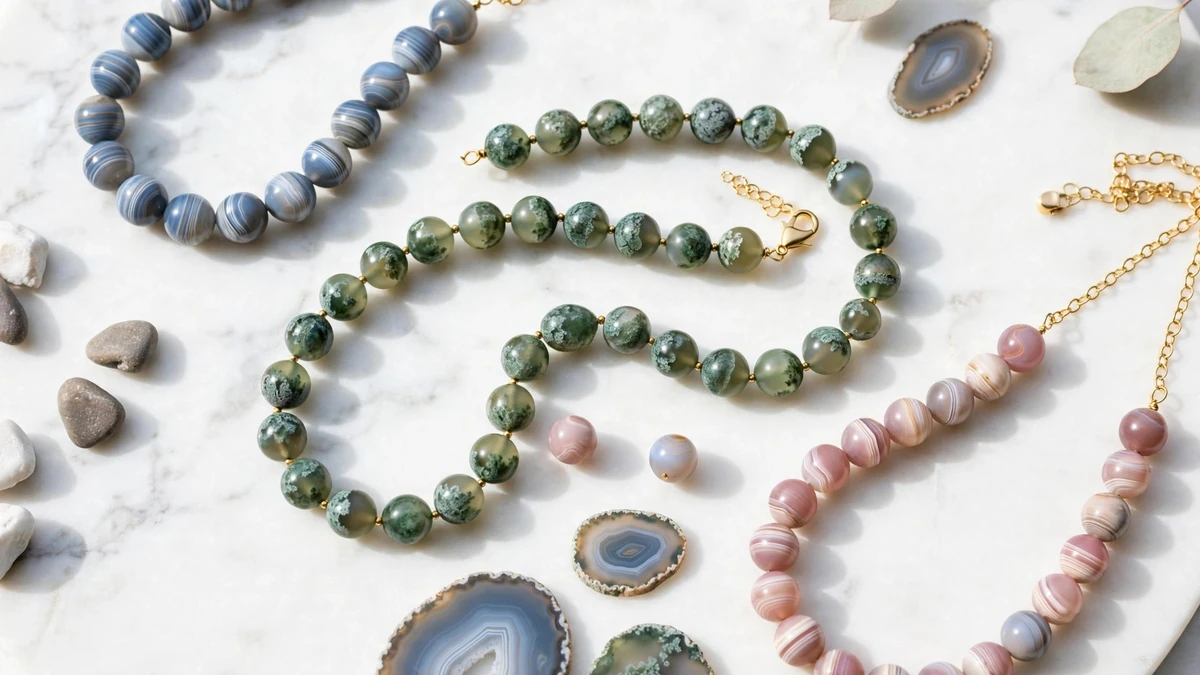
Colour is the other thing to understand. Natural agate is usually soft and muted: grey, white, brown, pale blue, and pale pink. The bright, saturated blues, pinks, and purples you see in shops are almost always dyed, which is standard practice for agate, stable, and nothing to worry about, as long as it is disclosed. Dyeing does not make the stone fake, but it does mean the colour is not natural, and a seller who does not say so is not being straight with you. Varieties to know include blue lace agate, with its soft banded blue, moss agate, with green inclusions that look like tiny plants, fire agate, with flashes of orange and red, and Botswana agate, with fine grey and pink banding.
Agate has been used in jewellery for thousands of years, from ancient Egyptian and Roman ornaments to Victorian mourning jewellery, and it is still one of the most widely available stones in the world, mined in Brazil, India, Madagascar, and the United States. That long history is part of its appeal: it is a stone that has never been fashionable in the narrow sense, and never gone out of fashion either. It suits people who want jewellery that looks considered rather than trendy, and it is one of the few stones that works equally well in a fine gold pendant and in a simple beaded strand.
How we chose these necklaces and what to look for
Look first at the pattern. Agate is valued for its banding, so a stone with clear, interesting bands is worth more than a flat, even-coloured one, and no two stones should look identical. If every bead in a strand looks exactly the same, the stone is probably dyed a single colour or is not agate at all. A little variation is a good sign.
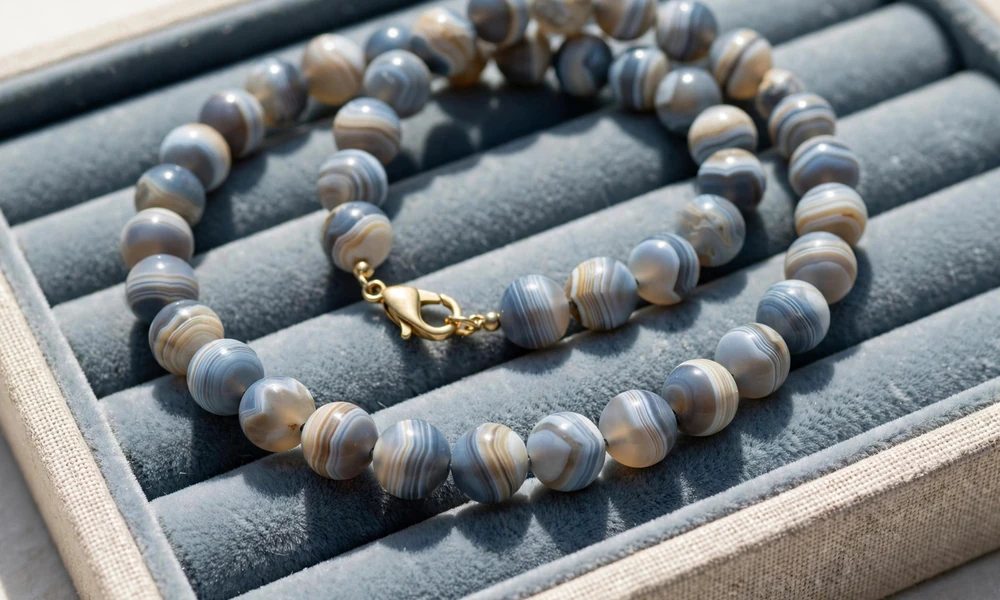
Look next at the cut and the setting. A well-cut agate cabochon should be smooth, polished, and free of cracks, with the banding visible rather than hidden. A bezel setting protects the edges and suits everyday wear, while a prong setting shows more of the stone but leaves it more exposed. Beaded strands are a classic choice, because the beads are small and a broken bead is easy to replace. Our guide to gold jewellery for everyday wear explains why the metal matters too, because a sturdy chain and a secure clasp protect the stone far better than a delicate one.
Finally, look at the colour against your skin and your wardrobe. Pale blue lace agate suits cool skin and light neutrals, while warmer banded agate suits warm skin and richer colours. Agate is a versatile stone, so a single necklace is usually enough, and it pairs well with white, cream, denim, and gold. Try it on in daylight before you decide, because banding shows up differently in shop lighting than in sun.
The 9 best agate necklaces of 2027
Tiffany & Co. Agate Pendant
What we like: A small, clean agate cabochon in a polished gold bezel, with a fine chain and a secure clasp, from a house with clear disclosure of the stone. What to consider: Premium price for an inexpensive stone, and the cabochon is small. Stone: Banded agate cabochon. Setting: 18k gold bezel. Best for: Everyday luxury, a first fine agate piece. Price range: $400 to $850.
The bezel setting is the right call for this stone, and the proportions are restrained enough to wear daily without it feeling like a statement piece.
Cartier Agate Pendant
What we like: A refined pendant with a well-chosen agate stone, solid gold work, and a chain that is made to last. What to consider: High price, and the stone itself is inexpensive. Stone: Banded agate cabochon. Setting: 18k gold, bezel. Best for: A special-occasion or heirloom piece. Price range: $850 to $2,500.
This is the necklace to buy when you want agate done quietly and well, with the craftsmanship carrying the piece rather than the stone.
David Yurman Agate Pendant
What we like: A sculptural pendant with a generous agate cabochon, cable detailing, and a strong, comfortable chain. What to consider: The stone is large and exposed, so it needs more care than a small bezel pendant. Stone: Banded agate cabochon. Setting: Sterling silver or 18k gold, cable. Best for: A bold everyday pendant. Price range: $395 to $1,100.
The cable work gives the pendant presence, and the size makes the banding the focus, which is exactly what agate does best.
Mejuri Agate Pendant
What we like: A simple, well-priced agate pendant on a fine gold vermeil chain, with clear disclosure of the stone. What to consider: The stone is small, and vermeil needs gentler care than solid gold. Stone: Banded agate. Setting: Gold vermeil bezel. Best for: A first agate necklace, layering. Price range: $88 to $220.
An easy entry point that gets the essentials right: a real agate stone, a protective setting, and a price that does not punish a first try.
Monica Vinader Agate Pendant
What we like: A clean, modern pendant with a well-cut agate stone, a comfortable chain, and a design that layers well. What to consider: Gold vermeil rather than solid gold, so avoid water and perfume. Stone: Banded agate. Setting: Gold vermeil bezel. Best for: Layering, everyday wear. Price range: $125 to $320.
The design is understated, which suits agate, because the banding does the work and the setting stays out of the way.
Missoma Agate Pendant
What we like: A relaxed, bohemian pendant with a natural-looking agate stone, at an accessible price. What to consider: The stone varies from piece to piece, and the chain is fine. Stone: Banded agate. Setting: Gold vermeil bezel. Best for: Casual wear, holidays, layering. Price range: $79 to $200.
A good holiday and weekend piece, and the variation between stones is part of the charm rather than a problem.
Maria Black Agate Pendant
What we like: A sculptural, contemporary pendant that treats agate as a design material, not just a colour. What to consider: The design is distinctive, so it suits some wardrobes more than others. Stone: Banded agate. Setting: Sterling silver or gold vermeil, sculptural. Best for: A modern, architectural look. Price range: $170 to $420.
If you like agate but not the traditional bohemian look, this is the version that feels current.
Astrid & Miyu Agate Pendant
What we like: A small, pretty agate pendant at a friendly price, with a delicate chain that suits layering. What to consider: The stone is small and the chain is fine, so treat it gently. Stone: Banded agate. Setting: Gold vermeil bezel. Best for: Layering, a gift. Price range: $65 to $160.
A sweet, affordable way to try agate, and it layers well with the fine gold chains it is designed to sit beside.
Thomas Sabo Agate Pendant
What we like: A bold agate pendant with a detailed setting and a strong chain, at a mid-range price. What to consider: The design is busy, so it suits casual and bohemian looks best. Stone: Banded agate. Setting: Sterling silver, detailed. Best for: A statement pendant, casual wear. Price range: $89 to $260.
The detailing gives the pendant character, and the silver setting suits the cool tones of the stone.
Which agate necklace is right for you
For everyday wear, choose a small pendant in a bezel setting, or a beaded strand. Both keep the stone protected, and both are easy to wear with most outfits. A pendant on a fine chain is the most versatile choice, because it sits close to the neck, does not catch on clothing, and works with both casual and smarter looks.
For a statement, choose a larger cabochon or a beaded strand with graduated beads. These show the banding at its best, and because agate is hard, a larger stone is less of a worry than it would be with a soft stone. If you want a blue stone, blue lace agate is the classic choice, while moss agate suits anyone who likes green and a more organic look. A matching agate bracelet can complete the look, but buy the necklace first, because it is the piece you will wear most.
For sensitive skin, gold and sterling silver settings are usually comfortable, but check the chain and clasp as well as the pendant, because nickel in a cheap chain can irritate skin even when the stone itself is fine. If you have had reactions to jewellery before, ask whether the chain is solid gold, vermeil over sterling silver, or a base metal, and choose the first two.
For gifting, a small pendant is the safest choice, because it suits most people and most wardrobes. A beaded strand is more personal, because the colour and the bead size say more about taste, so it works best when you know the wearer well. Either way, keep the receipt, because a well-made agate necklace is a piece that should last for years, and a good seller will stand behind it.
The caveats that matter
Agate is one of the easiest stones to buy honestly, because it is hard, durable, and inexpensive, and the main thing to check is the colour. Bright blue, pink, and purple agate is almost always dyed, which is standard, stable, and nothing to worry about, as long as it is disclosed. A seller who does not mention dyeing is not necessarily dishonest, but a seller who does is more trustworthy.
| Detail | What is known |
|---|---|
| What it is | Banded chalcedony quartz, Mohs 6.5 to 7, hard and durable |
| Colour | Natural agate is soft and muted; bright blue, pink, and purple is almost always dyed |
| Pattern | Banding varies from stone to stone; no two pieces look alike |
| Common varieties | Blue lace, moss, fire, Botswana, and crazy lace agate |
| What to avoid | Hard knocks and drops, which can chip even a hard stone |
| Best settings | Bezel or prong settings; beaded strands suit everyday wear |
| Care | Soap and warm water, soft cloth; store with other jewellery without much worry |
| What it does not do | It has no proven healing properties and is not an investment stone |
Agate can chip if it is dropped on a hard floor or knocked sharply against metal, so take it off before heavy work or exercise, even though it is harder than most coloured stones. A chip on the edge of a cabochon can sometimes be repolished, but a cracked bead usually needs replacing.
Checklist: choosing an agate necklace honestly
Use these checks before you buy, and again after a month of wear.
- Check the pattern: clear banding and variation from stone to stone is a good sign.
- Check the colour disclosure: ask whether bright blue, pink, or purple agate has been dyed.
- Check the cut: smooth, polished, and free of cracks, with the banding visible.
- Check the setting: a bezel protects the edges, while a prong setting shows more of the stone.
- Check the chain and clasp: sturdy, secure, and comfortable against the skin.
- Check the price against the stone: agate is inexpensive, so a very high price usually means the setting or the brand.
Frequently asked questions
Is dyed agate real agate?
Yes, it is real agate that has been dyed to deepen or change its colour. Dyeing is standard for agate, the colour is stable, and it does not make the stone fake, but it should be disclosed, because a dyed stone is not the same as a naturally coloured one.
Can I wear an agate necklace every day?
Yes. Agate is hard and durable, so it suits daily wear well. It can be cleaned with soap and warm water, and it does not need the gentle handling that soft stones such as turquoise or malachite require.
Why do no two agate stones look alike?
Agate forms in layers inside volcanic rock, and the banding depends on the minerals present as each layer formed. That means every stone has its own pattern, which is part of the appeal, and a strand where every bead looks identical is worth a second look.
What is blue lace agate?
Blue lace agate is a variety of agate with soft, banded layers of pale blue and white. It is one of the most popular varieties for jewellery, and its colour is usually natural, though pale stones are sometimes dyed to deepen the blue.
Can agate chip or break?
Yes, though it is harder than most coloured stones. A sharp knock or a drop on a hard floor can chip an edge or crack a bead, so take it off before heavy work or exercise, and store it where it will not be knocked about.
Is agate a good investment?
No. Agate is inexpensive and bought to wear and enjoy, not as an investment. A statement necklace should be chosen for how it looks on you, not for what it might be worth later.
The bottom line
The best agate necklace in 2027 is not the brightest or the most expensive. It is the one with a well-cut stone, clear banding, and honest disclosure about dyeing, in a setting that suits how you will wear it. A small pendant in a gold bezel is the safest first buy, a beaded strand is the most classic, and a larger cabochon is the choice when you want the pattern to do the talking.
Buy from a seller who says whether the colour is natural or dyed, check the banding in daylight, and enjoy a stone that is hard enough for everyday wear and interesting enough to look different on everyone who wears it. Agate will not impress anyone with its price, but it will quietly do its job, day after day, which is more than most stones can say.