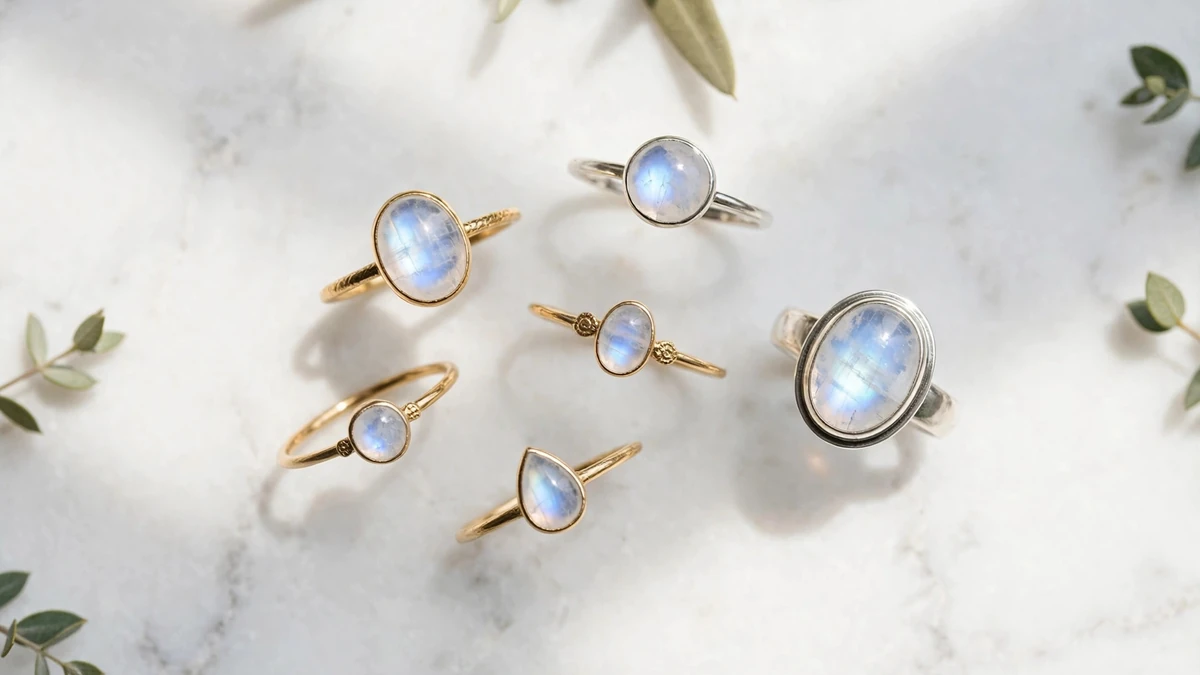

Moonstone has a quiet kind of magic that photographs can only partly capture. Tilt a good stone under light and a soft blue glow seems to float just beneath the surface, then vanish as you turn it. It is the reason moonstone rings have become a favourite for people who want something romantic and unusual without the formality of a diamond. The glow, called adularescence, is what you are really buying, and it varies enormously from one stone to the next.
The problem is that moonstone is also one of the softest stones commonly set in rings. At 6 to 6.5 on the Mohs scale, it scratches and chips far more easily than sapphire or diamond, and a ring takes more knocks than any other piece of jewellery. A beautiful moonstone in a high, exposed setting can look tired within a year if it is worn every day. The right ring is therefore a balance: a stone with a strong, even glow, a setting that protects its edges, and a design honest about how the ring will actually be worn.
Below are nine moonstone rings worth considering in 2027, from a classic solitaire to a bold cocktail ring and a slim stacking band. Each one is described by what it is good at, what to watch for, and who it suits best, so you can choose with the stone’s glow and its limits in mind.
Key takeaways
- Adularescence is the glow that moves across the stone as you tilt it; a strong, even blue sheen is worth more than a large, cloudy stone.
- Moonstone is soft for a ring stone, at 6 to 6.5 on the Mohs scale, so a protective bezel or halo setting suits everyday wear far better than high prongs.
- Blue sheen moonstone is the most prized, while rainbow moonstone is usually white labradorite, a related feldspar with a multi-colour flash.
- Never put a moonstone ring in an ultrasonic or steam cleaner, and take it off for the gym, gardening, and housework.
- No moonstone ring is an investment stone, and moonstone has no proven healing properties; buy it for its beauty, not for a return.
What moonstone actually is
Moonstone is a variety of feldspar, the most common mineral family on earth, and its glow comes from its structure rather than its colour. Microscopic layers of two feldspars scatter light as it enters the stone, creating the floating blue sheen. The best stones show that sheen clearly across the whole cabochon, visible in normal daylight rather than only under a spotlight. A stone that only glows under a jeweller’s lamp will look flat on your hand.
Colour matters less than the glow, but it still guides price. Colourless moonstone with a strong blue sheen is the classic and the most valuable. Grey, peach, and smoky body colours are common and usually cheaper, and they can be very pretty in a warm gold setting. Rainbow moonstone, with flashes of blue, purple, and gold, is usually white labradorite, a close feldspar relative sold under the moonstone name.
The stone is almost always cut as a smooth cabochon, never faceted, because the dome is what shows the glow. That dome is also its weakness. A high cabochon in open prongs is the first thing to catch on a pocket, a door handle, or a gym bag. For a ring you plan to wear daily, a lower dome, a bezel setting, or a halo of small diamonds that guards the edge will keep the stone looking good for far longer.
How we chose these rings and what to look for
Look first at the glow. Hold the ring at arm’s length in daylight and tilt it slowly. The sheen should roll across the stone in a broad, even band, not sit as a small bright spot in one corner. A stone with a strong sheen in a smaller size is a better buy than a large stone with a weak, patchy glow. Check the body colour too: a clean, transparent stone shows the sheen best, while a milky or heavily included stone can look cloudy even in good light.

Look next at the setting and the metal. A bezel setting wraps the stone’s edge in metal and is the safest choice for daily wear. A halo setting adds a ring of small diamonds that protects the edge and adds sparkle, though it adds cost. Four-prong settings show the most stone but leave the edges exposed, so they suit occasional wear better. Yellow gold warms a grey or peach moonstone; white gold and platinum suit a blue sheen stone and keep the look cool and modern.
Finally, consider the size and the occasion. A slim solitaire or stacking band is easy to wear every day and pairs well with other rings. A cocktail ring makes a stronger statement but is better kept for evenings and events. Our guide to moonstone necklaces is a useful companion if you want to build a matching set, because the same rules about glow and body colour apply to every piece.
The 9 best moonstone rings of 2027
Tiffany & Co. Moonstone Solitaire
What we like: A clean, classic solitaire with a well-chosen blue sheen stone, a low profile that sits close to the finger, and the reassurance of a major house’s sourcing and aftercare. What to consider: Premium price for the size of stone, and the solitaire setting leaves the stone’s edge partly exposed. Stone: Blue sheen moonstone cabochon. Setting: Six-prong solitaire in platinum. Best for: An understated engagement or everyday ring. Price range: £2,500–£4,000.
An elegant choice for someone who wants moonstone at its most refined, though it still deserves to come off for heavy work.
Cartier Moonstone Halo Ring
What we like: A halo of small diamonds that guards the moonstone’s edge and adds sparkle, a balanced design that suits the stone’s soft glow, and excellent finishing. What to consider: The halo adds significant cost, and the small diamonds need occasional checking. Stone: Blue sheen moonstone cabochon. Setting: Diamond halo in 18-karat white gold. Best for: A special occasion or proposal ring. Price range: £3,500–£6,000.
The halo does real work here, protecting the soft stone while making the glow look brighter. It is one of the most practical luxury options for near-daily wear.
David Yurman Moonstone Cable Ring
What we like: The signature cable shank gives the ring a distinctive look, the stone is well matched to the design, and the build quality is consistently strong. What to consider: The cable detail can trap lotion and soap, and the stone sits relatively high. Stone: Blue sheen moonstone cabochon. Setting: Cable shank in sterling silver with 18-karat gold accents. Best for: A statement everyday ring. Price range: £800–£1,400.
A good middle ground between a high-street ring and a fine jewellery piece. Clean it regularly and the cable detail stays crisp.
Mejuri Moonstone Bezel Ring
What we like: A slim bezel setting that fully protects the stone’s edge, a fair price for solid gold, and a design that stacks easily with other rings. What to consider: The stone is smaller than in luxury options, so the glow is subtler. Stone: Rainbow moonstone cabochon. Setting: Bezel in 14-karat solid gold. Best for: Everyday wear and stacking. Price range: £180–£320.
The bezel makes this one of the most wearable moonstone rings available. It is the sensible pick if the ring will rarely leave your finger.
Monica Vinader Moonstone Stacking Ring
What we like: A fine, delicate band designed for stacking, a gentle glow that layers well with gold and diamond bands, and a very accessible price. What to consider: The small stone shows less glow than a larger cabochon, and the band is fine enough to bend if knocked. Stone: Rainbow moonstone cabochon. Setting: Pavé-style setting in 18-karat gold vermeil. Best for: Stacking and everyday wear. Price range: £95–£175.
A pretty, low-commitment way into moonstone. Wear it between two plain bands and the stone gets extra protection from its neighbours.
Missoma Moonstone Cocktail Ring
What we like: A bold, oversized cabochon with a strong glow, a chunky setting that makes the stone the centre of attention, and a price that suits occasional wear. What to consider: Too large and high for everyday tasks, and the gold vermeil will wear with heavy use. Stone: Large rainbow moonstone cabochon. Setting: Statement setting in 18-karat gold vermeil. Best for: Evenings and special occasions. Price range: £120–£220.
Best kept for evenings, where the large stone catches the light beautifully. Treat it as a dress ring and it will last well.
Maria Black Moonstone Signet Ring
What we like: A modern signet shape that suits the stone’s soft glow, a sculptural design that feels current, and a solid, reassuring weight. What to consider: The signet style is a strong look that not everyone wants, and the flat stone shows scratches more readily. Stone: Blue sheen moonstone, low cabochon. Setting: Signet in recycled sterling silver. Best for: A modern, architectural look. Price range: £200–£350.
A good choice if you like jewellery with an edge. The low stone is practical, but keep it away from keys and hard surfaces.
Astrid & Miyu Moonstone Three-Stone Ring
What we like: Two small side stones frame the moonstone and add sparkle, the design reads as a proper ring rather than a single stone on a band, and the price is fair. What to consider: The side stones are small, so the moonstone still does most of the work, and the setting is open at the sides. Stone: Blue sheen moonstone cabochon with white topaz sides. Setting: Three-stone in 18-karat gold vermeil. Best for: A romantic everyday ring. Price range: £110–£200.
A sweet, balanced design that works as a gift or a self-purchase. The side stones lift the centre stone without overwhelming it.
Thomas Sabo Moonstone Bypass Ring
What we like: A bypass design that wraps around the stone, a good size for the price, and a brand with reliable quality control at this level. What to consider: The open bypass can catch on fine fabrics, and the stone sits high. Stone: Rainbow moonstone cabochon. Setting: Bypass in sterling silver. Best for: A bold everyday ring. Price range: £130–£240.
The bypass shape gives the ring movement and makes the stone look larger. It suits someone who wants presence without a cocktail-ring silhouette.
Which moonstone ring is right for you
For daily wear, choose a bezel or halo setting in solid gold, with a low dome and a stone under 8 millimetres. A smaller stone with a strong, even glow will look better and last longer than a large stone in tall prongs. Slim bands and stacking rings are the easiest to live with, and they pair well with a plain wedding band.
For a proposal or a special gift, a halo or three-stone design in white gold or platinum gives the ring a more formal feel, and the halo protects the stone at the same time. If the ring is a surprise, check the size carefully first, because resizing a bezel or halo ring is harder and more expensive than resizing a plain band. Our guide to engagement rings covers sizing and metal choices in more detail, and the same advice applies here.
For occasional wear, a cocktail or signet ring is the freer choice. You can go larger, higher, and bolder, because the ring will not face the daily knocks of a keyboard, a gym bag, or housework. Keep it in a soft pouch between wears and it will keep its glow for years.
The caveats that matter
Moonstone is a soft stone in a hard-wearing position. That is the single most important fact about moonstone rings, and it shapes every other decision. It scratches, it chips, and it does not forgive being worn through a workout or a house clean. A ring you love is worth protecting with a sensible setting and a habit of taking it off when your hands are busy.
| Detail | What is known |
|---|---|
| What it is | A feldspar mineral; the glow, adularescence, comes from layered feldspar scattering light |
| Hardness | 6 to 6.5 on the Mohs scale, soft for a ring stone and easily scratched |
| Best glow | A strong, even blue sheen visible in daylight across the whole stone |
| Rainbow moonstone | Usually white labradorite, a related feldspar with a multi-colour flash, not blue sheen moonstone |
| Best setting for daily wear | Bezel or halo, with a low dome and a protected edge |
| Cleaning | Warm soapy water and a soft cloth only; never ultrasonic or steam cleaning |
| Common imitations | Glass with a fake glow, and dyed or coated stones; buy from a reputable seller |
| What it is not | Not an investment stone, and it has no proven healing properties |
Buy from a seller who names the stone honestly. If a listing calls a stone rainbow moonstone, ask whether it is white labradorite. If a stone is described as blue moonstone, check that the sheen is natural and not a coating. A reputable jeweller will answer plainly, and a vague answer is itself an answer.
Checklist: choosing a moonstone ring honestly
Use these checks before you buy, and again after a month of wear.
- Check the glow in daylight: tilt the ring slowly and look for a broad, even blue sheen, not a single bright spot.
- Check the setting: a bezel or halo protects the stone’s edge far better than tall open prongs.
- Check the dome: a lower cabochon catches on less and chips less than a tall one.
- Check the metal: solid gold or platinum suits daily wear; vermeil and plating wear faster on a ring.
- Check the size: measure the finger at the end of the day, and remember that bezel and halo rings are harder to resize.
- Check the care: warm soapy water only, a soft pouch for storage, and off for the gym, gardening, and cleaning.
Frequently asked questions
Can I wear a moonstone ring every day?
Yes, if the setting suits it. A bezel or halo ring in solid gold, with a low dome, can be worn daily with care. Take it off for the gym, gardening, housework, and swimming, and it will keep its glow far longer than a tall prong-set ring worn through everything.
Is moonstone a good engagement ring stone?
It can be, for someone who loves the glow and understands the trade-off. It is softer than diamond or sapphire, so it needs a protective setting and gentle handling. Many people choose moonstone for a promise ring or a right-hand ring and keep a harder stone for an engagement ring worn every day.
What is the difference between moonstone and rainbow moonstone?
Blue sheen moonstone is orthoclase feldspar with a floating blue glow. Rainbow moonstone is usually white labradorite, a related feldspar with flashes of blue, purple, and gold. Both are genuine feldspars and both are attractive, but they are different stones and should be priced differently.
How do I clean a moonstone ring?
Warm water, a drop of mild soap, and a soft cloth are all you need. Rinse well and pat dry. Never use an ultrasonic cleaner, a steam cleaner, or harsh chemicals, and never scrub the stone with a brush, because moonstone scratches easily.
Does moonstone fade in sunlight?
Moonstone is generally stable in sunlight and does not fade the way some dyed stones do. Heat is the bigger concern: sudden temperature changes and prolonged heat can damage the stone, so keep it away from radiators, saunas, and hot water.
Can I match a moonstone ring with other moonstone jewellery?
Yes, and it works well because the glow is the same across pieces. A matching set, such as our moonstone bracelets, looks best when the stones share a similar body colour and sheen strength, so buy pieces together or from the same collection where you can.
The bottom line
The best moonstone ring in 2027 is not the largest stone or the most expensive setting. It is the ring with the strongest, most even glow in a setting that protects it, in a size and style you will actually wear. For daily wear, a bezel or halo ring in solid gold is the honest choice. For evenings, a cocktail or signet ring lets the stone be as bold as it wants to be.
Choose the glow first, the setting second, and the price third. A small stone with a beautiful sheen will give you more pleasure every day than a large, cloudy stone in a setting that leaves it exposed. That is the honest way to buy moonstone, and it is how a ring stays beautiful for years rather than months.