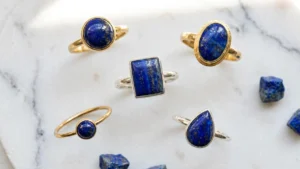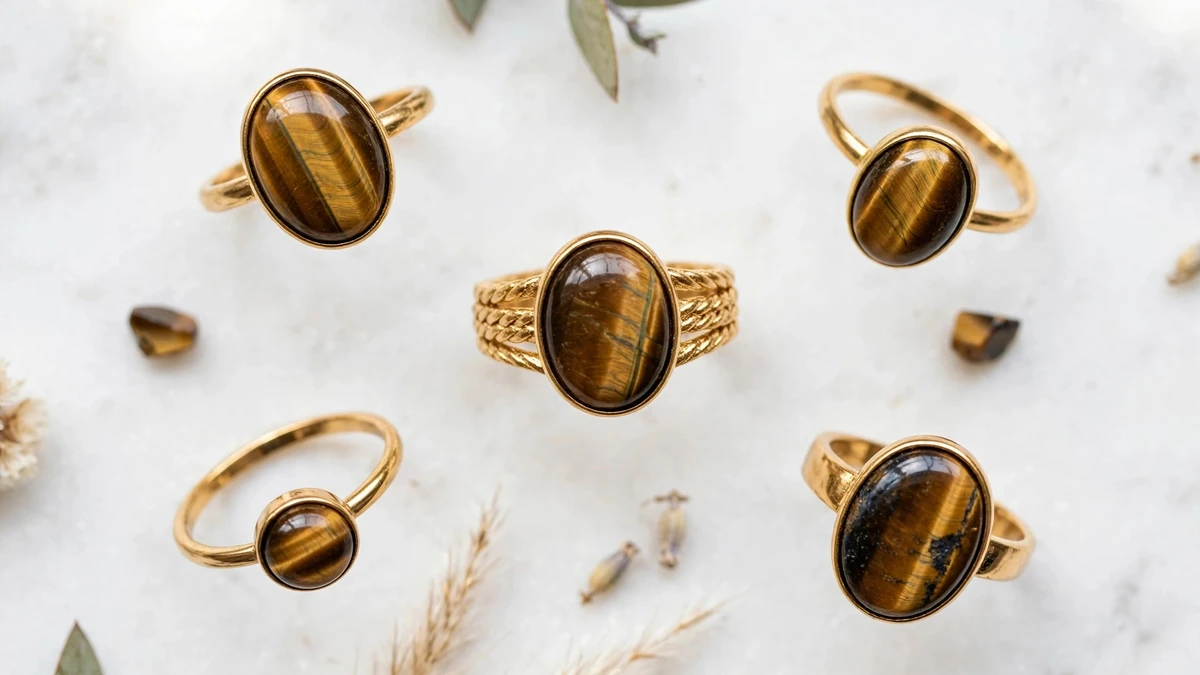

Tiger’s eye is the warmest stone in the jewellery cabinet. A golden-brown quartz with a silky band of light that moves as the ring turns, it looks expensive without trying too hard, and it works with yellow gold, rose gold and silver alike. That is why tiger’s eye rings keep appearing in 2027, from simple signet styles to bold cocktail rings, and why they suit people who want colour without the price of a ruby or a sapphire.
The problem is not finding a tiger’s eye ring. It is finding one with a genuinely good stone, set properly, at a fair price. Much of what is sold as tiger’s eye is dyed, heat-treated or made from glass, and a thin, poorly cut stone in a flimsy prong setting will chip, fade or fall out within a year. Blue tiger’s eye is almost always dyed, red tiger’s eye is usually heat-treated, and a stone that looks flat and glassy in daylight is rarely worth its price tag.
Below are nine tiger’s eye rings worth considering in 2027, from a classic signet to a sculptural statement piece. Each one is described by what it does well, what to watch for, and who it suits best, so you can choose with the stone in mind, not just the brand name.
Key takeaways
- Tiger’s eye is a quartz (Mohs 7) with chatoyancy, a moving band of light caused by parallel fibres of crocidolite replaced by quartz.
- Bezel and halo settings protect the stone best on a ring, because a high, exposed cabochon is the first thing to catch on a door handle.
- Red tiger’s eye is usually heat-treated and blue tiger’s eye is usually dyed, both standard and acceptable when disclosed, but neither should be priced as natural.
- Glass imitations are common at the cheap end, so check for a silky, shifting band of light rather than a flat, painted stripe.
- Tiger’s eye has no proven healing properties and is not an investment stone, so buy it for how it looks on your hand, not for what it promises.
What tiger’s eye actually is for a ring
Tiger’s eye is a variety of quartz, formed when crocidolite fibres are replaced by silica, leaving a stone with a distinctive silky sheen. The effect is called chatoyancy, and it is the whole point of the stone. A good tiger’s eye shows a bright, narrow band of light that slides across the surface as you move your hand. A poor one looks muddy, with a dull patch instead of a band, and no movement at all.
On the Mohs scale it scores 7, which is hard enough for everyday ring wear, but not indestructible. A tiger’s eye ring can still chip if it is knocked against a hard surface, especially if the stone is cut thin or set high. That is why the setting matters as much as the stone. A bezel setting, where a rim of metal wraps around the edge of the stone, is the safest choice for a ring you will wear daily. Prong settings show more of the stone, but they leave the edges exposed, and a four-prong setting on a cabochon is a chip waiting to happen.
Most tiger’s eye is the familiar golden-brown, but two other colours are widely sold. Red tiger’s eye, sometimes called bull’s eye, is almost always golden tiger’s eye that has been heat-treated, and blue tiger’s eye, or hawk’s eye, is usually dyed. Both treatments are standard practice in the trade, and neither is a reason to avoid a ring, but they should be disclosed, and they should not carry the price of a naturally coloured stone. A ring described as natural blue tiger’s eye, at a premium price, deserves a second look.
How we chose these rings and what to look for
Look first at the stone. Hold the ring under a light and tilt it slowly. A good tiger’s eye shows a sharp, bright band that moves smoothly across the surface. The colour should be warm and even, golden-brown with honey and amber tones, not patchy or grey. Avoid stones with visible cracks, dull cloudy patches, or a band so wide and pale that it looks painted on.

Look next at the setting and the band. A bezel or halo setting protects the stone and suits daily wear. A signet style, where the stone sits flush with the band, is the most practical of all. Check the band thickness, because a ring under 1.8 millimetres will bend and thin over time, and check that the stone sits level, not tilted, which is a sign of a rushed setting. Our guide to tiger’s eye bracelets uses the same checks, because the stone behaves the same way whether it is set in a ring or a bracelet.
Finally, look at the metal and the price. Solid gold costs more but lasts decades, while gold vermeil and gold-plated bands are cheaper and will need replating after a year or two of daily wear. Sterling silver is a sensible middle ground, and it suits the warm brown of tiger’s eye well. As a rough guide, a solid gold tiger’s eye ring from a good maker starts around the mid-hundreds, a silver or vermeil version is usually under two hundred, and anything under fifty pounds is almost certainly glass, not stone.
The 9 best tiger’s eye rings of 2027
Tiffany & Co. Tiger’s Eye Signet Ring
What we like: A clean, polished signet in solid gold with a well-cut golden-brown cabochon, a sharp chatoyant band, and a comfortable, substantial band that sits well on the hand. What to consider: Premium price, and the signet style is understated, so it suits people who prefer quiet luxury over a statement. Stone: Natural golden tiger’s eye cabochon. Setting: Bezel-set signet in 18-karat yellow gold. Best for: Everyday wear and a first fine-jewellery tiger’s eye ring. Price range: £1,200–£1,800.
Cartier Tiger’s Eye and Gold Ring
What we like: A sculptural gold band with a polished tiger’s eye cabochon, excellent finishing, and a design that reads as Cartier from across the room. What to consider: A high price for the size of the stone, and the polished gold shows scratches, so it needs regular care. Stone: Golden tiger’s eye cabochon. Setting: Bezel-set in 18-karat yellow gold. Best for: A statement ring and a gift with a famous name behind it. Price range: £2,000–£3,500.
David Yurman Tiger’s Eye Cable Ring
What we like: The signature cable band in sterling silver with a smooth tiger’s eye cabochon, comfortable to wear, and a design that pairs easily with other Yurman pieces. What to consider: The silver will need occasional polishing, and the cable texture can catch on fine knitwear. Stone: Golden tiger’s eye cabochon. Setting: Bezel-set on a silver cable band. Best for: Stacking and everyday wear with a designer signature. Price range: £400–£650.
Mejuri Tiger’s Eye Dome Ring
What we like: A smooth dome of tiger’s eye in gold vermeil, a modern, minimal shape, and a price that makes it easy to try the stone before committing to solid gold. What to consider: Gold vermeil will wear through after a year or two of daily wear, so treat it as a fashion ring rather than a forever piece. Stone: Golden tiger’s eye dome. Setting: Bezel-set dome in gold vermeil over sterling silver. Best for: Trying the stone and wearing it often, but not every day. Price range: £120–£180.
Monica Vinader Tiger’s Eye Signet Ring
What we like: A neat signet in gold vermeil with a well-matched tiger’s eye cabochon, engravable, and designed to stack with the brand’s other rings. What to consider: Vermeil wears over time, and the stone is smaller than in the dome styles, so the band of light is less dramatic. Stone: Golden tiger’s eye cabochon. Setting: Bezel-set signet in 18-karat gold vermeil over sterling silver. Best for: Stacking, gifting and engraving. Price range: £130–£200.
Missoma Tiger’s Eye Stacking Ring
What we like: A slim, delicate band with a small tiger’s eye cabochon, made for stacking, with a warm gold tone that suits the stone. What to consider: The stone is small, so the chatoyancy is subtle, and a slim band needs care if you wear it every day. Stone: Small golden tiger’s eye cabochon. Setting: Bezel-set on a slim gold vermeil band. Best for: Stacking and a first, affordable tiger’s eye ring. Price range: £90–£150.
Maria Black Tiger’s Eye Sculptural Ring
What we like: A bold, sculptural silver setting with a polished tiger’s eye cabochon, a modern, architectural look that suits the stone’s warm tones. What to consider: A statement piece, so it will not suit a minimal wardrobe, and the sculptural setting adds weight. Stone: Golden tiger’s eye cabochon. Setting: Sculptural bezel in sterling silver. Best for: A statement ring and modern, architectural styling. Price range: £180–£300.
Astrid & Miyu Tiger’s Eye Band Ring
What we like: A clean gold band with a small, well-cut tiger’s eye, a modern shape, and a price that works for everyday wear. What to consider: Gold-plated rather than vermeil, so it needs more care, and the stone is modest in size. Stone: Small golden tiger’s eye cabochon. Setting: Bezel-set on a gold-plated band. Best for: Everyday wear on a budget and layering with other bands. Price range: £60–£100.
Thomas Sabo Tiger’s Eye Charm Ring
What we like: A playful charm-style ring with a tiger’s eye cabochon, detailed metalwork, and a design that suits collectors of the brand. What to consider: A busy design that will not suit minimal tastes, and the charm details need gentle cleaning. Stone: Golden tiger’s eye cabochon. Setting: Bezel-set charm ring in sterling silver. Best for: Collectors and a playful, detailed ring. Price range: £100–£180.
Which tiger’s eye ring is right for you
Start with how you will wear it. If the ring is for every day, choose a bezel-set signet or dome in solid gold or sterling silver, with the stone sitting low and flush. If it is for evenings or occasional wear, a higher cocktail setting or a sculptural design is fine, because it will not take the knocks that daily wear brings. A ring you love but never wear is money wasted, so be honest about your routine before you buy.
Next, match the metal to your skin. Tiger’s eye is warm, so yellow gold deepens its honey tones, rose gold softens them, and silver gives a cooler, more modern contrast. Try the ring in daylight, not under shop lights, and check the band of light by tilting your hand. If the stone looks flat and brown in daylight, it will look flat every day. Our guide to tiger’s eye necklaces makes the same point about daylight, because the stone’s beauty is all in how it catches light.
Finally, think about size and fit. Tiger’s eye rings are often sold in whole sizes only, and a signet or dome needs a snugger fit than a slim band, because the weight pulls it around the finger. Get sized in the afternoon, when your fingers are at their largest, and remember that a ring that spins is a ring that will chip its stone on the first door handle it meets.
The caveats that matter
Tiger’s eye is a durable stone for a ring, but it is not indestructible, and it is one of the most imitated stones on the market. Glass imitations, often called tiger’s eye glass or fibre-optic glass, show a band that is too perfect, too straight and too bright, with no variation as you tilt the stone. Real tiger’s eye has a soft, silky band with natural variation, and the colour changes subtly across the stone. If the price seems too good for solid gold and a large stone, it usually is.
| Detail | What is known |
|---|---|
| What it is | A quartz (Mohs 7) with chatoyancy from parallel crocidolite fibres replaced by silica |
| Best setting for a ring | Bezel or halo, low and flush, to protect the stone from knocks |
| Red tiger’s eye | Usually heat-treated golden tiger’s eye, standard but must be disclosed |
| Blue tiger’s eye | Usually dyed, standard but must be disclosed, and should not carry a premium |
| Common imitation | Glass, with a band that is too perfect, too straight and too bright |
| Cleaning | Warm soapy water and a soft brush, never an ultrasonic or steam cleaner |
| Daily wear | Suitable, but remove it for gardening, gym work and heavy manual tasks |
| What it does not do | It has no proven healing properties and is not an investment stone |
Cleaning is simple. Warm soapy water and a soft brush are enough, and the ring should be dried thoroughly before it goes back in a box. Never put tiger’s eye in an ultrasonic or steam cleaner, because the vibration can loosen the setting and the heat can damage a dyed or treated stone. A quick check of the setting every few months, a gentle wiggle of the stone, will catch a loose bezel before the stone is lost.
Checklist: choosing a tiger’s eye ring honestly
Use these checks before you buy, and again after two weeks of wear.
- Check the band of light: tilt the ring under a lamp and look for a sharp, moving band, not a flat painted stripe.
- Check the setting: a bezel or halo protects the stone best, and the stone should sit level, not tilted.
- Check the treatment: ask whether the stone is dyed or heat-treated, and whether that is reflected in the price.
- Check the band: at least 1.8 millimetres thick for daily wear, and a size taken in the afternoon.
- Check the metal: solid gold or sterling silver for a ring you will wear daily, vermeil or plated for occasional wear.
- Check the price: a large stone in solid gold for under fifty pounds is almost certainly glass, not tiger’s eye.
Frequently asked questions
Is tiger’s eye good for an everyday ring?
Yes, with the right setting. At Mohs 7 it is hard enough for daily wear, but it needs a bezel or halo setting that protects the edges, and it should come off for gardening, gym work and heavy manual tasks.
How can I tell real tiger’s eye from glass?
Real tiger’s eye has a soft, silky band of light that moves as you tilt the stone, with natural variation in colour. Glass imitations show a band that is too perfect, too straight and too bright, and the colour looks flat and painted on.
Is blue tiger’s eye natural?
Almost never. Blue tiger’s eye, or hawk’s eye, is usually golden tiger’s eye that has been dyed blue. The treatment is standard practice and the stone is still genuine tiger’s eye, but it should be disclosed and should not carry a premium price.
Does tiger’s eye fade in sunlight?
No, not in normal wear. Tiger’s eye is a quartz and its colour is stable in daylight. Prolonged, intense heat is a different matter, so keep the ring away from radiators, saunas and steam cleaners.
Can tiger’s eye be worn as an engagement ring?
It can, if the setting is right. A bezel-set tiger’s eye in solid gold is durable enough for daily wear, and its warm colour suits people who want something different from a diamond. A ring like this, and the options in our engagement ring guide, show that a non-diamond stone needs a protective setting and a metal that will last.
How do I clean a tiger’s eye ring?
Warm soapy water and a soft brush, then dry it thoroughly. Never use an ultrasonic or steam cleaner, and have the setting checked every few months, because a loose bezel is the most common reason a tiger’s eye stone is lost.
The bottom line
The best tiger’s eye ring in 2027 is not the most expensive or the largest. It is the one with a well-cut stone that shows a sharp, moving band of light, set low in a bezel that protects it, in a metal you will wear every day. For a forever piece, a solid gold signet is the right choice. For everyday wear on a budget, a sterling silver cable or dome ring does the same job with less outlay.
Choose the stone first, the setting second and the brand last. Check the band of light in daylight, ask about treatments, and buy a ring that fits snugly and sits comfortably. That is the honest way to buy tiger’s eye, and the ring you choose this way is the one you will still be wearing in five years.