Hematite rings look like nothing else in the jewellery box. They are dark, metallic and almost mirror-polished, with a gunmetal shine that sits somewhere between silver and black. They cost very little, they suit almost any outfit, and they have a weight on the finger that feels far more substantial than the price suggests. The problem is not finding a hematite ring. It is knowing what you are actually buying, because much of what is sold as hematite is a man-made substitute, and the real stone is softer and more fragile than its metallic look suggests.
That is why this guide starts with the stone itself. Hematite is an iron oxide mineral, grey-black with a metallic lustre, and it is surprisingly heavy for its size. It is also relatively soft for a ring stone, at 5.5 to 6.5 on the Mohs scale, and it is brittle, which means it can chip or crack if it is dropped or knocked hard. Many rings sold as hematite are actually hematine, a man-made material that looks very similar but is magnetic, and the distinction matters, because it changes how the ring should be cared for and what it is honestly worth.
Below are nine hematite rings worth considering in 2027, from a classic signet to slim stacking bands and bold cocktail rings. Each one is described by what it does well, what to watch for, and who it suits best, so you can choose with your eyes open rather than being fooled by a shine that is harder than the stone beneath it.
Key takeaways
- Hematite is an iron oxide mineral with a metallic grey-black shine, and it is noticeably heavy for its size.
- At Mohs 5.5 to 6.5 it is softer and more brittle than it looks, so it can scratch and chip, and it needs a protective setting.
- Much of what is sold as hematite is hematine, a man-made magnetic material, so ask the seller which one you are buying.
- Keep hematite dry, never use an ultrasonic or steam cleaner, and store it away from harder stones.
- Hematite has no proven healing or magnetic health benefits and is not an investment stone, so buy it for how it looks and how it wears, not for what it promises.
What hematite actually is for rings
Hematite is iron oxide, one of the most common iron ores on earth. Polished, it has a dark metallic lustre that can look almost like polished steel, and it takes a shine that few other dark stones can match. It is also dense, so a hematite ring feels heavier on the finger than a ring of the same size in agate or quartz. That weight is part of its appeal, and it is also a useful test, because a ring that feels light for its size is unlikely to be real hematite.
The hardness is the catch. At 5.5 to 6.5 on the Mohs scale, hematite is softer than agate, quartz and most other ring stones, and it is brittle, which means it does not just scratch, it can chip or crack. A ring you wear every day will show wear, and a ring you drop on a hard floor may not survive the fall. A protective setting helps, but it cannot change the nature of the stone, so hematite is best suited to a ring you wear with care rather than one you never take off.
The hematine question is the other one to understand. Hematine, sometimes sold as magnetic hematite, is a man-made material that imitates hematite’s look and is strongly magnetic. Real hematite is only weakly magnetic at most. Hematine is often harder and more durable than the real stone, which is not necessarily a bad thing, but it should be sold as what it is. If a seller claims magnetic health benefits, that is a sign to walk away, because no magnetic jewellery has proven health benefits, and a seller making that claim is not being honest about the stone either.
How we chose these rings and what to look for
Look first at the polish. A good hematite ring has a smooth, mirror-like surface with no pits, dull patches or visible scratches. Run your finger over the stone and check for a consistent shine, because a stone that is dull in places will only get duller with wear. Check the edges too, because chips usually start at the rim, and a ring with a chipped edge on arrival will not improve.
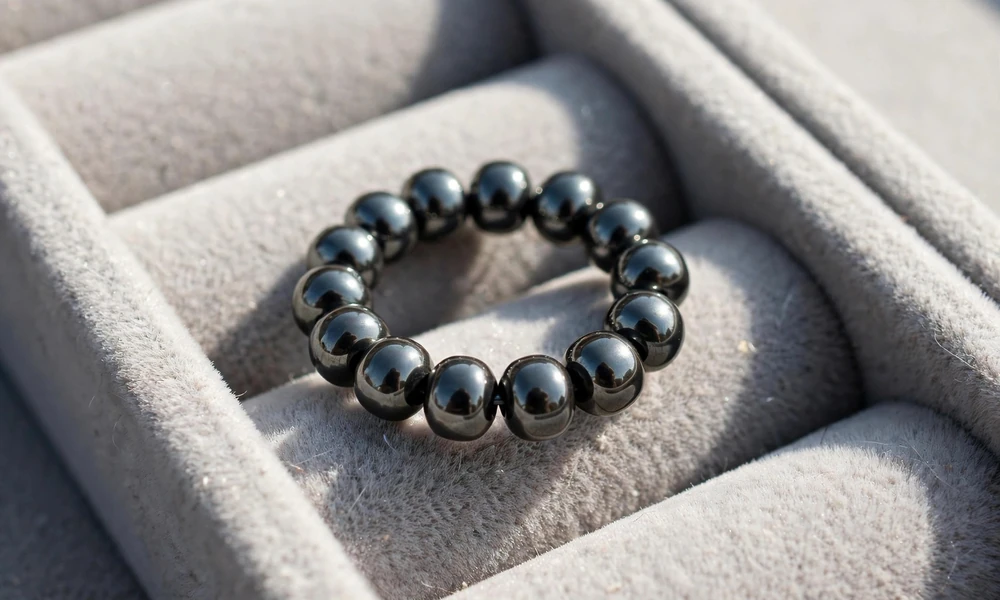
Look next at the setting. A bezel setting that wraps the stone in metal is the best choice for hematite, because it protects the edges where chips start. A prong setting leaves the stone exposed and is a poor choice for a brittle stone. A signet or inlay design, where the stone sits flush in the metal, is also practical, because the metal takes the knocks instead of the stone. Our guide to hematite bracelets covers the same stone in a setting that takes far less punishment than a ring, which is useful context for how much care a ring needs.
Finally, ask the seller what the stone is. A reputable seller will tell you whether the ring is natural hematite or hematine, and will not claim health benefits for either. Check the return policy too, because a ring that arrives with a chip or a dull patch should go back. Hematite is an affordable stone, so most of the price should be in the metal and the making, not in a story about magnetism or healing.
The 9 best hematite rings of 2027
Tiffany & Co. Hematite Signet Ring
What we like: A clean signet design with a well-polished stone set flush in the metal, a comfortable band, and the brand’s usual standard of finishing. What to consider: Premium price for an affordable stone, and the dark colour suits some skin tones better than others. Stone: Hematite. Setting: Signet, inlay. Best For: Understated everyday style. Price Range: Premium.
Cartier Hematite Cocktail Ring
What we like: A bold cocktail ring with a large, mirror-polished stone and an architectural setting that makes the most of hematite’s metallic shine. What to consider: Too large and too heavy for everyday wear, and the price reflects the house rather than the stone. Stone: Hematite. Setting: Cocktail, bezel. Best For: Evenings and occasions. Price Range: Luxury.
David Yurman Hematite Cable Ring
What we like: The signature cable band frames the dark stone beautifully, the polish is consistently good, and the setting is secure enough for regular wear. What to consider: The cable design is a strong style statement, and the dark stone can look severe on very pale skin. Stone: Hematite. Setting: Cable, bezel. Best For: Signature everyday style. Price Range: Premium.
Mejuri Hematite Bezel Ring
What we like: A slim, modern bezel ring at a fair price, with a well-polished stone and a comfortable band that suits daily wear. What to consider: The stone is small, and it will show scratches with everyday wear. Stone: Hematite. Setting: Bezel. Best For: Daily wear on a budget. Price Range: Affordable.
This is the sensible everyday hematite ring. The bezel protects the stone, the band is slim enough to stack, and the price is honest about what the stone is. A good first hematite ring, provided you accept that it will show wear.
Monica Vinader Hematite Signet Ring
What we like: A contemporary signet with a flat, mirror-polished face, a solid feel on the finger, and a design that suits both men and women. What to consider: The flat face shows scratches more readily than a domed stone, and the dark colour is a bold look. Stone: Hematite. Setting: Signet, bezel. Best For: Bold everyday style. Price Range: Mid-range.
Missoma Hematite Stacking Ring
What we like: A slim stacking band with a small, dark stone that layers well with gold and silver rings, at a price that makes collecting easy. What to consider: The stone is small and will scratch with wear, so it is a fashion piece rather than a fine jewellery investment. Stone: Hematite. Setting: Stacking, bezel. Best For: Layering and contrast. Price Range: Affordable.
Maria Black Hematite Sculptural Ring
What we like: A sculptural, contemporary design that treats the hematite as part of the metalwork, with a distinctive, editorial feel. What to consider: The sculptural shape is not comfortable for everyone, and it is a fashion-forward piece rather than a classic. Stone: Hematite. Setting: Sculptural, bezel. Best For: Fashion-forward styling. Price Range: Mid-range.
Astrid & Miyu Hematite Band Ring
What we like: A clean band ring with a hematite inlay that sits flush in the metal, protecting the stone while showing off its shine, at a very reasonable price. What to consider: The inlay is narrow, so the stone makes less impact than in a cocktail ring, and it needs gentle cleaning. Stone: Hematite. Setting: Band, inlay. Best For: Minimal everyday wear. Price Range: Affordable.
The inlay design is one of the smartest ways to wear hematite. The metal takes the knocks, the stone stays protected, and the dark line of hematite gives a plain band a distinctive edge. A good choice for a first dark-stone ring.
Thomas Sabo Hematite Charm Ring
What we like: A playful charm-style ring with a dark, polished stone, a comfortable band, and a price that makes it an easy gift or a first hematite ring. What to consider: The stone may be hematine rather than natural hematite, so check with the seller, and the design is casual. Stone: Hematite. Setting: Charm, bezel. Best For: Gifting and casual wear. Price Range: Affordable.
Which hematite ring is right for you
Start with how you will wear it. If the ring is for every day, choose a bezel, signet or inlay setting, because those protect the stone’s edges where chips start. A slim bezel ring in a dark, polished stone is the most practical choice, and it pairs well with both gold and silver. If the ring is for evenings, a cocktail ring with a large stone makes more sense, because it is designed to be seen rather than to survive a working day.
Think about the colour and the weight honestly. Hematite is dark, metallic and heavy, and it suits people who like bold, architectural jewellery. On very pale skin it can look severe, while on deeper skin tones it often looks striking. Try it on in daylight before you buy, because the shine changes with the light, and a stone that looks mirror-bright in a shop can look flat in dim light. Our guide to hematite necklaces shows the same stone at a larger scale, which can help you decide whether the colour and the weight suit you before committing to a ring.
Consider the metal too. Hematite’s gunmetal shine pairs well with both silver and gold, but it looks most natural with darker metals such as blackened silver or gunmetal, and with yellow gold it creates a strong contrast. Whatever you choose, check that the band is comfortable, that the stone sits securely, and that the ring is sized correctly, because a heavy ring that spins or pinches will spend its life in a drawer.
The caveats that matter
Hematite is a beautiful stone, but it is not a hard-wearing one. It can scratch against harder stones, it can chip if dropped, and it can leave a grey or reddish mark on skin or fabric if it gets wet, because it is an iron oxide and iron rusts. None of that makes it a bad choice for a ring, but it does mean you should treat it with more care than a sapphire or a diamond. Take it off before washing your hands, keep it dry, and store it in a soft pouch away from harder stones.
| Detail | What is known |
|---|---|
| What it is | Iron oxide mineral, grey-black with a metallic lustre |
| Hardness | 5.5 to 6.5 on the Mohs scale, softer and more brittle than it looks |
| Weight | Noticeably heavy for its size, which is a useful authenticity check |
| Hematine | Much sold hematite is hematine, a man-made magnetic material, so ask the seller |
| Best settings | Bezel, signet and inlay settings protect the stone best |
| Cleaning | Soft dry cloth only, never water, ultrasonic or steam cleaners |
| What to avoid | Water, hard knocks, and contact with harder gems that can scratch it |
| What it is not | It has no proven healing or magnetic health benefits and is not an investment stone |
If you are buying a ring as a gift, check the return policy before you buy, because ring sizing is the most common reason a gift goes back. A seller who offers free resizing or exchanges is worth more than a small discount, and a ring that fits properly is a ring that gets worn.
Checklist: choosing a hematite ring honestly
Use these checks before you buy, and again when the ring arrives.
- Check the polish in daylight: the surface should be smooth and mirror-like, with no pits, dull patches or visible scratches.
- Check what the stone is: ask whether it is natural hematite or hematine, and walk away from any seller claiming magnetic health benefits.
- Check the setting: a bezel, signet or inlay protects the stone best, while prongs leave a brittle stone exposed.
- Check the weight: real hematite is noticeably heavy for its size, so a light ring is unlikely to be the real stone.
- Check the fit: the ring should sit comfortably, not spin on the finger, and not pinch when your hands are warm.
- Check the care: soft dry cloth only, stored in a soft pouch away from harder stones, kept dry, and never in an ultrasonic cleaner.
Frequently asked questions
Is hematite durable enough for an everyday ring?
It depends on how you wear it. At 5.5 to 6.5 on the Mohs scale it is softer than most ring stones, and it can scratch and chip. In a protective bezel or signet setting, worn with care and taken off for heavy work, it can be an everyday ring, but it will show wear sooner than agate or quartz.
Is magnetic hematite real hematite?
Usually not. Most strongly magnetic hematite sold in shops is hematine, a man-made material that imitates hematite’s look. Real hematite is only weakly magnetic at most. Hematine is not necessarily a bad choice, it is often harder than the real stone, but it should be sold as what it is.
Can hematite rings get wet?
They should not. Hematite is iron oxide, and water can leave a grey or reddish mark on skin or fabric, and may dull the polish over time. Take the ring off before washing your hands, clean it with a soft dry cloth, and never use an ultrasonic or steam cleaner.
Does hematite have healing powers?
No. There is no reliable evidence that hematite, or magnetic jewellery of any kind, has health benefits. Sellers who claim otherwise are not being honest about the stone, and that should make you question their other claims too. Buy hematite for how it looks, not for what it promises.
Does hematite go with gold or silver?
Both. Its gunmetal shine pairs naturally with silver and darker metals, and it creates a strong, attractive contrast with yellow gold. Our guide to gold jewellery for everyday wear explains how to mix dark stones with gold without the combination looking heavy.
How do I tell real hematite from hematine?
Real hematite is heavy for its size and only weakly magnetic, while hematine is strongly magnetic and will stick firmly to a magnet. A simple fridge magnet is a useful test, though it is not definitive. If you are unsure, buy from a seller who states the material in writing.
The bottom line
The best hematite ring in 2027 is not the cheapest or the shiniest. It is the one with a well-polished stone, a setting that protects it, and a seller who told you honestly whether it is natural hematite or hematine. For everyday wear, a slim bezel or signet ring is the smartest choice. For occasions, a cocktail ring with a large, mirror-polished stone makes a confident statement without the price of a precious gem.
Choose the stone in daylight, check that it is what the seller claims, pick a setting that suits how you will actually wear the ring, and keep it dry. That is the honest way to enjoy one of the most striking and most affordable dark stones in jewellery.