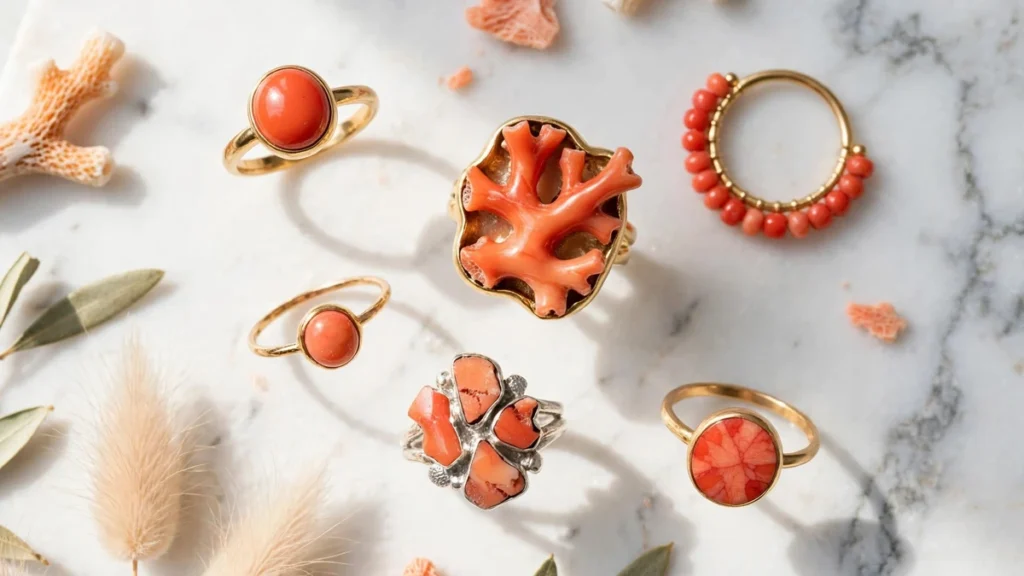
Coral rings are the warmest jewellery you can wear on your hand. A single deep-red cabochon against gold catches the light in a way no faceted stone quite manages, and the colour, a soft orange-red that suits almost every skin tone, is why coral has been carved into rings for thousands of years, from Mediterranean fishing villages to the runways of 2027. It is also, honestly, one of the trickiest stones to buy well.
The problem is not finding a coral ring. It is finding one made from real coral, set well enough to survive daily wear, and priced fairly for what it is. Coral is soft, so a badly set stone chips. Most coral on the market is dyed, reconstructed, or made from resin, glass or bamboo coral, and the price rarely tells you which. Genuine Mediterranean red coral is protected and increasingly scarce, so it costs far more than the imitations that look identical in a photograph.
Below are nine coral rings worth considering in 2027, from a classic gold solitaire to sculptural and stacking styles. Each one is described by what it is good at, what to watch for, and who it suits best, so you can choose with the stone in mind, not just the colour.
Key takeaways
- Real coral is calcium carbonate, soft at Mohs 3 to 3.5, and best in a bezel or protective setting rather than exposed prongs.
- Genuine Mediterranean red coral is scarce and protected, so most affordable coral rings use dyed bamboo coral, reconstructed coral or resin.
- Ask whether the stone is natural, dyed, reconstructed or an imitation, and expect a clear answer in writing before you buy.
- Keep coral away from perfume, acids, ultrasonic cleaners and steam, and clean it only with a soft, damp cloth.
- Coral is a beautiful fashion stone, not an investment, and it has no proven healing properties.
What coral actually is
Coral used in jewellery is the skeleton of a tiny marine animal, built up over decades on the seabed. The coral most prized for rings is Mediterranean red coral, Corallium rubrum, a deep orange-red material that has been harvested off the coasts of Italy, Spain and North Africa for centuries. It is not a mineral at all. It is calcium carbonate, the same material as a seashell, which is why it is soft, warm to the touch, and easy to carve into cabochons and beads.
That softness is the first thing to understand. At Mohs 3 to 3.5, coral is softer than a steel nail and far softer than sapphire or diamond. It scratches easily, chips if knocked against a hard surface, and loses its polish with rough handling. A ring stone takes more knocks than any other piece of jewellery, so coral rings need a setting that protects the stone, a bezel or a halo, rather than tall prongs that leave the edges exposed.
The second thing to understand is supply. Mediterranean red coral is protected under international trade rules, and harvesting is tightly limited. Genuine natural red coral is therefore expensive and increasingly hard to find, especially in large sizes. Most coral rings sold today use alternatives: dyed bamboo coral, which is a paler natural coral coloured to look red; reconstructed coral, made from coral powder bound in resin; or outright imitations in resin, glass or plastic. None of these is necessarily a bad choice, but the price should match what you are actually buying.
How we chose these rings and what to look for
Look first at the stone and how it is described. A reputable seller will say whether the coral is natural Mediterranean red coral, dyed bamboo coral, reconstructed coral or an imitation, and will put that in writing. Vague words like “genuine coral” without a species or treatment note are a warning sign. Deep, even colour with a slightly waxy lustre is typical of good coral; a very bright, uniform, almost orange-red colour often means dye.

Look next at the setting and the metal. Coral suits warm yellow gold best, which deepens its colour, but it also looks striking in rose gold and clean in white gold or platinum. A bezel setting, where a rim of metal surrounds the stone, is the safest choice for everyday wear. A halo of small diamonds or white sapphires adds sparkle and a second layer of protection. Avoid high, exposed prongs on a large cabochon if you plan to wear the ring daily. Our guide to the best coral bracelets follows the same logic, because the same softness that shapes a ring setting shapes every coral piece.
Finally, look at size and wearability. A large cabochon makes a statement but catches on everything, while a small stone in a slim band is easy to live with. Coral is light, so even a large ring feels comfortable, but it is also fragile, so a ring you wear to the office is a better idea than one you wear to the gym. Check the band thickness too: a thin band under a heavy stone bends over time, while a solid band keeps the setting true.
The 9 best coral rings of 2027
Tiffany & Co. Coral Solitaire
What we like: A classic deep-red cabochon in a low yellow gold bezel, with the clean, unfussy lines Tiffany does best. What to consider: Premium price, and the stone is small for the money. Stone: Natural red coral cabochon, around 8 mm. Setting: 18-karat yellow gold bezel. Best for: A first serious coral ring. Price range: £1,800 to £2,400.
This is the ring to buy if you want one coral piece done properly. The bezel keeps the stone safe, the gold is substantial, and the colour is the deep, slightly dark red that marks good Mediterranean coral.
Cartier Coral Cocktail Ring
What we like: A bold oval cabochon in a sculpted gold setting with a pavé diamond halo that makes the red look even richer. What to consider: A statement size that is not an everyday ring. Stone: Red coral cabochon, around 12 mm. Setting: 18-karat yellow gold with diamond halo. Best for: Evenings and occasions. Price range: £4,500 to £6,000.
David Yurman Coral Cable Ring
What we like: A smooth coral cabochon set into Yurman’s signature twisted cable band, which feels substantial and wears comfortably. What to consider: The cable texture can catch on fine fabrics. Stone: Red coral cabochon, around 9 mm. Setting: 18-karat yellow gold cable band. Best for: Everyday luxury. Price range: £1,200 to £1,700.
The cable band is the point of this ring, and it works beautifully with coral: the twisted metal frames the smooth stone, and the weight of the band balances a larger cabochon without feeling heavy.
Mejuri Coral Dome Ring
What we like: A smooth domed coral stone in a slim gold vermeil band, at a price that makes coral easy to try. What to consider: Gold vermeil wears faster than solid gold, and the stone is dyed bamboo coral. Stone: Dyed bamboo coral dome, around 8 mm. Setting: Gold vermeil band. Best for: A first coral ring on a budget. Price range: £120 to £180.
Monica Vinader Coral Signet Ring
What we like: A flat coral inlay in a clean signet shape, modern and easy to stack, with a warm, even colour. What to consider: The flat inlay shows scratches more readily than a domed cabochon. Stone: Red coral inlay, around 10 mm. Setting: 18-karat gold vermeil signet. Best for: Stacking and everyday wear. Price range: £150 to £220.
The signet shape suits coral well because the stone sits flush and protected, and the flat face shows the colour beautifully. It stacks neatly with slim gold bands.
Missoma Coral Stacking Ring
What we like: A small coral bead on a fine gold band, designed to be stacked with two or three others. What to consider: The stone is small, so the colour reads subtly rather than boldly. Stone: Red coral bead, around 5 mm. Setting: 18-karat gold vermeil band. Best for: Layering and gifting. Price range: £85 to £130.
This is the least precious ring on the list and the most wearable. A single small bead of coral adds a flash of warm colour without committing you to a statement piece.
Maria Black Coral Sculptural Ring
What we like: An irregular coral cabochon in an asymmetric silver-gold setting that looks like a piece of sculpture. What to consider: The sculptural shape suits some hands better than others, so try it on if you can. Stone: Red coral cabochon, around 10 mm. Setting: Sterling silver with gold plating. Best for: A distinctive, modern look. Price range: £200 to £300.
Maria Black’s organic shapes suit coral, a material that is itself organic and irregular. The asymmetry makes the ring feel designed rather than assembled, and the price is reasonable for the craft.
Astrid & Miyu Coral Halo Ring
What we like: A round coral cabochon ringed by tiny white stones, with a slim band that keeps the focus on the colour. What to consider: The halo stones are small, so they need gentle cleaning. Stone: Red coral cabochon, around 7 mm. Setting: Gold vermeil with white stone halo. Best for: A romantic, vintage feel. Price range: £110 to £160.
Thomas Sabo Coral Charm Ring
What we like: A playful coral bead with a small charm detail, in sterling silver, at an entry-level price. What to consider: Silver tarnishes and needs regular polishing, and the stone is dyed coral. Stone: Dyed coral bead, around 7 mm. Setting: Sterling silver band. Best for: A fun, casual coral ring. Price range: £70 to £110.
Thomas Sabo keeps it light: a bright bead, a small charm, a silver band. It is not a heirloom, and it does not pretend to be, but it is a cheerful way to wear coral every day.
Which coral ring is right for you
Warm skin tones suit coral best, because the orange-red in the stone picks up the warmth in the skin. Cool skin tones can wear it too, especially a deeper red coral against white gold or platinum, which cools the colour down. If you are unsure, hold the ring against the back of your hand in daylight: the right coral will look warm and alive, not flat or orange.
For everyday wear, choose a small cabochon in a bezel setting on a solid band, and keep it away from hard knocks. For occasions, a larger cocktail ring with a halo is the classic choice, and the extra metal around the stone is protection as well as decoration. If you like stacking, pick a slim signet or bead ring and build around it with plain gold bands. A matching set always looks considered, and our guide to the best coral necklaces is a good place to start if you want a necklace in the same colour.
Hand shape matters more than most people expect. A large oval cabochon lengthens a short finger, while a round stone suits a longer finger. A wide band can overwhelm a small hand, and a very slim band can look lost on a larger one. Coral is light, so a bigger stone does not feel heavy, but it does catch on pockets and sleeves, so consider how you actually use your hands during the day.
The caveats that matter
Coral is a beautiful stone, but it is a fragile one, and a ring is the hardest-wearing piece of jewellery there is. The two facts sit in tension, and the honest way to handle that tension is to buy well, set protectively, and care for the stone properly. Never put a coral ring in an ultrasonic cleaner or a steam cleaner: the vibration and heat can crack the stone and loosen the setting. Never wear it in a swimming pool or the sea, because chlorine and salt water damage the surface, and never spray perfume or hairspray over it.
| Detail | What is known |
|---|---|
| What it is | Calcium carbonate, the skeleton of a marine animal, not a mineral |
| Hardness | Mohs 3 to 3.5, soft and easy to scratch or chip |
| Best setting | Bezel or halo, which protects the stone edges |
| Best coral | Natural Mediterranean red coral, scarce and protected |
| Common alternatives | Dyed bamboo coral, reconstructed coral, resin, glass and plastic |
| What to avoid | Ultrasonic and steam cleaners, perfume, acids, chlorine, salt water |
| Cleaning | Soft, damp cloth only, then dry immediately |
| What it is not | Not an investment stone, with no proven healing properties |
If a seller cannot tell you whether the coral is natural, dyed, reconstructed or an imitation, do not buy from them. A genuine seller will answer the question directly, and a good one will put it in writing on the receipt or certificate.
Checklist: choosing a coral ring honestly
Use these checks before you buy, and again when the ring arrives.
- Check the stone: ask whether it is natural, dyed, reconstructed or an imitation, and get the answer in writing.
- Check the colour: deep, slightly uneven red with a waxy lustre is typical of real coral; very bright, uniform orange-red often means dye.
- Check the setting: a bezel or halo protects the stone far better than tall prongs.
- Check the band: solid and well finished, thick enough to support the stone without bending.
- Check the size: try it on, make a fist, and check it does not catch or twist.
- Check the care: no ultrasonic or steam cleaning, no perfume or chlorine, soft cloth only.
Frequently asked questions
Is coral a real gemstone?
Coral is an organic gem, like pearl and amber, rather than a mineral gemstone like sapphire or diamond. It is the calcium carbonate skeleton of a marine animal, cut and polished into cabochons and beads. It is a genuine jewellery material, but it is much softer than mineral stones.
How can I tell if a coral ring is real?
Real coral has a slightly waxy lustre, a warm colour that varies a little across the stone, and often tiny surface lines or pores visible under a loupe. Glass imitations are very smooth and cold, plastic feels light and warm, and dyed bamboo coral often has a very even, bright colour. A reputable seller and a written description are the most reliable checks.
Can I wear a coral ring every day?
Yes, if it is set protectively in a bezel or halo and you are careful with it. Take it off for cleaning, gardening, the gym and swimming, and keep it away from perfume and chemicals. A small, low-set coral ring is far more practical for daily wear than a large cocktail ring.
Why is some coral so expensive?
Genuine Mediterranean red coral is scarce and protected, with harvesting strictly limited, so large, well-coloured natural pieces command high prices. Most affordable coral rings use dyed bamboo coral or reconstructed coral, which look similar but cost far less. The price should reflect what the stone actually is.
Does coral fade?
Coral can fade and lose its polish with prolonged exposure to strong sunlight, heat and chemicals. Dyed coral fades faster than natural coral. Store your ring in a soft pouch away from light, and clean it only with a damp cloth.
Is coral a good investment?
No. Coral is a fashion stone, bought for its colour and beauty, and its value does not reliably rise. Antique natural red coral pieces can hold value, but a new coral ring should be bought because you love wearing it, not as an investment. For everyday gold care, our guide to gold jewellery for everyday wear covers the metal side of looking after a ring like this.
The bottom line
The best coral ring in 2027 is not the biggest or the most expensive. It is the one with an honestly described stone, a setting that protects it, and a size you will actually wear. For a first coral ring, a small cabochon in a gold bezel is the smartest choice. For a statement, a halo cocktail ring in deep red coral is hard to beat, as long as you treat it as an occasion piece.
Choose one ring, ask the hard questions about the stone before you buy, and look after it with a soft cloth and a little care. Coral rewards that care with a warmth no other stone has, and a ring that looks as good in ten years as it does on the day you buy it.