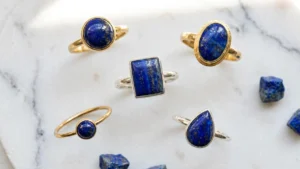
Turquoise rings are the cool counterpoint to coral: a soft, sky-blue stone that has been worn for thousands of years, from Egyptian tombs to Native American silverwork to the bohemian jewellery of 2027. The colour is unmistakable, a robin’s-egg blue that no other stone quite matches, and it suits silver in a way that makes a ring look instantly considered, even with jeans.
The problem is not finding a turquoise ring. It is finding one made from real turquoise, stabilised honestly, and set well enough to survive on a hand. Turquoise is soft and porous, so it absorbs oils, perfume and water, and it chips easily. Most turquoise on the market is stabilised with resin, reconstituted from powder, or not turquoise at all but dyed howlite or magnesite, and the price rarely tells you which.
Below are nine turquoise rings worth considering in 2027, from a classic silver solitaire to sculptural and stacking styles. Each one is described by what it is good at, what to watch for, and who it suits best, so you can choose with the stone in mind, not just the colour.
Key takeaways
- Real turquoise is a hydrated copper aluminium phosphate, soft at Mohs 5 to 6 and porous, so it needs a protective setting and gentle care.
- Most turquoise sold today is stabilised with resin, which is standard practice, but it should be disclosed and priced accordingly.
- Dyed howlite and magnesite are the commonest imitations, with a very even colour and visible dark veins that look painted on.
- Keep turquoise away from water, oils, perfume, ultrasonic cleaners and steam, and clean it only with a soft, dry cloth.
- Turquoise is a beautiful fashion stone, not an investment, and it has no proven healing properties.
What turquoise actually is
Turquoise is a hydrated copper aluminium phosphate, a mineral that forms in dry, copper-rich ground, which is why the finest turquoise comes from arid places: the American Southwest, Iran, and parts of China and Egypt. Its blue colour comes from copper, and its green tint from iron. The most prized colour is a clear, even sky blue, often called robin’s-egg blue, with little or no matrix, the dark veining of host rock that runs through many stones.
That beauty comes with fragility. At Mohs 5 to 6, turquoise is harder than coral but still soft for a ring stone, and it is porous, which means it absorbs whatever touches it. Perfume, hand cream, sunscreen and even the oils from your skin can stain it over time, turning a bright blue stone green or dull. A ring stone takes more knocks and more contact than any other piece of jewellery, so turquoise rings need a setting that protects the stone and a wearer who takes it off before washing up.
The second thing to understand is stabilisation. Most turquoise mined today is soft and chalky, too fragile to cut and polish as it is, so it is stabilised by infusing it with a clear resin that hardens it and deepens its colour. This is standard, accepted practice in the trade, and stabilised turquoise is still real turquoise. What matters is disclosure: a seller should say the stone is stabilised, and the price should reflect it. Reconstituted turquoise, made from turquoise powder bound in resin, is a different thing, and dyed howlite or magnesite is not turquoise at all.
How we chose these rings and what to look for
Look first at the colour and the matrix. Good turquoise has a soft, slightly waxy lustre and a colour that varies gently across the stone. A very bright, uniform, almost electric blue often means dye, and dark veins that look sharp and painted on, rather than soft and natural, are a sign of dyed howlite. Sleeping Beauty turquoise, from Arizona, is famous for its clear blue with almost no matrix. Kingman turquoise, also from Arizona, often has a darker blue with a distinctive matrix. Persian turquoise is a deep, even blue.

Look next at the setting and the metal. Turquoise suits silver best, which is why so much classic turquoise jewellery is set in sterling silver, and it also looks fresh in white gold and warm in yellow gold. A bezel setting, where a rim of metal surrounds the stone, is the safest choice for everyday wear, and it also protects the porous edges from oils and water. Avoid tall prongs on a large cabochon if you plan to wear the ring daily. Our guide to the best turquoise bracelets follows the same logic, because the same softness that shapes a ring setting shapes every turquoise piece.
Finally, look at size and wearability. A large cabochon makes a statement but catches on everything, while a small stone in a slim band is easy to live with. Turquoise is light, so even a large ring feels comfortable, but it is also fragile, so a ring you wear to the office is a better idea than one you wear to the gym. Check the band thickness too: a thin band under a heavy stone bends over time, while a solid band keeps the setting true.
The 9 best turquoise rings of 2027
Tiffany & Co. Turquoise Solitaire
What we like: A clear sky-blue cabochon in a low sterling silver bezel, with the clean, unfussy lines Tiffany does best. What to consider: Premium price, and the stone is small for the money. Stone: Natural stabilised turquoise cabochon, around 8 mm. Setting: Sterling silver bezel. Best for: A first serious turquoise ring. Price range: £900 to £1,300.
This is the ring to buy if you want one turquoise piece done properly. The bezel keeps the stone safe, the silver is substantial, and the colour is the clear, even blue that marks good Sleeping Beauty turquoise.
Cartier Turquoise Cocktail Ring
What we like: A bold oval cabochon in a sculpted gold setting with a pavé diamond halo that makes the blue look even richer. What to consider: A statement size that is not an everyday ring. Stone: Turquoise cabochon, around 12 mm. Setting: 18-karat yellow gold with diamond halo. Best for: Evenings and occasions. Price range: £4,000 to £5,500.
David Yurman Turquoise Cable Ring
What we like: A smooth turquoise cabochon set into Yurman’s signature twisted cable band, which feels substantial and wears comfortably. What to consider: The cable texture can catch on fine fabrics. Stone: Turquoise cabochon, around 9 mm. Setting: Sterling silver cable band. Best for: Everyday luxury. Price range: £700 to £1,000.
The cable band is the point of this ring, and it works beautifully with turquoise: the twisted metal frames the smooth stone, and the weight of the band balances a larger cabochon without feeling heavy.
Mejuri Turquoise Dome Ring
What we like: A smooth domed turquoise stone in a slim gold vermeil band, at a price that makes turquoise easy to try. What to consider: Gold vermeil wears faster than solid gold, and the stone is stabilised turquoise. Stone: Stabilised turquoise dome, around 8 mm. Setting: Gold vermeil band. Best for: A first turquoise ring on a budget. Price range: £110 to £170.
Monica Vinader Turquoise Signet Ring
What we like: A flat turquoise inlay in a clean signet shape, modern and easy to stack, with a fresh, even blue. What to consider: The flat inlay shows scratches more readily than a domed cabochon. Stone: Turquoise inlay, around 10 mm. Setting: 18-karat gold vermeil signet. Best for: Stacking and everyday wear. Price range: £140 to £210.
The signet shape suits turquoise well because the stone sits flush and protected, and the flat face shows the colour beautifully. It stacks neatly with slim silver bands.
Missoma Turquoise Stacking Ring
What we like: A small turquoise bead on a fine gold band, designed to be stacked with two or three others. What to consider: The stone is small, so the colour reads subtly rather than boldly. Stone: Turquoise bead, around 5 mm. Setting: 18-karat gold vermeil band. Best for: Layering and gifting. Price range: £80 to £120.
This is the least precious ring on the list and the most wearable. A single small bead of turquoise adds a flash of cool blue without committing you to a statement piece.
Maria Black Turquoise Sculptural Ring
What we like: An irregular turquoise cabochon in an asymmetric silver setting that looks like a piece of sculpture. What to consider: The sculptural shape suits some hands better than others, so try it on if you can. Stone: Turquoise cabochon, around 10 mm. Setting: Sterling silver. Best for: A distinctive, modern look. Price range: £190 to £280.
Maria Black’s organic shapes suit turquoise, a stone that is itself irregular and full of character. The asymmetry makes the ring feel designed rather than assembled, and the price is reasonable for the craft.
Astrid & Miyu Turquoise Halo Ring
What we like: A round turquoise cabochon ringed by tiny white stones, with a slim band that keeps the focus on the colour. What to consider: The halo stones are small, so they need gentle cleaning. Stone: Turquoise cabochon, around 7 mm. Setting: Gold vermeil with white stone halo. Best for: A romantic, vintage feel. Price range: £100 to £150.
Thomas Sabo Turquoise Charm Ring
What we like: A playful turquoise bead with a small charm detail, in sterling silver, at an entry-level price. What to consider: Silver tarnishes and needs regular polishing, and the stone is stabilised turquoise. Stone: Stabilised turquoise bead, around 7 mm. Setting: Sterling silver band. Best for: A fun, casual turquoise ring. Price range: £65 to £100.
Thomas Sabo keeps it light: a bright bead, a small charm, a silver band. It is not a heirloom, and it does not pretend to be, but it is a cheerful way to wear turquoise every day.
Which turquoise ring is right for you
Turquoise suits almost every skin tone, because its cool blue flatters both warm and cool skin. On warm skin it provides a fresh contrast; on cool skin it reads as a natural extension of the palette. Silver is the classic pairing and the most flattering for most people, while gold warms the stone up and makes it feel more luxurious. If you are unsure, hold the ring against the back of your hand in daylight: the right turquoise will look clear and alive, not flat or chalky.
For everyday wear, choose a small cabochon in a bezel setting on a solid band, and keep it away from water and chemicals. For occasions, a larger cocktail ring with a halo is the classic choice, and the extra metal around the stone is protection as well as decoration. If you like stacking, pick a slim signet or bead ring and build around it with plain silver bands. A matching set always looks considered, and our guide to the best turquoise necklaces is a good place to start if you want a necklace in the same colour.
Hand shape matters more than most people expect. A large oval cabochon lengthens a short finger, while a round stone suits a longer finger. A wide band can overwhelm a small hand, and a very slim band can look lost on a larger one. Turquoise is light, so a bigger stone does not feel heavy, but it does catch on pockets and sleeves, so consider how you actually use your hands during the day.
The caveats that matter
Turquoise is a beautiful stone, but it is a fragile one, and a ring is the hardest-wearing piece of jewellery there is. The two facts sit in tension, and the honest way to handle that tension is to buy well, set protectively, and care for the stone properly. Never put a turquoise ring in an ultrasonic cleaner or a steam cleaner: the vibration and heat can crack the stone and loosen the setting. Never wear it in a swimming pool or the sea, because chlorine and salt water damage the surface, and never spray perfume or apply hand cream over it, because the porous stone absorbs oils and changes colour.
| Detail | What is known |
|---|---|
| What it is | Hydrated copper aluminium phosphate, coloured blue by copper |
| Hardness | Mohs 5 to 6, soft and porous for a ring stone |
| Best setting | Bezel or halo, which protects the stone edges |
| Best colour | Clear, even sky blue, often called robin’s-egg blue |
| Common treatments | Stabilisation with resin is standard and should be disclosed |
| Common imitations | Dyed howlite and magnesite, with even colour and painted-looking veins |
| What to avoid | Water, oils, perfume, ultrasonic and steam cleaners, chlorine |
| What it is not | Not an investment stone, with no proven healing properties |
If a seller cannot tell you whether the turquoise is natural, stabilised, reconstituted or an imitation, do not buy from them. A genuine seller will answer the question directly, and a good one will put it in writing on the receipt or certificate.
Checklist: choosing a turquoise ring honestly
Use these checks before you buy, and again when the ring arrives.
- Check the stone: ask whether it is natural, stabilised, reconstituted or an imitation, and get the answer in writing.
- Check the colour: clear, slightly variable sky blue with a waxy lustre is typical of real turquoise; very bright, uniform blue often means dye.
- Check the matrix: soft, natural veining is fine; sharp, painted-looking dark veins suggest dyed howlite.
- Check the setting: a bezel or halo protects the stone far better than tall prongs.
- Check the band: solid and well finished, thick enough to support the stone without bending.
- Check the care: no water, oils or perfume on the stone, no ultrasonic or steam cleaning, soft dry cloth only.
Frequently asked questions
Is turquoise a real gemstone?
Yes. Turquoise is a genuine mineral gemstone, a hydrated copper aluminium phosphate that has been used in jewellery for thousands of years. It is softer and more porous than sapphire or diamond, which is why it needs a protective setting and gentle care.
How can I tell if a turquoise ring is real?
Real turquoise has a slightly waxy lustre, a colour that varies gently across the stone, and soft, natural matrix veining. Dyed howlite has a very even colour, sharp dark veins that look painted on, and a chalky feel. A reputable seller and a written description are the most reliable checks.
Can I wear a turquoise ring every day?
Yes, if it is set protectively in a bezel or halo and you are careful with it. Take it off for washing up, cleaning, the gym and swimming, and keep it away from perfume, hand cream and sunscreen. A small, low-set turquoise ring is far more practical for daily wear than a large cocktail ring.
Why does turquoise change colour?
Turquoise is porous, so it absorbs oils, perfume and chemicals over time, which can turn a bright blue stone green or dull. This is normal for untreated turquoise, and stabilised turquoise resists it better. Keep the stone dry and away from cosmetics to slow the change.
Is stabilised turquoise real turquoise?
Yes. Stabilisation infuses a soft, chalky turquoise with clear resin to harden it, and the stone remains real turquoise. It is standard practice and should be disclosed. Reconstituted turquoise, made from powder and resin, is a different product, and dyed howlite is not turquoise at all.
Is turquoise a good investment?
No. Turquoise is a fashion stone, bought for its colour and beauty, and its value does not reliably rise. Fine natural turquoise from famous mines can hold value, but a new turquoise ring should be bought because you love wearing it, not as an investment. For the ring side of the decision, our guide to the best engagement rings explains how to weigh a fashion stone against a harder gemstone when a ring needs to last decades.
The bottom line
The best turquoise ring in 2027 is not the biggest or the most expensive. It is the one with an honestly described stone, a setting that protects it, and a size you will actually wear. For a first turquoise ring, a small cabochon in a silver bezel is the smartest choice. For a statement, a halo cocktail ring in clear sky blue is hard to beat, as long as you treat it as an occasion piece.
Choose one ring, ask the hard questions about the stone before you buy, and look after it with a dry cloth and a little care. Turquoise rewards that care with a colour no other stone has, and a ring that looks as good in ten years as it does on the day you buy it.