A bride’s ring is the one piece of jewellery that will be photographed more than anything else she wears on her wedding day, and the one she will keep wearing long after the dress is packed away. It has to look right beside an engagement ring and suit a hand that will wear it every day for years. That is a harder brief than it sounds, because the ring that photographs beautifully in a jewellery box is not always the one that feels comfortable after a long day of photographs, dancing and handshakes.
A slim pavé band suits a bride who wants sparkle without weight, while a bold gold ring suits a bride whose engagement ring is simple. A pearl or coloured-stone ring suits a bride who wants something personal rather than traditional, and the right choice is the one that fits your hand, your dress and your everyday life.
Below are nine rings for brides worth considering in 2027, from a classic platinum solitaire to a pearl ring and a sculptural gold band. Each one is described by what it is good at, what to watch for, and who it suits best.
Key takeaways
- A bride’s ring should sit comfortably beside an engagement ring, so check the fit and the profile of both rings together before you buy.
- Platinum and 18k gold are the most durable choices for daily wear, while vermeil and plated metals wear through within a few years.
- A slim pavé or solitaire band gives the most sparkle for the least weight, which matters on a long wedding day.
- Try rings on in the afternoon, when fingers are at their normal size, and leave a little room for warm weather and swelling.
- No ring suits every bride, every dress and every budget at once, and a ring that needs constant resizing or repair is a poor choice for daily wear.
What a ring for a bride actually needs to do
A wedding ring is not the same as a fashion ring. A fashion ring can be bold, heavy and worn for an evening. A bride’s ring will be worn while typing, cooking, travelling and holding hands, and it will be knocked against tables and door handles. That is why the practical details matter as much as the look. A high setting can catch on fabric, a wide band can feel tight in warm weather, and a delicate pavé setting needs its small stones checked once a year.
Comfort is the first test. A ring that fits well in the morning can feel tight by the afternoon, because fingers swell slightly with heat and activity. Try rings on in the afternoon, leaving enough room for the ring to slide over the knuckle with a gentle push, but not so much room that it spins freely. If the ring spins, it will wear unevenly and the stone will sit sideways in photographs.
The second test is how it sits with the engagement ring. A straight band sits flush against a solitaire, while a curved or shaped band is made to fit around a halo or a raised setting. If the two rings do not sit together, they will rub, and the harder metal will wear the softer one over time. Bring your engagement ring when you try on wedding bands, and wear both together for a few minutes before deciding.
How we chose these rings and what to look for
Look first at the metal. Platinum is the most durable and the most expensive, and it holds its shape well, though it develops a soft patina over time. Eighteen-karat gold is a good balance of strength and warmth, and it comes in yellow, white and rose. Fourteen-karat gold is slightly harder and a little less rich in colour. Vermeil and gold-plated silver are cheaper, but the coating wears through in one to three years of daily wear.

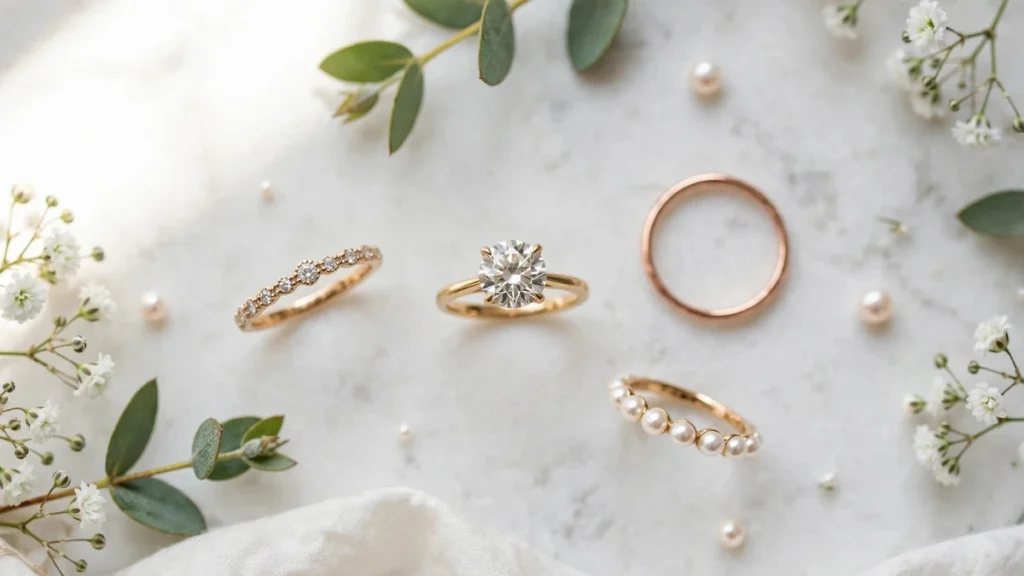
Look next at the setting and the stone. A solitaire puts one stone at the centre and suits a bride who wants a clean, classic line. A pavé setting covers the band in small diamonds and gives the most sparkle, but it needs regular checking. A halo surrounds the centre stone and makes it look larger. A bezel wraps the stone in metal, which is the most secure choice and the best for a bride who works with her hands. Our guide to the best engagement rings of 2027 explains how these settings work, because the same choices shape a wedding band.
Finally, look at the weight and the profile. A comfort-fit band has a rounded inside edge and feels kinder on the finger than a flat band, especially if you are not used to wearing rings. A slim band of two to three millimetres suits most hands and sits well beside an engagement ring. A wide band of five millimetres or more makes a statement, but it can feel tight in warm weather and needs a slightly larger size than a slim band.
The 9 best rings for brides of 2027
Tiffany & Co. Solitaire Engagement Ring in Platinum
What we like: A classic six-prong solitaire in platinum, with a clean line and a stone that sits high enough to catch the light from every angle, and a house with a long record of consistent quality. What to consider: Premium price, and the high setting can catch on fine fabrics. Stone: Diamond. Setting: Six-prong solitaire. Best For: A bride who wants a timeless, classic ring. Price Range: $6,000 and above, depending on the stone.
A strong first choice for a bride who wants a ring that will look right in twenty years as well as on her wedding day.
Cartier 1895 Solitaire Ring in 18k White Gold
What we like: A slim, elegant solitaire with a fine band and a beautifully finished setting, light on the finger and easy to wear beside a wedding band. What to consider: The slim band is less forgiving of knocks than a heavier one, and the white gold needs rhodium replating every couple of years. Stone: Diamond. Setting: Four-prong solitaire. Best For: A bride who wants a refined, understated ring. Price Range: $4,500 and above, depending on the stone.
A quiet, well-made ring that sits well with a straight wedding band and rarely catches on anything.
De Beers Aura Pavé Diamond Ring
What we like: A pavé band of small diamonds around a central stone, giving a bright, even sparkle that photographs beautifully, with a comfortable rounded profile. What to consider: Pavé stones need checking once a year, and the ring is best removed for heavy manual work. Stone: Diamond. Setting: Pavé. Best For: A bride who wants maximum sparkle. Price Range: $5,000 and above, depending on the stone.
Generous sparkle for a bride who wants her hand to catch the light, with an annual stone check as the trade-off.
Harry Winston Classic Diamond Ring
What we like: A classic round brilliant in a simple, perfectly finished setting, with a stone cut for brightness rather than size, and a band that sits comfortably all day. What to consider: Premium price, and the classic design suits a bride who wants tradition rather than a fashion statement. Stone: Diamond. Setting: Classic solitaire. Best For: A bride who wants a traditional, high-quality ring. Price Range: $7,000 and above, depending on the stone.
A straightforward, beautifully made ring that looks right with any dress and any wedding band.
Mikimoto Akoya Pearl Ring
What we like: A lustrous Akoya pearl in a simple gold setting, soft and luminous rather than glittering, and a distinctive choice for a bride who wants something personal. What to consider: Pearls are softer than diamonds and need care, and they should not be worn in the shower or with perfume sprayed directly on them. Stone: Akoya pearl. Setting: Simple prong. Best For: A bride who wants a soft, romantic ring. Price Range: $1,000 to $3,000, depending on the pearl.
A lovely choice for a bride who does not want a diamond, though it needs more care than one.
Bulgari Serpenti Viper Ring
What we like: A sculptural gold coil inspired by a serpent, bold and unmistakable, with a flexible design that wraps the finger comfortably. What to consider: A fashion-forward design that suits a confident bride, and it is best worn on its own rather than stacked with a busy engagement ring. Metal: 18k gold. Setting: Sculptural coil. Best For: A bride who wants a statement ring. Price Range: $3,000 to $6,000, depending on the finish.
A statement ring for a bride whose dress is simple; try it with the dress before deciding.
Van Cleef & Arpels Perlée Ring
What we like: A band of small gold beads, delicate and light, with a soft texture that catches the light without glitter, and a design that stacks beautifully with a solitaire. What to consider: The beaded texture is delicate, so it suits a bride who is gentle with her hands, and it is best in solid gold rather than plated. Metal: 18k gold. Setting: Beaded band. Best For: A bride who wants a delicate, stackable ring. Price Range: $2,000 to $4,000, depending on the metal.
A pretty, understated ring that works beside a solitaire or on its own.
Monica Vinader Riva Diamond Ring
What we like: A cluster of small diamonds in a modern, geometric setting, bright and contemporary, at a more accessible price than the classic houses. What to consider: The brand uses 18k gold vermeil on some pieces, so choose the solid gold version for daily wear, and check the stone setting once a year. Stone: Diamond. Setting: Cluster. Best For: A bride who wants a modern ring at a fair price. Price Range: $600 to $1,500, depending on the metal and stone.
A good modern choice at a fair price; buy solid gold, not vermeil, for daily wear.
Mejuri Diamond Tennis Ring
What we like: A slim band of small diamonds in a continuous line, bright and even, comfortable to wear, and easy to stack with an engagement ring. What to consider: The small stones need an annual check, and the slim band is best in solid 14k or 18k gold rather than vermeil. Stone: Diamond. Setting: Tennis, or line, setting. Best For: A bride who wants an everyday sparkle. Price Range: $500 to $1,200, depending on the metal and stone.
A practical, pretty ring that sits neatly beside most engagement rings and is easy to wear daily.
Which ring is right for your wedding day
Start with your engagement ring, because the wedding band has to live beside it. A solitaire with a high setting needs a straight band or a shaped band that curves around it. A halo engagement ring needs a band that does not fight with the halo. A plain gold engagement ring can take almost any wedding band.
Think next about your dress and your day. A heavy, embellished dress suits a simpler ring, because the eye has enough to look at. A plain, modern dress can carry a bolder ring. If your wedding is outdoors or on a beach, a low, secure setting is safer than a high prong that can catch on fabric or sand. Your wedding shoes deserve the same thinking, because comfort matters all day, and the same is true of a ring you will wear for twelve hours or more.
Finally, think about the years after the wedding. Choose a metal and a setting that suit how you actually live, not just how you look in a photograph. A bezel setting is the safest choice for a bride who works with her hands, and a solid gold or platinum band is the safest choice for daily wear.
The caveats that matter
A bride’s ring is a significant purchase, and the common mistakes are easy to avoid.
| Detail | What is known |
|---|---|
| Best metal for daily wear | Platinum or 18k gold; both are durable and hold their shape well |
| Metal to avoid for daily wear | Vermeil and gold-plated silver, which wear through in 1 to 3 years |
| Most secure setting | Bezel, which wraps the stone in metal and protects it from knocks |
| Most sparkle for least weight | Pavé or tennis settings, with small stones in a continuous line |
| When to try rings on | In the afternoon, when fingers are at their normal size |
| How it should fit | Slides over the knuckle with a gentle push, without spinning freely |
| Maintenance | Pavé and tennis settings need a stone check once a year |
| What it does not do | No ring suits every bride, every dress and every budget at once |
If you have a nickel allergy, ask for the metal composition in writing before you buy, because some white gold alloys contain nickel and can irritate sensitive skin. Platinum and 18k yellow gold are usually the safest choices for sensitive skin.
Checklist: choosing a ring for a bride honestly
Use these checks before you buy.
- Check the fit with your engagement ring: wear both together for a few minutes and look for rubbing or a gap.
- Check the metal: choose platinum or solid 18k or 14k gold for a ring you will wear every day.
- Check the size in the afternoon, when fingers are larger than in the morning.
- Check the setting: a bezel is the most secure, and pavé and tennis settings need an annual stone check.
- Check the weight: hold the ring for a few minutes and make sure it feels comfortable, not heavy or distracting.
- Check the care: ask how to clean it and what the warranty covers.
Frequently asked questions
Should my wedding ring match my engagement ring?
It should sit well beside it, but it does not have to match exactly. A straight band in the same metal is the simplest choice, and a shaped band is made to fit around a raised setting. Mixing metals can work, but the harder metal will wear the softer one over time, so ask your jeweller before you mix.
How much should a bride’s ring cost?
There is no right amount. A solid gold band with small diamonds can cost a few hundred, while a platinum solitaire from a classic house can cost several thousand. Set a budget first, then choose the best metal and setting within it.
When should I buy my wedding ring?
Buy it at least two to three months before the wedding, so there is time for sizing, engraving and any adjustments. If you are ordering a shaped band or a bespoke design, allow three to four months, because a rushed ring is more likely to need resizing later.
Can I wear my wedding ring every day?
Yes, if it is made for daily wear. A solid gold or platinum band with a secure setting is designed for it. Remove it for heavy manual work, the gym and the garden, and have pavé and tennis settings checked once a year for loose stones.
What if my ring does not fit on the wedding day?
Fingers swell in heat and with nerves, so a ring that fitted in the shop can feel tight on the day. Keep your hands cool, avoid salty food the night before, and have a little hand cream ready, because a ring that is slightly tight will usually slide on with a dab of cream and a calm moment.
Is a pearl ring a good choice for a bride?
It can be, if you accept the care it needs. Pearls are softer than diamonds, so they should not be worn in the shower or sprayed with perfume, and they need gentle cleaning. A pearl ring suits a bride who wants a soft, romantic look, and it pairs beautifully with a statement necklace, but it is best as a second ring or a reception ring if you work with your hands.
The bottom line
The best ring for a bride in 2027 is not the most expensive or the most sparkling. It is the one that sits comfortably beside your engagement ring, that suits how you actually live, and that you will still love wearing in ten years. For most brides, that means a solid gold or platinum band, a protective setting, and a size checked in the afternoon.
Choose one ring, wear it with your engagement ring for a few days before the wedding, and judge it on how it feels at the end of a long day. That is the honest way to choose a ring you will wear every day, long after the wedding photographs are framed.