

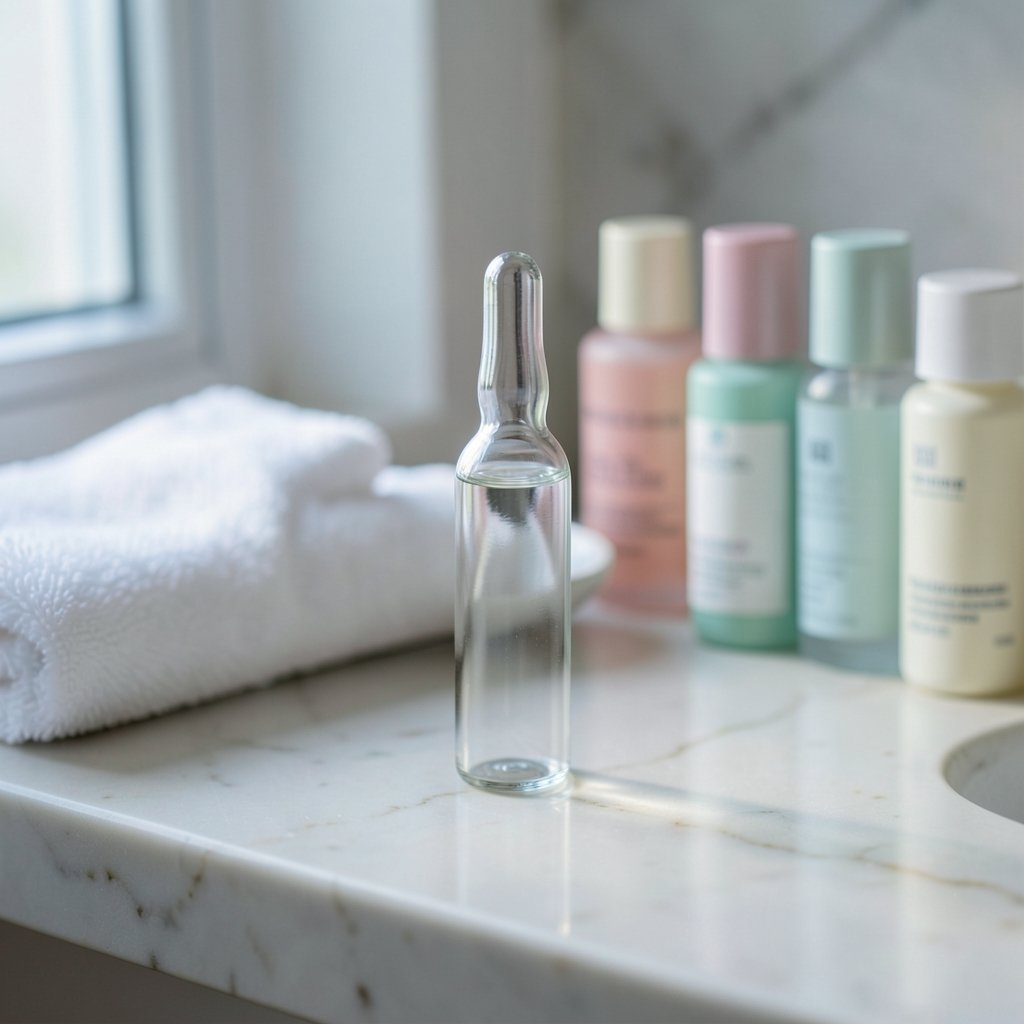
Have you ever stood at a pharmacy counter holding a tiny glass vial and quietly hoped no one would ask you to say the word aloud? Plenty of fluent English speakers hesitate over Ampoule pronunciation, including nurses, skincare fans, and the occasional pharmacist. No single right answer exists to feel anxious about: two well-established pronunciations are accepted. Once you understand why the word splits in two, you will not second-guess yourself again.
The Short Answer: Two Accepted Pronunciations
English speakers pronounce ampoule in one of two ways:
| Pronunciation | Sounds like | Common in |
|---|---|---|
| /ˈæmpuːl/ | AM-pool | British sources, everyday speech |
| /ˈæmpjuːl/ | AM-pyool | American sources, speakers echoing the French |
Both put the stress on the first syllable. Neither is a mistake. If you say AM-pool in London or AM-pyool in New York, you will be understood instantly. The difference comes down to a single glide sound, a small “y” that sneaks in before the “oo.”
That tiny “y” is the whole story. Everything else about the word stays the same.
Why One Little Word Has Two Sounds

The word entered English from French ampoule, which itself traces back to Latin ampulla, meaning a small flask or bottle. That Latin root also gives English the word “ampulla,” used for a flask and as a term in anatomy and church ritual.
French speakers say the word with a nasal vowel and no “y” glide at all, roughly like ahn-POOL. When English borrowed the word, speakers had to make a choice. Some kept the vowel clean and landed on AM-pool. Others added a /juː/ glide, the “y” sound, and arrived at AM-pyool. That glide is a familiar English habit. Think of how “tube” and “due” pick up a “y” in many accents. Ampoule simply followed the same pattern.
So the split is not random. It is English doing what English does: absorbing a foreign word and quietly reshaping it in more than one direction at once.
Which One Should You Use?
Here is where practical advice helps more than theory. In everyday use, either form works, but context can nudge you toward one.
- In British English, the cleaner AM-pool tends to dominate. It is the form most British dictionaries lean toward.
- In American English, AM-pyool appears frequently, partly because the French-looking spelling invites the glide.
- In medical and pharmaceutical settings, you will hear both, often within the same hospital. Nobody corrects anybody.
- In skincare and beauty content, AM-pool is common because the word is spoken quickly and casually.
A useful rule of thumb: pick one, say it with confidence, and stay consistent. Listeners notice hesitation far more than they notice which vowel you chose.
The Spelling Clue Most People Miss
Here is a detail that rarely gets mentioned but explains a lot. The word has three common spellings: ampoule, ampule, and ampul. They all mean the same thing and share the same pronunciations. But the spelling you see on the page can nudge how you say it.
- Ampoule looks French. That visible Frenchness tends to pull readers toward AM-pyool.
- Ampule and ampul look plainer and more English, which tends to steer readers toward AM-pool.
This is an inference rather than a documented rule, but it matches what most people report. If you have only ever seen the word written as “ampul” on a medical supply box, AM-pool probably feels natural. If your first encounter was a French skincare label, AM-pyool likely stuck.
A Quick Note on the French Original
It helps to know what the French actually say, if only to stop worrying that you are “butchering” it. French ampoule is pronounced roughly /ɑ̃.pul/, with a nasal vowel and no “y” sound. English speakers rarely reproduce that nasal vowel, and that is fine. English has its own sound system, and borrowed words get adapted.
The takeaway is not that English speakers are getting it wrong. It is that the word has lived in English long enough to develop its own local habits. Both AM-pool and AM-pyool are English pronunciations, not failed French ones.
Common Mistakes to Avoid
A few habits cause most of the confusion around this word. Watch for these.
- Stressing the second syllable. Some speakers say am-POOL, as if rhyming with “mule” but with the stress shifted. Standard English keeps the stress on the first syllable.
- Over-correcting into full French. Attempting the nasal vowel mid-sentence in English usually sounds forced and can confuse listeners. Save it for actual French conversation.
- Switching mid-conversation. Picking AM-pool in one sentence and AM-pyool in the next sounds uncertain. Choose one and hold it.
- Assuming one form is “wrong.” Correcting someone who says the other version is a losing game. Both are listed in dictionaries.
- Letting the spelling bully you. Do not feel you must say AM-pyool just because the label looks French. AM-pool is equally valid.
How to Practice Saying It Naturally
Pronunciation improves fastest when you stop treating it as a test and start treating it as a habit. A few low-pressure drills help.
- Say the word in a full sentence, not in isolation. “The nurse drew the medication into an ampoule” flows better than repeating the word alone.
- Record yourself once. Play it back. Most people discover their version is perfectly clear and stop worrying.
- Listen for it in the wild. Skincare videos, pharmacy training clips, and medical podcasts all use the word. Notice which form each speaker uses and how little it matters.
- Anchor it to a rhyme. AM-pool rhymes with “pool.” AM-pyool rhymes with “mule” minus the “m” sound at the front. Rhymes stick faster than phonetic symbols.
If you are the kind of person who likes to see how other tricky hair and beauty terms get handled in real content, browsing style guides and tag pages can help you hear how words live in context. Sites that cover texture and styling vocabulary, such as those discussing 4c hair or 2b hair, show how everyday language around products shifts depending on the audience. The same is true of ampoules: the audience shapes the sound.
Where You Will Hear the Word Most
Ampoule is not a word that comes up at dinner. It lives in specific worlds, and knowing them helps you predict which pronunciation you will encounter.
Medicine and pharmacy. Glass ampoules hold injectable drugs. Nurses and doctors say the word constantly, and both forms circulate freely on hospital floors.
Skincare and cosmetics. Concentrated serum ampoules are a staple of Korean and European beauty lines. Marketing videos tend to favor the quicker AM-pool.
Science and laboratories. Sealed ampoules store samples and reference materials. Lab settings lean toward whichever form the local team already uses.
Collecting and antiques. Small decorative ampoules and vintage glass vials show up in antique markets, often described in writing rather than speech.
In none of these settings does the pronunciation change the meaning. The context does all the work.
Does the Register Change Anything?
It is worth saying plainly: no. Whether you are giving a formal presentation or chatting with a friend, the pronunciation does not shift with formality. There is no “posh” version and no “casual” version. The choice between AM-pool and AM-pyool tracks region and personal habit, not politeness or education.
This is reassuring. It means you do not need a different pronunciation for a job interview than for a grocery run. One word, one sound, wherever you go.
How Dictionaries Handle the Split
Dictionaries do not always agree on which form to list first, and that is normal. Some lean British and favor AM-pool. Some lean American and list AM-pyool prominently. Many list both without ranking them at all.
There is also a technical wrinkle. Dictionaries use different transcription systems. Some use the International Phonetic Alphabet. Some use their own respelling systems, like “AM-pool.” Comparing entries across sources can feel like comparing apples to oranges unless you know which system you are reading.
The practical lesson: do not treat any single dictionary as the final judge. If two respected dictionaries list different first forms, that is a signal that both are alive and well in English, not that one is secretly wrong.
Why This Word Confuses So Many People
A few factors stack up to make ampoule unusually slippery.
- It looks foreign. The “-oule” ending signals French, which makes English speakers unsure how far to go.
- It is rare in casual speech. Most people meet the word in writing first, then have to guess.
- It has three spellings. Ampoule, ampule, and ampul all compete, and each nudges the reader differently.
- It sounds like other words. “Amp” and “ampule” sit nearby, adding to the fog.
- It appears in high-stakes settings. Medical contexts make people nervous about getting things wrong, which makes them second-guess a word they actually know.
Recognizing these pressures helps. The confusion is structural, not personal. Anyone encountering this word for the first time faces the same puzzle.
A Realistic View of “Correct”
Here is the balanced truth. English has no academy handing down rulings on every borrowed word. Usage decides, and usage has decided that both AM-pool and AM-pyool are fine. If you want to align with a particular region, follow local habit. If you want to sound neutral, AM-pool travels well almost anywhere.
What does not work is treating the other pronunciation as an error. Correcting a colleague who says AM-pyool when you say AM-pool adds friction and gains nothing. The word means the same thing either way, and both forms have centuries of use behind them.
For anyone writing style guides or training materials, the smart move is to list both forms and note the regional lean. That way nobody feels policed, and everyone knows the options.
If you spend time in beauty and grooming spaces, you have probably noticed how quickly vocabulary settles into local norms. Communities discussing the row or debating product routines develop their own shorthand, and pronunciation follows the same pattern. Language is social before it is technical.
Conclusion
Ampoule pronunciation comes down to a single glide sound and a lot of unnecessary anxiety. Say AM-pool or say AM-pyool, and you will be right either way. The word came from French, passed through Latin, and picked up two English habits along the way. Neither habit is a mistake.
The next time you hold a tiny glass vial and someone asks what it is called, answer with confidence. Pick your version, keep the stress on the first syllable, and let the other one go. The word has survived centuries of borrowing and reshaping. It can survive a little variation in your voice too.
Frequently Asked Questions
Is “ampoule” pronounced AM-pool or AM-pyool?
Both are accepted. AM-pool (/ˈæmpuːl/) is common in British English, and AM-pyool (/ˈæmpjuːl/) is common in American English. The difference is a small “y” glide before the “oo” sound. Neither form is wrong, and both appear in dictionaries.
Is the stress on the first or second syllable?
The stress falls on the first syllable in standard English: AM-pool or AM-pyool. A stressed second syllable, as in am-POOL, is not the usual form.
Do “ampoule,” “ampule,” and “ampul” sound the same?
Yes. They are variant spellings of the same word and share the same pronunciations. The spelling you see may nudge which form you choose, but the meaning and sound options stay the same.
Should I use the French pronunciation in English?
Not usually. French ampoule has a nasal vowel and no “y” glide, roughly /ɑ̃.pul/. Attempting that mid-sentence in English often sounds forced. Stick with one of the English forms unless you are actually speaking French.
Does the pronunciation change in medical or skincare settings?
No. The word is used mainly in medical, pharmaceutical, and cosmetic contexts, but the register does not change how it is said. You will hear both forms in hospitals, labs, and beauty videos alike.
Why do dictionaries list different pronunciations?
Dictionaries differ in which regional form they favor and in which transcription system they use, such as IPA or respelling. When two respected sources list different first forms, it signals that both pronunciations are current, not that one is incorrect.









