

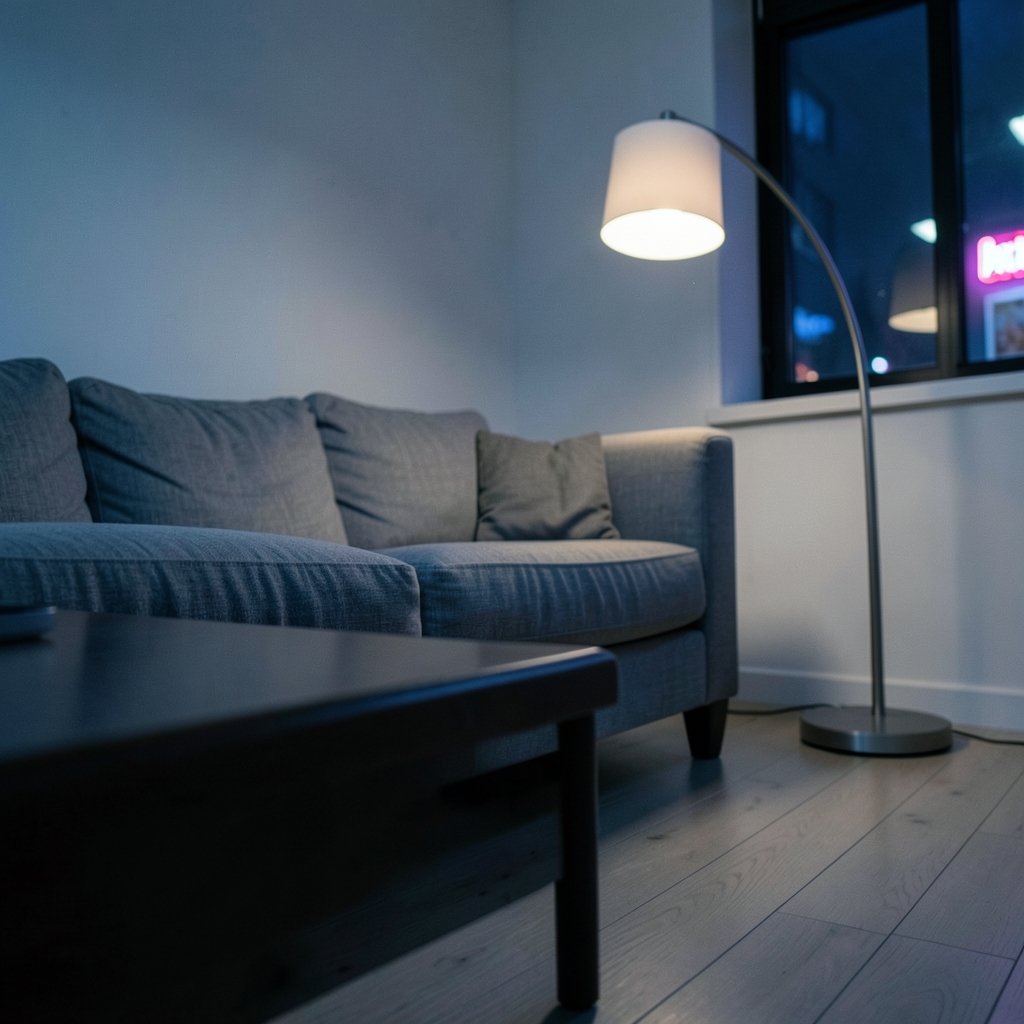
What if the best lighting upgrade for a living room wasn’t a bigger fixture, but a lamp that reaches over your sofa without a table underneath it? That’s the promise of an arc floor lamp: a long, curved arm that cantilevers a shade across a seating area, delivering overhead light exactly where you need it while the base sits quietly off to the side. It looks effortless in photos. In real rooms, though, an arc lamp is a small engineering project, and the difference between a great one and a wobbly regret comes down to a handful of details most buyers never check.
This guide covers how arc lamps work, what to measure before buying, which specs matter, and the mistakes that show up again and again in living rooms.
What an arc floor lamp actually is
An arc floor lamp has three defining parts: a weighted base, a vertical stem, and a long curved arm that sweeps the light source out over a sofa, armchair, or dining table. The shade typically hangs from the end of the arm, often with a slight downward tilt.
The form is widely credited to the 1962 “Arco” lamp designed by the Castiglioni brothers for Flos, which popularized the idea of a lamp that behaves like a hanging pendant but plugs into the wall. That single design decision is why arc lamps remain popular in rentals and open-plan apartments: no ceiling wiring, no electrician, no landlord conversation.
Terminology note: shoppers sometimes type “lamp floor arc” or “floor arc lamp.” Retailers almost universally use arc floor lamp, so search that phrase when comparing models.
How the cantilever works, and why the base matters so much

An arc lamp is a lever. The arm extends the lamp head far from the stem, and that distance creates an overturning moment, a twisting force that tries to tip the whole thing over. The base resists it through mass and footprint.
This has practical consequences:
- Base weight is the headline number. A lamp with a light base and a long reach is a tipping hazard, especially in homes with kids, pets, or thick carpet.
- Carpet changes everything. A heavy base sitting on plush carpet compresses the pile and can shift. A base that feels rock-solid on hardwood may wobble on rug edges.
- Reach and stability trade off. A 70-inch reach needs meaningfully more counterweight than a 40-inch reach. If a listing brags about extreme reach but shows a slim base, be skeptical.
In the US, portable lamps fall under the UL 153 standard for portable luminaires; in Europe and much of the rest of the world, the equivalent family is EN 60598-1 / IEC 60598-1. A lamp carrying a recognized safety mark has at least been evaluated for basic electrical and mechanical safety. That mark doesn’t guarantee the lamp suits your room, but its absence is a reason to keep shopping.
Measure these four things before you buy
Most arc lamp returns trace back to a measurement that was never taken. Do this with a tape measure, not by eye.
- Reach. Measure from where the base will sit to the point where you want light. Add a few inches of margin so the shade lands over the seating area, not behind it.
- Base footprint. Mark the base’s diameter on the floor with painter’s tape. Confirm it fits without blocking a walkway or the sofa’s front legs.
- Height clearance. Check the arm’s highest point against ceiling height, ceiling fans, and any wall art. Arc arms are tall, and the curve peaks higher than the shade.
- Shade height above the floor. For reading, the bottom of the shade generally wants to sit above seated eye level so the bulb isn’t in your face. For ambient light, lower is fine.
A useful trick: have someone hold a broom at the intended lamp height and reach while you sit where you’d actually read. It sounds silly and it works better than any spec sheet.
Reading the specs that matter
Arc lamps vary enormously in quality, and the spec sheet is where that shows. The table below compares what to look for across the main buying tiers.
| Spec | What to check | Why it matters |
|---|---|---|
| Base weight | Listed in pounds or kilograms; heavier is better for long reaches | Prevents tip-over |
| Material | Metal base (steel, iron, marble) vs. filled resin | Resin can crack; metal holds up |
| Reach | Measured in inches or centimeters | Determines whether light lands on the sofa |
| Bulb type | Integrated LED vs. standard socket (E26/E27) | Integrated LEDs can’t be replaced when they fail |
| Dimming | Inline dimmer, foot switch, or smart bulb | Inline dimmers are the most reliable |
| Color temperature | Kelvin rating, ideally around 2700K to 3000K for living spaces | Warm light feels residential; cooler light feels clinical |
| CRI | 90+ preferred | Higher color rendering makes fabrics and skin look natural |
Two spec-sheet traps deserve special mention. First, integrated LED arc lamps often cannot be repaired; when the LEDs age out, the whole lamp goes. A socket-based lamp lets you swap in a dimmable LED bulb and keep the fixture for years. Second, reach is sometimes measured to the outer edge of the shade rather than the center of the light, which flatters the number by several inches.
For anyone comparing layouts across multiple buildings or unit types, the same measurement-first mindset applies to interiors generally; resources on apartment floor plans show how furniture zones and lighting points are typically mapped before move-in.
Where an arc lamp earns its place
Arc lamps solve specific problems better than any other fixture:
- No side table space. If the sofa is flush against a wall or the room is tight, an arc lamp puts light overhead without stealing floor area next to the seat.
- Rentals. No ceiling hooks, no hardwiring, no patching drywall at move-out.
- Open-plan rooms. A single arc can serve a sofa and a dining table if the reach and height are right.
- Reading corners. A properly aimed arc gives even light across a lap and a page, which a low table lamp rarely does.
They’re less ideal for small bedrooms, narrow hallways, and anywhere foot traffic crosses the base. In those spots, a swing-arm wall lamp or a compact table lamp usually wins.
Practical buying tips that save returns
Test the switch before you commit. Inline dimmers on the cord are the most durable option. Touch dimmers on the stem look sleek but fail more often, and foot switches get stepped on. If dimming matters, a smart bulb in a standard socket is the most flexible route.
Buy the bulb at the same time. Many arc lamps ship without a bulb. A dimmable LED around 2700K to 3000K with a CRI of 90 or higher transforms how the lamp looks and how the room feels. A cheap cool-white bulb in a handsome lamp is the most common self-inflicted disappointment in lighting.
Weigh down the base if needed. Some manufacturers sell sand-fillable bases or offer weighted plates. If your lamp feels tippy, a base weight or a rug grip underneath can help. Never solve a stability problem by leaning the lamp against a wall.
Keep the arm out of walkways. The single most common regret is placing the base where people cut through the room. The arm becomes a head-bump and the base becomes a stubbed toe. Put the base behind or beside the sofa, not in the traffic path.
Check the shade’s openness. An open-top or open-bottom shade throws light up the wall and down onto the seat, which reads as softer and more architectural. A fully enclosed drum concentrates light in one pool.
For readers planning a full apartment layout around a new lamp, comparing floor plan options helps identify which rooms have the wall runs and clearances that suit a cantilevered fixture.
Styling an arc lamp without it looking like a showroom
The arc lamp is a statement piece by nature, so restraint elsewhere helps. A few principles that hold up:
- Let it be the tallest thing in the room. Competing tall furniture flattens its effect.
- Anchor it visually. A rug under the seating group makes the base look intentional rather than stranded.
- Match the finish to the room’s metals, not the furniture. A brass arc in a room with black hardware looks accidental; a black arc in a brass-and-cream room looks deliberate.
- Aim the shade slightly toward the seating, not straight down. A small tilt spreads light more evenly across laps and coffee tables.
In modern luxury apartment floor plans, living areas are often drawn with a single overhead fixture and generous wall runs, which is exactly the layout where an arc lamp adds a second, more flexible light layer without construction work.
Common mistakes, and what actually works
The pattern across returns and complaints is consistent. People underestimate base weight, overestimate reach, and buy for the photo rather than the room. What works in practice is dull but reliable: measure the reach, confirm the base weight, choose a socket-based lamp so the bulb is replaceable, buy a warm dimmable bulb at the same time, and place the base outside the walking path.
A second pattern involves height. Buyers see a dramatic arch in a product photo shot in a loft with 14-foot ceilings and are surprised when the same lamp crowds an 8-foot apartment ceiling. Check the arm’s peak height as well as the shade’s.
Finally, don’t overlook assembly. Arc lamps arrive in long boxes with multi-piece arms. Read reviews for complaints about wobble at the arm joints; a joint that loosens over time is hard to fix and ruins the lamp’s steadiness.
Conclusion
An arc floor lamp is one of the few lighting purchases that can change how a room functions and how it looks. It replaces a ceiling fixture you can’t install, a side table you don’t have room for, and a floor lamp that lights the wrong spot. The catch is that the design’s elegance depends entirely on physics: enough base mass, sensible reach, and a placement that respects foot traffic.
Measure first, weight second, bulb third. Get those three right and the lamp disappears into the room, doing its job quietly over your shoulder. Get them wrong and you’ll spend the next year nudging it back into place. The good news is that the checklist is short, and none of it requires an electrician.
Frequently asked questions
How heavy should an arc floor lamp base be?
There’s no universal number, but the longer the reach, the more mass you need. As a rule of thumb, a lamp reaching 60 inches or more should have a base in the range of 30 to 50 pounds (roughly 14 to 23 kilograms), often achieved with a marble or sand-filled metal base. If a long-reach lamp lists a base under about 20 pounds, treat it as a tipping risk, especially on carpet or in homes with children and pets.
Can an arc floor lamp replace a ceiling light?
In many living rooms, yes, for ambient and reading light. An arc lamp throws light down onto a seating area and often bounces some off the wall, which reads as soft and layered. It won’t light an entire open-plan space on its own, and it isn’t a substitute for task lighting in a kitchen or bathroom. Think of it as a second light layer rather than a replacement for general illumination.
Are integrated LED arc lamps a good idea?
They can be, if you plan to keep the lamp for its full lifespan and the manufacturer has a solid warranty. The trade-off is repairability: when integrated LEDs dim or fail, the fixture usually can’t be fixed. A lamp with a standard E26 or E27 socket lets you choose the bulb’s color temperature, brightness, and dimming behavior, and replace it cheaply years later.
What color temperature is best for a living room arc lamp?
Warm white in the range of 2700K to 3000K suits most living spaces. It reads as cozy and flattering to skin tones and wood finishes. Cooler temperatures around 4000K and above feel more clinical and are better suited to kitchens, offices, and task areas. If the lamp dims, choose a bulb rated as dimmable; standard LEDs can flicker or buzz on dimmer circuits.
Where should the base of an arc lamp go?
Behind or beside the sofa, outside the main walking path. The base is heavy and the arm is at head height, so placing either in a traffic route invites stubbed toes and bumped heads. Keep the base on a stable, level surface, avoid rug edges where it can rock, and confirm the arm’s reach lands the shade over the seating rather than behind it.
Do arc floor lamps work on carpet?
They can, with caveats. Plush or deep-pile carpet compresses under a heavy base and can let the lamp shift or lean over time. A firm, low-pile rug or a rigid base plate underneath helps distribute the weight. Check stability by giving the stem a gentle nudge after setup; if the lamp rocks noticeably, reposition it or add weight before trusting it near a seating area with kids or pets.









