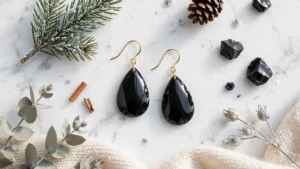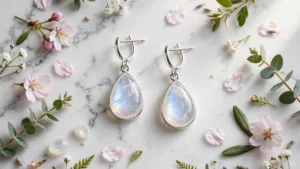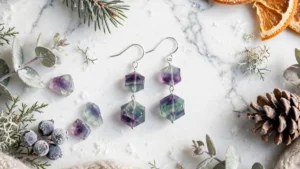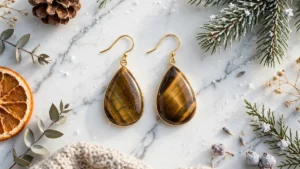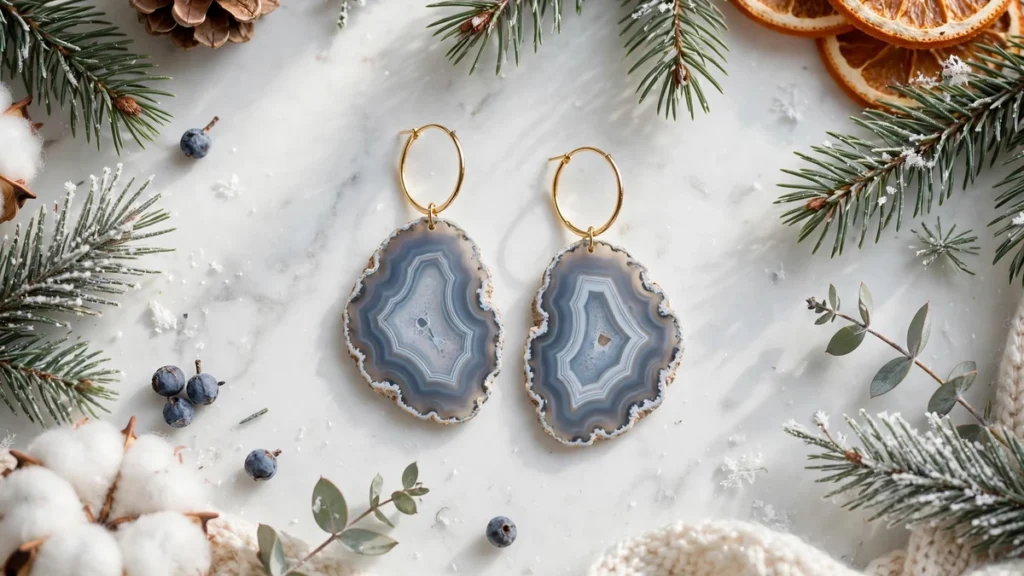
Agate earrings are the quiet workhorse of a winter jewellery box. Agate is a banded form of chalcedony, a quartz, and it comes in soft greys, milky whites, earthy browns and pale blues that sit easily against wool, cashmere and dark winter coats. Unlike a bright gemstone that demands attention, agate adds pattern and depth without shouting, which is exactly why it works so well in the cold months, when outfits are layered and jewellery has to hold its own against scarves, high collars and heavy fabrics.
Winter is also the season when jewellery takes more knocks than usual. Coats come on and off, scarves catch on posts, and earrings are handled with cold hands. Agate handles that better than most stones at its price. At 6.5 to 7 on the Mohs hardness scale, it is hard enough for daily wear, and because it is widely available, a well-made pair of agate earrings costs far less than a comparable pair in sapphire or emerald. The trade-off is honesty about colour: much of the brightly coloured agate sold today is dyed, and a good seller will say so.
Below are nine agate earrings worth considering for winter 2027, from simple studs in natural grey agate to drop earrings in softly banded stone. Each one is described by what it does well, what to watch for, and who it suits best, so you can choose a pair you will actually wear through the season, not one that sits in a box until spring.
Key takeaways
- Agate is banded chalcedony, a quartz, at 6.5 to 7 on the Mohs scale, hard enough for everyday winter wear and far more affordable than sapphire or emerald.
- Most brightly coloured agate is dyed, especially vivid blues, pinks and greens; natural agate is usually grey, brown, milky white or pale blue, and a good seller discloses dyeing.
- Bezel settings protect the stone best for daily wear, while prong settings show more of the stone; studs suit everyday, drops suit evenings and occasions.
- Agate pairs easily with winter fabrics: grey and white agate with charcoal and navy, warm brown agate with camel and cream, soft blue agate with grey and black.
- Agate has no proven healing properties and is not an investment stone; buy it because you like the pattern and the price, not because it promises health or value gains.
What agate actually is and why it suits winter
Agate is silicon dioxide, the same mineral family as quartz, formed in layers inside volcanic rock. Those layers are what give agate its bands, and because no two stones form in exactly the same way, no two agate earrings look identical. That variety is part of the appeal: a pair of grey banded studs has a quiet pattern that reads as texture rather than colour, which is useful in winter, when most outfits are already dark and heavy.
Colour is where buyers need to pay attention. Natural agate is usually grey, brown, milky white or pale blue, with soft, cloudy bands. The vivid blues, hot pinks and bright greens seen in many shops are almost always dyed, because agate is porous enough to take dye well. Dyeing is standard practice and not a flaw in itself, but it should be disclosed, and dyed stone needs gentler care, because harsh cleaning can fade it. If a seller describes a bright blue stone as natural agate without mentioning treatment, that is a reason to shop elsewhere.
For winter wear, agate has two practical advantages. First, it is hard enough to survive daily life under a coat and scarf, and it does not scratch as easily as softer stones such as pearl or turquoise. Second, it is inexpensive for the stone itself, so the price of a pair reflects the metal and the workmanship rather than the gem. That makes it a sensible choice for a first pair of fine earrings, or for anyone who wants a winter pair they can wear without worrying.
How we chose these earrings and what to look for
We looked first at honesty about the stone: natural colour where claimed, disclosed dyeing where the colour is vivid, and a setting that protects the stone rather than hiding flaws. We looked next at the metal and the findings, because a good pair of earrings is worn for hours at a time, and a cheap post or a loose back will end the day in a pocket. Price mattered too, but only in relation to what you get: agate itself is affordable, so a high price should mean better metal, better finishing, or a better-known maker. Our guide to the best diamond earrings follows the same logic, because the questions that matter are the same whatever the stone.

Look next at the setting. A bezel setting, where a rim of metal wraps around the edge of the stone, is the safest choice for daily wear, because it protects the stone from knocks and from catching on scarves. A prong setting shows more of the stone and lets in more light, which suits a pale or milky agate, but it leaves the edges exposed. For drops, check that the hook or post is secure and that the earring is not so heavy it pulls, because a drop that hurts by lunchtime will not be worn again.
Finally, look at the metal. Solid gold costs more but lasts longest, gold vermeil over sterling silver is a good middle ground, and plain sterling silver suits anyone who prefers a cool tone. If your ears are sensitive, ask what the post is made of, because nickel in a cheap alloy is a common cause of irritation. A reputable seller will answer that question directly, and a vague answer is a warning sign.
The 9 best agate earrings for winter 2027
The nine pairs below cover studs and drops, natural and dyed stone, and prices from under a hundred dollars to several hundred. Every pair is described honestly, including where the stone is dyed and where the price is mostly metal.
Tiffany & Co. Studs
What we like: Natural grey banded agate in a clean 18k gold bezel, with the careful finishing and secure screw backs you expect at this level. What to consider: A premium price for a stone that is itself inexpensive, and the grey banding is subtle rather than dramatic. Stone: Natural grey banded agate. Setting: 18k gold bezel. Best for: Everyday winter wear. Price range: $400–$650.
Cartier Studs
What we like: Milky white banded agate in a fine prong setting that lets the stone catch the light, with a slim, elegant profile. What to consider: The prongs leave the stone edges exposed, so these are better for occasions than for rough daily wear. Stone: White banded agate. Setting: 18k gold prong. Best for: Occasions and evenings. Price range: $500–$800.
David Yurman Studs
What we like: Grey agate set in sterling silver with the maker’s signature cable detail, a distinctive look that reads clearly as David Yurman. What to consider: Silver needs occasional polishing, and the cable detail adds weight. Stone: Grey agate. Setting: Sterling silver bezel with cable detail. Best for: Everyday wear with personality. Price range: $250–$450.
Mejuri Stud Earrings
What we like: Natural grey agate in 14k gold vermeil, a straightforward stud at a fair price, with a comfortable butterfly back. What to consider: Vermeil wears over time and will eventually need replating if worn daily for years. Stone: Natural grey agate. Setting: 14k gold vermeil bezel. Best for: A first pair of agate earrings. Price range: $90–$150.
Monica Vinader Studs
What we like: Banded grey agate in warm 18k gold vermeil, with a smooth bezel that sits flat against the ear and does not catch on scarves. What to consider: The banding varies from pair to pair, so the exact pattern is a small surprise. Stone: Banded grey agate. Setting: 18k gold vermeil bezel. Best for: Everyday winter wear. Price range: $110–$180.
Missoma Stud Earrings
What we like: Soft pale blue agate that adds a gentle touch of colour to grey and navy winter outfits, in a neat gold vermeil setting. What to consider: The pale blue is dyed, which the seller discloses, and dyed stone should be kept away from harsh cleaners. Stone: Pale blue agate, dyed and disclosed. Setting: Gold vermeil bezel. Best for: Soft colour against dark coats. Price range: $85–$140.
Maria Black Studs
What we like: Deep black agate in polished sterling silver, a sharp, modern contrast that works well for evening and for dark winter tailoring. What to consider: Black agate is usually dyed, and the dark colour shows dust and fingerprints more than a pale stone. Stone: Black agate, dyed and disclosed. Setting: Sterling silver bezel. Best for: Evenings and dark tailoring. Price range: $120–$200.
Astrid & Miyu Drops
What we like: Warm brown banded agate in a graceful gold vermeil drop, long enough to be noticed but light enough to wear all evening. What to consider: Drops move more than studs and can catch on a scarf, so they suit evenings rather than commuting. Stone: Banded brown agate. Setting: Gold vermeil drop. Best for: Evenings and occasions. Price range: $95–$160.
Thomas Sabo Drops
What we like: Grey banded agate in a sterling silver drop with a clean, contemporary line, a good match for both work and weekend outfits. What to consider: Silver tarnishes if left unworn, so keep these in a closed box between wears. Stone: Grey banded agate. Setting: Sterling silver drop. Best for: Occasions and smart days. Price range: $130–$220.
Which agate earrings are right for you
Start with your winter wardrobe. Grey and white agate suit charcoal, navy and black, which is most of a winter wardrobe, while warm brown agate suits camel, cream and olive. Soft blue agate works best as a single accent against grey or black, rather than competing with a bright coat. If you mostly wear dark, tailored clothes, a grey or black stone will blend in and be worn often; if you want the earrings to be the point of the outfit, choose a drop in brown or blue.
Studs or drops is the next decision, and it is mostly about how you spend your day. Studs are the safer daily choice: they do not move, they do not catch on scarves, and they sit comfortably under a hat or headphones. Drops are better for evenings, dinners and occasions, when you want the earrings to be seen. If you can only buy one pair, buy studs, because they will be worn ten times as often. A guide to gold jewellery for everyday wear makes the same point about metal choice: the piece you reach for daily is the one that earns its price.
Metal choice follows skin tone and habit. Warm gold suits warm skin and looks good against camel and cream; silver suits cool skin and reads well against charcoal and navy. If your ears are sensitive, solid gold or a high-quality vermeil over sterling silver is worth the extra cost, because a post that irritates will keep the earrings in their box. Ask the seller what the post is made of before you buy, not after your ears tell you.
The caveats that matter
Agate is an honest, affordable stone, but it is not a rare one, and the claims made about it are often bigger than the stone deserves. Most of the price of a pair of agate earrings is metal and workmanship, not the gem, so a very high price should be questioned. Dyed stone is normal, but it must be disclosed, and any claim that agate heals, protects or brings luck is marketing, not fact. Agate is also hard but not unbreakable: a sharp knock on a hard surface can chip it, especially at a thin edge or a prong setting.
| Detail | What is known |
|---|---|
| What agate is | Banded chalcedony, a quartz, at 6.5 to 7 on the Mohs hardness scale |
| Natural colour | Grey, brown, milky white or pale blue, with soft cloudy bands |
| Dyeing | Common and standard practice, especially for vivid blues, pinks and greens, but it must be disclosed |
| Hardness | Hard enough for daily wear, but it can chip if knocked hard on a thin edge |
| Cleaning | Warm soapy water and a soft cloth; avoid ultrasonic and steam cleaners, especially for dyed stone |
| Best settings | Bezel protects the stone best; prong shows more stone but leaves edges exposed |
| Price | The stone is inexpensive; most of the price is metal, workmanship and brand |
| What it does not do | No proven healing properties; not an investment stone and unlikely to gain value |
Care is simple. Wash agate earrings in warm water with a drop of mild soap, dry them with a soft cloth, and store them in a closed box or pouch so they do not knock against harder jewellery. Keep dyed agate away from perfume, hairspray and harsh cleaners, because chemicals can fade the colour over time. If a stone ever looks cloudy or the colour looks uneven, have it checked by a jeweller rather than trying to clean it aggressively at home.
Checklist: buying agate earrings honestly
Use these checks before you buy, and again when the earrings arrive.
- Check the colour: natural grey, brown or white, or a disclosed dye if the colour is vivid blue, pink or green.
- Check the setting: bezel for daily wear, prong if you want to see more of the stone.
- Check the metal: solid gold or good vermeil for sensitive ears, and ask what the post is made of.
- Check the back: a secure butterfly or screw back that will not slip off under a scarf or hat.
- Check the price: compare the metal and workmanship, not just the stone, because agate itself is inexpensive.
- Check the return policy: buy from a seller who accepts returns, so you can see the banding in daylight.
Frequently asked questions
Is agate a real gemstone?
Yes. Agate is a natural variety of chalcedony, a quartz, and it has been cut and worn as jewellery for thousands of years. It is a semi-precious stone, which means it is genuine but widely available and affordable, unlike rare stones such as ruby or emerald.
Is dyed agate bad?
No, dyeing is standard practice for agate, because the stone is porous and takes colour well. What matters is disclosure: a good seller will tell you the stone is dyed, and dyed agate needs gentler cleaning, because harsh chemicals and ultrasonic cleaners can fade the colour.
Can I wear agate earrings every day?
Yes, agate is hard enough for daily wear at 6.5 to 7 on the Mohs scale. Studs in a bezel setting are the best choice for everyday use, because the setting protects the stone and the earrings do not catch on scarves or collars.
How do I clean agate earrings?
Use warm water, a drop of mild soap and a soft cloth, then dry them fully before storing. Avoid ultrasonic and steam cleaners, especially for dyed stone, and keep the earrings away from perfume and hairspray, which can dull the surface over time.
Does agate go with winter clothes?
Very well. Grey and white agate suit charcoal, navy and black, brown agate suits camel and cream, and soft blue agate works as a single accent against grey. For more winter jewellery ideas, our guide to diamond jewellery for winter covers how to pair stones with heavy fabrics and dark colours.
Is agate a good gift?
Yes, especially as studs, because agate suits most skin tones and most wardrobes, and the price is usually modest. Choose a neutral grey or white stone if you are unsure of the recipient’s taste, and buy from a seller with a clear returns policy in case the banding is not to their liking.
The bottom line
The best agate earrings for winter 2027 are not the most expensive or the most brightly coloured. They are the pair with an honestly described stone, a setting that protects it, and a metal that suits your ears and your wardrobe. Natural grey or white agate in a bezel setting is the safest first buy, while a dyed blue or black stone in a good setting is a fair choice if the dyeing is disclosed and the price reflects it.
Choose one pair, wear it through the season, and judge it on how often you reach for it, not on how it looked in a photograph. Agate rewards that kind of use: it is durable, affordable and quietly patterned, and a good pair will still look right when the coats come off in spring.