A brooch is the most versatile piece of jewellery most people own and the least worn. It pins to a lapel, a scarf, a hat or a bag, it needs no sizing, and it turns a plain coat into an outfit. The problem is not finding a brooch. It is finding one that stays put, suits the fabric you actually wear, and does not look like something borrowed from a dressing-up box.
That is why this guide is organised by design and construction, not just by brand. A heavy enamel brooch needs a sturdy pin and a thick fabric, while a fine gold brooch suits silk and lightweight wool. A pearl brooch reads classic, a sculptural brooch reads modern, and a motif brooch only works if the motif means something to you. Price is a poor guide on its own. Some of the most wearable brooches are mid-priced, and some of the most expensive are the hardest to place.
Below are nine brooches worth considering in 2027, from a classic camellia to a sculptural gold pin for modern tailoring. Each one is described by what it is good at, what to watch for, and who it suits best, so you can choose with your wardrobe in mind, not just a bestseller list.
Key takeaways
- Brooches suit every wardrobe because they need no sizing, but the pin, the weight and the fabric must match, or the brooch will sag, spin or fall off.
- Solid gold, sterling silver and well-made enamel outlast plated brooches, which wear through fastest at the pin and the edges.
- Wear a brooch on the left lapel, high on the chest, and pin it through a seam or a buttonhole for extra hold.
- Heavy brooches belong on coats, jackets and thick knitwear, while fine brooches suit silk, blouses and lightweight tailoring.
- No brooch is an investment piece, and a motif you do not love will spend more time in a drawer than on your coat.
What a brooch actually is
A brooch is a decorative pin, usually made of metal, enamel, stone or pearl, fastened to clothing with a pin and a clasp on the back. It is one of the oldest forms of jewellery, and one of the most practical. Unlike a ring or a bracelet, it needs no size. Unlike a necklace, it does not compete with a neckline. It sits where you put it, and it stays there, as long as the pin is sound and the fabric can carry the weight.
The most common brooch types each behave differently. A floral brooch, such as a camellia or a rose, is soft and romantic, and suits coats and knitwear. An animal brooch, such as a bee or a panther, is playful and bold, and works best as a single statement. A pearl brooch is classic and restrained, and suits silk and tailoring. A sculptural brooch is modern and architectural, and suits clean, simple clothing. An enamel brooch is colourful and durable, and a motif brooch, from a star to a bow, is personal and easy to wear.
Placement matters more with brooches than with almost any other jewellery, because a brooch in the wrong place looks accidental. The classic position is the left lapel, high on the chest, just below the collarbone. On a coat without a lapel, place it on the left chest, and on a scarf, pin it where the fabric folds so the pin goes through two layers. Pinning through a seam or a buttonhole gives the clasp something solid to hold.
How we chose these brooches and what to look for
Look first at the pin and the clasp. A brooch is only as good as its fastening. A sturdy pin with a safety catch, often called a trombone clasp, is the safest choice, because it cannot work open by accident. A simple C-clasp is fine for a light brooch on a thick fabric, but it can open if the brooch is heavy or the fabric is thin. Test the clasp before you buy, and if it feels loose, do not buy the brooch.
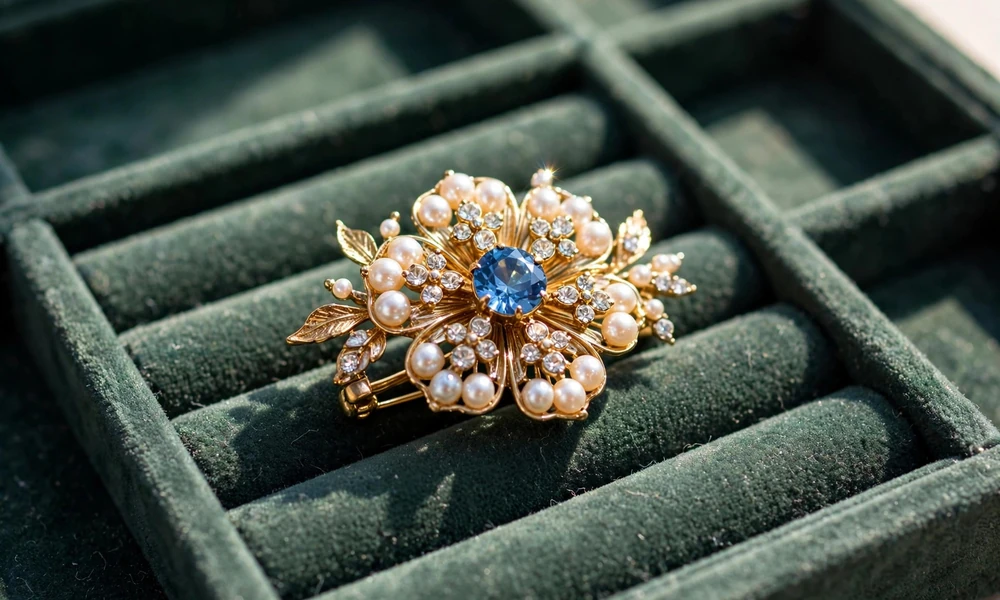
Look next at the weight and the fabric. A brooch over about 20 grams will pull on silk and fine wool, and it will sag on a soft knit. Heavy brooches belong on coats, jackets and thick knitwear, where the fabric can carry them. Fine brooches suit blouses, silk and lightweight tailoring. If a brooch spins or droops when you try it on, it is too heavy for what you are wearing, whatever it costs. If you are building a jewellery wardrobe around statement pieces, our guide to statement necklaces follows the same principle, that one well-chosen piece does more than three pieces competing for attention.
Finally, look at the metal and the finish. Solid gold and sterling silver last longest, because there is no surface layer to wear away. Enamel, when it is well fired, is hard and keeps its colour for years, but it can chip if it is dropped on a hard floor. Gold vermeil and plated brooches look identical on day one but wear through fastest at the pin and the edges, where the metal rubs against fabric.
The 9 best brooches of 2027
Chanel Camellia Brooch
What we like: The house camellia in white enamel and gold-tone metal, instantly recognisable, light enough for a jacket lapel, and made to be worn for years. What to consider: Premium price, and the camellia is a signature design, so it reads as Chanel wherever you wear it. Stone: None. Setting: Enamel camellia, pin with safety clasp. Best for: Classic tailoring and special occasions. Price range: Premium.
This is the brooch other brooches are measured against. It is not the cheapest, and it is not subtle, but for a piece that will still look right in ten years, it remains a strong first choice.
Dior Pearl Brooch
What we like: A single baroque pearl on a gold-tone pin, elegant and understated, light enough for silk and fine wool. What to consider: Pearls are soft and should never be sprayed with perfume, and the design is deliberately simple. Stone: Baroque pearl. Setting: Pearl on a gold-tone pin, safety clasp. Best for: Weddings, work and evening wear. Price range: Premium.
A straightforward, well-made brooch for people who want one classic piece to wear with everything. The pearl is the whole design, and it does not need anything else.
Tiffany & Co. 18k Gold Bow Brooch
What we like: A polished bow in solid 18k gold, with a sturdy pin and safety clasp, made to be worn every day without losing its finish. What to consider: A high price for a simple motif, and gold shows scratches more readily than enamel. Stone: None. Setting: Solid gold bow, pin with safety clasp. Best for: Everyday luxury and formal tailoring. Price range: Premium.
The bow is Tiffany at its most restrained. It is light, it sits flat on a lapel, and the solid gold will hold its finish for years with only occasional polishing.
Cartier Panthère Brooch
What we like: The house panther in gold with onyx and emerald details, a bold statement piece with a secure trombone clasp. What to consider: Heavy and premium-priced, so it belongs on coats and thick jackets, not on silk. Stone: Onyx and emerald. Setting: Gold panther motif, trombone clasp. Best for: Statement occasions and evening coats. Price range: Premium.
For anyone who wants a brooch to be the outfit, the panther is the answer. It is unmistakable, it is beautifully made, and it needs a coat that can carry its weight.
Van Cleef & Arpels Alhambra Brooch
What we like: The four-leaf clover motif in gold with mother-of-pearl, light, lucky and instantly recognisable, with a reliable safety clasp. What to consider: Mother-of-pearl is delicate and should be kept away from perfume and water. Stone: Mother-of-pearl. Setting: Gold clover motif, pin with safety clasp. Best for: Everyday elegance and gifting. Price range: Premium.
The Alhambra is the friendliest brooch in this guide. It is light, it suits almost any outfit, and the clover motif is one people genuinely enjoy wearing every day.
Gucci Bee Brooch
What we like: A gold-tone bee with enamel detailing, playful and well made, with a sturdy pin that holds well on jackets and coats. What to consider: The bee is a signature motif, so it reads as Gucci, and enamel can chip if dropped. Stone: None. Setting: Enamel bee motif, pin with safety clasp. Best for: Adding personality to tailoring and denim jackets. Price range: Luxury.
This is the brooch to choose if you want jewellery with a sense of humour. It is small, it is well made, and it turns a plain jacket into something people notice.
Mejuri Pearl Brooch
What we like: A cluster of freshwater pearls on a 14k gold pin, delicate and modern, light enough for blouses and silk. What to consider: Pearls need care and should never be worn in water or sprayed with perfume. Stone: Freshwater pearl. Setting: Pearl cluster on a gold pin, safety clasp. Best for: Weddings and soft, feminine styling. Price range: Mid to high.
For anyone who loves pearls but finds a single pearl brooch too formal, the cluster is a softer, more modern answer. Put it on last, after perfume, and it will keep its lustre for years.
Monica Vinader Diamond Brooch
What we like: A fine gold pin set with small diamonds, subtle and sparkling, with a secure clasp and a light, wearable weight. What to consider: The diamonds are small, so this is a quiet piece rather than a statement, and it is best kept for occasions. Stone: Diamond. Setting: Gold pin with pavé diamonds, safety clasp. Best for: Evening wear and special occasions. Price range: Luxury.
A sensible, beautiful choice for people who want sparkle without size. The diamonds catch the light with every movement, and the brooch is light enough to wear all evening without thinking about it.
Thomas Sabo Sterling Silver Star Brooch
What we like: A sculptural star in solid sterling silver, affordable and well made, with a sturdy pin and safety clasp. What to consider: Sterling silver tarnishes and needs occasional polishing, and the star is a bold motif. Stone: None. Setting: Silver star motif, pin with safety clasp. Best for: Everyday wear and adding edge to coats. Price range: Affordable to mid-range.
If you want to try brooches without a luxury price, this is the one. The silver is solid, the star is clean and modern, and a quick polish now and then keeps it looking new.
Which brooch is right for you
For classic tailoring, choose a floral, pearl or bow brooch in gold or enamel. These designs suit lapels, sit flat, and read as intentional rather than decorative. A single brooch on the left lapel is enough. Two brooches on one outfit usually compete, and the outfit loses.
For modern styling, choose a sculptural or motif brooch. A star, a bee or a clean geometric shape works well on denim jackets, plain coats and simple knitwear, where it becomes the one interesting detail. Our guide to gold jewellery for everyday wear is a useful companion here, because the same rules about solid metal and sensible fastenings apply across all jewellery.
For evenings and weddings, choose a pearl or diamond brooch. These catch the light without shouting, they suit silk and fine wool, and they photograph beautifully. Keep the rest of your jewellery quiet, and let the brooch do the work.
The caveats that matter
Brooches fail in predictable ways. The most common failure is a lost brooch, usually because the clasp worked open or the pin was too light for the fabric. The second most common is a sagging brooch, because the piece was too heavy for the fabric it was pinned to. Both are avoidable, and both are worth thinking about before you buy.
| Detail | What is known |
|---|---|
| Safest clasp | Trombone or safety clasp; avoid a simple C-clasp on a heavy brooch |
| Best placement | Left lapel, high on the chest, pinned through a seam or a buttonhole |
| Heavy brooches | Over about 20 grams belongs on coats, jackets and thick knitwear only |
| Fine brooches | Under about 10 grams suits silk, blouses and lightweight tailoring |
| Best metals | Solid gold and sterling silver; well-fired enamel keeps its colour for years |
| Fastest to wear out | Plated finishes, which wear through at the pin and the edges first |
| Pearl care | Put pearls on last, after perfume and sunscreen, and never wear them in water |
| What it does not do | No brooch is an investment, and no clasp is unbreakable, whatever the price |
If a brooch is lost, it is usually lost for good, which is another reason to choose a secure clasp and to check it before you leave the house. A quick tug on the pin takes two seconds and saves a piece you love.
Checklist: choosing a brooch honestly
Use these checks before you buy, and again after a day of wear.
- Check the clasp: a trombone or safety clasp is the safest, and it should close with a firm click.
- Check the weight: heavy brooches belong on coats and thick knitwear, fine brooches on silk and tailoring.
- Check the pin: it should be straight, sharp and long enough to go through two layers of fabric.
- Check the motif: choose a design you love, because a brooch you do not love will stay in a drawer.
- Check the metal: solid gold or sterling silver lasts longest; plated finishes wear through at the pin first.
- Check the placement: left lapel, high on the chest, pinned through a seam or a buttonhole for extra hold.
Frequently asked questions
Where should I wear a brooch?
On the left lapel, high on the chest, just below the collarbone. On a coat without a lapel, place it on the left chest, and on a scarf, pin it where the fabric folds so the pin goes through two layers.
Can I wear a brooch on a dress?
Yes, if the fabric is thick enough to carry it. Pin it at the shoulder or the waist, through a seam where possible, and choose a light brooch for fine fabrics.
Can I wear more than one brooch at a time?
You can, but one is usually better. Two brooches compete for attention, and the outfit loses its focus. If you do wear two, keep them on the same side and make one clearly smaller than the other.
How do I stop a brooch from sagging?
Pin it through a seam or a buttonhole, where the fabric is doubled, and choose a lighter brooch for soft fabrics. A small piece of felt behind the fabric can also help a heavy brooch sit flat.
Are brooches still in fashion?
Yes. Brooches have moved from formal occasions into everyday styling, worn on coats, jackets, scarves and bags. The key is choosing a design that suits your wardrobe rather than one that looks like a costume piece. If you are choosing stones for a brooch, our diamond buying guide explains what to look for in a stone, whatever the setting.
How do I clean a brooch?
Wipe gold and silver with a soft, dry cloth, and polish silver occasionally with a silver cloth. Clean enamel with a damp cloth and dry it at once. Never soak a brooch, and keep pearls away from perfume, water and cleaning products.
The bottom line
The best brooch in 2027 is not the most expensive or the most elaborate. It is the one whose weight matches the fabric you wear, whose clasp you trust, and whose design you love enough to reach for again and again. For classic tailoring, a floral or pearl brooch is hard to beat. For modern styling, a sculptural or motif brooch does more with less.
Choose one brooch, pin it on the left lapel through a seam, and check the clasp before you leave the house. Do that, and a good brooch will turn a plain coat into an outfit, every time you wear it.