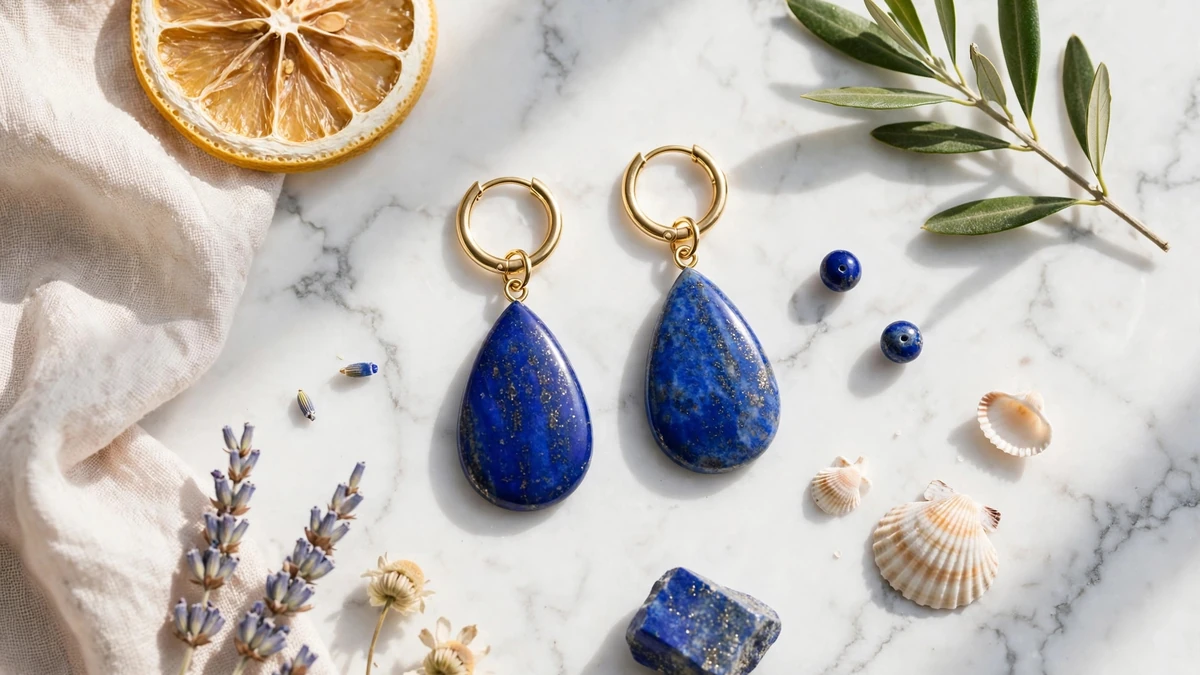
Lapis lazuli is the deep blue of a summer evening, and it is one of the oldest jewellery stones in the world. It was carved into beads and inlay more than six thousand years ago, ground into ultramarine pigment for Renaissance painters, and worn by queens who valued its colour above almost any other gem. In summer it does something few stones can do: it looks cooler and richer against sun-warmed skin, white linen, and navy, the colours most of us actually wear from June to September.
The problem is that lapis is a soft stone, and summer is hard on jewellery. Lapis lazuli measures 5 to 5.5 on the Mohs hardness scale, which means it can be scratched by a key, a zip, or a grain of sand at the beach. It should never go in an ultrasonic cleaner or a steam cleaner, and it does not like long soaks in a pool or the sea. The other problem is imitation. Dyed howlite, blue glass, and plastic are sold as lapis every day, and a pair of earrings that looks deep blue in a photograph can be disappointingly flat, or oddly purple, in person.
Below are nine lapis lazuli earrings worth considering for summer 2027, from classic gold studs to light drop earrings that move well in warm weather. Each one is described by what it is good at, what to watch for, and who it suits best, so you can choose with the stone in mind, not just the colour in the picture.
Key takeaways
- Lapis lazuli is a deep blue metamorphic rock coloured by lazurite, with natural gold pyrite flecks, and it pairs beautifully with white, navy, and gold in summer.
- It is soft, at 5 to 5.5 on the Mohs scale, so a bezel setting protects the edges far better than a prong setting.
- Clean it only with warm water, mild soap, and a soft cloth, and never use an ultrasonic or steam cleaner.
- Real lapis has uneven colour and pyrite flecks; perfectly uniform, very dark blue stones are often dyed howlite or glass.
- Lapis has no proven healing properties and is not an investment stone, so buy it for its colour and craftsmanship, not as a financial asset.
What lapis lazuli actually is
Lapis lazuli is not a single mineral. It is a rock, made mostly of lazurite, which gives it that intense royal blue, with calcite, which appears as white veining, and pyrite, which shows as tiny gold flecks. The best material comes from the Sar-e-Sang mines in Afghanistan, which have been worked for thousands of years, with other sources in Chile, Russia, and Pakistan. Colour is everything in lapis. The most valued stones are a rich, even royal blue with fine pyrite scattered through them, while stones with heavy white calcite veining or a greenish cast are less desirable.
That softness is the practical fact that shapes every buying decision. At 5 to 5.5 on the Mohs scale, lapis is softer than quartz, softer than a steel nail, and easily scratched by everyday contact. In earrings this matters less than in a ring, because earrings do not knock against desks and door handles, but it still matters. A bezel setting, where a rim of metal wraps around the edge of the stone, protects it far better than prongs, and it is the setting to look for if you plan to wear the earrings often.
Imitation is common because real lapis is expensive to cut and polish well. Dyed howlite is the usual substitute: it is white, porous, and takes a blue dye that can look convincing until you notice the colour is too uniform, too dark, or slightly purple. Blue glass is another, often with tiny bubbles visible under a loupe. Plastic imitations feel warm and light where real lapis feels cool and solid. None of these is a crime if it is sold honestly as an imitation, but a price that seems too good for solid gold and real lapis usually is.
How we chose these earrings and what to look for
Look first at the colour of the stone. Good lapis is a deep, saturated royal blue, not navy-black and not pale or washed out. A little pyrite is a good sign: fine gold flecks scattered evenly through the blue are natural and desirable, though large brassy patches or heavy white calcite veins lower the value. If the stone looks perfectly uniform, like a piece of blue plastic, be suspicious. Real lapis is a natural rock, and its colour varies slightly from stone to stone, even within one pair.

Look next at the setting and the metal. A bezel setting is the safest choice for lapis in summer, because it shields the soft edges from knocks and from sunscreen, salt, and sand. Yellow gold is the classic pairing: it warms the blue and echoes the pyrite flecks. White gold and silver are cooler and more modern, and they suit the stone well too, but they can make a pale lapis look washed out. Check the weight as well. A heavy drop earring is tiring in hot weather, and a light, well-balanced pair is the one you will actually reach for on a summer morning. Our guide to the best diamond earrings of 2027 uses the same checks for setting and comfort, and they apply just as well to a coloured stone.
Finally, look at the price honestly. Lapis is not a precious stone, and a pair of small studs in silver or gold vermeil should be affordable. A high price should buy you a better cut, a richer colour, a solid gold setting, or a respected maker, not just a brand name. Ask whether the stone is natural, dyed, or stabilised, and expect a straight answer. A reputable seller will tell you.
The 9 best lapis lazuli earrings of summer 2027
Tiffany & Co. Studs
What we like: A clean, classic stud in solid gold with a well-matched pair of deep blue lapis cabochons, finished to Tiffany’s usual high standard. What to consider: Premium price for a simple design, and the stones are small, so the colour reads quietly rather than boldly. Stone: Natural lapis lazuli, cabochon cut. Setting: Bezel, 18k yellow gold. Best for: Everyday summer wear and quiet luxury. Price range: £1,200 to £1,800.
Cartier Studs
What we like: Elegant proportions, a deep blue stone with fine pyrite, and a secure screw-back fitting that stays put in heat and humidity. What to consider: Expensive for the stone size, and the design is deliberately understated. Stone: Natural lapis lazuli, cabochon cut. Setting: Bezel, 18k yellow gold. Best for: Polished daytime looks and special occasions. Price range: £1,500 to £2,200.
David Yurman Studs
What we like: A sculptural cable setting that gives a simple stud real presence, with a rich blue stone and excellent polish. What to consider: The cable detail adds weight, and the price sits well above high-street options. Stone: Natural lapis lazuli, cabochon cut. Setting: Bezel with cable detail, 18k yellow gold. Best for: Making a small stud feel like a statement. Price range: £900 to £1,400.
Mejuri Stud Earrings
What we like: A well-priced, well-made stud in gold vermeil with a good colour match between the two stones, and a light, comfortable fit. What to consider: Gold vermeil wears through with heavy use, so treat these gently and keep them dry. Stone: Natural lapis lazuli, cabochon cut. Setting: Bezel, gold vermeil over sterling silver. Best for: A first pair of lapis earrings at a fair price. Price range: £70 to £120.
Monica Vinader Studs
What we like: A neat, modern stud with a smooth bezel and a deep blue stone, made to be worn every day and easy to pair with other jewellery. What to consider: Gold vermeil needs care in summer, especially around sunscreen and seawater. Stone: Natural lapis lazuli, cabochon cut. Setting: Bezel, 18k gold vermeil over sterling silver. Best for: Everyday wear with a gold stack. Price range: £85 to £140.
Missoma Stud Earrings
What we like: A soft, organic shape with a good blue stone, lightweight and comfortable for long summer days. What to consider: Gold vermeil, so avoid water and perfume, and the stones are modest in size. Stone: Natural lapis lazuli, cabochon cut. Setting: Bezel, 18k gold vermeil over sterling silver. Best for: Relaxed, everyday summer outfits. Price range: £75 to £130.
Maria Black Studs
What we like: A cool, sculptural take on the stud, with a deep blue stone set in silver for a modern, slightly edgy look. What to consider: Silver tarnishes faster in summer heat and humidity, so keep the polishing cloth handy. Stone: Natural lapis lazuli, cabochon cut. Setting: Bezel, sterling silver. Best for: Cooler, modern summer styling. Price range: £90 to £160.
Astrid & Miyu Drops
What we like: A light drop earring that moves gently and catches the light, with a good colour and a comfortable hook. What to consider: Drops swing more than studs, so they are less practical for sport or a windy beach day. Stone: Natural lapis lazuli, faceted drop. Setting: Bezel, 18k gold plated stainless steel. Best for: Summer evenings and holiday dinners. Price range: £65 to £110.
Thomas Sabo Drops
What we like: A playful, well-made drop with a rich blue stone and a secure fitting, at a price that makes it easy to try the style. What to consider: Silver plating needs gentle care, and the design is more decorative than minimal. Stone: Natural lapis lazuli, cabochon drop. Setting: Bezel, sterling silver. Best for: Holidays and evenings out. Price range: £80 to £150.
Which lapis lazuli earrings are right for you
Start with your summer wardrobe. Lapis is at its best with white, cream, navy, and denim, and with gold jewellery it already owns. If your summer is mostly white linen and gold, a yellow gold bezel stud is the natural choice. If your wardrobe runs cooler, with silver, grey, and black, a silver setting will feel more like you. Our guide to the best gold jewellery for everyday wear is useful here, because the way you already wear gold is a good guide to how much lapis you will actually enjoy.
Think about how you will wear them. Studs are the practical summer choice: they stay put in heat, they work with sunglasses and hats, and they do not catch on a beach towel or a linen collar. Drops are for evenings, when you want movement and a little drama, and when you are not swimming or walking in strong wind. If you only buy one pair, buy the studs. If you already own studs, the drops are the fun second pair.
Skin tone matters less than people think with lapis, because the blue is so saturated that it reads clearly on almost everyone. Very fair skin can make the stone look darker and more dramatic, which is often the effect people want. Deeper skin tones make the blue look richer and the gold pyrite flecks more visible. The main question is not whether lapis suits you, but whether you like a bold blue stone near your face, and whether you are willing to care for a soft stone properly.
The caveats that matter
Lapis is a beautiful stone with real limits, and summer exposes them. It scratches easily, it hates ultrasonic and steam cleaners, and it should not be worn swimming, in a hot tub, or while applying sunscreen and insect repellent. Put your earrings on last, after perfume and sunscreen, and take them off before the pool. A pair that is looked after will keep its colour for decades. A pair that is treated like a diamond will look dull and scratched within a season.
| Detail | What is known |
|---|---|
| What it is | A metamorphic rock, mostly lazurite, with calcite and pyrite |
| Hardness | 5 to 5.5 on the Mohs scale, relatively soft and easy to scratch |
| Best setting | Bezel, which protects the soft edges far better than prongs |
| Best metal | Yellow gold warms the blue; silver and white gold give a cooler look |
| Cleaning | Warm water, mild soap, soft cloth only, never ultrasonic or steam |
| What to avoid | Swimming, hot tubs, sunscreen and perfume on the stone, hard knocks |
| Common imitations | Dyed howlite, blue glass, and plastic, often sold as real lapis |
| What it is not | Not an investment stone, and it has no proven healing properties |
If you buy from a market stall or an unfamiliar online seller, ask directly whether the stone is natural lapis, dyed, or an imitation, and expect a clear answer. A seller who cannot or will not answer is a seller to walk away from. Keep the receipt and any certificate, even for a modest pair, because it is the only proof you have if the colour fades or the stone turns out to be dyed howlite.
Checklist: choosing lapis lazuli earrings honestly
Use these checks before you buy, and again when the earrings arrive.
- Check the colour: a rich, even royal blue with fine gold pyrite flecks, not flat, purple, or perfectly uniform.
- Check the setting: a bezel protects the soft stone far better than prongs, especially for daily wear.
- Check the match: the two stones should be close in colour and size, with similar pyrite.
- Check the metal: solid gold or sterling silver lasts; vermeil and plating need gentle care and will wear.
- Check the weight: light and balanced is better for summer, especially for drop earrings.
- Check the seller: ask whether the stone is natural, dyed, or an imitation, and keep the receipt.
Frequently asked questions
Can I wear lapis lazuli earrings every day in summer?
Yes, if they are studs in a bezel setting and you look after them. Put them on after sunscreen and perfume, take them off before swimming, and wipe them with a soft cloth at the end of the day. Drops are better kept for evenings.
Is lapis lazuli real gold flecked stone?
The gold flecks are pyrite, sometimes called fool’s gold, not real gold. They are natural to lapis and a good sign of a genuine stone, but they do not add gold value to the earrings.
How do I tell real lapis from dyed howlite?
Real lapis has uneven colour, fine pyrite flecks, and a cool, solid feel. Dyed howlite is often too uniformly dark blue, sometimes slightly purple, and feels lighter and warmer. Under a loupe, howlite shows a crackled, web-like pattern that lapis does not have.
Can lapis lazuli go in water?
Brief contact with clean water is fine, but do not swim in it, and do not soak it. Chlorine, salt water, and hot tubs can damage the polish and, over time, the stone itself. Dry the earrings straight away if they get wet.
Does lapis lazuli fade in the sun?
Lapis is generally stable in sunlight and does not fade the way some pink stones do, but long, strong sun and heat can dull the polish over years. Store the earrings in a soft pouch, out of direct sun, when you are not wearing them.
What should I wear with lapis earrings in summer?
White, cream, navy, and denim are the easiest pairings, and yellow gold jewellery ties the look together. A spring accessory trends guide is a useful starting point for the same colour logic, because the blue-and-gold combination that works in spring works just as well through the summer months.
The bottom line
The best lapis lazuli earrings for summer 2027 are the ones with a rich, even blue, a bezel setting that protects the soft stone, and a metal that suits the rest of your jewellery. For most people that means a simple gold stud, worn daily, looked after gently, and taken off before the pool. It is a stone with six thousand years of history behind it, and it still earns its place in a summer wardrobe.
Choose one pair, check the colour and the setting before you buy, and treat the stone kindly. Lapis rewards gentle care with decades of colour, and it punishes rough treatment faster than almost any other stone you are likely to own.