


What happens when a guest at your dinner party tries to slice the cake and discovers it is made of wax? That awkward moment is the whole appeal of candles that look like food. These hyper-realistic dessert candles, fruit pillars, and pastry-shaped wax creations have moved from craft-fair novelties to mainstream home decor. They are beautiful, they are funny, and they are also a genuine safety puzzle. This guide covers what the category actually is, how to shop for one that burns well, the mistakes people make, and the rules that keep a decorative candle from becoming a hazard.
What Counts as a Food-Shaped Candle?
There is no formal industry standard that defines “food-shaped candles.” It is a descriptive, marketing-and-craft term rather than a regulated product category. In practice, it covers pillar and container candles shaped, colored, and scented to resemble:
- Cakes, cupcakes, and layer slices
- Pies, tarts, and pastries
- Fruit, including citrus halves and apple shapes
- Drinks, from lattes to cocktails
- Bread, croissants, and other baked goods
Because the category is informal, quality varies wildly. Two candles that look identical in a photo can differ enormously in wax type, wick design, fragrance load, and whether the thing will actually burn cleanly or tunnel into a wax crater after twenty minutes. That inconsistency is the single most useful thing to understand before spending money.
The materials behind the illusion
Most realistic food candles are built from one of three wax families, often blended:
| Wax type | Typical behavior | Best for |
|---|---|---|
| Paraffin | Strong scent throw, smooth surface, can burn hot | Detailed shapes, vivid color |
| Soy | Slower, cooler burn, softer surface, frosts sometimes | Container candles, clean look |
| Beeswax | Naturally firm, subtle honey scent, holds shape well | Fruit and pillar shapes |
Fragrance oils and dyes do the rest of the work. A candle that smells like vanilla buttercream is usually relying on a fairly heavy fragrance load, which matters for both burn performance and indoor air quality in small rooms.
Why People Are Drawn to Realistic Dessert Candles
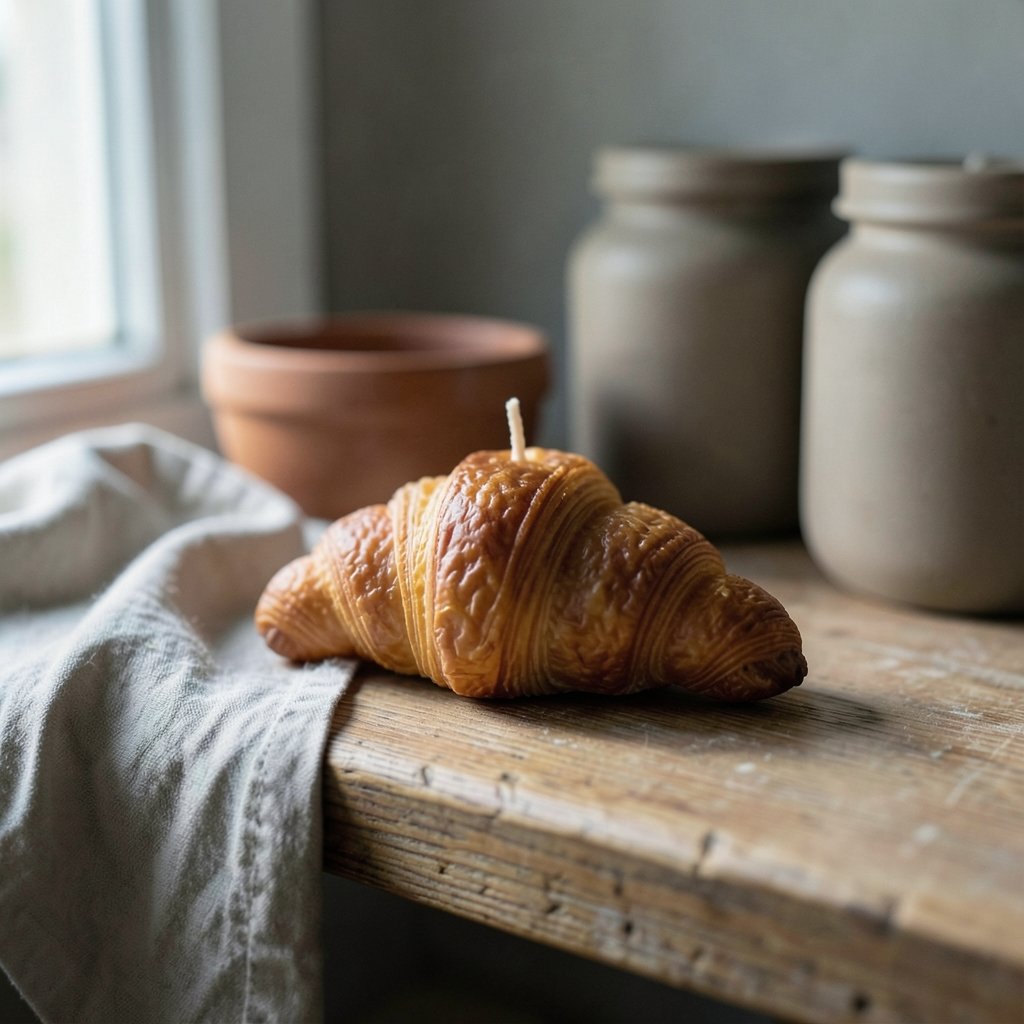
The appeal is easy to explain. Food-shaped candles are visual jokes, decor pieces, and scent delivery systems all at once. A croissant candle on a kitchen shelf signals warmth and humor. A slice-of-cake candle on a birthday table is a conversation starter before anyone lights it.
They also photograph extremely well, which is why the category exploded on social media and in craft markets through the 2010s and 2020s. If you have ever fallen down a rabbit hole comparing transformation photos, you already know the pattern: the before-and-after reveal is the whole hook. The same psychology drives people to search for what microneedling before and after results really look like or what a bbl before and after results really look like in practice. Realistic candles work the same way: the reveal is the product.
There is a practical side too. A well-made dessert candle can scent a room for weeks without burning, simply by sitting there. Many buyers treat them as permanent decor and never light them at all, which sidesteps most safety concerns entirely.
The Safety Problem Nobody Wants to Talk About
Here is the uncomfortable part. A candle that looks exactly like food is, by design, confusing. Children and pets cannot read a warning label. A wax cupcake with a realistic frosting swirl is a choking and ingestion risk in a way that a plain pillar candle simply is not.
Consumer safety guidance on candles is consistent and blunt: keep burning candles within sight, keep them away from children and pets, and never burn them near anything flammable. Those rules apply to every candle, but food-shaped candles raise the stakes because the object itself invites the wrong behavior.
Fire data backs up the caution. Candles cause a meaningful share of home structure fires, and the majority of those fires start when a candle is left unattended or placed too close to combustible material. A decorative candle shaped like a pie, sitting on a kitchen counter next to a dish towel, is exactly the scenario that statistic describes.
The “it’s not food” labeling gap
In the United States, candles are consumer products, not food. They fall under general consumer product safety law rather than food regulation. That means there is no mandatory federal standard specifically written for candle shapes, and no one is checking whether a wax lemon looks too much like a real lemon.
The practical takeaway for buyers: read the label yourself. A responsible maker will print clear warnings, note that the item is not edible, and specify burn instructions. A maker who ships a food-shaped candle with no warning text is telling you something about their attention to detail.
Pets deserve their own paragraph
Fragrance oils and essential oils used in candles can irritate or harm pets, and plant-based ingredients vary widely in toxicity. If a household has cats, dogs, or birds, the safest approach is to keep food-shaped candles out of reach entirely and to be cautious about heavy fragrance loads in small, closed rooms. A candle that smells like a bakery is not a pet-safe object just because it smells nice.
How to Choose a Food Candle That Actually Burns Well
Most disappointment with this category comes down to wick and wax engineering, not looks. A gorgeous candle with an undersized wick will tunnel. An oversized wick will smoke and burn hot. Here is what to check, in order.
- Look at the wick before you look at the shape. A single small wick in a wide pillar is a red flag. Wide candles need multiple wicks or a carefully designed wick.
- Check whether the shape leaves room for a melt pool. Deeply sculpted details, like petals or frosting peaks, often burn unevenly because wax cannot pool properly.
- Read the burn instructions. Reputable makers specify a maximum burn time, usually around four hours, and recommend trimming the wick to roughly a quarter inch before each use.
- Ask what happens when it burns down. A candle shaped like a strawberry may look odd halfway through. Some makers design a core so the shape collapses gracefully; others do not.
- Smell it cold, then imagine it warm. Cold scent throw and hot scent throw are different. A candle that smells subtle in the jar may become overpowering when lit in a small bathroom.
Common mistakes people make
The most frequent error is treating a decorative candle like a utility candle. People light a sculpted dessert candle for eight hours straight, wonder why the wax is pooling out the side, and blame the maker. Long burns are the enemy of sculpted shapes.
The second mistake is placement. Food-shaped candles end up on kitchen counters and dining tables, which are exactly where heat, fabric, and distracted people congregate. A sideboard or shelf away from traffic is a much better home.
The third mistake is buying purely on appearance. A cheap molded candle with a fragrance load that smells like candy and no ingredients list is a gamble. If you care about indoor air and burn quality, ask what wax and fragrance the maker uses.
Styling Food Candles Without the Clutter
Used well, these candles are excellent decor. Used badly, they turn a shelf into a yard sale. A few principles that hold up in real rooms:
Group by theme, not by quantity. Three pastry candles on a cake stand read as intentional. Fifteen scattered across a kitchen read as hoarding.
Mix heights and finishes. A tall pillar shaped like a bread loaf next to a small fruit candle creates rhythm. Identical shapes in a row look like inventory.
Keep them away from real food. This is both a safety rule and a styling rule. A wax lemon next to a fruit bowl invites a very unpleasant surprise.
Rotate seasonally. Food candles are naturally tied to seasons, and swapping a summer citrus display for autumn pie shapes keeps the arrangement fresh without buying anything new.
If you enjoy practical before-and-after styling comparisons, the same “does the result match the promise” instinct applies here. It is the mindset behind checking what a fran time good crossfit fran score really looks like before setting a goal, or reading up on how to clean a whiteboard so it looks new again before assuming a surface is ruined. Realistic candles reward the same skepticism: verify the burn quality, not just the photo.
What to Look For in a Maker
Since the category is unregulated, the maker is the standard. A few signals separate serious candle crafters from drop-shippers.
- Ingredient transparency. They name the wax and describe the fragrance.
- Burn testing. They can tell you how many hours the candle lasts and how it behaves at the halfway point.
- Clear warnings. “Not food” and “keep away from children and pets” appear on the label and the listing.
- Realistic photography. Photos show the candle unlit and lit, not just a styled hero shot.
- Honest limitations. Good makers admit when a sculpted shape burns unevenly and tell you how to manage it.
On the flip side, be wary of listings with no ingredient information, no burn time, and photos that look suspiciously like stock images. If a candle costs less than a coffee and ships from nowhere, the wax quality is probably matching the price.
A note on candles as gifts
Food-shaped candles are popular gifts because they are funny and low-commitment. Two cautions. First, consider the recipient’s household: a candle shaped like a cookie is a bad gift for someone with a toddler or a chew-happy dog. Second, pair the gift with a cheap wick trimmer. It sounds like a throwaway add-on, but it is the single tool that most improves how a candle burns, and it signals that you thought about the practical side.
Conclusion
Candles that look like food are one of the more charming corners of home decor, and one of the easiest to get wrong. The category has no formal standard, which means the difference between a delightful object and a smoky, tunneling mess comes down to the maker’s craft and the buyer’s attention. Choose candles with transparent ingredients, sensible wick design, and honest burn instructions. Keep them away from children, pets, and anything flammable. Treat sculpted shapes as decor first and light sources second. Do that, and a wax croissant earns its place on the shelf. Skip it, and you have bought a very pretty fire hazard with a frosting swirl.
Frequently Asked Questions
Are food-shaped candles safe to burn?
They can be, if you follow standard candle safety. Keep them within sight, away from children, pets, and flammable items, and never leave one burning unattended. The extra risk with food shapes is confusion: children and pets may mistake them for real food, so store and place them out of reach. Sculpted candles also tend to burn unevenly, so follow the maker’s maximum burn time.
Why do my shaped candles tunnel or burn unevenly?
Sculpted candles often have irregular wax mass around the wick, so the melt pool cannot form evenly. An undersized wick makes it worse. Trim the wick to about a quarter inch before each burn, burn in shorter sessions rather than for hours at a stretch, and accept that some shapes will never burn cleanly to the edge. That is a design limitation, not a defect you can fix.
Can children or pets eat a candle that looks like food?
No. These candles are not food and are not regulated as food. Wax, fragrance oils, and dyes can cause choking, stomach upset, or worse if swallowed, and some fragrance and essential oils are irritating or toxic to pets. Keep food-shaped candles well out of reach and store them in a closed cabinet rather than on a low shelf or counter.
How can I tell a good food candle from a cheap one?
Look for ingredient transparency, a stated burn time, and clear safety warnings on both the label and the listing. Good makers describe their wax and fragrance and show photos of the candle both unlit and burning. Be cautious with listings that have no ingredient information, no burn instructions, and only styled hero photos.
Do food-shaped candles smell as strong as regular candles?
It depends on the wax and fragrance load, and cold scent in the jar is not the same as hot scent when lit. Paraffin blends tend to throw scent more strongly, while soy and beeswax are usually subtler. In a small room, a heavily fragranced dessert candle can become overpowering, so start with a short burn and see how it behaves.
What is the best way to display dessert candles?
Group a few by theme on a tray or cake stand, mix heights and finishes, and keep them away from real food, heat sources, and busy walkways. Rotate them with the seasons so the arrangement stays intentional. If you plan to burn them, place them on a stable, heat-safe surface well away from fabric and paper.









