

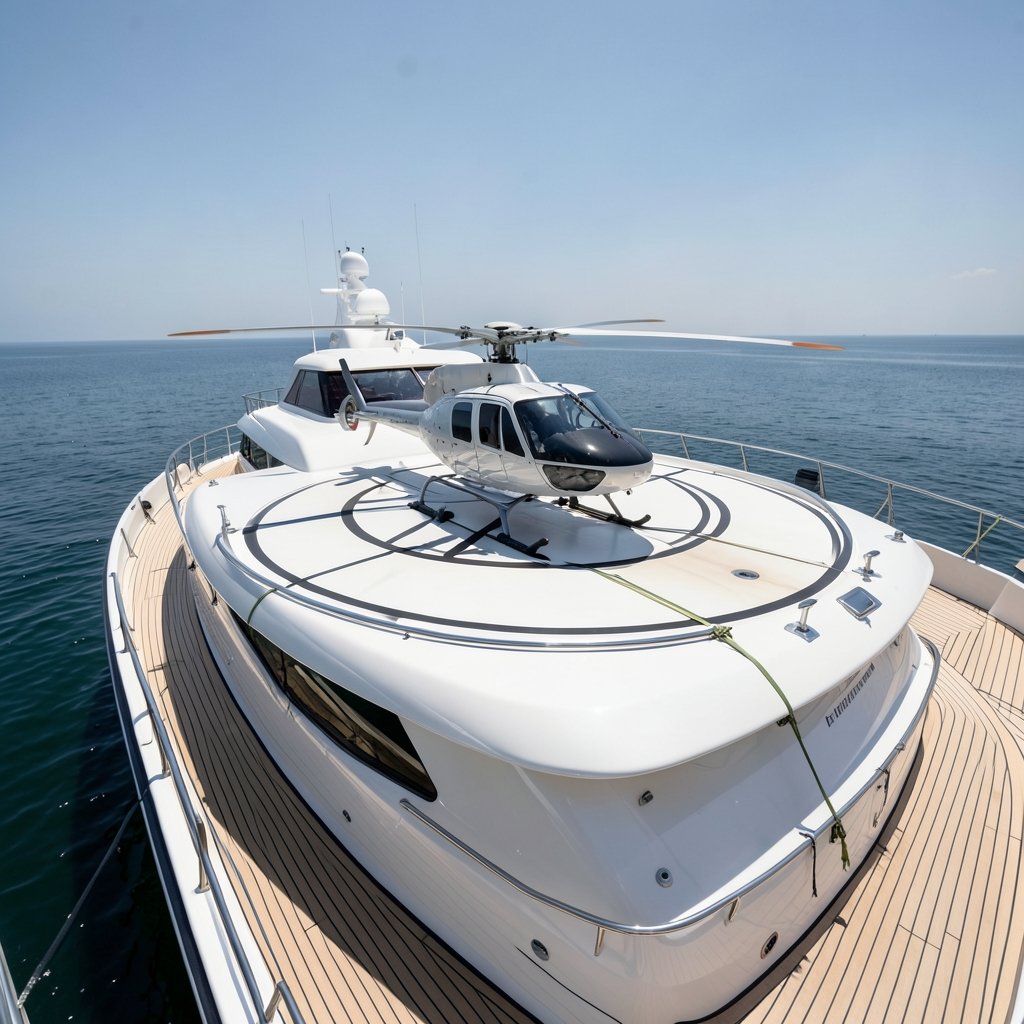
Can you land a helicopter on a charter yacht, step off, and start your holiday without ever touching a commercial airport? Yes, but the details matter far more than the brochure photos suggest. A helipad on a yacht is not a single feature. It is a regulatory category, an insurance question, a deck-engineering problem, and a weather-dependent operational decision all at once. Anyone planning a 2027 charter around helicopter access needs to understand what a pad actually permits before signing anything. (Motor yacht vs sailing yacht charter cost crew itinerary)
This guide explains how helipad-equipped charter yachts work, what separates a genuine helideck from a landing spot, how to evaluate a shortlist of large yachts, and where charterers most often get caught out. It deliberately avoids naming nine specific vessels as fixed “2027 picks,” because yacht names, ownership, refit schedules, and charter availability shift constantly, and any list published today is a snapshot that may not survive the year. What follows is the framework that makes a shortlist trustworthy. (Luxury yacht charter sardinia cost crew coast really deliver)
Why a helipad is rarer than the marketing suggests
Walk the pontoon at any major charter show and you will see plenty of yachts over 50 metres. Very few of them can take a helicopter. The reason is structural. A certified landing area needs a deck strong enough for dynamic landing loads, a clear approach sector with no masts, cranes, or radar arches in the way, dedicated firefighting equipment, and markings that meet a classification society’s rules.
Classification societies such as DNV, Lloyd’s Register, ABS, and Bureau Veritas publish rules for helicopter landing areas on yachts. These rules define pad dimensions, load limits, firefighting provision, and marking. A yacht that meets them carries a genuine helideck. A yacht that does not may still advertise a “helipad,” which is where confusion begins.
There is a second layer: aviation regulation. Helicopter operations to and from a yacht are governed by the flag state of the vessel and by the aviation authority of the coastal state where the landing happens. In the United States, commercial helicopter operations fall under FAA rules for Part 91 and Part 135 operations, and a yacht’s pad is typically not a certified heliport. That distinction shapes who can fly to the vessel, under what conditions, and who carries the liability.
Touch-and-go versus full helipad: the distinction that changes everything

The single most common misunderstanding among first-time charterers is treating “helipad” as one thing. In practice, there are two broad categories, and the gap between them is enormous.
| Feature | Touch-and-go pad | Full helideck |
|---|---|---|
| Engine shutdown permitted | Usually no | Yes |
| Refuelling on board | Rarely | Possible on larger vessels with fuel storage |
| Typical yacht size | Mid-size, pad fitted for convenience | Generally 70 metres and above |
| Guest transfer | Drop-off and immediate departure | Arrival, baggage handling, stay on board |
| Operational flexibility | Weather and slot dependent | Broader, but still weather-limited |
A touch-and-go pad lets a helicopter land, deliver or collect passengers, and lift off again without shutting down. It is useful for transfers, but it is not a private airport on the stern. A full helideck with refuelling capability and hangar space is a different proposition, and it is largely confined to the very largest yachts. When a listing says “helipad,” ask which category applies. The answer should come in writing.
What actually drives the shortlist for 2027
Because vessel-level availability for 2027 is a moving target, the practical approach is to build your own shortlist using criteria that do not change. Four filters do most of the work.
Size and deck geometry
Helidecks cluster in the upper size brackets. Below roughly 60 to 70 metres, a pad is more often a touch-and-go arrangement squeezed onto a foredeck or an upper deck. Above that, purpose-built helidecks with proper firefighting and clear approach sectors become realistic. If helicopter access is non-negotiable, size is your first filter, not your last.
Certification and class notation
Ask for the class notation covering the landing area and the flag state’s position on helicopter operations. A yacht that can produce documentation is a different risk profile from one that relies on a verbal assurance. This is also where a good charter broker earns their commission: they should be able to obtain the paperwork before you commit.
Cruising ground and local rules
Some of the most desirable cruising grounds restrict helicopter flights. Marine protected areas in parts of the Mediterranean and the Caribbean limit low-level flying and landing. Local aviation authorities may require permits, and the vessel’s flag state may impose its own conditions. A helideck is only useful where you can actually use it. If your 2027 plan centres on a specific coastline, check local rules before you fall in love with a yacht.
Insurance and pilot arrangements
Who flies the helicopter, under which operator’s certificate, and who is insured for a landing on a private vessel are questions that must be settled early. A charterer arranging their own helicopter needs an operator willing to land on an uncertified pad, and not all are. Yachts that regularly support helicopter operations usually have established relationships with local operators, which smooths the process considerably.
How to evaluate a helipad yacht without wasting a season
The sequence below is the one that avoids the most expensive mistakes. It works whether you are looking at the Mediterranean, the Caribbean, or further afield.
- Define the mission. Is the helicopter for a single airport transfer, for daily shore excursions, or for genuine independence from commercial aviation? Each answer points to a different vessel class.
- Confirm the pad category in writing, including whether engine shutdown and refuelling are permitted.
- Request the class notation and any flag-state documentation covering helicopter operations.
- Identify local helicopter operators at your intended destination and confirm they will land on the vessel.
- Check insurance coverage for the landing, the passengers, and the vessel.
- Verify the yacht’s 2027 availability directly, and treat any published list as a starting point rather than a booking.
- Build a weather contingency. Pad use depends on wind limits, visibility, and sea state, and a fallback plan is not optional.
Step seven is the one people skip. A helicopter transfer that cannot happen because of a swell is not a disaster if a tender and a car are already arranged. It is a disaster if the entire itinerary depends on the rotor blades turning.
The money question, honestly
Helicopter access adds cost at several points: the yacht’s charter fee reflects its capability, the helicopter operator charges separately, landing permissions may carry fees, and insurance may need extending. Charter pricing structures vary widely, and the gap between the advertised base rate and the final invoice is a subject in its own right. If you want a clear-eyed breakdown of how charter costs accumulate, the real numbers behind a charter and its hidden fees are worth reading before you compare quotes.
The same logic applies across regions. A week in the Mediterranean and a week in the Indian Ocean can look similar on a headline rate and diverge sharply once fuel, permits, and ancillary services are added. Understanding what a luxury yacht charter in Indonesia for a week really involves is a useful counterweight to European pricing assumptions, particularly if your 2027 plan involves remote cruising grounds where helicopter support is logistically harder and more expensive.
Matching the yacht to the water
A helipad is a means, not an end. The yacht still has to suit the cruising ground, and the two decisions should be made together.
In the Mediterranean, the choice between motor and sail shapes everything downstream. The trade-offs between a motor yacht and a sailing yacht on charter cost, crew, and itinerary are more consequential than most first-time charterers expect, and a sailing yacht with a helipad is a genuine rarity. If you are set on Sardinia, the practicalities of a Sardinia charter, from cost and crew to what the coast actually delivers, are a better starting point than a vessel list. The same is true of Greece, where understanding what your money actually buys on a Greek charter will tell you quickly whether helicopter access fits your budget or belongs in a different year. (Luxury yacht charter indonesia week really involves)
Croatia deserves its own note. The cruising is spectacular and the season is short, so booking well ahead matters more than in almost any other market. Knowing what a Croatia charter really costs when you book well in advance is the difference between a workable plan and a scramble. Mallorca follows similar logic: the island rewards charters that are planned around berth availability and local restrictions rather than around a single feature on the yacht.
The pattern is consistent. Charterers who start with the destination, then the yacht class, then the helicopter question, end up with better trips than those who start with the pad.
Common mistakes that cost charterers real money
Several errors come up again and again. Treating a marketing photo as certification is the first. Assuming the yacht arranges the helicopter is the second; sometimes it does, often it does not, and the responsibility needs to be assigned in writing. Booking a vessel for 2027 without confirming its refit schedule is the third, because a yacht in the yard is not a yacht you can board.
A fourth mistake is ignoring the approach sector. A pad surrounded by tenders, water toys, and a crane may be technically certified but practically unusable on a given day. Ask how the deck is kept clear during helicopter operations. A fifth is forgetting the return leg. It is easy to arrange an arrival by air and much harder to arrange a departure from a remote anchorage at short notice.
Experienced charterers tend to handle this by naming a single point of contact for aviation logistics, confirming everything in the charter agreement, and keeping a ground-based contingency for every flight. None of that is glamorous. All of it is what separates a smooth arrival from a stranded one.
Conclusion
The search for charter yachts with helipads for 2027 is really a search for clarity. The vessels exist, they cluster in the largest size brackets, and their pads fall into distinct categories with very different capabilities. What does not exist is a fixed list that stays accurate through a booking cycle. Names change, refits intervene, and local aviation rules shift.
The charterers who get this right do three things. They confirm the pad category and certification in writing. They check local helicopter operators and insurance before committing. And they build the itinerary around the destination first, treating the helicopter as an enhancement rather than the foundation. Do that, and a helipad becomes what it should be: a genuinely useful way to start a holiday, not a source of expensive surprises.
Frequently Asked Questions
Can any charter yacht with a helipad let a helicopter shut down on deck?
No. Many pads are certified only for touch-and-go operations, meaning the helicopter lands, delivers or collects passengers, and departs without shutting down. Full helidecks that permit engine shutdown, and in some cases refuelling, are far rarer and are generally found on the largest yachts. Always confirm the category in writing before booking.
Is a yacht helipad the same as a certified heliport?
No. A yacht’s landing area is typically not a certified heliport. Operations to and from a vessel are governed by the flag state of the yacht and the aviation authority of the coastal state, and in the United States commercial operations fall under FAA Part 91 and Part 135 rules. The pad meets classification society rules for the vessel, which is a different standard.
Who arranges the helicopter for a charter?
It varies. Some yachts have established relationships with local operators and can coordinate flights; others expect the charterer to arrange aviation separately. Either way, the responsibility should be assigned clearly in the charter agreement, along with who holds the insurance for the landing and the passengers.
Why can’t I just book from a published list of helipad yachts for 2027?
Because yacht names, ownership, refit schedules, and charter availability change constantly. A list published today is a snapshot, and a vessel may be in the yard or already committed for your dates. Use any list as a starting point, then verify each vessel’s availability and documentation directly with the operator or a central charter agency.
Do local rules ever prevent helicopter use even when the yacht has a pad?
Yes. Marine protected areas in parts of the Mediterranean and the Caribbean restrict low-level flying and landings, and local authorities may require permits. Weather limits on wind, visibility, and sea state also apply. A helideck is only useful where local rules and conditions allow it, so check before you plan an itinerary around it.
Does a helipad raise charter costs much?
It can. The yacht’s charter fee reflects its capability, the helicopter operator charges separately, landing permissions may carry fees, and insurance may need extending. The gap between an advertised base rate and the final invoice is often wider than charterers expect, so budget for the aviation side as a distinct line item rather than assuming it is included.









