

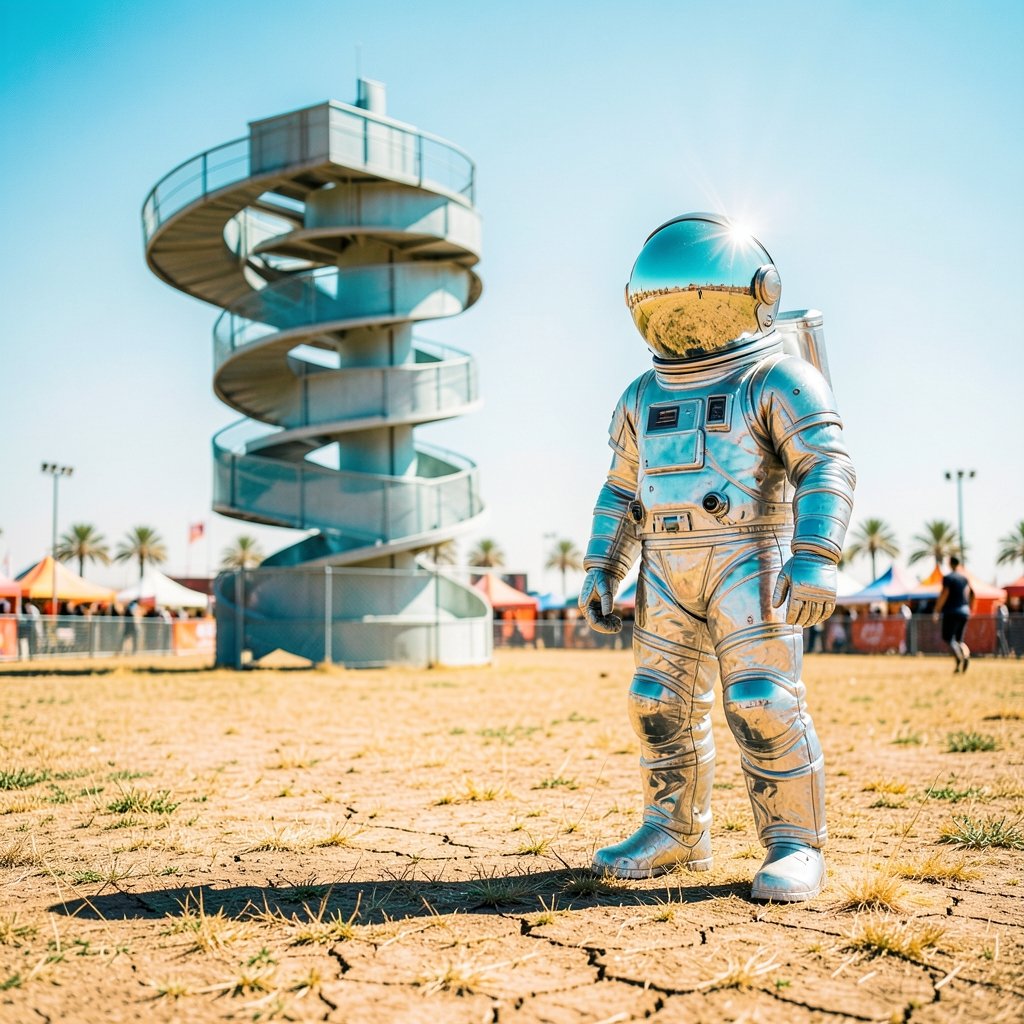
What if the most photographed thing at a music festival isn’t a musician at all? At Coachella, that’s often the case. Long before the headliners take the main stage, crowds are already queuing to walk through a seven-story spiral tower, stand beneath a giant astronaut, or climb inside a glowing honeycomb. The art installation program at Coachella has quietly become one of the festival’s defining features, and for many attendees it’s the reason they arrive early and stay late.
This guide breaks down how the art program works, which pieces became icons, what to know before you visit, and the practical mistakes that catch first-timers off guard.
How the Coachella Art Program Actually Works
Coachella takes place at the Empire Polo Club in Indio, California, a sprawling expanse of grass that becomes a temporary city each April. The festival commissions monumental temporary installations and places them across the grounds, often encouraging people to interact with them rather than just look at them.
The commissioning model matters. Coachella typically approaches artists directly rather than running an open competition, which means the lineup of installations is curated with the same intent as the music booking. Artists are chosen for scale, spectacle, and shareability. That last point is not cynical; it’s structural. An installation that photographs well becomes part of the festival’s visual identity for years.
Most pieces are temporary by design. After the festival ends, installations are dismantled or relocated, and some have been re-exhibited elsewhere. That ephemerality is part of the appeal. You either saw it or you didn’t.
One more structural detail worth knowing: large installations at the Empire Polo Club are subject to local permitting and fire-safety review by Indio city and Riverside County authorities. That regulatory layer shapes what gets built, how tall it can go, and what materials are allowed. It’s the unglamorous backbone behind the glamorous photos.
The Installations That Became Landmarks

A handful of pieces have crossed over from festival decor into genuine pop-culture memory. Here are the ones most often cited.
| Installation | Artist / Studio | Notes |
|---|---|---|
| Escape Velocity (astronaut) | Poetic Kinetics | Giant astronaut sculpture that appeared to move across the field |
| Escape Velocity (caterpillar to butterfly) | Poetic Kinetics | Earlier landmark piece involving a transformation |
| Spectra | NEWSUBSTANCE | 56-foot-tall, seven-story spiral observation tower with a color-shifting interior |
The Poetic Kinetics Effect
Poetic Kinetics is the studio most associated with Coachella’s art identity. The studio produced a piece involving a caterpillar that transformed into a butterfly, and later a giant astronaut that seemed to travel across the grounds. Both became pilgrimage sites within the festival.
There’s a naming wrinkle here that trips up even seasoned festival writers: the title Escape Velocity has been attached to more than one Poetic Kinetics project across different years, and the 2014 versus 2018 attributions are frequently muddled in secondary coverage. If you’re citing a specific year, check the artist’s own portfolio rather than relying on a listicle.
Spectra and the Observation Tower
Spectra, by UK studio NEWSUBSTANCE, stood 56 feet tall and spiraled seven stories into the air. Visitors climbed inside and looked out over the polo fields through a color-shifting interior. The height figure is widely reported, though it’s worth verifying against the studio’s own project documentation.
Spectra returned in later editions, which is unusual for a piece of this scale. It also demonstrates a pattern: the installations that come back are the ones that function as landmarks. A tower is useful. It gives people a meeting point, a vantage, and a photo that reads instantly.
Pieces That Need Verification
Two names circulate constantly in Coachella art discussions but are hard to pin down: a honeycomb-like structure often called the Hive or H.i.V.E., and a large reflective or kinetic piece referred to as Crown. Both are associated with recent editions, but the artist, year, and exact title are not consistently documented. Treat these as unverified until you can confirm them against official festival or studio channels.
If you’re writing about this topic, that’s the honest move. Naming a piece confidently when the record is murky is how misinformation spreads.
Why the Art Matters More Than People Admit
Music festivals are loud, crowded, and physically demanding. Art installations solve a real problem: they give people somewhere to go that isn’t a stage.
Think about the rhythm of a festival day. There are gaps between sets. There are moments when the crowd at the main stage is unbearable. There are hours when the sun is brutal and shade is scarce. A large-scale installation absorbs that overflow. It becomes a rendezvous point, a cooling-off zone, and a conversation starter all at once.
There’s also the interactivity factor. Climbable and walk-through pieces convert passive spectators into participants. That changes behavior. People linger. They take their time. They bring friends back to show them. The installation becomes a shared reference point for the weekend.
And then there’s the aesthetic argument. Coachella’s visual identity is built substantially on its art program. The desert light, the palm trees, the Ferris wheel, the giant sculpture on the horizon: these elements combine into something instantly recognizable. Musicians rotate every year. The art is what makes the place look like itself.
Practical Tips for Experiencing the Installations
If you’re going and want to actually engage with the art rather than sprint past it, a few things genuinely help.
- Arrive early on the first day. Installations are least crowded in the first few hours. This is also when the light is best for photos and the temperature is still manageable.
- Visit during set changes. When a major act ends, crowds migrate. Use that window to hit a piece you’ve been meaning to see.
- Check height and accessibility restrictions before queuing. Climbable structures often have capacity limits and safety rules. Knowing them in advance saves disappointment.
- Go at night and again in daylight. Many pieces read completely differently after dark. Spectra’s color-shifting interior, for instance, is a different experience at night.
- Look for the smaller pieces. The headline installations get the crowds, but the grounds are dotted with works that reward a slower walk.
Common Mistakes People Make
The biggest one is treating the art as background. People walk past a major installation on the way to a stage and never come back. Then they see everyone’s photos afterward and regret it.
The second mistake is queuing at peak times. Mid-afternoon on Saturday is the worst window for any popular walk-through piece. Go early or go late.
The third is assuming everything is permanent. It isn’t. If a piece is on your list, prioritize it. Some installations have been dismantled or moved after a single edition, and there’s no guarantee a return.
A fourth, subtler mistake: not checking what’s actually there that year. The lineup of installations changes. Coverage from a previous year is not a guide to the current one. Confirm against official channels before you build a plan around a specific piece.
How the Art Fits Into Festival Culture More Broadly
Coachella’s art program sits inside a larger visual culture that extends well beyond the polo fields. Festival style, beauty, and self-presentation have become their own ecosystem, and the same instinct that drives people to photograph a giant astronaut also drives the details they wear.
That instinct shows up in smaller ways too. Festival-goers plan their looks months ahead, from nail art ideas that hold up across a long weekend to more elaborate festive nail art designed to catch desert light. The connection isn’t superficial. Both the installations and the personal styling are about creating something worth looking at in a specific place and time.
Some attendees lean into the visual spectacle with simple nail art that survives dust and heat, while others go maximalist with heart nail art or full nail art compositions. Others add movement to the mix through hair tinsel installation, which catches light in a way that photographs beautifully against large-scale sculpture.
The point is that Coachella’s art isn’t confined to the commissioned pieces. It’s a whole visual environment, and the crowd is part of it.
The Cancellation Years and What They Changed
Coachella was cancelled in both 2020 and 2021 due to COVID-19. That’s well documented and worth stating plainly, because it means no new on-site installations debuted during those years.
The gap had a practical effect. Two full cycles of commissioning and fabrication were interrupted. When the festival returned, the art program came back into a landscape that had changed: supply chains, fabrication timelines, and audience expectations had all shifted. It’s a reminder that these installations are industrial-scale projects with long lead times, not decorations thrown up in a week.
It also means that any list of “Coachella art through the years” with entries for 2020 or 2021 is wrong. There were no installations those years because there was no festival.
What to Watch For in Future Editions
The most recent festival before late 2026 would have taken place in April 2026, but the specific installations from that edition cannot be confirmed without checking official festival and artist channels. That’s the responsible answer, and it’s also the useful one: don’t trust a list that doesn’t cite the artist or the festival directly.
What’s more predictable is the pattern. Coachella tends to commission work that is:
- Monumental in scale, because scale reads across a crowded field
- Interactable, because participation generates the images that define the year
- Structurally reviewed, because local permitting and fire-safety rules govern what can be built
- Temporary, because the polo club returns to being a polo club
If you want to track the program properly, follow the studios rather than the aggregators. Poetic Kinetics and NEWSUBSTANCE both document their own projects, and their pages are more reliable than a roundup written from memory.
Conclusion
The art installation program at Coachella is not a side attraction. It’s one of the festival’s central engines, a commissioning pipeline that has produced some of the most recognizable visuals in contemporary festival culture. A giant astronaut crossing a field, a seven-story spiral tower glowing from within, a caterpillar becoming a butterfly: these are the images that outlast the set times.
The practical takeaway is simple. If you’re going, treat the installations as destinations, not scenery. Arrive early, go back at night, and prioritize the pieces you actually want to see, because most of them won’t be there next year.
And if you’re reading about them rather than attending, apply some skepticism. Titles, artists, and years get scrambled in retelling. The verified record is thinner than the internet suggests, and the honest version is more interesting anyway.
FAQ
What is the most famous art installation at Coachella?
The giant astronaut sculpture by Poetic Kinetics is the most widely recognized, partly because it appeared to move across the field. The seven-story spiral tower Spectra by NEWSUBSTANCE is a close second, largely because it returned in later editions and became a landmark people used to navigate the grounds.
Who commissions the art at Coachella?
Coachella typically commissions artists directly rather than running an open competition, though the current selection process isn’t publicly confirmed in detail. The practical result is a curated program chosen for scale, interactivity, and visual impact rather than an open call for submissions.
Are the Coachella art installations permanent?
No. Most are temporary by design and are dismantled or relocated after the festival. A few pieces have been re-exhibited elsewhere, and some have returned to later editions of the festival, but nothing on the grounds is guaranteed to be there the following year.
Can you climb or walk through the installations?
Many of them, yes. Interactivity is a core part of the commissioning approach, and pieces like Spectra were built specifically for visitors to enter and climb. Individual structures have their own capacity limits and safety rules, so check before you queue.
Were there art installations at Coachella in 2020 and 2021?
No. The festival was cancelled in both 2020 and 2021 due to COVID-19, so no new on-site installations debuted in those years. Any list that includes entries for those years is inaccurate.
How do I verify which installation appeared in a given year?
Check the artist’s or studio’s own project documentation first, then the festival’s official channels. Titles, artists, and years get mixed up frequently in secondary coverage, and at least two well-known pieces have naming and dating inconsistencies that persist across many published lists.









