


Can a root that has been chewed for energy for centuries actually do anything for your face? That is the question behind the steady stream of ginseng creams, serums, essences, and sheet masks now crowding drugstore shelves and luxury counters alike. The marketing is confident. The science is quieter. Somewhere between the two is a reasonable answer, and it is more interesting than either “miracle root” or “worthless hype.” (Face shape frame guide)
This article walks through what ginseng actually is in a cosmetic context, what the lab work suggests, where the human evidence gets thin, how to read a label, and how to use a ginseng product without wasting money or irritating your skin. No miracle claims. Just the practical picture.
What “ginseng” on a skincare label usually means
In cosmetics, ginseng almost always refers to Panax ginseng, also called Asian or Korean ginseng. That is the species most of the research uses, and the one whose root extract or ginsenosides show up in ingredient lists.
Two impostors and cousins complicate things:
- American ginseng (Panax quinquefolius) is a related species with a different ginsenoside profile. It appears in some products but is far less studied for skin.
- Siberian ginseng is actually Eleutherococcus senticosus, which is not a true Panax at all. It is an adaptogen with its own chemistry. If a label says “Siberian ginseng,” you are not getting the ingredient most skincare research describes.
This distinction matters more than most shoppers realize. A product can legally say “ginseng” while using a species with little or no facial-skin research behind it. If you want the version that has actually been studied, look for Panax ginseng root extract or ginsenosides on the ingredient list, rather than only the word “ginseng” on the front of the box.
The active compounds: what ginsenosides are
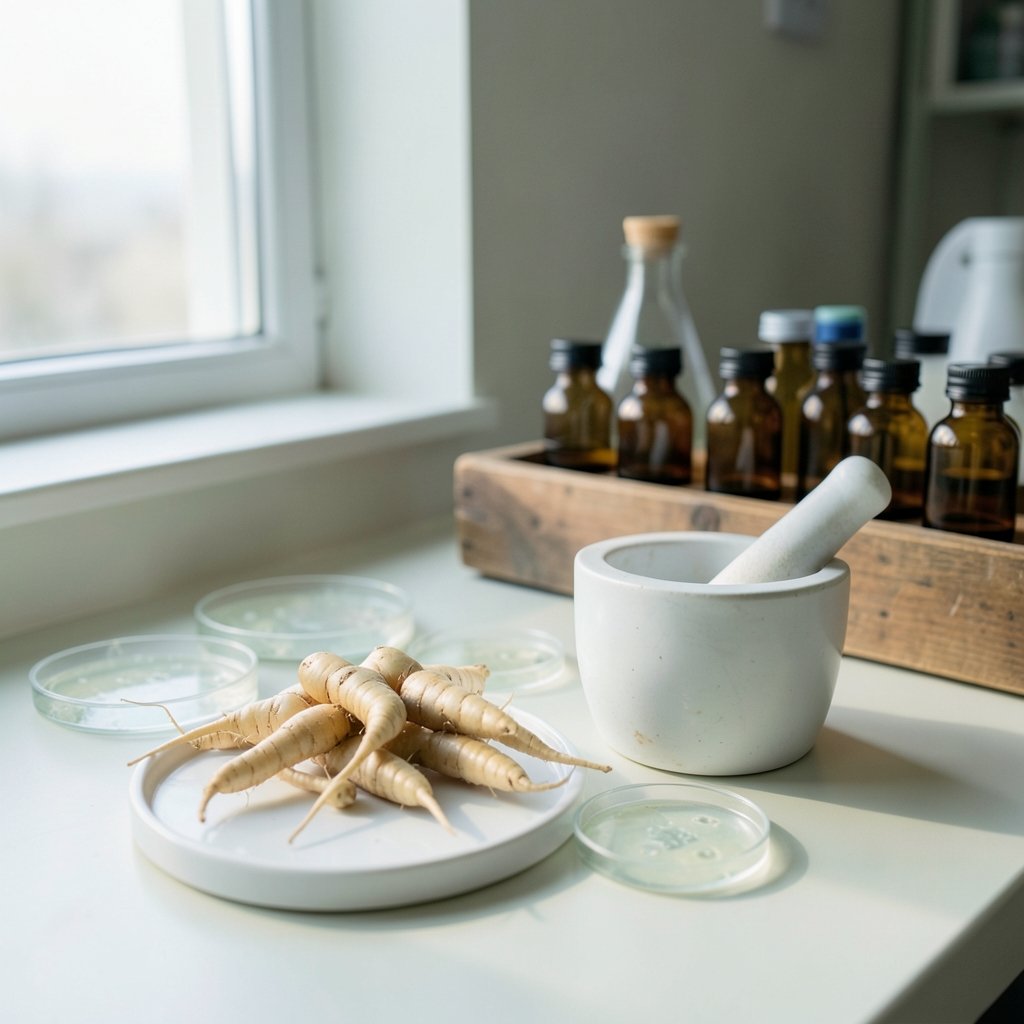
The star molecules are ginsenosides, a family of triterpene saponins found in the root. In laboratory settings, these compounds show antioxidant and anti-inflammatory activity. That is the foundation of nearly every ginseng skincare claim you will read.
Here is the honest caveat: most of that evidence comes from cell cultures and animal studies, not from people applying cream to their faces. Antioxidant activity in a petri dish does not automatically translate into fewer wrinkles on a human forehead. Skin is a barrier. Formulation matters. Dose matters. And the leap from “the compound scavenges free radicals in a flask” to “this serum firms your jawline” is a big one that marketing departments make casually.
So when a brand says ginseng is “clinically proven,” ask a follow-up question: proven in what, at what concentration, on how many people, for how long? The answers are usually less impressive than the label implies.
What the research actually supports
Human trials on topical ginseng for facial skin exist, but they are small, few, and often funded by the industry. Some suggest possible improvements in wrinkles, elasticity, or hydration. That is genuinely promising. It is also preliminary. Sample sizes tend to be modest, durations short, and formulations proprietary, which makes independent replication hard.
Oral ginseng has a much longer research history than topical use, but that research is about energy, fatigue, and general wellness, not about your cheekbones. Do not assume that because a ginseng capsule has been studied for something, a ginseng serum inherits that evidence.
The fair summary is this: ginseng is a plausible skincare ingredient with a sensible mechanistic story and mostly preclinical support. It is not a proven anti-aging treatment in the way that, say, broad-spectrum sunscreen or retinoids are. Treat “may help” as the ceiling of what the evidence currently supports, and be suspicious of anything stronger.
How cosmetics are regulated, and why claims are marketing
In the United States, the FDA does not approve cosmetics for efficacy before they go on sale. Cosmetics need no premarket approval, and “cosmeceutical” is not a legal category. A product can be sold with claims that have never been reviewed by a regulator.
The European Union takes a stricter line. Cosmetic claims must be supported by adequate evidence and must not mislead. That is a higher bar than the US system, but enforcement still depends on the claim and the market.
The practical takeaway for shoppers: a ginseng label is a marketing document, not a regulatory finding. “Anti-aging,” “energizing,” and “revitalizing” are words chosen to sell, not conclusions reached by a review board. This is not unique to ginseng. It is true of the entire aisle.
Reading a ginseng product like someone who knows the tricks
Ingredient lists are where the truth lives, and they are easy to misread. A few habits that separate informed buyers from hopeful ones:
- Check the species name. Panax ginseng is the one with the most research. “Siberian ginseng” is a different plant entirely.
- Look at position, not presence. Ingredients are listed in descending order of concentration up to about 1%. A ginseng extract near the bottom may be a token amount included for the label story.
- Be wary of “fermented” and “red” ginseng as potency signals. These are processed forms, sometimes with higher ginsenoside content, but direct head-to-head facial-skin trials confirming they work better are lacking. It is a reasonable marketing claim, not a proven advantage.
- Notice what else is in the jar. Many ginseng products lean on niacinamide, hyaluronic acid, glycerin, or peptides for their visible effects. The ginseng may be a supporting player riding on the formula’s real workhorses.
- Ignore the percentage unless it is specific. “Ginseng extract” with no concentration tells you almost nothing. Even a stated percentage of raw extract does not tell you the ginsenoside content, which is what actually matters.
If you are the type who likes to evaluate gear before committing, the same discipline applies here as in any good pre-purchase checklist: check the specs, not the badge on the box.
Patch testing and irritation: the step people skip
Ginseng itself is generally well tolerated on skin, and reactions are usually limited to mild irritation or contact dermatitis. The bigger risk comes from everything else in the bottle: fragrance, plant oils, preservatives, and multi-herb blends that stack several botanicals at once.
The standard advice is a patch test on the inner forearm for 24 to 48 hours before putting anything new on your face. Most people skip this. Most people also get away with it. The ones who do not end up with a red, itchy cheek and a lesson learned.
A few practical notes:
- Test the actual product, not a similar one.
- If you have eczema, rosacea, or sensitive skin, test longer and start with a small area.
- Stop immediately if you feel stinging, burning, or spreading redness. Itch that appears hours later counts too.
- Do not introduce three new products the same week. If something goes wrong, you will have no idea which one caused it.
Ginseng and oral supplements: a different risk profile
Some people take ginseng capsules hoping for skin benefits from the inside out. That is a different conversation, and it comes with different cautions.
Oral ginseng can interact with warfarin and other drugs, and it may affect blood glucose. If you take blood thinners, diabetes medication, or anything with a narrow safety margin, talk to a clinician before adding ginseng to your routine. Topical use does not carry those systemic risks, which is one quiet argument for keeping ginseng in your moisturizer rather than your pill organizer.
Pregnancy, breastfeeding, and upcoming surgery are also standard reasons to check with a professional first. None of this means ginseng is dangerous. It means it is a real botanical with real pharmacology, not a neutral flavoring.
Where ginseng fits in a routine that actually works
If you want to try ginseng, the sensible approach is to treat it as a supporting ingredient, not the centerpiece of your regimen. The fundamentals still do the heavy lifting:
| Priority | What it does | Where ginseng fits |
|---|---|---|
| Sunscreen | Prevents UV damage, the main driver of visible aging | Nothing replaces it |
| Retinoid or similar | Proven collagen and texture benefits | Ginseng can layer alongside |
| Moisturizer | Barrier support and hydration | Ginseng serums often live here |
| Antioxidant serum | Environmental defense | Ginseng is a reasonable option |
| Ginseng product | Possible modest antioxidant help | Optional, not necessary |
A ginseng serum or essence can sit comfortably in the morning under sunscreen or in the evening before moisturizer. It is pleasant, often cosmetically elegant, and unlikely to hurt. Just do not expect it to outperform the boring steps you already know matter more.
Think of it the way a collector thinks about a well-made object: the appeal is often craft and character rather than raw spec-sheet dominance. Ginseng skincare is similar. It can be a lovely product with a real botanical story, even if it is not the most powerful tool in the drawer.
Common mistakes people make with ginseng skincare
A short list of traps, drawn from how these products are typically marketed and used:
- Buying based on the front label. The ingredient list is where the actual information is.
- Assuming “natural” means “gentle.” Botanical extracts can irritate, especially in fragranced formulas.
- Expecting fast results. If ginseng does anything, it does it slowly and subtly. Anyone promising visible change in three days is selling optimism.
- Stacking multiple ginseng products. More ginseng is not better ginseng, and layering several botanical serums raises irritation risk without adding proven benefit.
- Skipping the concentration question. A named extract with no stated amount is a story, not a dose.
- Ignoring the rest of the formula. The supporting ingredients usually deserve more credit than the headline one.
Matching the product to your skin, not the trend
Skin type should drive the choice more than the ingredient hype. A ginseng cream built for dry skin will feel heavy and congesting on oily skin. A ginseng essence designed for layering may be too light for someone who needs barrier repair.
There is a useful parallel in how people choose frames: the right pick depends on the face in the mirror, not the poster on the wall. Fit beats fashion every time. Skincare works the same way. A ginseng product that suits your skin type and budget will serve you better than a prestige one that fights your complexion.
There is also a sensory dimension worth naming. Ginseng products often have a distinct earthy, rooty scent and a slightly warming feel. Some people love it. Some find it odd. Neither reaction is wrong, and neither predicts whether it will help your skin. Texture and scent are legitimate reasons to choose or skip a product, as long as you are honest that they are preferences, not efficacy. (Reverso tribute chronograph collectors guide two faced icon)
The bottom line on ginseng for face
Ginseng is a real botanical with a believable antioxidant and anti-inflammatory story, a long traditional history, and a thin but not empty modern evidence base for topical facial use. It is probably not the anti-aging breakthrough the packaging suggests. It is also not snake oil. It sits in the wide middle ground of skincare ingredients that are pleasant, plausibly helpful, and oversold.
If you want to try it, choose a product that names Panax ginseng clearly, patch test it, use it consistently for a few weeks, and judge it by how your skin actually behaves rather than by how the marketing makes you feel. Keep your sunscreen and your proven actives. Let ginseng be the supporting character. That is a realistic, affordable, and genuinely useful way to approach it.
Frequently asked questions
Does ginseng really reduce wrinkles?
The evidence is preliminary. Some small human trials suggest possible improvements in wrinkles, elasticity, or hydration, but the studies are limited and often industry-funded. Ginseng is a plausible supporting ingredient, not a proven wrinkle treatment. Sunscreen and retinoids have far stronger evidence behind them.
Is Siberian ginseng the same as the ginseng in skincare studies?
No. Siberian ginseng is Eleutherococcus senticosus, which is not a true Panax species. Most skincare research uses Panax ginseng root extract and its ginsenosides. If a label says Siberian ginseng, you are getting a different plant with far less facial-skin research.
Can ginseng skincare cause irritation?
It can, though reactions are usually mild. The bigger culprits are often fragrance, plant oils, and multi-herb blends rather than ginseng itself. Patch test on your inner forearm for 24 to 48 hours before using a new product on your face, especially if you have sensitive skin, eczema, or rosacea.
Is fermented or red ginseng better for skin?
Not proven. Fermented and red ginseng are processed forms that may contain higher ginsenoside levels, and marketing often implies greater potency. But direct head-to-head facial-skin trials confirming they outperform standard ginseng extract are lacking. Treat the claim as a reasonable possibility, not an established advantage.
Can I take ginseng capsules for skin benefits?
Oral ginseng has a better-documented safety profile than topical use but comes with real caveats. It can interact with warfarin and other drugs and may affect blood glucose. If you take blood thinners, diabetes medication, or have surgery planned, check with a clinician first. Topical use avoids those systemic risks.
How long before I see results from a ginseng serum?
Give any new skincare product four to six weeks of consistent use before judging it, and expect subtle changes at most. If ginseng helps, it does so gradually. Anyone promising visible transformation in a few days is selling optimism rather than evidence.
What should I look for on a ginseng product label?
Look for Panax ginseng root extract or ginsenosides named clearly, check where the ingredient sits in the list, and be skeptical of vague percentages. Remember that supporting ingredients like niacinamide, glycerin, and hyaluronic acid often do more visible work than the headline botanical. The ingredient list tells the real story.









