

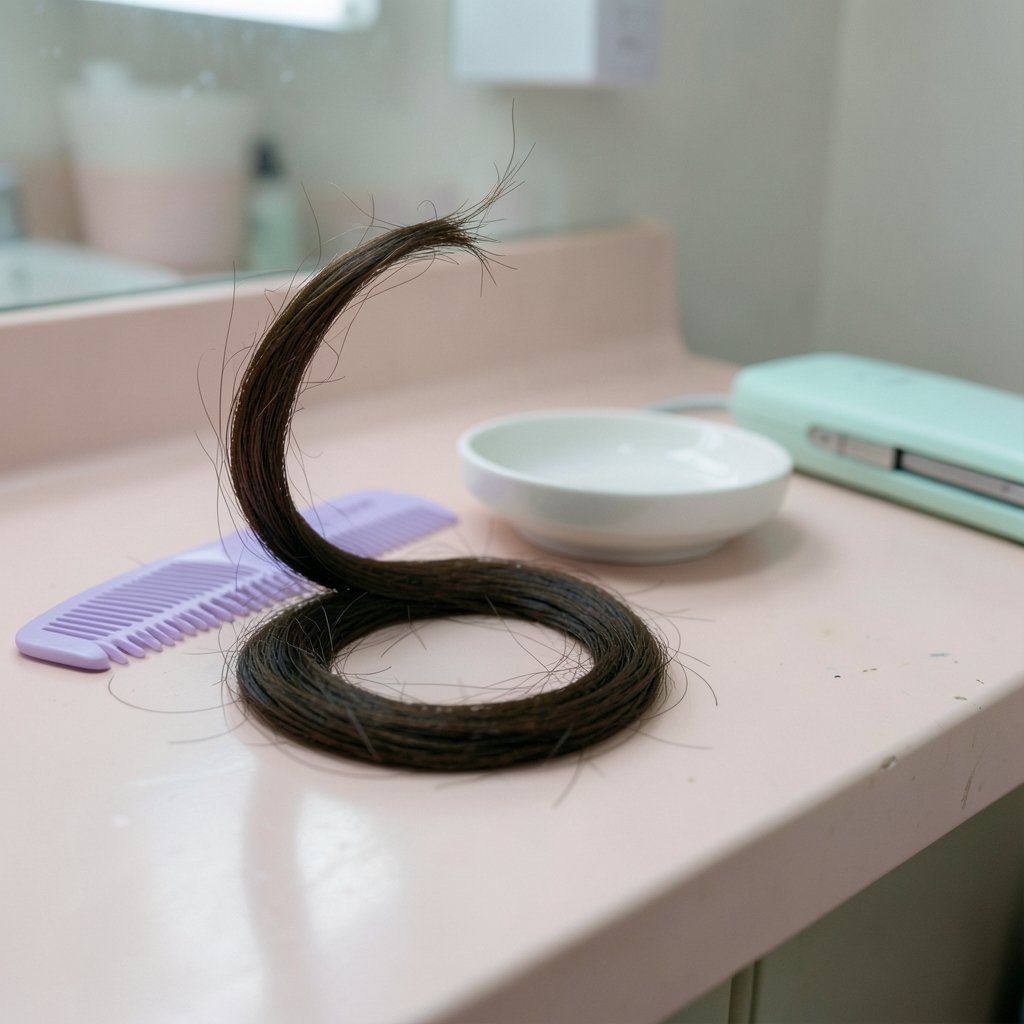
Have you ever twirled a strand of hair around your finger, watched it spring back, and wondered what is actually going on in there? That tiny coil is a small physics experiment. Hair bending is the study of how a single fiber resists, absorbs, and recovers from flexing, and it explains why some hair snaps back into shape while other hair sags, frizzes, or breaks at the same spot over and over. It also explains why your curl pattern behaves the way it does, why humidity ruins a blowout, and why the same flat iron can leave one head glossy and another brittle. This guide stays practical: what bending actually means for a real strand, what changes it, and how to work with it instead of fighting it.
What hair bending actually means
Hair bending is the mechanical response of a hair fiber when a force pushes it out of a straight line. It is different from stretching. When hair is pulled lengthwise, the load lands mostly on the cortex, the inner core of keratin-packed cells. When hair is bent, the fiber has to do two things at once: compress on the inside of the curve and stretch on the outside. The outer layer, the cuticle, takes much of that strain.
That layered design matters. A healthy cuticle is a sheath of overlapping scales, like roof shingles, and it protects everything underneath. Bend a fiber repeatedly and the cuticle is where the damage usually starts, with small cracks and lifted scales before anything dramatic happens.
Hair is also viscoelastic. That means it does not behave like a spring with one fixed stiffness. Its bending response depends on how fast the force is applied, how wet the hair is, and how warm it is. Ask “how stiff is hair?” and the honest answer is: stiffer than you think in dry air, much softer after a shower, and somewhere in between under a hot dryer.
The structure behind the flex

Three layers do the work. The cuticle is the armor. The cortex is the engine, made of long keratin chains held together by chemical bonds, including hydrogen bonds and stronger disulfide bonds. The medulla, a loosely packed core, appears mainly in thicker hairs and does not contribute much to strength.
Those bonds are the secret to why hair can be reshaped at all. Water and heat break and reform hydrogen bonds, which is why a wet strand can be wrapped around a roller and dry into a new curve. The shape is temporary because those bonds are relatively easy to reset. Disulfide bonds are tougher, and chemical perming changes those, which is why a perm lasts for months while a blowout lasts until the next wash.
One number worth knowing: the bending stiffness of hair is generally reported in the low gigapascal range, often somewhere around 1 to 4 GPa depending on the method and the humidity. Compare that to the fiber’s stiffness along its length, which is higher. In plain terms, hair is easier to bend than to stretch, and both properties shift with moisture.
Why wet hair bends so much more easily
Water is a plasticizer for keratin. It slips between the protein chains, weakens the bonds holding them in place, and lets the fiber deform with far less force. That is why wet hair feels almost rubbery and why it stretches noticeably before it snaps back.
The practical consequences are worth memorizing. Wet hair is more fragile, not less, because it stretches further before breaking and because the cuticle is swollen and easier to lift. Rough towel-drying, brushing from the roots down, and tight elastics on damp hair all cause more damage than most people expect. A wide-tooth comb, gentle squeezing, and a little patience do more for hair health than most expensive products.
Humidity works on the same principle from the other direction. On a muggy day, hair absorbs moisture from the air, softens, and loses the shape you set that morning. Frizz is largely hair reaching for water vapor and curling as it swells unevenly. If you have wavy hair types, you already know the pattern: sleek in dry air, unpredictable in the rain.
Heat, curl, and the shape memory of hair
Heat styling is controlled bending. A curling iron or flat iron raises the temperature, temporarily loosens the hydrogen bonds, and lets you set a new curve while the fiber cools. The shape holds because the bonds reform in the new position.
The catch is cumulative damage. Repeated high heat causes cuticle cracking and moisture loss, and the effects add up over months rather than appearing overnight. Two habits make the biggest difference in practice:
- Keep the tool moving. Holding a hot iron on one section for too long concentrates heat in a single spot.
- Respect the moisture balance. Hair that is bone dry going in loses more moisture and ends up rougher, so a light heat protectant has a real purpose.
Natural curl is a different story. Scientists have linked hair curvature to asymmetric growth in the follicle, where cells on one side of the root divide differently from the other. The mechanisms are still debated, which is why curl science remains an active research area rather than a settled recipe. What is clear is that the bend is built in at the root, not created by styling.
What changes how much hair bends
Several factors decide whether a strand flexes easily or fights back.
| Factor | Effect on bending | Practical note |
|---|---|---|
| Fiber diameter | Thicker fibers resist bending more | Fine hair bends and breaks more easily |
| Moisture level | Water lowers stiffness | Wet hair is more fragile than dry hair |
| Temperature | Heat softens the fiber | Heat styling reshapes, but repeated use damages |
| Cuticle condition | Damage reduces resilience | Rough, lifted cuticles crack sooner |
| Chemical treatment | Color and perms alter bonds | Treated hair needs gentler handling |
| Curl pattern | Curvier fibers bend differently | Curly hair is often drier and more breakage-prone |
Diameter is the one people underestimate. Fine hair is not weaker because it is “bad” hair; it simply has less material to resist a bend, so it dents, kinks, and snaps under loads that coarse hair shrugs off. That is why two people can use the same brush and only one ends up with split ends.
Hair typing and the language of bends
The word “bend” also shows up in everyday hair talk, usually meaning the wave or curl pattern in a lock. The best-known system, popularized in the 1990s, sorts hair into types from straight to tightly coiled, with subcategories for width and tightness. It is a useful shared vocabulary, and it is not a scientific standard. Two people with the same label can have very different porosity, density, and damage history.
Treat typing as a starting point for product choices, not a diagnosis. If a routine built for your “type” is not working, the label is not the problem. Porosity, how easily hair takes in and holds moisture, usually tells you more about what a strand actually needs.
Everyday habits that protect the bend
Most bending damage is mechanical, and mechanical damage is largely preventable. The fixes are unglamorous and effective.
Loosen tight styles. A ponytail pulled tight in the same spot every day bends the same fibers the same way, and over time that repeated stress shows up as breakage along the hairline or at the elastic. Rotate your styles and use soft ties.
Detangle from the ends up. Start at the tips and work upward in small sections. Ripping a brush from root to tip forces every tangle to be yanked through, which is exactly the load that cracks cuticles.
Sleep on something smooth. Cotton pillowcases create friction that bends and roughens hair all night. Satin or silk, or a loose braid, cuts that down.
Give hair a break from heat. Alternating heat days with air-dried days lets the fiber recover some moisture balance. If you are recovering from a big change, the guidance on hair transplant recovery is a useful reminder that new growth and healing tissue need gentle handling, not aggressive styling.
Trim when ends split. A split end does not heal. It travels up the fiber, and cutting above it stops the damage from spreading.
Learn the right way to use a treatment. A weekly conditioning mask helps restore flexibility, but technique matters as much as the product, so it is worth checking how to use a hair mask properly rather than leaving it on for a random amount of time.
Products that actually support flexible hair
The market is crowded, so filter by mechanism rather than by label. Humectants draw in moisture, emollients smooth the cuticle and reduce friction, and proteins temporarily patch gaps in damaged fibers. Protein treatments help brittle hair but can make it stiff and prone to snapping if overused, so most people do better with occasional use than with a weekly protein habit.
Leave-in conditioners and lightweight oils are the workhorses for bending protection because they lower friction between fibers, which means less tangling and fewer forced bends during detangling. For anyone dealing with thinning or a widening part, hair growth serums address the follicle rather than the fiber, and it helps to be clear about that difference: a serum will not repair a bent, cracked strand.
Two common mistakes are worth calling out. First, over-washing strips the natural oils that keep the cuticle supple, which makes hair stiffer and more brittle. Second, piling on heavy products to fix dryness can weigh fine hair down and make it look limp, which sends people back to heat styling and the cycle repeats. Start with less, add gradually, and change one thing at a time.
When bending becomes a warning sign
Some changes are cosmetic and some are worth a closer look. Hair that suddenly bends at odd angles, feels brittle all over, or breaks in short pieces may be signaling protein loss from over-processing, thyroid issues, nutritional gaps, or medication side effects. Sudden changes in texture or shedding deserve a conversation with a doctor or dermatologist rather than another product purchase.
Forensic science offers an odd but useful reminder about how much hair can reveal. Hair fiber comparison was once treated as strong evidence in criminal cases, but a 2009 report from the National Research Council flagged serious limits in comparative hair analysis, noting the lack of statistical foundation behind many claims. The lesson transfers neatly to everyday hair care: visible features tell you something, but they rarely tell you everything, and confident claims deserve scrutiny.
Conclusion
Hair bending is where structure, moisture, heat, and habit all meet in a single fiber. The cuticle takes the strain, the cortex supplies the strength, and the bonds inside decide whether a curve lasts a morning or a season. Water softens hair and makes it easier to shape but also easier to damage. Heat sets a new shape at a cost that accumulates quietly. Diameter and curl pattern set the baseline, and daily handling decides how well a strand holds up over years.
The practical takeaway is simple. Treat wet hair gently, loosen tight styles, detangle from the ends, give heat a rest, and keep the cuticle smooth with sensible conditioning. None of that requires a shelf of products. It requires understanding that every bend puts a small demand on the fiber, and that small demands add up in both directions. Respect the physics, and hair rewards you with flexibility, shine, and fewer bad hair days.
Frequently Asked Questions
Why does my hair bend instead of staying straight?
Hair holds a bend because the bonds inside the cortex reform in whatever position the fiber dries or cools in. If your hair bends easily, it may be naturally curvy, fine in diameter, or simply holding onto moisture from the air. Heat and water reset those bonds, so a straight style lasts until the next wash or humid day.
Is wet hair really more fragile?
Yes. Water acts as a plasticizer, so wet hair stretches further before breaking and its cuticle is swollen and easier to lift. That is why rough towel-drying and aggressive brushing on damp hair cause more damage than the same actions on dry hair.
Does bending hair back and forth cause damage?
Repeated bending in the same spot, such as a tight ponytail or a habitual twirl, concentrates stress on the same fibers. Over time that can lead to cuticle cracking and breakage along the hairline or at the elastic. Rotating styles and using soft ties reduces the risk.
Can damaged hair be repaired?
The fiber itself cannot be fully rebuilt once the cuticle is worn away, but the surface can be smoothed and protected. Conditioning treatments, gentle handling, and trims that remove split ends keep damage from spreading. New growth is where real improvement happens.
Does hair type affect how much it bends?
Yes. Thicker fibers resist bending more than fine ones, and curvier patterns behave differently from straight hair. Curly hair also tends to be drier, which makes it more prone to breakage at the bend points. Porosity often matters more than the type label for choosing products.
How often should I trim to prevent bending damage?
Most people do well with a trim every eight to twelve weeks, and more often if ends are splitting or if hair has been chemically treated. A split end will not heal on its own, and cutting above the split stops it from traveling up the fiber.









