


You order a pair of jeans online, wait for the delivery, try them on, and they are two inches too long. The problem is not the jeans: it is the inseam, the one number that decides whether trousers fit, and most people have never measured it. Learning how to measure inseam takes five minutes and a tape measure.
So how do you measure your inseam? Stand straight, measure from the crotch to the bottom of the ankle bone, and you have it. Or measure a pair of trousers that already fits you well, from the crotch seam to the hem. This guide explains both methods, the lengths that suit different heights and styles, and the mistakes that make the number wrong.
Key takeaways:
- Your inseam is the distance from the crotch to the bottom of the ankle bone, and it is the number that decides trouser length.
- Measuring a pair of trousers that already fits you well is the easiest and most reliable method, and it works for jeans, chinos and formal trousers.
- The right inseam depends on your height and the style: slim jeans sit shorter than wide-leg trousers, and a formal trouser breaks differently from a casual one.
- Most bad fits come from small mistakes: measuring with shoes on, pulling the tape too tight, or measuring trousers that do not actually fit.
What is an inseam?
The inseam is the length of the inside of the leg, measured from the crotch seam to the hem. It is the number shops use when they sell trousers by length. When trousers are too long or too short, the inseam is almost always the reason.
The outseam runs down the outside of the leg, from the waistband to the hem, and it includes the rise. The inseam starts at the crotch, so it measures only the leg. Shops selling trousers by waist and length, such as 32 by 32, are quoting the waist and the inseam.
How do you measure your inseam?

There are two ways to measure an inseam: on your body, or on trousers that already fit. The garment method is easier and usually more accurate, because measuring your own inside leg is awkward and the tape tends to slip.
Measuring on yourself. Stand barefoot on a hard floor, with your feet about shoulder-width apart and your back straight. Ask someone to help if you can. Place the end of a soft tape measure at the top of the inside of your leg, where it meets the crotch, and run it straight down to the bottom of the ankle bone. Keep the tape flat and straight, not pulled tight, and read the number at the ankle bone. That is your inseam.
If you are measuring alone, stand with your back against a wall and hold the tape with one hand while you read it with the other. Take the measurement twice and use the average if the two numbers differ. Do it barefoot: shoes add height, and measuring with them on is one of the most common mistakes.
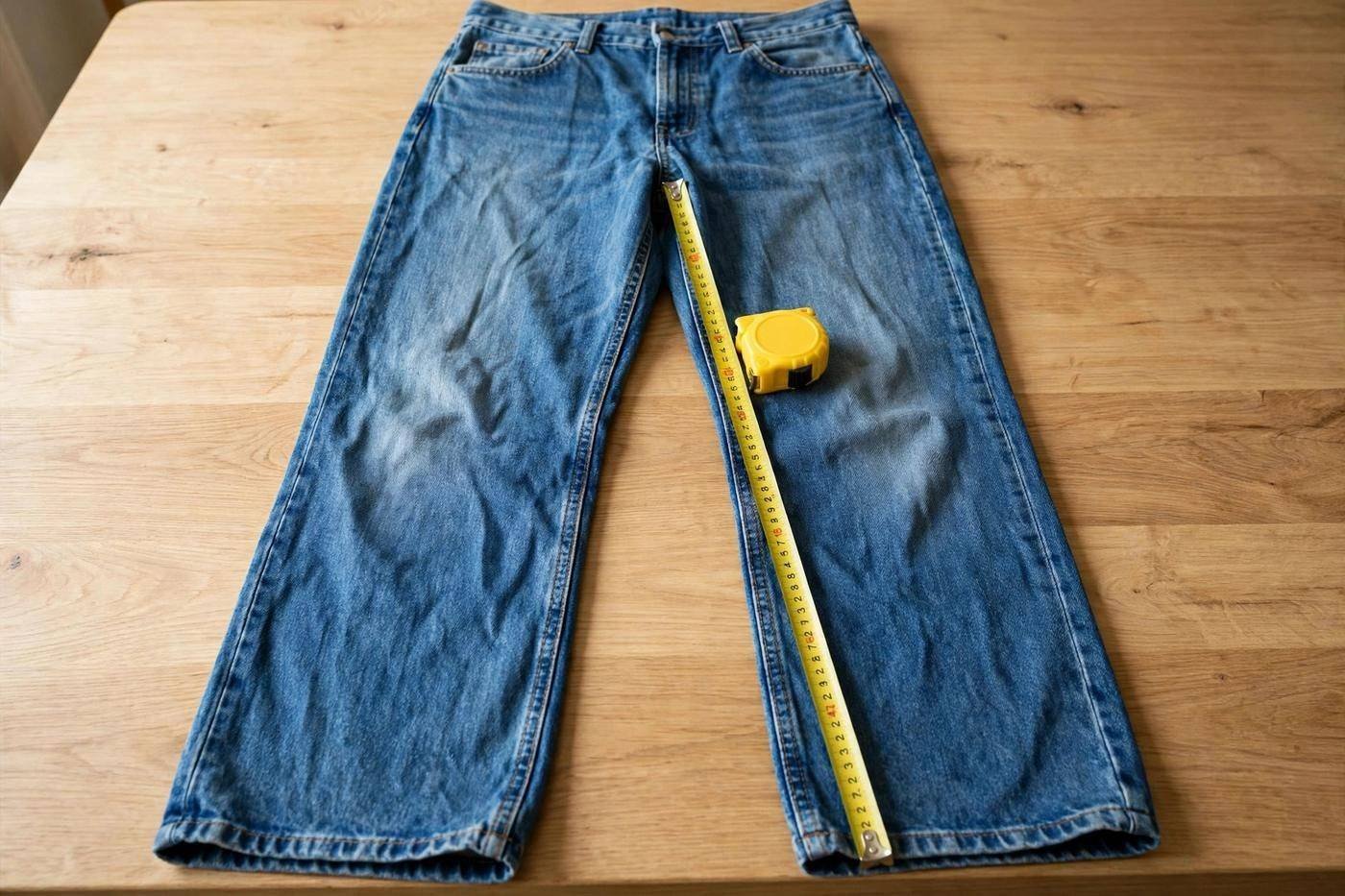
Measuring a garment. Choose trousers that fit you well, in the style you are shopping for. Lay them flat, smooth out any wrinkles, and make sure the legs are straight. Find the crotch seam, where the two legs meet, and place the end of the tape measure there. Run the tape down the inside of one leg to the hem, and read the number there. That is the inseam of those trousers, and it is the number to look for when you shop.
Measure both legs if you have time: they should match, and if they do not, the trousers were not cut evenly. If you are measuring jeans, the hem may be worn or frayed, so measure to the edge of the fabric rather than to the longest thread. Write the number down, in inches and in centimetres, so you have it ready when you shop online.
What inseam length should you choose?
The right inseam depends on your height, the style, and how you like them to fit. The table below gives the usual ranges, but they are starting points rather than rules: slim jeans sit shorter than wide-leg trousers, and a formal trouser breaks differently from a casual one.
| Height | Usual inseam | Best for | Watch out for |
|---|---|---|---|
| Under 5 ft 4 in (163 cm) | 28 to 30 inches | Short and regular lengths | Often needs hemming |
| 5 ft 4 in to 5 ft 8 in (163 to 173 cm) | 30 to 31 inches | Most standard trousers | Slim styles may need a shorter inseam |
| 5 ft 9 in to 6 ft (175 to 183 cm) | 32 to 33 inches | The most widely stocked length | Wide-leg styles may need longer |
| 6 ft 1 in to 6 ft 4 in (185 to 193 cm) | 34 to 36 inches | Long and tall lengths | Not every shop stocks them |
| Over 6 ft 4 in (193 cm) | 36 inches and over | Tall and extra-long lengths | Often only available online |
These are the ranges most shops use, but your own measurement matters more than any table: two people of the same height can have different leg lengths, and the only way to know yours is to measure it.
How does inseam differ by style?
Inseam is not a single number that works for every pair of trousers. The same legs need a different inseam in different styles. A slim pair of jeans ends at or just above the ankle, so it takes a shorter inseam than a straight-leg pair, which covers the top of the shoe. A wide-leg pair needs the longest inseam, because the fabric falls straight and the hem should just brush the floor.
Formal trousers are different again. They should break slightly at the front, where the fabric meets the shoe, with a single fold, so the inseam should reach the shoe without the fabric pooling. Chinos sit between the two: they are usually worn with a small break or none at all, and a slightly shorter inseam suits trainers. Shorts are measured the same way, but the inseam is much shorter, usually between 5 and 9 inches.
The practical rule is to measure a pair of trousers in the style you are buying, not just any pair you own. A well-fitting pair of jeans will give you the wrong number for a formal trouser. Keep a separate number for each style you wear often.
What are the common mistakes?
Most inseam measurements go wrong for predictable reasons. The first is measuring with shoes on: shoes add height, so always measure barefoot. The second is pulling the tape too tight: the tape should lie flat against the leg, not dig in, and a tight tape gives a number that is too short.
The third is measuring trousers that do not actually fit. If the trousers you measure are too long, you will buy trousers that are too long. Choose a pair you are happy with. The fourth is measuring to the wrong point: the inseam ends at the bottom of the ankle bone, not at the floor, and measuring to the floor adds an inch or two. The fifth is forgetting that fabric stretches: denim and cotton relax with wear.
How do you use your inseam when shopping online?
Shopping online is where an inseam measurement earns its keep. Most online shops list trousers by waist and length, and the length is the inseam, so knowing your number lets you filter to the pairs that will fit. Check the size guide before you order, because sizes vary between brands: a 32-inch inseam at one shop may measure 31 or 33 inches at another.
Look for the garment measurements as well as the body ones. Some shops give the inseam of the trousers themselves, and that number is more useful, because it tells you exactly how long the trousers are. If the shop only gives a body measurement, add half an inch to an inch, and check the returns policy before you order.
When the trousers arrive, try them on barefoot first, then with the shoes you will wear them with. The hem should sit where you want it with your usual shoes on, and if it does not, return them rather than hoping they will shrink or stretch into shape.
Your inseam checklist
Work through this list once.
- Get a soft tape measure: a fabric tailor’s tape, not a metal builder’s tape, which will not follow the leg.
- Measure barefoot: on a hard floor, standing straight.
- Measure a pair that fits: lay it flat and measure from the crotch seam to the hem.
- Take it twice: measure both legs, and use the average if the numbers differ.
- Write it down: in inches and in centimetres, with a separate number for jeans, chinos and formal trousers.
- Check the size guide: before ordering online, because inseams vary between brands.
- Try before you keep: try new trousers on with your usual shoes, and return them if the hem sits wrong.
Frequently asked questions
What is a normal inseam?
There is no single normal inseam, because it depends on your height and leg length. For most adults, inseams run from 28 to 36 inches, with 30 to 32 inches the most commonly stocked.
How do I measure inseam without a tape measure?
Use a piece of string or a belt: hold it along the inside of your leg from the crotch to the ankle bone, mark the length, then measure the string against a ruler. A pair of trousers that fits well works too: measure its inside leg with a ruler. Our guide to how to fold a pocket square covers another small skill that makes a big difference.
Should I measure inseam with shoes on or off?
Off. Shoes add height and change where the hem should fall, and measuring with them on gives a number that is too long. Measure barefoot, then try the trousers on with your usual shoes.
What inseam do I need if I am 5 ft 10 in?
Most people around 5 ft 10 in wear a 32-inch inseam, but it depends on your leg length and the style. Slim jeans may need 31 inches, wide-leg trousers may need 33. Measure your own legs rather than relying on height alone.
Can a tailor shorten trousers?
Yes, and it is one of the simplest alterations a tailor can do. Shortening is usually quick and inexpensive, and it is worth doing for a pair you love. Lengthening is harder, because it depends on how much spare fabric is inside the hem.
Sources
Measuring guidance in this guide reflects standard tailoring practice published by clothiers and sewing guides, including the measurement charts used by major trouser brands. Size ranges vary between brands, so check the size guide of the shop you are buying from. For more style guidance, our guide to how to fold a pocket square and our guide to sneakers cover the details that finish an outfit.
The bottom line
Measuring your inseam is a small job with an outsized payoff. Five minutes with a tape measure, or five minutes with a pair of trousers that already fits, gives you the one number that decides whether trousers fit, and it saves you the cycle of ordering, trying on and returning that most people go through.
Your next step is simple: measure your inseam tonight, write it down in inches and in centimetres, and use it the next time you shop. The next pair of trousers you buy will fit better for it, and so will the one after that.














