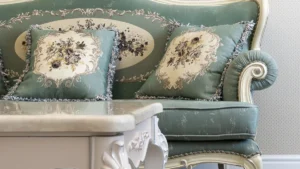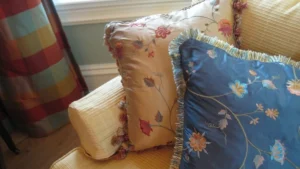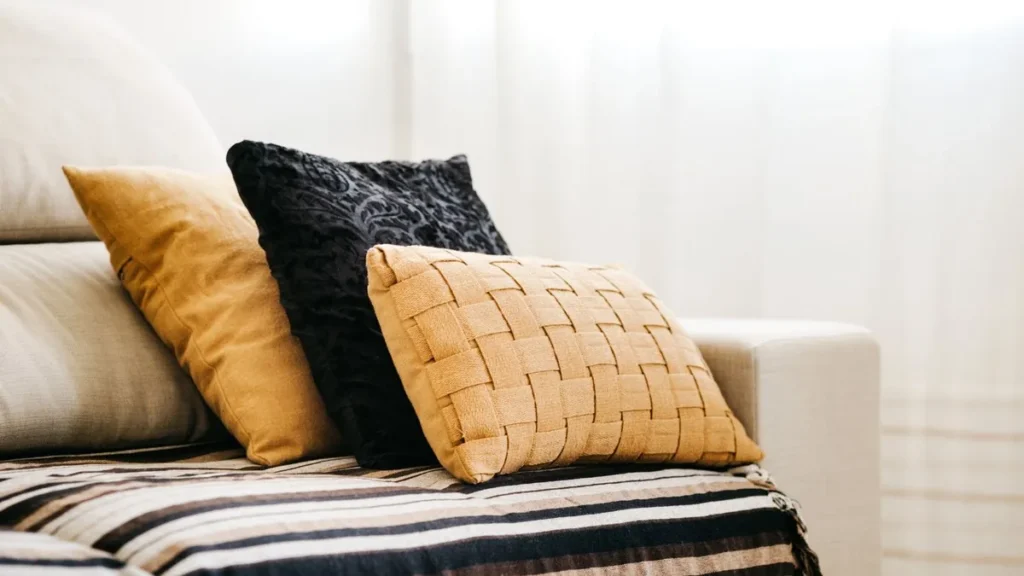
A velvet cushion can make a plain sofa look finished in ten seconds, or like a showroom nobody sits on. The difference is rarely the cushion: it is the colour it sits next to, the texture it sits against, and where it is placed.
Most velvet cushions fail for three reasons: the colour is chosen alone, on a screen, instead of against the sofa it will live on; every cushion is the same size, shape and fabric; or the cushions are arranged for a photograph and never touched again.
This guide covers styling only: colour pairing, texture mixing, placement, and seasonal swaps. It does not explain what velvet is, or rank cushions. Our guide to what a velvet cushion is covers the fabric and construction.
Key takeaways
- Style the cushion against the sofa, not the shop shelf: the sofa colour, the wall and the light decide whether a shade works.
- One velvet cushion per seating area is usually enough; the rest should be other textures, so the velvet reads as the accent.
- Mix shapes and sizes: a large square at the back, a smaller square or a lumbar in front.
- Place cushions where people lean: sofa ends, the head of the bed, and one cushion on a chair.
- No pairing works in every room: velvet changes with the light, so the only test is living with it for a few days.
What styling a velvet cushion means
Styling a cushion means deciding three things in order: the colour, what it sits next to, and where it goes. Get the order wrong and the cushion fights the room: a deep green velvet cushion is beautiful alone, but on a dark green sofa it disappears.
The first decision is the room, not the cushion. Look at the largest surfaces first: the sofa, the wall, the rug and the curtains. If the sofa is plain and pale, almost any velvet colour will show up well; if it is patterned or strongly coloured, the cushion needs to be quieter.
Light matters most with velvet, because the pile leans one way and catches light unevenly: a cushion that looks emerald in the shop can look teal at home. Judge it at the time of day the room is used, and live with it for a few days.
Finally, decide how many cushions the room needs. A three-seat sofa takes three to five, and only one or two need to be velvet. A two-seat sofa takes two or three, with one velvet. An armchair takes one, and a bed takes two or three, with one at most.
Colour pairing: letting the velvet talk
Colour pairing starts from the sofa: the cushion should be clearly different from it, but not fighting it. On a pale grey or cream sofa, a deep jewel velvet, emerald, sapphire or burgundy, makes both look better. On a dark sofa, the cushion needs to be lighter or warmer: mustard, dusty rose or pale gold.

Warm and cool is the next split. Warm velvets, mustard, rust, terracotta and burgundy, suit rooms with wood floors and brass fittings. Cool velvets, emerald, teal, sapphire and plum, suit rooms with grey walls and chrome fittings. One warm cushion in a cool room is a deliberate accent; two or three look like a mistake.
Neutrals deserve more attention than they get. A charcoal, taupe or deep mushroom velvet adds the softness of velvet without committing the room to a colour, and it survives a change of rug or curtains. The risk is dullness: a grey velvet cushion on a grey sofa is invisible.
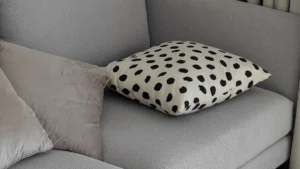
Pattern is where most people overreach. A patterned velvet cushion works best as the single patterned piece, between two plain cushions, one of them velvet in a colour from the pattern. If the sofa itself is patterned, skip patterned velvet and choose a plain velvet in the quietest colour in the pattern.
Texture mixing: why velvet needs company
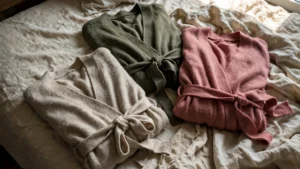
Velvet is a soft, light-catching fabric with a short, dense pile, and it looks its best next to fabrics that are not like it. A velvet cushion beside a linen cushion reads as richer than either alone, because flat, matte linen makes the velvet’s sheen visible. The same logic applies to leather, wool, knit and cotton.
The texture to be careful with is more velvet. Two velvet cushions of different colours can work, but three or more turn the sofa into a velvet display. One per seating area, two at most on a large sectional, is the limit.
Hard surfaces matter as much as soft ones. Velvet looks better with something smooth and reflective nearby, a brass lamp, a glass table, a lacquered tray, because the reflection picks up the velvet’s sheen. In a room of only soft, matte surfaces, velvet can look heavy and dull.
A linen or cotton throw reads as relaxed; a cashmere or wool throw reads as formal and wintery. The throw should never be velvet as well: our guide to the best luxury velvet throws covers throws as objects, and the rule is simpler — one velvet in the arrangement.
Placement: sofa, bed and chair
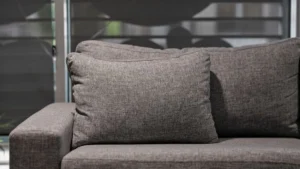
On a sofa, the corners do the work. A velvet cushion belongs at one end, leaning against the arm, where someone sitting there will actually use it. A second velvet cushion belongs at the opposite end, not in the middle.
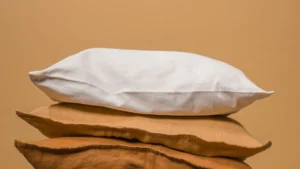
Layering follows a simple order: the largest cushion goes at the back, and each one in front is smaller. A 50-centimetre square at the back, a 45-centimetre square in front of it, and a lumbar of around 50 by 30 centimetres in front of that is the full arrangement.
On a bed, the rules change, because a bed is viewed from the foot. One velvet cushion is enough, placed in front of the sleeping pillows and slightly off-centre, so the bed looks dressed rather than symmetrical. The velvet cushion should be the easiest to remove at night, because it picks up dust fast on the floor. See our take on velvet cushions as a sofa upgrade.
On a chair, the answer is one cushion and one only. An armchair with two cushions looks crowded, and the second ends up behind the sitter’s back or on the floor. The single velvet cushion should be a 40 to 45 centimetre square, against one side of the chair back rather than dead centre.
Two placements should be avoided everywhere: the row, a line of identical cushions across a whole sofa that looks like a waiting room, and the cushion on the floor, which is where cushions go when there are too many of them.
Seasonal swaps: changing the room without new furniture
Velvet is a winter fabric in most people’s minds, and that is why seasonal swaps work. A deep velvet cushion in autumn and winter makes a room feel warmer; the same cushion in high summer can make it feel heavy. The swap need not be a full change: replacing one velvet cushion with a lighter one, or moving it to the bedroom, is often enough.
For autumn and winter, the deep jewel velvets earn their place: emerald, burgundy, sapphire and plum. The velvet’s sheen catches low winter light. For spring and summer, the velvet cushion should get lighter, smaller or fewer: a dusty rose, sage or pale gold velvet among linen and cotton cushions reads as a deliberate accent. Brush a pale velvet often and keep it out of direct sunlight.
Storage between seasons is part of styling: store a velvet cushion flat, in a breathable cotton bag, out of direct sunlight, with nothing heavy on top of it. Rotating it weekly while in use evens out fading and pressure marks.
The caveats that matter
Velvet styling has honest limits, and most come back to the pile. The same short, dense fibres that make velvet catch the light also show pressure marks, collect dust and pet hair, and fade in strong sunlight.
| Detail | What is known |
|---|---|
| Velvet cushions per sofa | One, two at most on a large sectional; the rest other textures |
| Best position on a sofa | At the ends, against the arms; never in the middle of a three-seat sofa |
| Best position on a bed | One cushion, in front of the sleeping pillows and slightly off-centre |
| Best position on a chair | One 40 to 45 cm square, against one side of the chair back |
| Colour rule | Clearly different from the sofa, same warm or cool family as the room |
| Texture rule | Pair velvet with linen, cotton, leather or wool; no velvet on velvet beyond two |
| Sunlight | Velvet fades in strong direct sun; rotate it and keep it out of the brightest spot |
| Seasonal limit | Deep jewel velvets suit autumn and winter; lighter ones suit spring and summer |
The other limit is the room itself. A small room with a dark sofa and dark walls cannot take a dark velvet cushion: there is not enough light for the colour shift to show. A room with pets or small children can take velvet, but the cushion should be cotton or polyester velvet rather than silk.
Checklist: styling a velvet cushion
Use these checks before the cushion joins the room.
- Hold the cushion against the sofa in the room’s own light, at the time of day it is used.
- Count the velvets: one per seating area, two at most on a large sectional, and no velvet throw beside it.
- Check the neighbours: the cushions beside the velvet one should be different textures, in a colour from the same family.
- Place it at the end of the sofa, against the arm, with the largest at the back and each one in front smaller.
- Check the sun: the cushion should not sit in bright direct sunlight for hours a day, and it should be rotated weekly.
- Plan the swap: know which lighter cushion replaces the velvet in summer, and where it will be stored flat.
Frequently asked questions
How many velvet cushions should go on one sofa?
One velvet cushion per seating area is the usual answer, and two at most on a large sectional. The rest should be other textures, so the velvet reads as the accent. More than that turns the sofa into a velvet display.
What colour velvet cushion goes with a grey sofa?
Almost any deep velvet works on a pale grey sofa: emerald, sapphire, burgundy and mustard all show up well. On a dark grey sofa, it needs to be lighter or warmer: mustard, dusty rose or pale gold.
Can you mix velvet cushions with linen cushions?
Yes, and it is one of the best pairings. Flat, matte linen makes the velvet’s sheen visible, and the velvet makes the linen look crisp. Put the velvet at the back and the linen in front of it.
Where should a velvet cushion go on a bed?
One velvet cushion, in front of the sleeping pillows and slightly off-centre, so the bed looks dressed rather than symmetrical. Two on a bed look like a set, and the velvet one should be easiest to remove at night.
Do velvet cushions work in summer?
They can, but they should be lighter, smaller or fewer. A dusty rose, sage or pale gold velvet among linen and cotton cushions keeps the softness without the heaviness. Keep it out of strong sunlight, and brush it more often.
How do I stop a velvet cushion looking flat?
Brush the pile with a soft clothes brush, in the direction of the nap and then against it, and plump the filling weekly. Most flat-looking velvet is not worn out; it is pile pressed one way by weeks of leaning.
The bottom line
Styling a velvet cushion comes down to three decisions in order: the colour against the sofa, the texture beside it, and the place it sits. One velvet cushion at the end of a sofa, clearly different from the sofa and in the same warm or cool family as the room, will do more than a whole set of matching velvets.
The rest is maintenance: rotate it weekly, brush the pile when it flattens, swap it for something lighter in summer, and store it flat and out of the sun. A cushion styled that way looks deliberate for years, not just for one afternoon.
Note: This article is a styling guide only. It does not explain what velvet is, rank cushions, or recommend products. For the fabric itself, see our guide to what a velvet cushion is.
Meet Our Experts
Our interiors editors cover fabrics, furniture and home textiles, and check styling advice against real rooms and real light, not against showroom photographs.
Why Trust BrassSmile
We describe home textiles from their construction, fibre and weave, and we separate styling advice that works in a lived-in room from arrangements that only work in a photograph.
Sources
Colour and texture guidance follows published interior design references; velvet care guidance follows manufacturer care labels and published textile guides. Fabric definitions follow standard textile references.