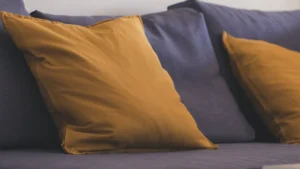
A velvet cushion is a cushion covered in velvet, a woven fabric with a short, dense pile that catches the light and changes colour as you move. It looks expensive and feels soft in a way no flat fabric does, yet it is assumed to be fragile and hard to keep clean.
Most of that reputation comes from confusing the fabric with the cushion. Velvet is a type of cloth, not a type of cushion: a velvet cushion is simply that cloth cut and sewn around a filling. Once the two parts are separated, both are easy to judge on their own terms.
Labels add to the confusion by saying velvet without saying which velvet: a cushion described as velvet can be cotton, silk, polyester, or a blend. This guide explains what a velvet cushion is, how the fabric is made, how the cushion is put together, and where its limits lie.
Key takeaways
- A velvet cushion is a cushion with a velvet cover: a woven cloth with a short, dense pile, sewn around a filling.
- Velvet is a weave and a finish, not a fibre: cotton, silk, polyester and blends all exist, and the fibre decides how the cushion feels and should be cleaned.
- The pile, or nap, makes velvet look the way it does: the fibres lean one way, so the colour shifts as the light and the viewing angle change.
- The usual shapes are the square, the rectangle and the lumbar bolster, in sizes from around 40 centimetres to around 60 centimetres.
- No velvet is fragile by definition, and none is fade-proof, mark-proof or washable by default: the fibre and the care label decide what it can take.
What a velvet cushion actually is
A cushion is a soft bag of filling with a cover, made to be leaned on or arranged for comfort and appearance. A velvet cushion keeps that shape and makes the cover from velvet. The parts are simple: the cover, cut from velvet cloth, a filling inside it, and a closing, usually a hidden zip along one edge, sometimes a sewn seam. Some are sold as covers only, so the label is worth reading.
The cover is where most of the cost and most of the difference between one cushion and another sits. A well-made cover is cut so the nap runs the same way on every panel, because a panel cut against the nap looks like a different colour. The seams are usually piped, with a cord covered in the same velvet running along the edge, which frames the shape and stops the corners from going soft. Cheap covers often skip the piping, and the difference shows within weeks. The filling is the part nobody sees and everybody feels: a feather filling can be plumped back into shape with a shake, while a hollowfibre pad keeps its shape with less attention but goes flat and lumpy sooner. Our guide to what a velvet sofa is describes the same fabric at a larger scale, and much of what it says about pile, nap and fibre applies here too.
The fabric underneath the softness
Velvet is woven with extra threads cut to form a short, dense pile standing upright from the base cloth. Run a hand across it and the pile bends, then springs back. That bending is what makes the fabric look different from every angle: pile leaning towards you looks pale, while pile leaning away falls into shadow. This is why a velvet cushion seems to change colour as you walk around the room, and why it shows marks: lean against one spot every evening and the pile there gets pressed flat, and brushing it the other way mostly lifts it back.

The fibre underneath the pile decides how a velvet cushion feels, wears and ages, and the label should name it plainly. Cotton velvet is the workhorse: dense, matte and hard-wearing, with a rich colour that stays true, which is why the deepest jewel tones are almost always cotton. Silk velvet is lighter, softer and more luminous, but it is delicate and marks easily, so it suits bedrooms better than a family sofa. Polyester velvet is the most common velvet in 2027: it resists stains and fading and is the easiest to clean, but it can look shiny rather than deep. Crushed velvet, pressed so the pile lies in irregular directions, hides marks well but looks less formal, and a label that says only velvet claims none of these types.
The shapes, sizes and fillings a velvet cushion takes
The most familiar shape is the square. A square of around 45 to 50 centimetres is the standard size for a three-seat sofa, and squares of around 40 centimetres suit armchairs and smaller sofas. Larger squares, around 60 centimetres, fill the corner of a sofa, but they overwhelm a small chair. The rectangle is the second shape: a lumbar cushion of around 50 by 30 centimetres, made to sit at the small of the back, and it is the shape that supports rather than decorates. A longer bolster, a cylinder rather than a flat rectangle, is rarer in living rooms and more common on beds.
The filling decides how the cushion behaves day to day. Feather and down are the softest and the most shapeable, but they need shaking and turning, and they are the wrong choice for anyone with a feather allergy. Hollowfibre fillings are hypoallergenic and hold their shape with little attention, but they flatten with use and cannot be revived by plumping. Foam fillings hold a firm, structured shape and suit cushions meant to look tailored rather than soft, but they feel firmer to lean on. The filling is the first thing to check after the fabric.
Velvet cushion vs velvet sofa cushion, and lookalikes
A velvet cushion and a velvet sofa cushion are the same object in most listings, and the difference is one of use, not of construction. A velvet cushion is any cushion covered in velvet, wherever it sits; a velvet sofa cushion is one placed on a sofa, usually a square of 45 to 50 centimetres. In British use, a cushion is the decorative piece on a sofa or chair, while a pillow is the piece slept on in bed; in American use, a throw pillow is the same object as a cushion.
The lookalikes are the fabrics that feel soft without being velvet. Velveteen is the closest: a cotton cloth with a short, dense pile that looks like velvet and wears harder, but with less depth of colour. Corduroy has a ribbed pile in distinct ridges, and it reads as casual where velvet reads as formal. Chenille has a soft, tufted pile that looks plush at a glance, but it is woven from fuzzy yarns rather than cut pile, so it shows less light-and-shadow movement. A cushion described as velvet-feel or velvet-touch is usually one of these, and the label is telling you it is not velvet at all. Our take on velvet cushions as a sofa upgrade covers the sofa side of the question, while this guide stays with the cushion itself.
The caveats that matter
Velvet has honest limits, and most follow from the pile itself. The short, dense fibres that make velvet soft also show what other fabrics hide: pressure marks where someone has leaned, a pale patch where the pile has been brushed the wrong way, and dust and pet hair that sits on the surface. Sun is the slowest damage: velvet fades in strong, direct sunlight, and a cushion left in the same sunny spot fades on one side first, so rotating it matters more than any cleaning product.
| Detail | What is known |
|---|---|
| What it is | A cushion with a velvet cover, sewn around a filling |
| The fabric | A woven cloth with a short, dense cut pile; velvet is a weave, not a fibre |
| Fibre | Cotton, silk, polyester, or a blend; the label should name it |
| Most practical fibre | Cotton velvet, dense and hard-wearing |
| Most delicate fibre | Silk velvet, beautiful and easily marked |
| Usual shapes | Square, rectangle and lumbar bolster |
| Usual sizes | Squares 40 to 60 cm; lumbar rectangles 50 by 30 cm |
| What it is not | Not velveteen, not a sleeping pillow |
Care follows from the fibre, not from the shine. Cotton velvet is brushed with a soft clothes brush, vacuumed with an upholstery attachment, and spot-cleaned with a damp cloth. Silk velvet needs dry cleaning in most cases, because water marks the pile. Polyester velvet is the most forgiving, and many polyester covers can be gently washed at home if the label allows it, but a hot iron can leave a permanent shine mark on any velvet, and steam is safer. For where a velvet cushion belongs in a room, see our guide to how to create a luxury living room.
Checklist: reading a velvet cushion honestly
Use these checks to read what a cushion is, not what its name suggests.
- Check the fibre: the label should name cotton, silk, polyester, or a blend with percentages.
- Check the pile: brush it both ways; the colour should shift.
- Check the nap direction: the pile should run the same way on every panel of the cover.
- Check the closing: a hidden zip means the cover is removable; a sewn seam means it is not.
- Check the filling: feather plumps back into shape, hollowfibre holds shape with less care, foam stays firm.
- Check the care label: it should give instructions you can follow, and name dry cleaning if the velvet needs it.
Frequently asked questions
What is a velvet cushion?
A velvet cushion is a cushion covered in velvet, a woven fabric with a short, dense pile, sewn around a filling of feather, down, or synthetic fibre. The fabric gives it the soft feel; the filling decides how it holds its shape.
Is velvet a fabric or a fibre?
Velvet is a weave and a finish, not a fibre: a way of weaving cloth so extra threads are cut to form a short, dense pile. A velvet cushion can be cotton, silk, polyester, or a blend, and the fibre decides how it feels and should be cleaned.
What is the difference between a velvet cushion and a velvet sofa cushion?
There is no difference in construction: a velvet sofa cushion is a velvet cushion placed on a sofa, usually a square of 45 to 50 centimetres. The same cushion on a bed is simply a velvet cushion; the name follows where it sits.
Why does velvet show marks and change colour?
The pile leans one way, and the colour depends on which way it leans and where the light falls: pile leaning towards you looks pale, pile leaning away falls into shadow. Pressure flattens the pile in one spot, which reads as a mark, and brushing it the other way usually lifts it back.
Can a velvet cushion be washed at home?
It depends on the fibre, not the shine. Many polyester velvet covers can be gently washed at home if the label allows it, while silk velvet usually needs dry cleaning, because water marks the pile. Cotton velvet is usually spot-cleaned and brushed, and a hot iron can mark any velvet, so steam is safer.
What sizes do velvet cushions come in?
Squares usually run from around 40 centimetres for a small chair cushion to around 60 centimetres for a large statement cushion, with 45 to 50 centimetres the standard for a three-seat sofa. Lumbar rectangles are around 50 by 30 centimetres.
The bottom line
A velvet cushion is a cushion with a velvet cover, and velvet is a woven cloth with a short, dense pile that catches light and shadow in a way no flat fabric can. The weave gives it the softness and the colour shift, the fibre decides how it is cared for, and the shape and the filling decide what it can do.
Once those parts are separated, the rest falls into place: the care follows from the fibre, and the limits follow from the pile.
Note: This article defines what a velvet cushion is; it is not a styling, picks or buying guide. For the sofa side of the question, see our take on velvet cushions as a sofa upgrade, and for the fabric at a larger scale, see our guide to what a velvet sofa is.
Meet Our Experts
Our interiors editors cover fabrics, furniture construction and home textiles, and check fibre and weave claims against the label and the cloth itself.
Why Trust BrassSmile
We describe home textiles from their construction, fibre and weave, not from marketing copy, and we separate what a fabric is from what a label claims it is.
Sources
Fibre and weave definitions follow standard textile references; velvet types and care guidance follow manufacturer care labels and published textile guides.