A luxury living room is not the room with the most expensive furniture in it. It is the room where everything feels considered — where the sofa invites you to sit down, the light flatters everyone in it, and nothing is fighting for attention. Walk into a truly luxurious living room and you feel it before you can explain it: the proportions are right, the textures are generous, and the room feels lived in.
That feeling is not reserved for penthouses and country houses. It comes from decisions made in the right order: layout first, then the anchor pieces, then colour, light, texture and art. Get the order wrong and even beautiful pieces will look stranded.
This guide works through each layer in turn, from the floor plan outwards, drawing on where interiors are heading in 2027 — warmer colours, softer curves, collected furniture rather than matching sets, and lighting designed around evenings in.
Key takeaways
- Start with the layout: anchor the room on one focal point and arrange seating for conversation.
- Buy the best sofa you can afford — it is the single most important piece in the room.
- Choose a warm, restrained palette: deep greens, warm cream, cocoa, clay and burgundy lead in 2027.
- Layer lighting in threes — overhead, task and accent — all warm and dimmable.
- Use one large rug to ground the seating group, and edit ruthlessly.
Start With the Layout — the Sofa Is the Anchor
Every luxury living room is built around its seating, and the sofa is the anchor. Before you buy anything, decide on the room’s focal point: a fireplace, a large window, a view, or a piece of art. The main sofa faces it, and everything else is arranged in conversation with it.
Think in zones. A generous room earns two: a main conversation group around the coffee table, and a quieter corner with a reading chair and lamp. A smaller room earns one zone done properly. Leave walkways of at least 75 centimetres around the seating, seat the sofa and chairs roughly 2 to 2.5 metres apart, and keep the coffee table 35 to 45 centimetres from the sofa. Size the sofa to the room, not to the showroom: a three-seater of around 2.2 metres suits most living rooms.
Choose the Sofa Like It Is the Whole Room
Because, in a sense, it is. The sofa sets the tone for everything else, so it deserves the largest share of the budget. In 2027 the direction is softness: curved backs, rounded arms, deep seats and generous cushions.
Upholstery is where luxury is felt rather than seen. Velvet in deep green or burgundy reads rich; bouclé in warm cream feels soft and modern; leather in cognac or oxblood ages gracefully. Whatever you choose, sit on it properly before you buy — a sofa that looks right and feels wrong is money wasted.
Do not buy a matching three-piece suite. The 2027 living room is collected, not matched: a sofa in one fabric, armchairs in another, tied together by a repeated colour or material. That layered, gathered-over-time feeling defines quiet luxury. For the broader philosophy behind that look, see our guide to quiet luxury home decor.
Let the Rug Do the Grounding
The rug is the most underestimated piece in a living room, and the one most often bought too small. A rug that floats in the middle of the seating group, with chair legs half on and half off it, makes the whole room look accidental. The rule is simple: it should be large enough that the front legs of every seat rest on it — in most rooms, at least 2.4 by 3 metres.
Material matters as much as size. Wool is the classic luxury choice — soft underfoot, durable, and forgiving of spills if treated. Colour-wise, the rug is the room’s foundation, not its statement: choose it in the same tonal family as the sofa and walls, and let cushions and art carry the contrast.
Build a Warm, Restrained Palette
Colour is the fastest way to change how a living room feels, and 2027 is a warm year for it. After years of cool whites and greys, the direction is warmer neutrals and deeper, nature-led colour: mushroom, warm cream, cocoa, clay, muted olive and dusty rose. Deep forest green and earthy olive are among the colours of the year, and green has become the new neutral.
The most useful approach is tonal: pick one colour family and work within it. A deep green wall with olive cushions and warm wood feels rich; a cocoa sofa with cream cushions feels warm without being dark. The principle is restraint: two or three colours, used generously, always beat six used sparingly.
Layer the Lighting for Evenings
Lighting is the difference between a living room that looks expensive in a photograph and one that feels expensive at nine o’clock at night. A single ceiling light flattens the room and gives you exactly one mood. A luxury living room needs at least three layers of light, all warm — around 2700K to 3000K — and all on dimmers.
The three layers are simple. First, a statement overhead fixture: a chandelier or sculptural pendant — the jewellery of the room. Second, task light: a floor lamp beside the reading chair, table lamps on side tables, or sconces at eye level. Third, accent light: picture lights over art, a small lamp on a console, or concealed LED strips behind shelving.
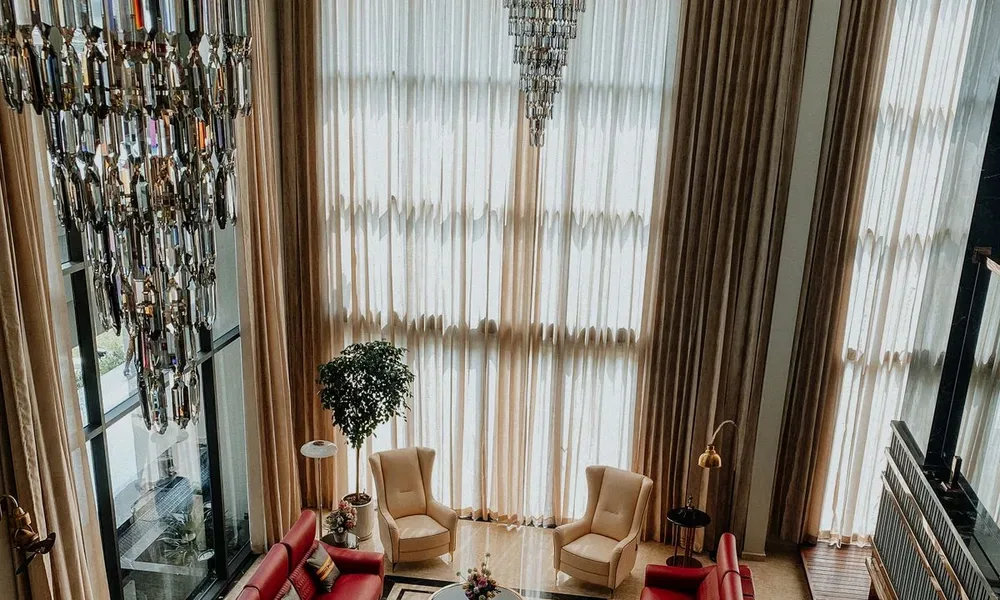
Keep the overhead light off in the evening whenever you can — that is what the lamps are for. Floor-to-ceiling curtains in a full fabric make a room feel taller than any blind can.
Mix Textures, Materials and Collected Furniture
Luxury is tactile as much as visual, and texture is where a living room earns its richness. A room of smooth, matching surfaces feels flat, however expensive the pieces. One that mixes velvet, linen, wool, wood, stone and a little brass feels layered and alive.
Build the mix deliberately: a velvet sofa, linen cushions, a wool throw, a wooden coffee table, a stone side table, brass lamp bases. Each material should appear at least twice so it feels intentional. Collected furniture works the same way: a vintage console beside a modern sofa, tied together by a shared colour rather than a shared style.
Choose Art and Objects at the Right Scale
Art is where most living rooms go wrong, and the mistake is almost always scale: pictures too small for the wall, hung too high, or scattered in groups that read as clutter. One large piece over the sofa beats five small ones every time. As a guide, art above a sofa should span roughly two-thirds of the sofa’s width, with its centre at eye level — about 145 centimetres from the floor.
Let one piece lead and the rest support: a large painting sets the room’s mood, and smaller pieces echo its colours. A coffee table holds three things at most, a book, a bowl and a candle, at different heights. If you want inspiration for how well-known homes layer art and objects, our round-up of celebrity home decor shows the same principles at a larger scale.
Handle the Television Without Letting It Run the Room
Most living rooms have a television, and most luxury living rooms hide it well. The mistake is letting the screen become the focal point by default. Place it where it is comfortable to watch but not the first thing you see on entering — on a side wall, or above a low console, rather than floating alone on the longest wall.
Mount the screen so its centre sits at seated eye level, around 105 to 110 centimetres from the floor, and frame it with a dark panel or a low media console in warm wood. The best luxury living rooms are built for conversation first and screens second.
Make It Comfortable to Actually Live In
A luxury living room that nobody wants to sit in has failed at its only job. Comfort is not the enemy of elegance: the most expensive-looking rooms have a throw within reach, a side table beside every seat, and cushions that have clearly been leaned on.
Put a surface within arm’s reach of every seat so nobody is balancing a glass on their knee, and keep a throw folded over the sofa arm. Plan for the life the room will actually hold: if you entertain, leave space for a drinks tray and an extra chair; if children or pets use the room, choose fabrics that can be cleaned. A room designed around its real use always looks more luxurious than one designed around a photograph.
| Element | What works in 2027 | Common mistake |
|---|---|---|
| Sofa | Deep seat, curved back, velvet or bouclé, 2.2 m | Matching suite, oversized corner sofa |
| Rug | Wool, large enough for all front legs | Rug too small, floating mid-group |
| Palette | Warm neutrals plus deep green or cocoa | Six colours used sparingly |
| Lighting | Three warm layers, all dimmable, 2700K–3000K | One ceiling light at full brightness all evening |
| Art | One large piece, two-thirds of sofa width | Small pictures hung too high |
| Coffee table | 35–45 cm from the sofa, three objects | Too far to reach, or crowded |
| Television | Side wall or framed panel | Screen as the default focal point |
| Textures | Velvet, linen, wool, wood, stone, a little brass | Smooth matching surfaces with nothing to touch |
Your luxury living room checklist
- ☐ Focal point chosen, sofa facing it, 75 cm walkways
- ☐ Sofa sized to the room — 2.2 m suits most
- ☐ Rug large enough that every front leg rests on it
- ☐ Three layers of warm, dimmable lighting
- ☐ One large piece of art, centre at 145 cm
- ☐ A surface within reach of every seat, throw on the sofa arm
Frequently asked questions
What is the first thing to buy for a luxury living room?
The sofa. It is the largest piece, the most used, and the one that sets the tone for everything else. Choose it after you have fixed the layout, and spend the largest share of your budget on it.
How big should a rug be in a living room?
Large enough that the front legs of every seat in the group rest on it. In most rooms that means at least 2.4 by 3 metres. A rug that is too small is the most common living-room mistake, and it makes even expensive furniture look stranded.
What colours make a living room look luxurious in 2027?
Warm neutrals — mushroom, warm cream, cocoa, clay — with one deeper tone such as forest green, olive or burgundy. Work tonally within one colour family and let texture do the talking.
How do I make a small living room feel luxurious?
Choose one seating zone and do it properly: a well-sized sofa, a rug close in tone to the floor, curtains hung high, one large piece of art, and warm layered lighting.
Should the television be the focal point of a living room?
No — the focal point should be a fireplace, a window, a view or a piece of art, with seating arranged for conversation. Place the television where it is comfortable to watch but not the first thing you see on entering.
What is the quickest way to make a living room feel more luxurious tonight?
Clear the coffee table to three objects, switch off the overhead light and use only the lamps, plump the cushions, fold a throw over the sofa arm and light a candle. Five moves, under half an hour, no cost. For more on borrowing the atmosphere of the world’s best hotel lounges, see our guide to the best luxury hotels in Paris.
The bottom line
A luxury living room is not a shopping list. It is a sequence of calm, deliberate decisions: a layout built around conversation, a sofa with presence, a rug large enough to ground the room, a warm palette, lighting that softens as the day ends, textures that invite touch, and art at the right scale. None of that needs a large room or an unlimited budget — only attention and the willingness to choose less.
Start with the layout, buy the sofa second, and let the room grow into itself one layer at a time. The most luxurious living rooms are gathered slowly and designed around the people who use them.
Note: Trends and colour guidance here reflect widely reported 2027 interior directions; choose what suits your room and treat any single trend as inspiration rather than a rule.